Pair of floral still life paintings by Elisabetta Marchioni | Baroque art
An exceptional pair of oil on canvas paintings attributed to the Venetian Baroque painter Elisabetta Marchioni. Explore their history, style, and provenance.
- Artist: Elisabetta Marchioni (Rovigo, 17th century – Rovigo, 18th century)
- Object: Pair of oil paintings on canvas
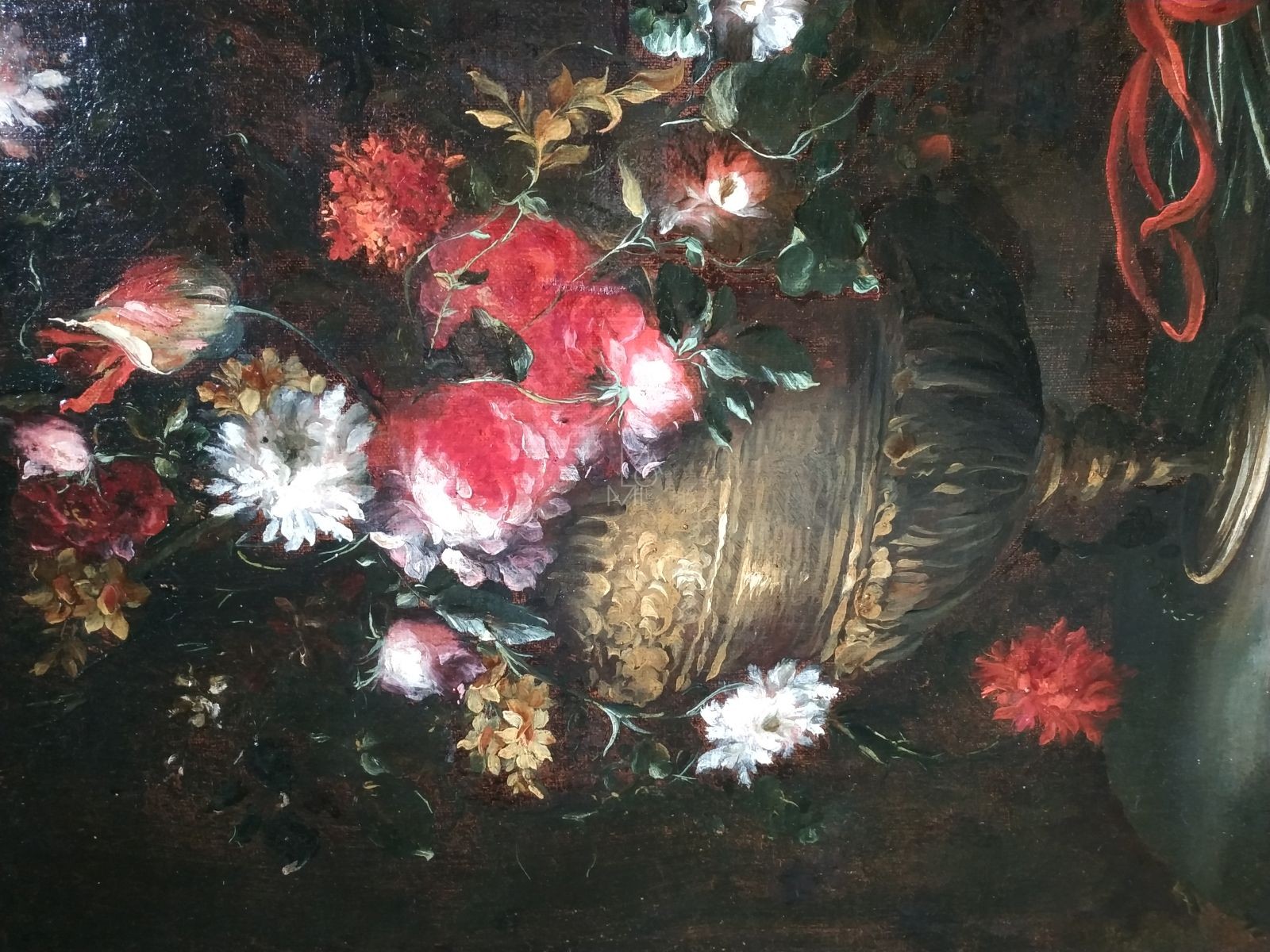
- Subject: Floral compositions (roses, tulips, chrysanthemums) inside bronze urns and garlands on stone shelves with landscape backgrounds
- Period: Late 17th – early 18th century (Venetian Baroque)
- Dimensions (each canvas): Length 140 cm × Height 120 cm
- Condition report: Good, displaying professional conservation restorations consistent with age
- Expertise: Attribution confirmed and cataloged by the art historian Gianluca Bocchi
- Historical note: These large-scale canvases represent a quintessential example of Marchioni's workshop production for the patrician galleries of Rovigo. Her work was highly praised by the biographer Francesco Bartoli in 1792, who specifically celebrated her fluid, impasto-rich brushwork and her capability to emulate natural elements within complex staging.
The Baroque naturalism of Elisabetta Marchioni: critical analysis of a pair of still lifes
Introduction and historiographical profile of the artist
The biographical mystery and eighteenth-century sources
Reconstructing the life and artistic itinerary of Elisabetta Marchioni means immersing oneself in a fascinating enigma of Venetian Baroque historiography. As is often the case with many female painters of the early modern era, the artist's biographical coordinates remained buried for a long time in the silence of archives. Her exact dates of birth and death are unknown, as is her original maiden name, since Marchioni is actually that of her husband, identified by historians as the Rovigo goldsmith Sante Marchioni.
This lack of data even fueled a suggestive local legend according to which the painter should be identified with a nun from Rovigo, Elisabetta Marchiori, or that, having been widowed by her artisan husband, she chose to retire to a convent, taking her vows to dedicate herself entirely to prayer and devotional painting.
The credit for saving this extraordinary figure from oblivion belongs to the Bolognese actor, playwright, and art enthusiast Francesco Bartoli. In his famous treatise Le pitture, sculture ed architetture della città di Rovigo con indici ed illustrazioni, published in Venice in 1792, Bartoli was the first to praise the painter, describing her as a renowned author of flowers endowed with a delicate brushstroke aimed at emulating nature.
His testimony reveals a curious detail about Marchioni's success, as the scholar notes that almost every house in Rovigo possessed four, six, or even eight pieces by her hand, confirming a fertile production that was capillarly inserted into the local collecting fabric. Thanks to recent philological investigations and the precise cataloging of the scholar Gianluca Bocchi, the attribution of this fine pair of canvases has been confirmed, allowing us to appreciate two intact testimonies of her full executive maturity.
Iconographic analysis and composition of the works
The exuberance of the first painting
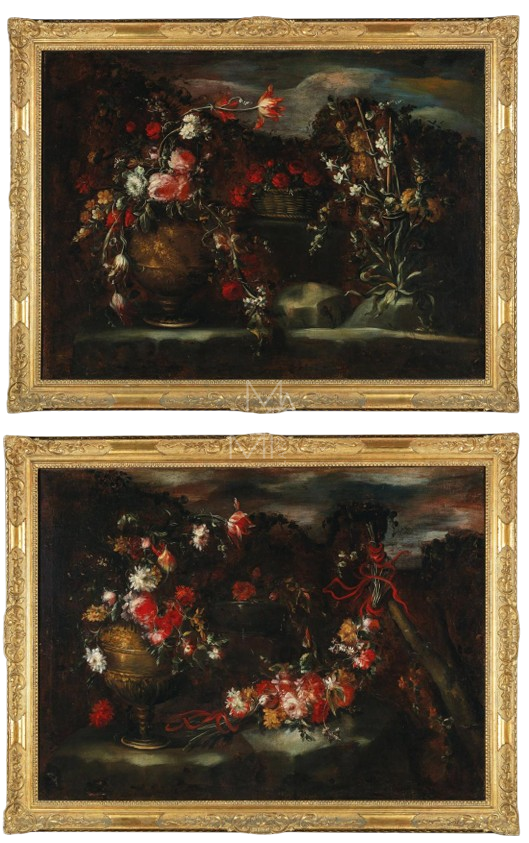
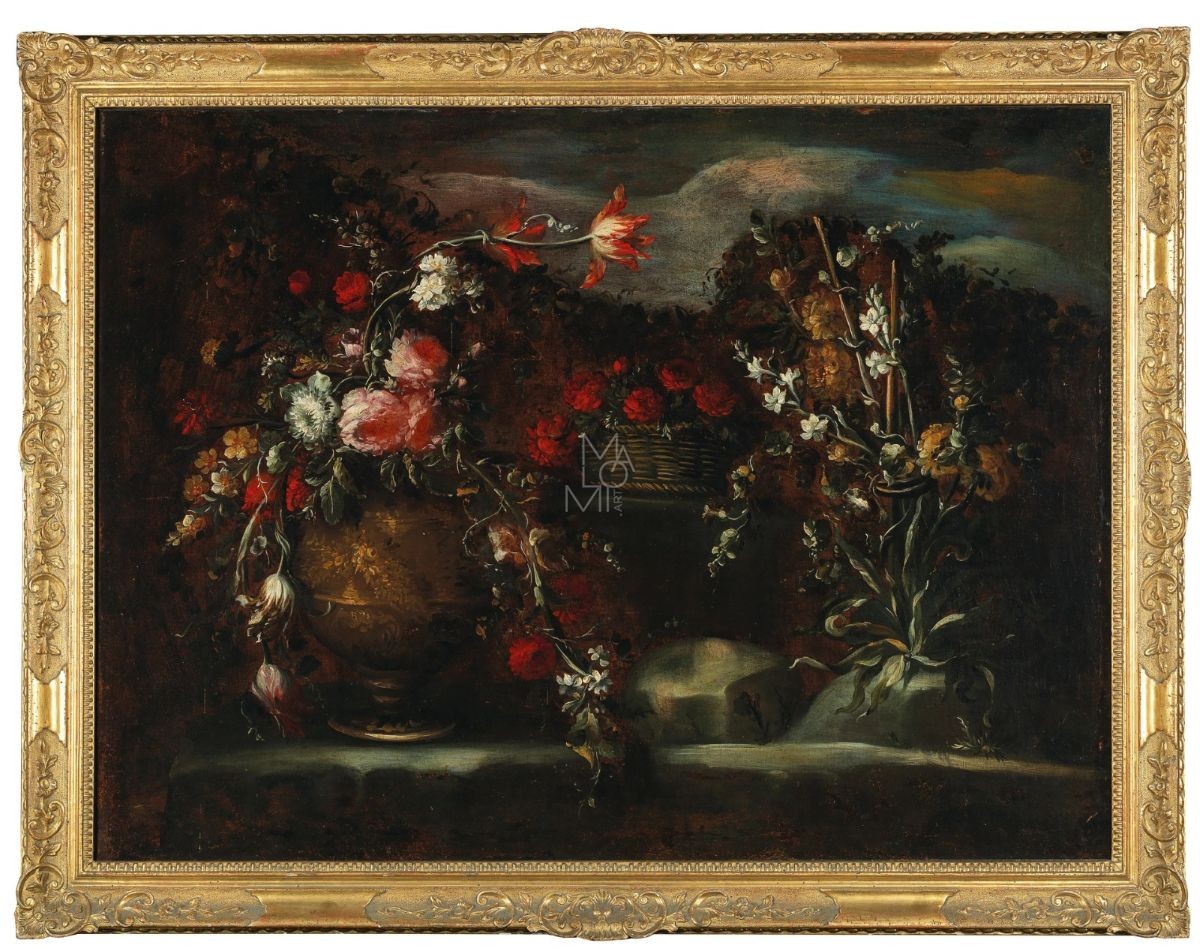
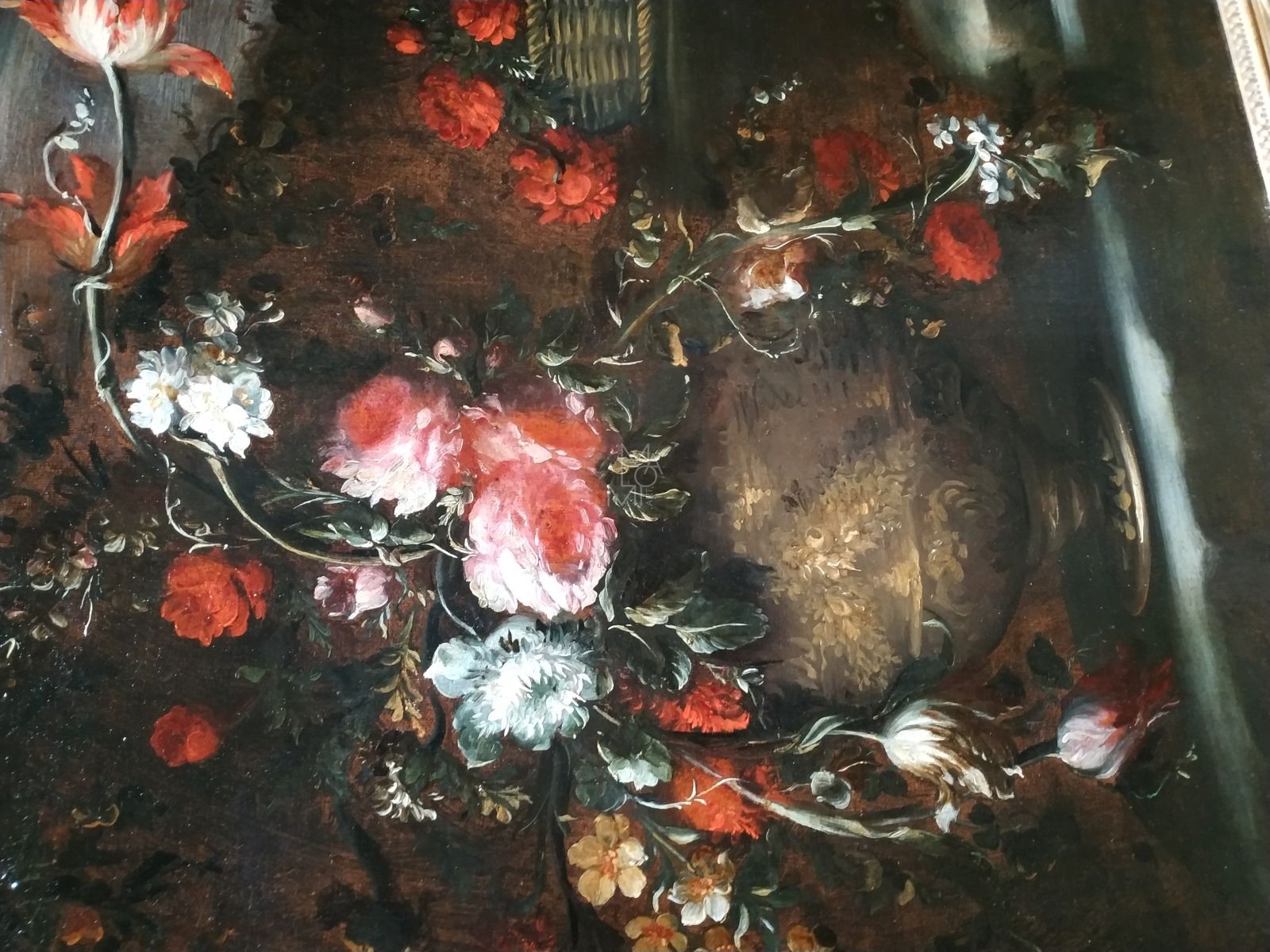
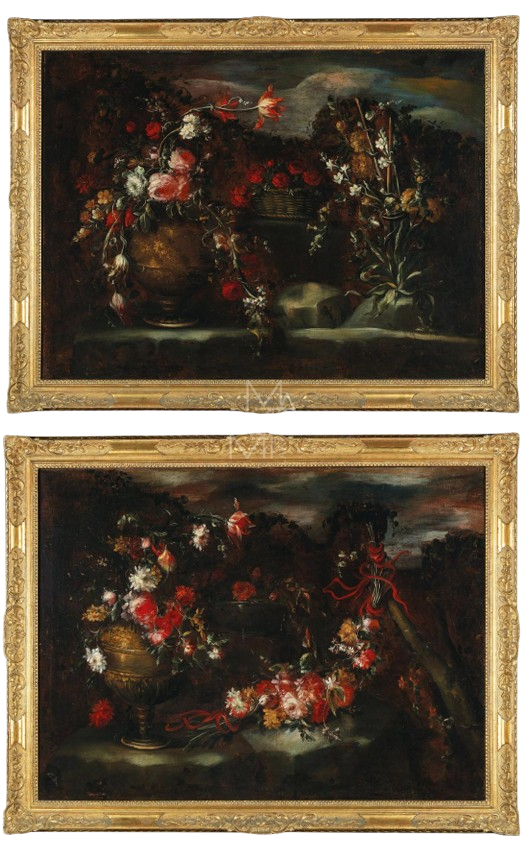
The pair of oil paintings on canvas, measuring one hundred and forty centimeters in length by one hundred and twenty centimeters in height, presents itself as a refined specular dialogue designed for the monumental furnishing of a patrician hall. In the first painting, the composition is guided by a luxuriant and asymmetrical dynamism. The focal element is an embossed metal urn from which bursts a dazzling variety of tulips, roses, and chrysanthemums.
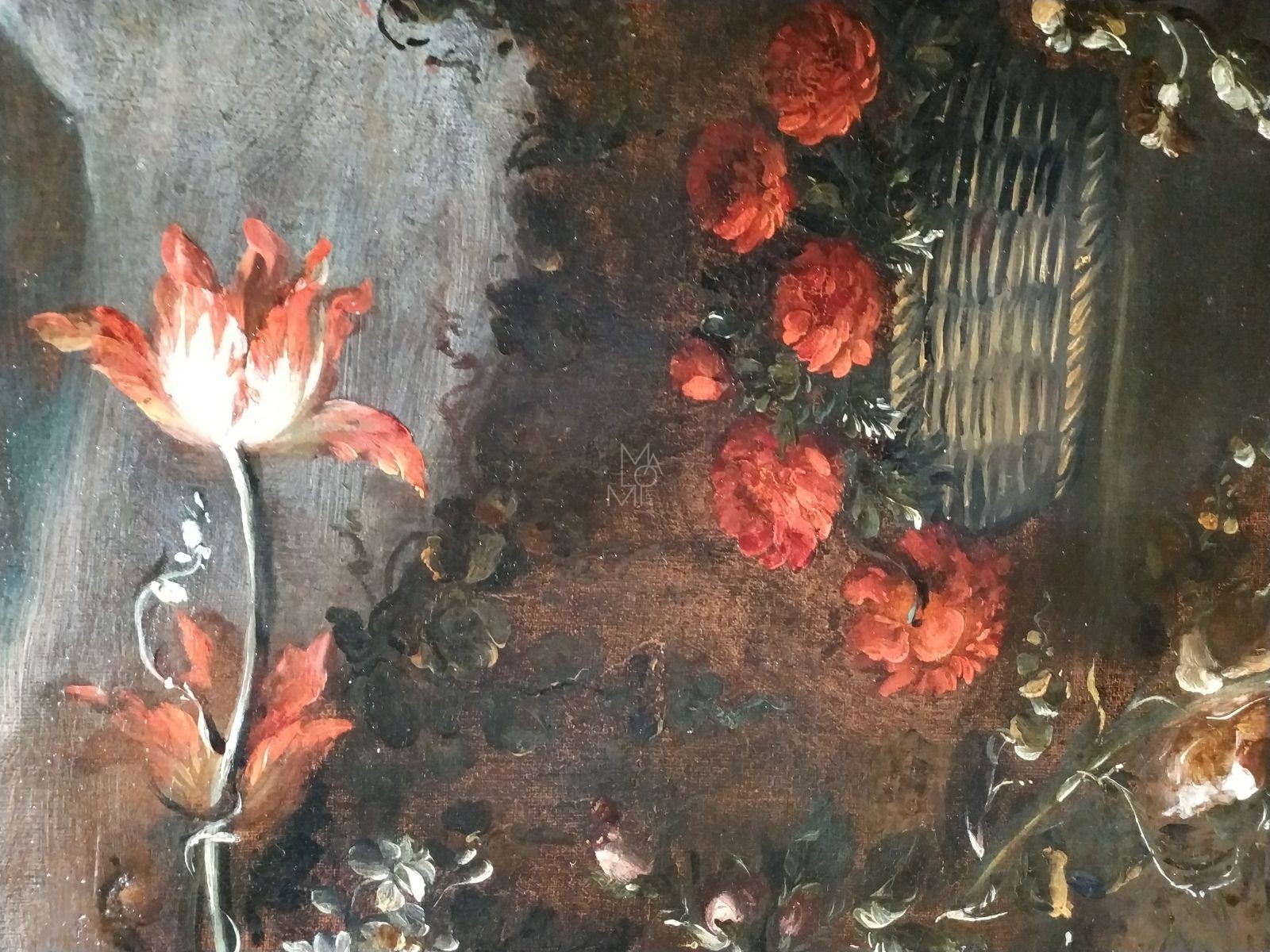
The nature described by Marchioni rejects all staticity: the flowers do not remain confined within the vase but spill outward, filling a woven wicker basket and resting directly on a massive stone shelf in the foreground. In the background, the density of the floral bouquets thins out to leave room for a wooded wing, which opens onto a twilight landscape to provide perspective depth and breathing room to the entire scene.
The solemnity of the second painting
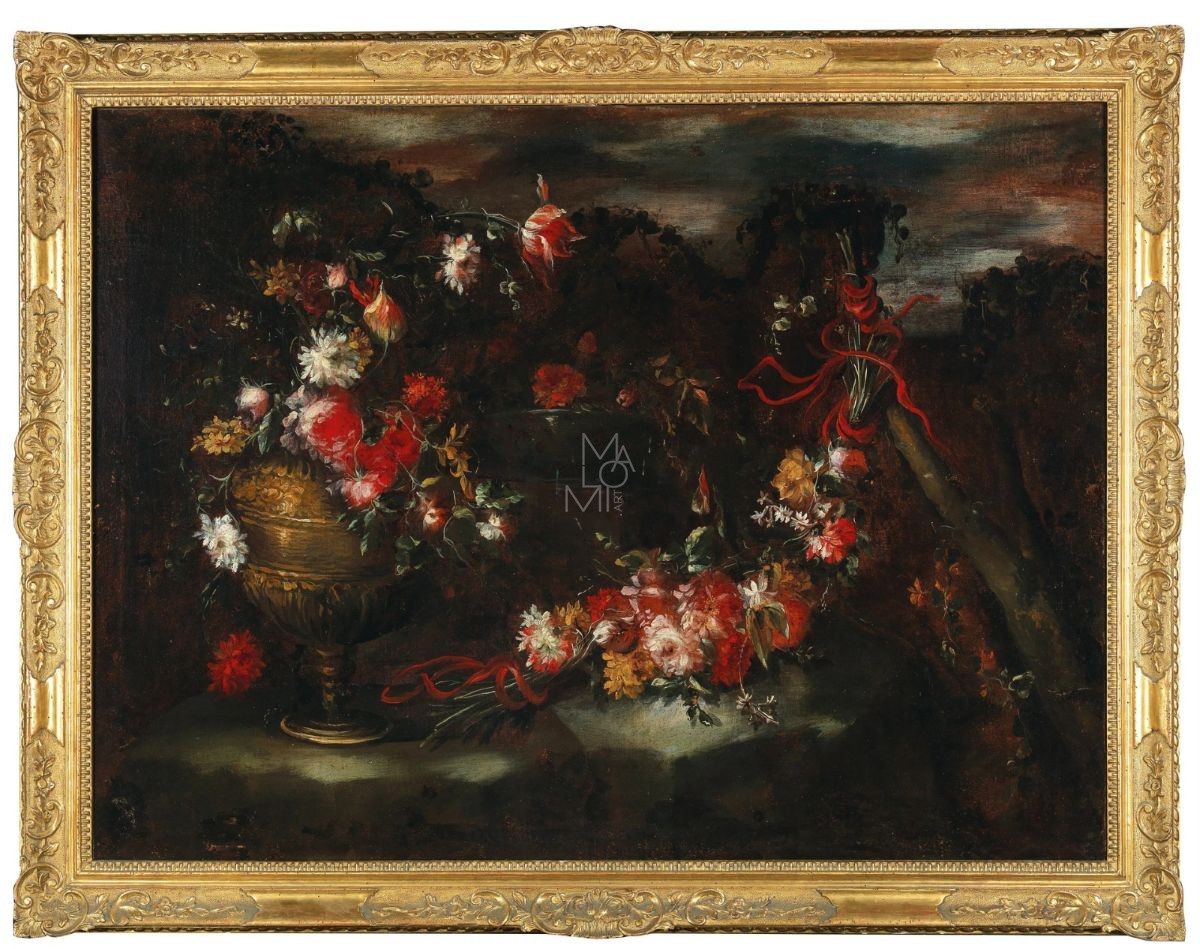
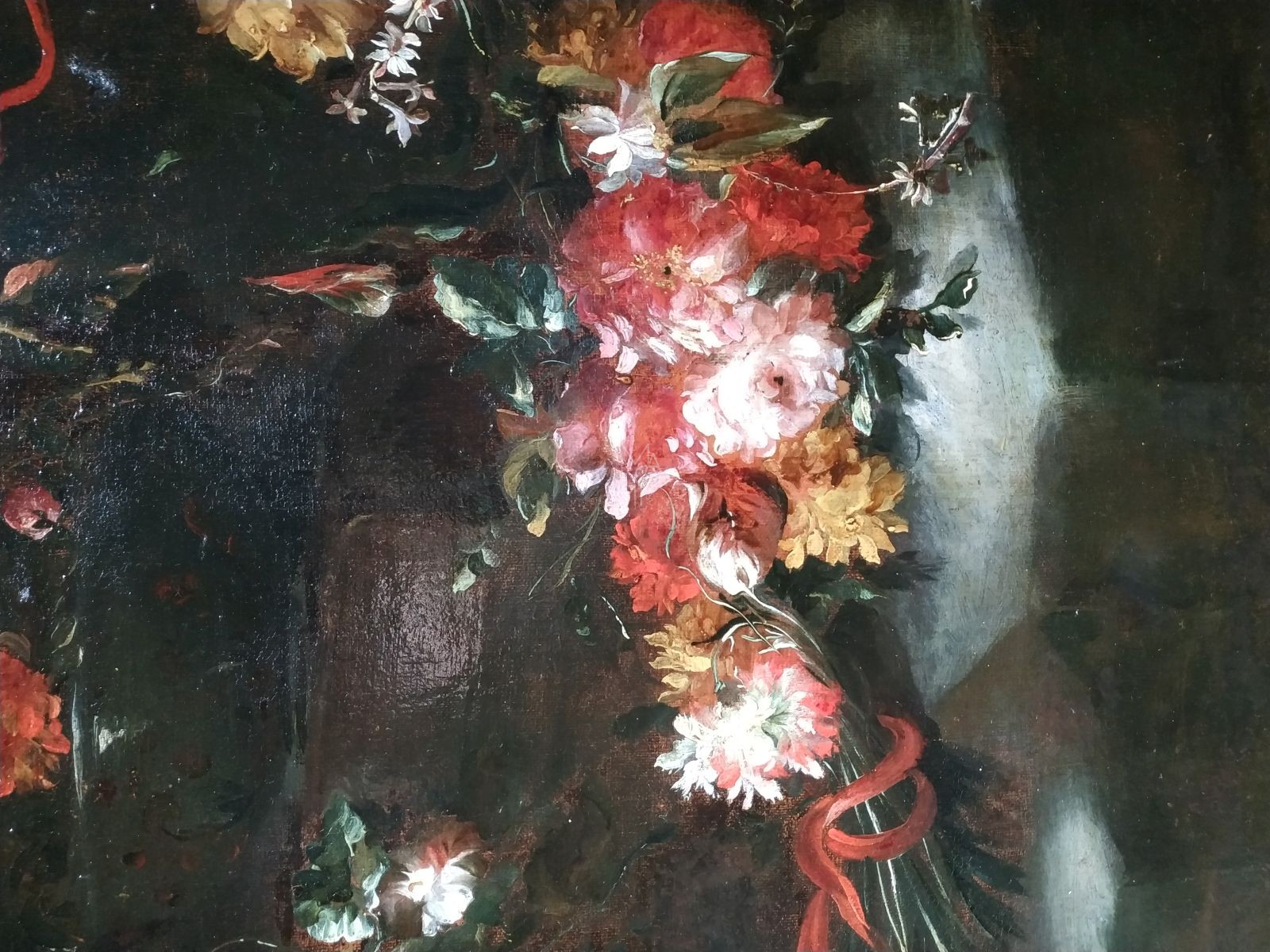
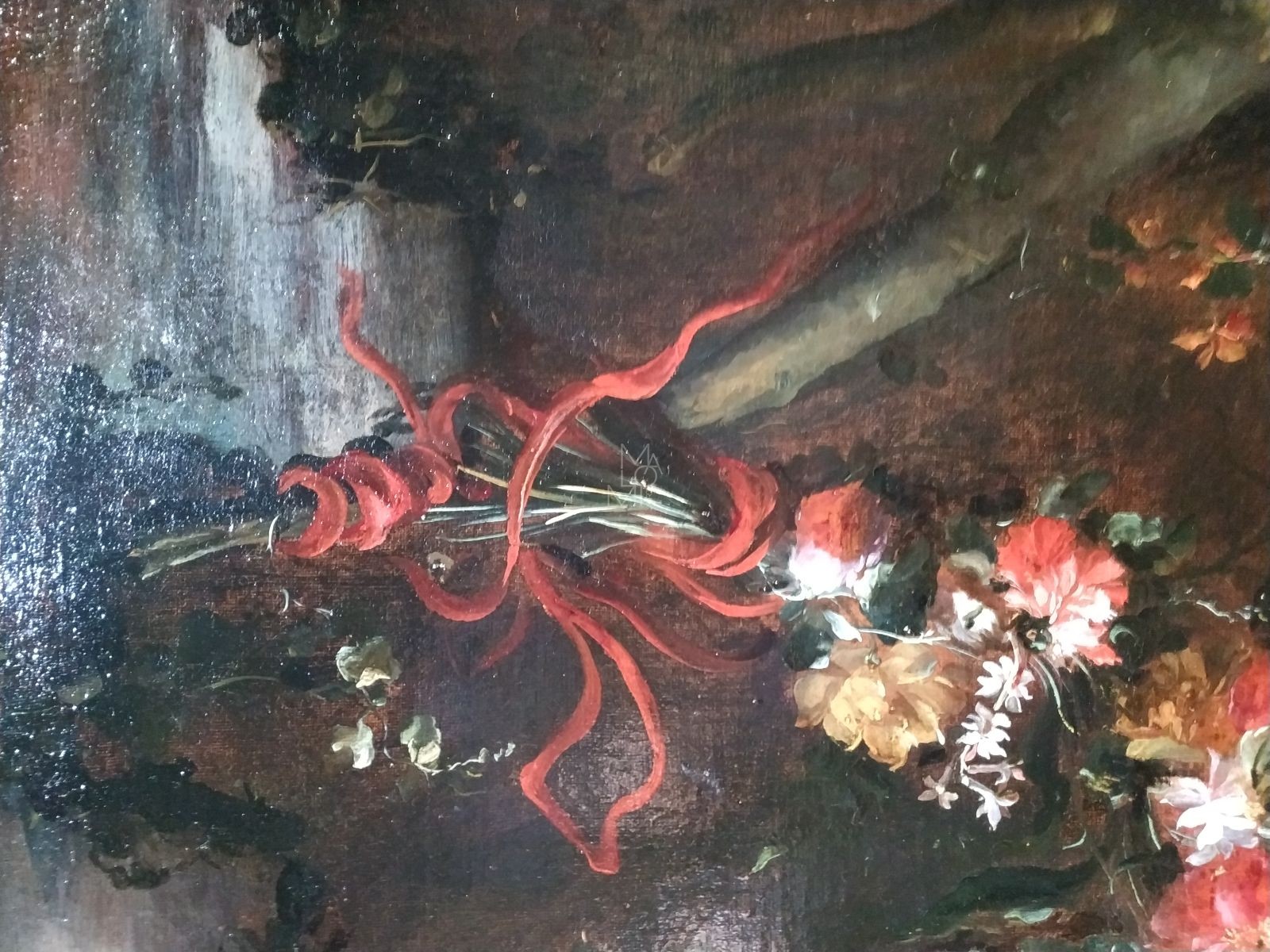
The second painting responds to the first with a more calibrated and solemn structure. We find the bronze urn filled with tulips and roses again, but here the chaotic explosion of the first canvas gives way to a studied formal orchestration. Next to the vase, stretched out on the same stone shelf, a dense garland of mixed flowers winds its way toward the viewer with a sinuous movement.
Beyond the block of the still life, the horizon opens once again toward a natural landscape dominated by restless skies. The transition between the inorganic matter of the stone and bronze and the fragile freshness of the petals becomes more evident here, highlighting an extraordinary maturity in managing visual weights and spatial distances.
Stylistic features, painting technique, and traditions compared
The comparison with Margherita Caffi
On a strictly stylistic level, the art of Elisabetta Marchioni finds a chosen connection with the production of the Milanese Margherita Caffi, a highly celebrated specialist of the floral genre in northern Italy, with whose works those of the Rovigo artist have been historically confused due to the absence of autograph signatures. Both painters choose to overcome the scientific and calligraphic precision of the Flemish tradition in favor of a free, compendious painting style based on the vibration of color.
However, whereas Caffi dissolves form into an almost pre-impressionistic luminous dust against strictly blind and dark backgrounds, Marchioni retains a marked attention to the plastic and volumetric consistency of objects. Her tulips and roses maintain a concrete turgor, and her technical audacity manifests itself in her ability to make the swiftness of the brush coexist with a firm, monumental framework.
The assimilation of Flemish models in the Veneto
The introduction of floral still life painting into the territory of the Republic of Venice during the seventeenth century was heavily influenced by the lesson of Flemish and Dutch masters, whose works populated the collections of the mainland. From this world, Marchioni inherited the iconographic repertoire of large ceremonial vases and a predilezione for exotic species such as the tulip.
The painter from Rovigo, however, operates a profound anthropological and formal metamorphosis of these models. She rejects the smooth drafting and the lenticular rendering of dew or botanical textures typical of northern Europe, preferring a theatrical and dramatic approach. The flower ceases to be a specimen to be cataloged and becomes a chromatic event, shaped through light and color according to an exquisitely Venetian sensitivity.
The executive and symbolic dialogue between the two works
The rendering of the urns and the morphology of the compositions
Entering into the microscopic detail of the two canvases, it emerges how the apparent similarity of the subjects hides a refined technical differentiation. In the urn of the first painting, Marchioni adopts a fragmented and unstable touch to describe the embossed surface of the metal: the light breaks into a thousand fragments of lead white that restore the irregularity of the chisel. Conversely, the urn of the second painting shows a smooth and spherical surface, defined by longer and more fluid brushstrokes that follow the roundness of the burnished bronze, conveying a sense of immobility and monumental composure.
This duality is reflected in the arrangement of the flowers. In the first painting, a centrifugal and free movement prevails, a calculated disorder that evokes the profusion of nature. In the second, the closed shape of the garland imposes a centripetal order, a geometric bond in which the individual plant elements merge into a unified structure.
The hidden symbolism of vanitas and redemption
This formal alternation does not only respond to an aesthetic need, but veils a dense allegorical program linked to the Baroque philosophy of transience. The first painting celebrates earthly life through the exotic luxury of tulips—a seventeenth-century emblem of vanity and economic fragility—and the freshness of roses. The falling of petals onto the stone table admonishes the fragility of this beauty.
The second painting, by introducing the garland resting next to the urn, shifts the conceptual horizon toward the sphere of spiritual memory and triumph over death. In Counter-Reformation culture, the garland assumes the value of a crown of immortality. The contrast is thus made explicit in the transition from the exuberance of earthly youth to the solemnity of eternal remembrance, transforming the pendant into a sacred meditation on human destiny.
The secrets of the background and the atmosphere of the landscapes
The technique of the dark fundo and the theatrical light
The canvases reveal a perfect mastery of the Venetian technique of the dark background, commonly called fundo. Marchioni applied an imprimatura based on raw umber, lamp black, and reddish clays that served as a tonal base. This method made it possible to paint by subtraction, saving time and precious pigments, since the areas of deep shadow were already suggested by the underlying preparation. The flowers and urns are extracted from this darkness thanks to a violent and directional light, similar to a theatrical spotlight.
The artist applied touches of pure lead white to capture the ambient light, then spread glazes of lacquers and cinnabar to ignite the petals. A chemical phenomenon typical of these mixtures is the progressive transparency acquired by the binders over the centuries, which has caused the dark fundo to resurface, accentuating the nocturnal character and chiaroscuro intensity of the canvases in their current condition, which shows the normal restorations of use necessary to stabilize the paint film.
Atmospheric landscapes and the faunal microcosm
A further curiosity lies in the analysis of the skies and vegetation of the background. If in the first painting the sky is furrowed by dynamic clouds that let a white and silvery light filter through, in the second the atmosphere becomes leaden and twilight, marked by a final, dramatic solar glow on the horizon that accentuates the elegiac tone of the scene. The vegetation of the second painting appears harsher, with twisted branches that evoke a wild and melancholy nature.
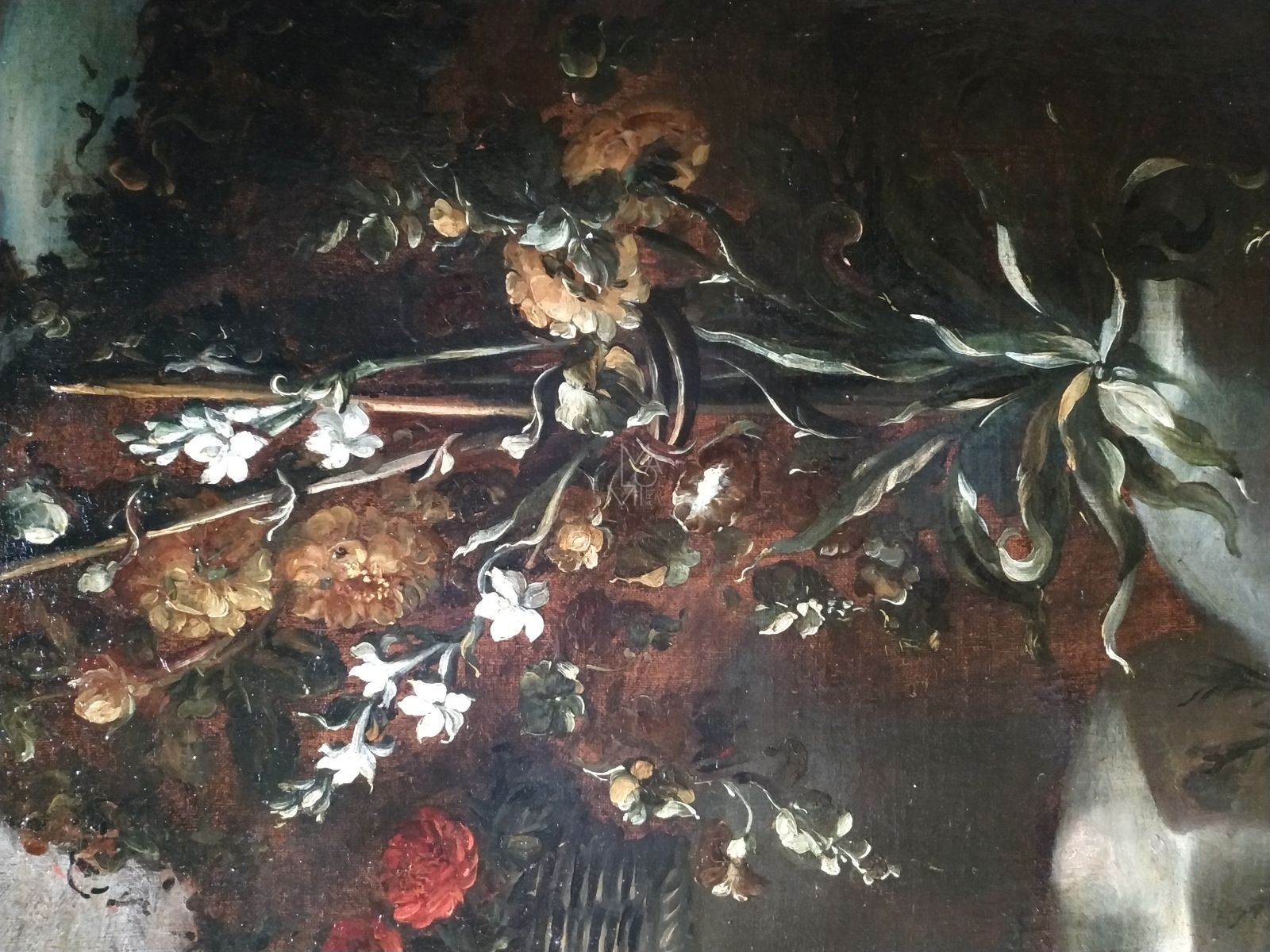
Moving within this complex atmospheric direction is a faunal microcosm camouflaged by the painter's rapid touch. Among the petals and the chipping of the stone, the evocation of small butterflies, caterpillars, or flies enriches the visual text: the butterfly, linked to metamorphosis, refers to the resurrection of the soul, while the fly, an insect of corruption, acts as a silent but inexorable reminder of the vanity of all things fleshly.
Reference bibliography
- F. Bartoli, Le pitture, sculture ed architetture della città di Rovigo con indici ed illustrazioni, Venice, Pietro Savioni, 1792.
- L. Salerno, La natura morta italiana. 1560-1805, Rome, Bozzi Editore, 1984.
- F. Porzio, F. Zeri (eds.), La natura morta in Italia, 2 vols., Milan, Electa, 1989.
- G. Bocchi, U. Bocchi, Elisabetta Marchioni, in Naturaliter. Nuovi contributi alla natura morta in Italia settentrionale e Toscana fra XVII e XVIII secolo, Calenzano, Arti Grafiche Step, 1998, pp. 417-434.
- M. Baldin (ed.), Elisabetta Marchioni pittrice di fiori nella Rovigo del XVII secolo, degree thesis, Ca' Foscari University, Venice.