Padovanino (Alessandro Varotari) – Madonna and Child with saint Theodore: a masterpiece of seventeenth-century Venetian neo-Titianism
Explore the scholarly analysis of the Madonna and Child with saint Theodore by Padovanino (Alessandro Varotari). A neo-Titian seventeenth-century Venetian masterpiece confirmed by Dario Succi, complete with its original frame.
A historical-artistic study on the Madonna and Child with saint Theodore of Amasea attributed to Alessandro Varotari
Introduction and historical-critical contextualization of the work
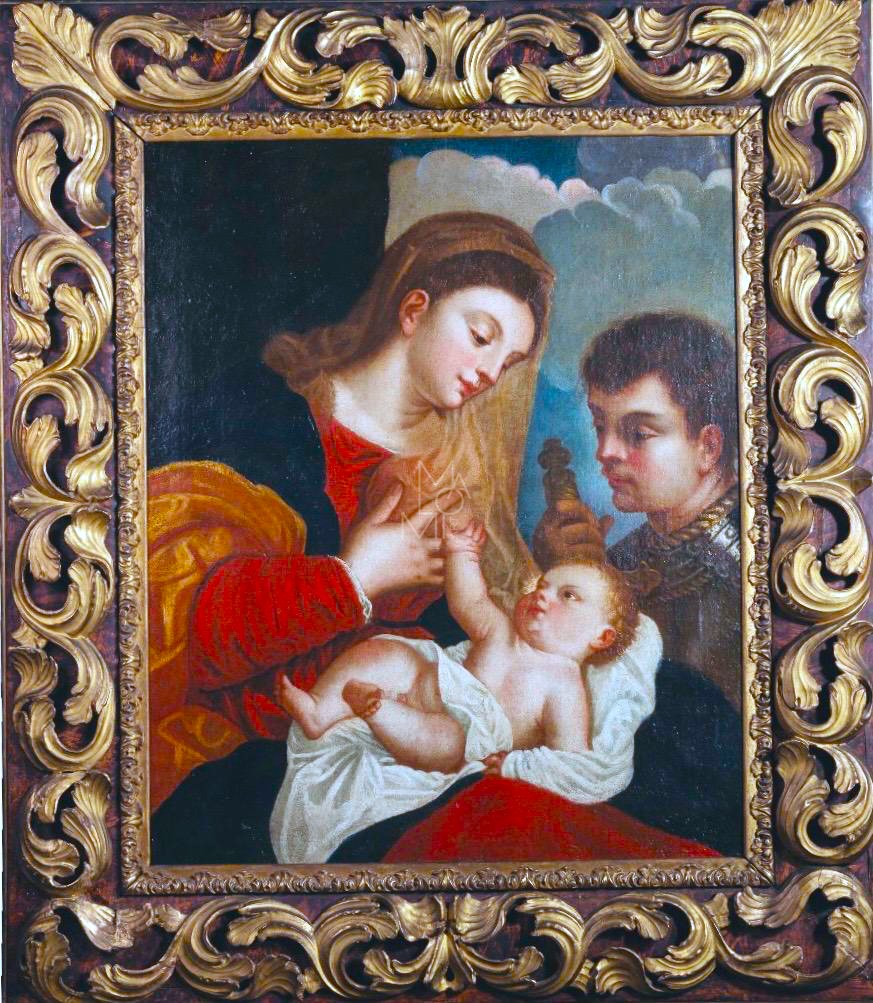
The work under analysis is a vertical rectangular oil painting on canvas, measuring an imposing one hundred and thirteen centimeters in height by eighty-seven centimeters in width. The painting is enclosed within a precious coeval and original frame made of richly carved and pure gold-leaf gilded wood, characterized by motifs of large foliate cartridges and acanthus scrolls that enhance its scenic presence. The work can be attributed to Alessandro Varotari, universally known by the celebrated moniker Padovanino, based on solid stylistic evidence orally confirmed by Professor Dario Succi. The canvas represents a visual document of extraordinary significance for understanding the complex stylistic transition that affected Venetian painting between the late sixteenth century and the first half of the seventeenth century, a period in which Venetian art sought an autonomous path away from the naturalistic and dark trends spreading throughout the rest of the Italian peninsula.
The cultural context in which Padovanino operated was marked by a profound theoretical and formal reflection on the legacy of the great Renaissance masters. Born in Padua in 1588 into a family of artists, Alessandro Varotari grew up immersed in the influences of sophisticated Venetian painting, but it was his relocation to Venice that marked the fundamental turning point of his career. In the lagoon city, the young painter was captivated by the early masterpieces of Titian, giving rise to the historiographical phenomenon that modern criticism defines as neo-Titianism. The painting analyzed here fits perfectly into this cultural current, offering an admirable synthesis between post-Tridentine sacred devotion and a warm chromatic sensitivity that looks directly to the glories of the previous century, while preserving structural integrity thanks to the inseparable bond between the canvas and its original exhibition frame.
Iconographic analysis and theological interpretation of the characters
The sacred composition is articulated around the emotional and theological core of the relationship between the Virgin Mary and the Christ Child, flanked in the background by the devout figure of the soldier saint. Mary is portrayed in a half-length pose, wrapped in a large dark mantle that opens to reveal a gown of intense vermilion red, a color that in Christian liturgical and iconographic tradition symbolizes both royalty and the blood sacrifice of the Passion. The Virgin’s face is characterized by a classical and Apollonian elegance, with downcast eyes and a delicate tilt of the head that expresses a serene yet melancholy awareness of the destiny awaiting her Son. The Christ Child rests on a pure white cloth that visually prefigures the shroud of the deposition, breaking the potential static nature of the scene through a dynamic and highly naturalistic movement, by which He rotates his torso and reaches his right arm toward his mother’s face in search of an affectionate touch.
On the right side of the canvas, the kneeling figure of saint Theodore of Amasea emerges from the darkness, the ancient and revered patron of the city of Venice prior to the translation of the relics of saint Mark. The saint is depicted with youthful and vigorous features, short curly hair, and a gaze enraptured in a devotional ecstasy entirely directed toward the divine core. He clasps the hilt of his sword between his joined hands, an iconographic attribute that in this specific work assumes a dual and profound significance as the instrument of the martyrdom suffered and the emblem of the earthly Christian militia. The entire scene is set against an atmospheric background dominated by twilight skies and leaden clouds, which nevertheless thin out near Mary’s head, creating a sort of natural luminous aura that accentuates the miraculous and solemn character of the sacred composition.
The poetics of neo-Titianism and the critical opinion on the attribution
The assignment of the canvas to the catalogue of Alessandro Varotari finds decisive confirmation not only in the authoritative oral opinion expressed by Professor Succi, but above all in a series of formal correspondences with undisputed works by the Paduan master. Padovanino was the undisputed leader of an artistic current that deliberately chose to reject the violent contrasts and extreme realism of prevailing Caravaggism, preferring to engage in an intellectual and philological recovery of the painting of Titian and Palma the Elder. This approach was not a sterile imitation of the past, but rather a modern reinterpretation based on more plastic forms, monumental volumes, and a much sharper definition of drawing compared to the sixteenth-century sfumato.
In the painting under examination, the distinctive traits of this pictorial grammar are recognized with absolute clarity, starting from the execution of the Virgin’s flesh tones, which appear smooth and compact, almost porcelain-like, evoking the idealized beauty of the female figures populating Titian’s masterpieces from the 1510s. The treatment of the drapery also responds to this precise stylistic hallmark, displaying wide geometric and heavy folds, as seen in the gilded and ochre turn of the mantle sliding over Mary’s shoulder, where the fabric appears almost sculpted in saturated color. The coherence of the drawing and the sovereign balance of the scene testify to the maturity achieved by the artist in balancing the classical grace of the Renaissance with the new monumental requirements of the seventeenth century.
Stylistic values, luministic choices, and the contribution of baroque carving
The stylistic framework of the work is governed by a skillful and calibrated use of chiaroscuro, which defines the three-dimensionality of the bodies in space without disrupting the overall chromatic harmony. A directional beam of light obliquely strikes the scene from the left, fully illuminating the ivory purity of the Child and the face of the Madonna, which thus configure themselves as the points of maximum reflectance and immediate visual focuses of the painting. Conversely, the figure of saint Theodore is partially immersed in an enveloping penumbra that softens his physical presence, emphasizing his nature as a silent and devout witness, a luministic choice that attests to Padovanino’s receptivity toward coeval research on light, though filtered through the softness of Venetian coloring.
The coeval original frame constitutes an added value of exceptional historical significance for the artifact, presenting itself as a high-relief Baroque box structure entirely occupied by a vigorous openwork carving. The foliate acanthus scrolls and shell elements running along the wooden band are typical expressions of the renowned workshops of carpenters and carvers active in Venice during the first half of the seventeenth century, who worked in close synergy with the architecs and painters of the time. The perfect structural integrity and the pure gold of the frame dialogue directly with the warm tones and bright reds of the canvas, suggesting that the work has reached us while preserving the original visual arrangement intended by the artist and the patron.
The rediscovery of saint Theodore and the sociopolitical context of the commission
The confirmation that the praying figure represents saint Theodore of Amasea introduces historical elements of extraordinary fascination, closely tied to the cultural identity of the Republic of Venice. Popularly known in the Lagoon as san Todaro, the Roman soldier was the first and absolute protector of the city before the translation of the body of saint Mark partially obscured his public prominence. However, during the first half of the seventeenth century, Venice was engaged in a grueling maritime conflict against the Ottoman Empire for the control of Mediterranean routes, a condition that prompted the patrician class to rediscover and enhance the cults of military saints linked to the historical origins of the State as an expression of fierce patriotism.
The inclusion of saint Theodore in a sacred composition intended for private devotion thus assumed a strong political and dynastic significance, as the patron, likely a high magistrate or a noble officer of the Serenissima, intended to place his family under the direct protection of the warrior saint. Padovanino chooses to depict the patron not in the customary triumphant guise of a public monument while trampling the dragon, but rather kneeling and stripped of his warlike fury, in the act of performing a formal feudal and spiritual submission before the Christ Child. This particular iconographic variation faithfully reflects the spiritual climate fostered by the Catholic Counter-Reformation, where the soldier’s sword ceases to be a mere instrument of offense to transform into the symbol of personal sacrifice offered to the divinity in defense of the Christian faith.
Anecdotes and curiosities regarding the life of Padovanino and his workshops
Numerous anecdotes have been passed down by art historiography surrounding the figure of Alessandro Varotari, useful for illuminating the eclectic personality and critical fortune of this master. Ancient sources recount that the young Alessandro manifested an extraordinary predisposition for drawing from earliest childhood, to the point that his father Dario Varotari, also an esteemed painter and architect, encouraged his early artistic education before dying prematurely. It is said that during his first trip to Venice, undertaken in his early twenties, Padovanino was so deeply impressed by Titian’s canvases in the Scuola del Santo in Padua and in Venetian churches that he spent entire days copying their details into sketchbooks, developing a prodigious visual memory that later allowed him to reproduce the style of the master from Cador with such fidelity that he deceived even the most expert collectors of his time.
A unique curiosity concerns the management of his crowded Venetian workshop, which became a true center of gathering for many young talents of the era, among whom Pietro Liberi and Giulio Carpioni stood out. Alessandro was known for his generous character and modern pedagogical methods, which encouraged students to study not only the masters of the past but also nature and the poses of children from life, a practice that explains the extraordinary freshness and anatomical truth of the cherubs and Christ Children populating his canvases. Furthermore, one cannot forget the close artistic and intellectual partnership with his sister Chiara Varotari, also a painter of exceptional talent and a refined portraitist, who chose never to marry in order to dedicate herself entirely to art and the management of the family enterprise, frequently working side by side with her brother in defining the complex draperies and rich fabrics that characterize the monumental works of Padovanino’s maturity.
Findings in the artist's catalogue and comparisons with Paduan collections
To further consolidate the philological assignment of the painting, it is possible to establish a targeted comparison with the catalogued works of Varotari preserved at the Museum of Medieval and Modern Art within the Civic Museums of Padua. A close parallel can be found in the famous canvas depicting Judith with the Head of Holofernes, where the perfect oval of the biblical heroine’s face, the straight line of the nose connecting to the brow arch, and the shape of the downcast eyes show a nearly millimetric overlap with the somatic features of the Virgin Mary examined in this study. This specific female physiognomy represents a true stylistic constant of Varotarian neo-Titianism, an aesthetic signature that the artist proposes with minimal variations in both mythological scenes and sacred compositions.
A second fundamental term of comparison involves the anatomy and dynamic posture of the Christ Child, whose rosy flesh and pronounced torsion of the torso find exact matches in the cherubs animating the large Paduan painting of Orpheus and Eurydice. Padovanino demonstrates in these works an extraordinary mastery in balancing the monumental sculpture-like quality of the figures with a natural and spontaneous grace, avoiding academic rigidity thanks to a warm pictorial execution rich in glazes. The recovery of these Renaissance prototypes, combined with the presence of saint Theodore and the superb seventeenth-century frame, qualifies the work as a high-school example within the master’s mature production, destined to remain a reference point for the study of devotional painting in Baroque Venice.
Selected critical bibliography
- Andrea Donati, Alessandro Varotari il Padovanino, Soncino, Edizioni dei Soncino, two thousand eleven.
- Rodolfo Pallucchini, La pittura veneziana del Seicento, Milan, Alfieri, nineteen eighty-one.
- Ugo Ruggeri, Il Padovanino, Soncino, Edizioni dei Soncino, nineteen ninety-three.
- Dario Succi, La pittura veneziana del Seicento, Gorizia, Edizioni della Laguna, two thousand five.
- Dario Succi, Il Seicento a Venezia, exhibition catalogue, Milan, Electa, nineteen eighty-eight.