Lombard devotional shrine with the Coronation of the Virgin by Carlo Pozzi
- Title of the work: Devotional shrine with Marian cycle
- Cultural sphere: Lombard art (Duchy of Milan)
- Chronology: Late 16th century - early 17th century (circa 1590-1610)
- Framework author: Milanese master carver of late-Mannerist culture
- Paintings author: Carlo Pozzi (Valsolda, active in Milan between the 16th and 17th centuries), attributed
- Technique and materials: Carved wooden shrine, lacquered in faux green marble and gilded with gold leaf; central painting in oil on copper (ramino); predella and pediment in oil on wooden panel
- Dimensions: 60 x 35 cm (maximum dimensions)
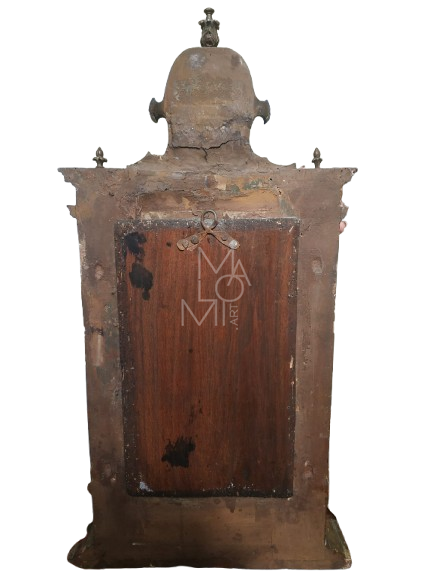
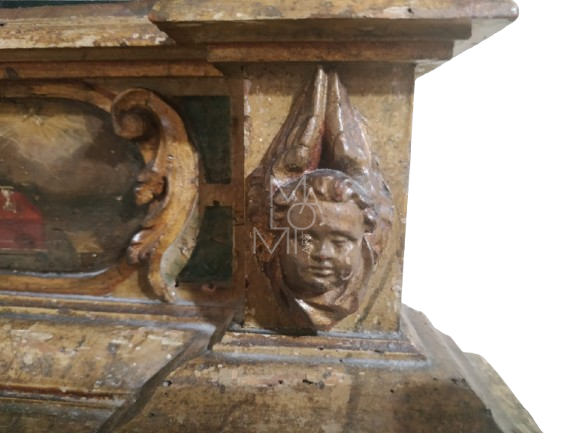
- State of conservation: Good in the central body and predella; cracks and a continuous horizontal structural crack on the back of the upper pediment (oval top piece); widespread loss of the original gilding on the cherub heads at the base
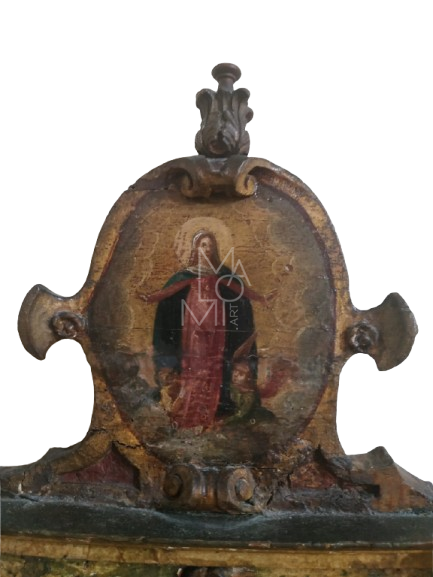
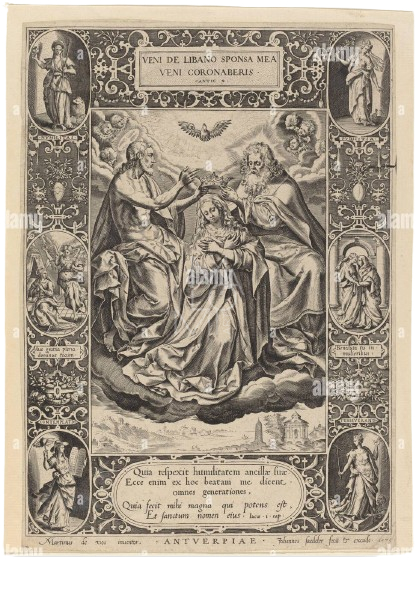
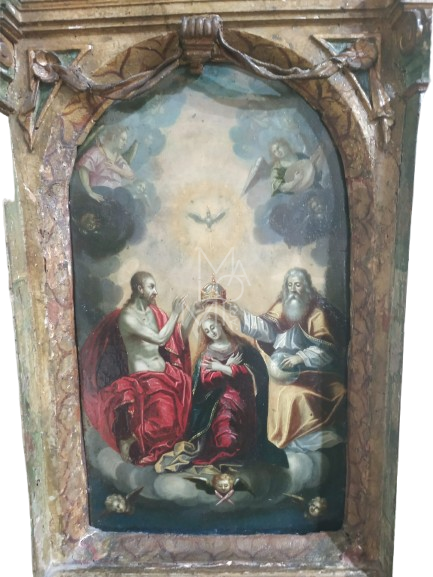
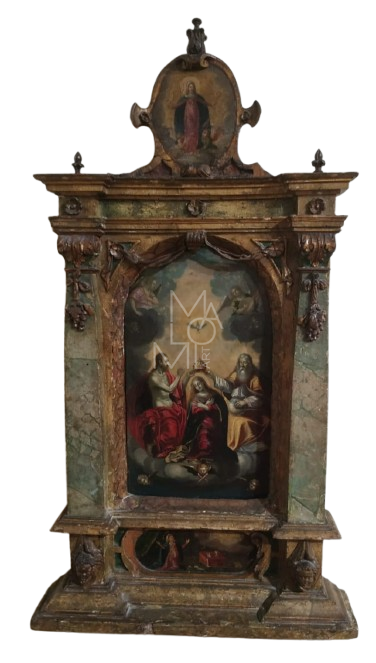
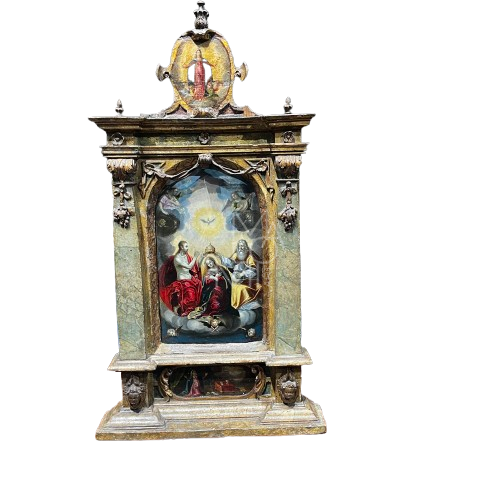
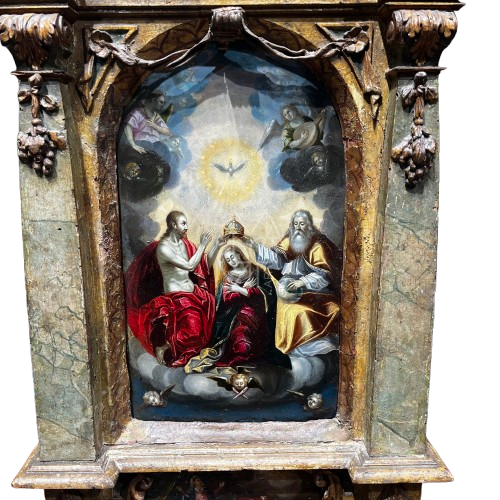
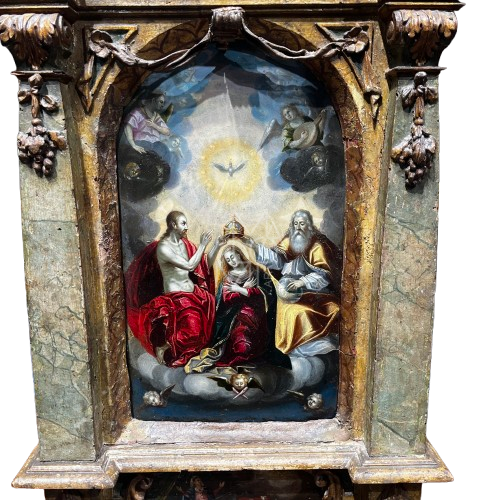
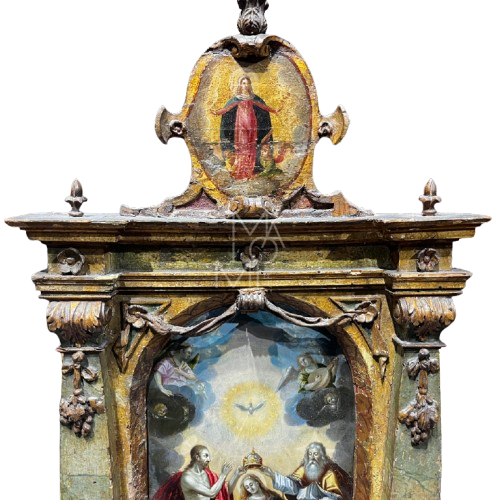
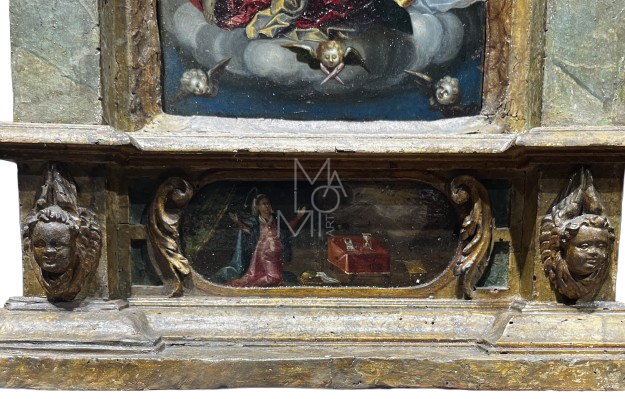
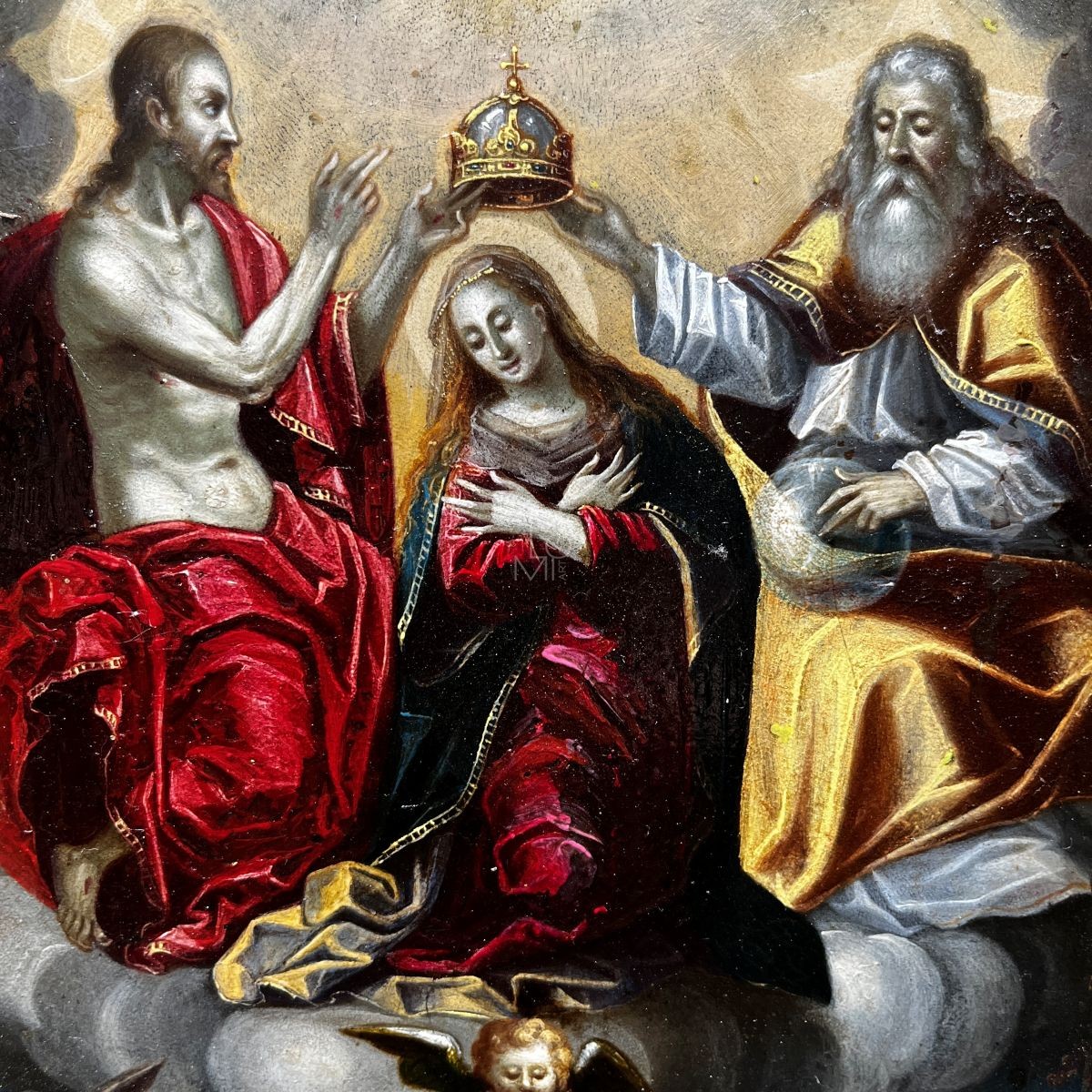
- Iconographic description: The artifact is structured as a complete ascensional Marian cycle. The lower predella depicts the Virgin Annunciate at the moment of the Fiat. The central arched copper plate features the Coronation of the Virgin by the Trinity, faithfully based on the 1576 Flemish engraving by Jan Sadeler I after a design by Maarten de Vos. The upper oval pediment displays the Virgin of Mercy welcoming devotees beneath her protective cloak.
- Historical-critical relevance: A rare and sophisticated example of domestic sacred micro-architecture from the Borromean era. The work documents the extraordinary phenomenon of the reception and pictorial translation of northern graphic models (Antwerp) within the art workshops of Counter-Reformation Lombardy.
A micro-architecture of devotion: the wooden shrine by Carlo Pozzi between mannerism and the Counter-Reformation
Critical and historical-artistic essay
This contribution offers a historical-artistic, iconographic, and technical analysis of a devotional shrine made of carved, lacquered, and gilded wood, datable between the late sixteenth century and the first decades of the seventeenth century. The structure houses in its central register a precious oil painting on copper depicting the Coronation of the Virgin, traditionally attributed to the hand of the master Carlo Pozzi. The investigation conducted here identifies the direct graphic source of this copper plate in a Flemish engraving dated 1576 by Jan Sadeler I based on an invention by Maarten de Vos, while tracing a sophisticated, unified, and ascensional theological program that closely binds the wooden framework to private devotional painting. The work, recently subjected to a complete restoration, is presented today in a perfect state of conservation that allows for the analysis of every minute original detail.
- The historical-artistic context: Lombardy between the Borromeos and the print market
1.1. The influence of Borromean guidelines
The work under examination is situated within the complex and rigorous cultural atmosphere of Tridentine and post-Tridentine Milan, a territory deeply shaped by the pastoral figures and provisions of Archbishops Carlo and Federico Borromeo. The publication of the famous guidelines entitled Instructiones fabricae et supellectilis ecclesiasticae in 1577 by Carlo Borromeo did not merely redefine the canons of monumental architecture, but also exerted a pervasive influence on the production of sacred furnishings and micro-architectures intended for private devotion. During these years, the practice of owning small domestic shrines became widespread both within noble palaces and inside the cells of cloisters. These objects were meant to act as visual catalysts for daily prayer, a practice recommended by conciliar decrees to counteract the advance of Protestant doctrines. There was an anecdote in the Milanese chronicles of the time according to which Federico Borromeo himself loved to inspect the private residences of his most illustrious faithful to ensure that sacred images did not display Mannerist licentiousness, but were instead compliant with decorum and capable of inspiring immediate spiritual ascent.
1.2. The penetration of Flemish models into the Po valley
In this specific socio-religious scenario, the extraordinary dissemination of prints and engravings from the Netherlands played a primary role in the development of local artistic languages. Carried to Milan by a dense network of publishers and merchants, these images on paper circulated freely within the workshops of Lombard painters and carvers. Northern prints rapidly became an inexhaustible source of ornamental and compositional modules. Local masters, despite having to respect the strict orthodoxy of the Counter-Reformation, were fascinated by the technical skill and graphic complexity of works from beyond the Alps. This phenomenon led to the birth of a curious stylistic hybrid, in which the severe Milanese Counter-Reformation rigorism combined harmoniously with the aesthetics of late international Mannerism. The shrine studied here represents a perfect point of material and conceptual convergence of this transalpine cultural dialogue.
- Structural analysis and ornamental vocabulary: the wooden framework
2.1. Miniature architecture and cherub heads
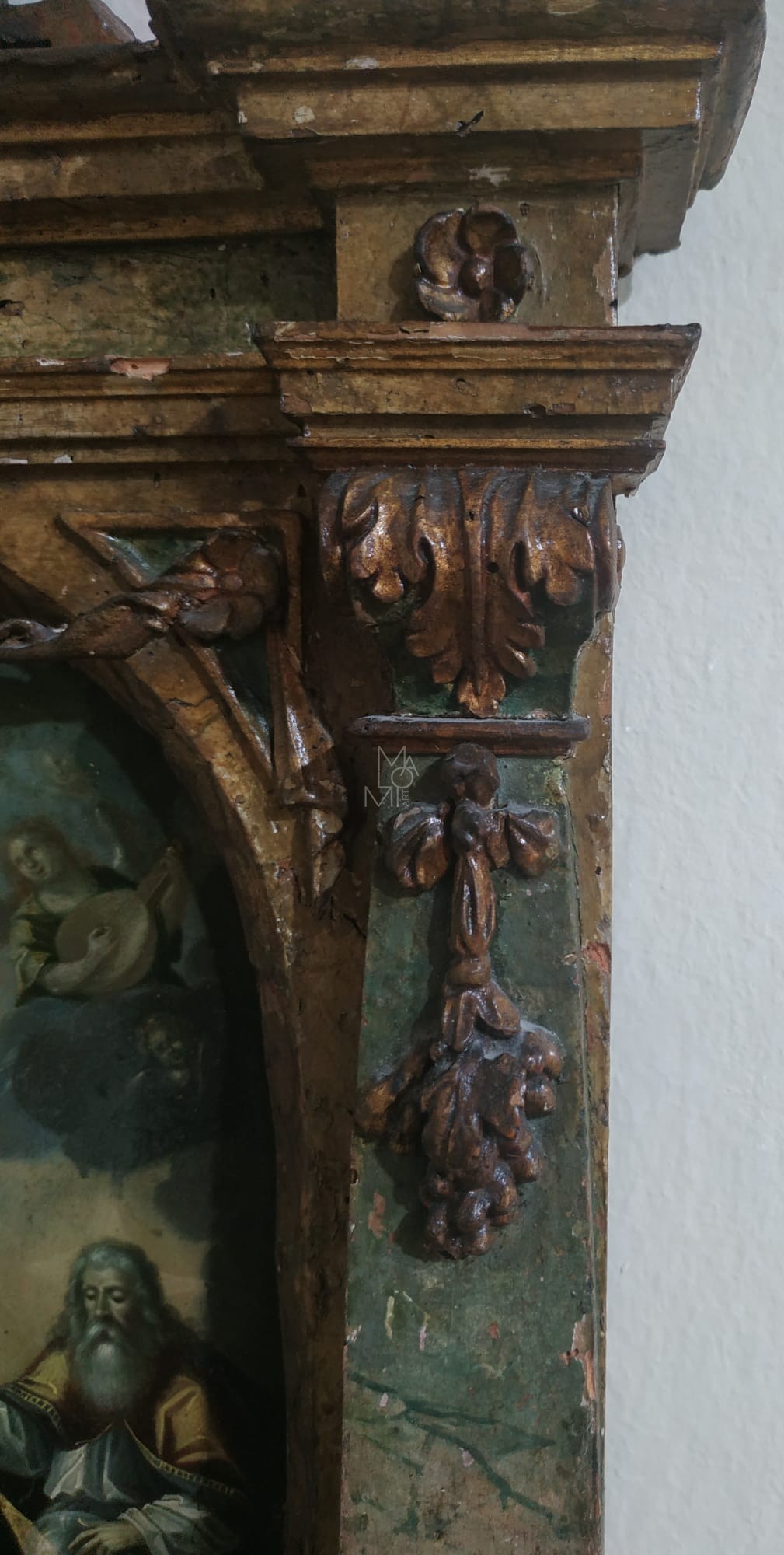
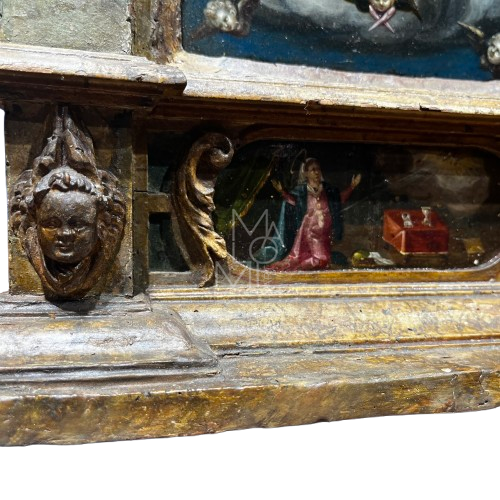
The outer wooden structure of the shrine must not be considered a simple frame, but a true monumental facade conceived on a reduced scale. The general layout develops along a strongly vertical line, rhythmically defined by a plastic and energetic carving that foreshadows the future developments of proto-Baroque sensitivity. At the base of this structure, the framework rests on projecting moldings that find a refined visual fulcrum in the lower corners, where the woodworker has carved two splendid cherub heads in the round. The morphology of the faces of the small putti, characterized by full cheeks, pouty lips, and short locks of hair worked with precise chisel strokes, bears witness to the hand of a high-level carver, likely trained in the Milanese decorative workshops of the late sixteenth century. The feathered wings of the cherubim extend upward with a marked geometric curvature, ending in an apex that serves as a structural connection with the base blocks of the pilasters above, elegantly masking the transition between figurative and architectural elements.
2.2. Polychromy and the secrets of imitation inlay
Ascending toward the central body of the shrine, the main opening designed to house the painting is framed by two lateral pilasters that hide a fascinating workshop secret. The wooden surface was not merely painted, but was subjected to a complex lacquer technique imitating marble. Through overlapping glazes of green tones and thin dark veins, the artisan managed to perfectly simulate the texture of serpentine marble or the famous verde di Varallo, a highly sought-after and expensive ornamental stone used in the most prestigious altar chapels of the region. This device, known as faux stone inlay, allowed the small domestic object to be invested with the visual authority of a monumental altar. The pilasters are crowned by composite capitals decorated with acanthus leaves gilded with gold leaf applied over a base of Armenian bole. From these capitals hangs a sumptuous cascading festoon, an ornamental motif typical of the Flemish area depicting fruits and foliage held tightly by ribbons, whose abundance symbolically alludes to the generosity of divine grace. Above the entablature, enriched by square panels with botanical rosettes in relief, sits the upper crowning element, consisting of a broken tympanum supporting an oval pediment, enclosed by neo-Mannerist volutes and surmounted by a central pinnacle in the shape of a plant bulb.
- The central copper plate: the technique of Carlo Pozzi and the discovery of the graphic source
3.1. The secrets of oil painting on copper
The theological heart and qualitative core of the entire shrine is constituted by the arched oil painting on copper inserted into the central body. In the jargon of the artistic workshops of the time, this metal plate was commonly referred to as a ramino. The adoption of copper as a pictorial support enjoyed extraordinary fortune between the end of the sixteenth century and the first decades of the seventeenth century, becoming a true status symbol for the most refined collectors. The processing of the plate required meticulous preparation, which included rubbing the metal with garlic juice to promote paint adhesion and applying a very thin layer of Helix ground. The smooth metallic surface, entirely free of the porosity typical of canvas, allowed the painter to execute a fluid, almost miniature-like brushwork. The oil-bound pigments were not absorbed by the support, thus keeping their original chromatic purity intact over time. This technical peculiarity allows the work of Carlo Pozzi to display even today an extraordinary enamel-like brilliance, in which the lacquer reds and deep blues of the cloaks stand out with an almost hypnotic intensity.
3.2. The philological dialogue with the engraving by Jan Sadeler I
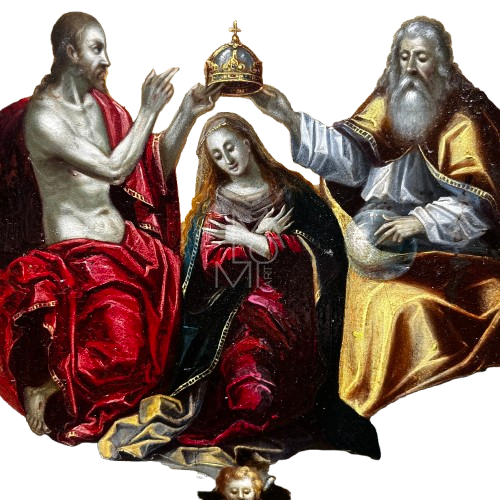
The critical attribution of the copper plate to Carlo Pozzi receives here a definitive and fundamental philological confirmation thanks to the identification of the precise graphic model used by the artist. Comparative examination reveals that the painter translated into paint a famous burin engraving printed in Antwerp in 1576 by the master Jan Sadeler I, executed from an original design by the painter Maarten de Vos. Carlo Pozzi performed an operation of intelligent selection and spatial adaptation, isolating the central sacred composition of the print to fit it harmoniously into the arched format of the wooden shrine. The derivation from the Flemish model is visible in the faithful reproduction of the pyramidal structure of the protagonists. On the left, the figure of Christ wears the same wide silk cloak moved by geometric folds, raising the royal crown with his right hand while with his left he holds the crossed banner of the Resurrection. On the right, God the Father is portrayed as a solemn, white-haired elder, with his left hand resting upon the terrestrial globe that symbolizes divine dominion over the universe. At the apex of the composition, in perfect alignment with the crown, the dove of the Holy Spirit is surrounded by a circular glory of light. Pozzi showed extraordinary mastery in translating the dense network of lines of the northern burin into a thick pictorial and atmospheric substance, bringing forth a multitude of cherub heads from the clouds through a wise use of chiaroscuro contrasts that feel the influence of late sixteenth-century tenebrism.
- The iconographic program: an ascensional Marian cycle
4.1. The humility of the incarnation in the predella
An analysis of the three painted compartments decorating the shrine reveals the existence of a unified theological program of extraordinary conceptual coherence. The object was conceived as a true Marian cycle developing vertically from the bottom upward, guiding the eye of the worshiper along a path of spiritual ascent. The sacred narrative opens in the lower register, within the mistilineal compartment with rounded corners inserted into the wooden predella of the base. Here the viewer encounters the episode of the Annunciation, caught at the exact moment when the Virgin pronounces her mystical assent to the divine designs. In an austere and bare domestic setting, perfectly in line with the pauperistic spirit of the Counter-Reformation, Mary is depicted on the left, kneeling with open arms in an attitude of total submission and humility. From the opening of clouds in the upper right, the Holy Spirit projects its golden rays upon her. The scene is enriched by delicate details of daily life that hide symbolic meanings, such as the kneeler covered by a red cloth on which rests the open book of the Scriptures being fulfilled, some liturgical ampoules, and, on the floor, a small sewing basket. This basket represents an interesting medieval iconographic curiosity that survived over time, recalling how Mary was intent on weaving the veil of the temple at the moment of the angel's arrival, a symbol of her purity of soul. This first register represents the Incarnation of the Word and the historical beginning of human salvation on earth.
4.2. The heavenly triumph and the protection of Mercy
Leaving behind the earthly dimension of the predella, the eye of the devotee rises toward the central register of the copper plate, where the otherworldly triumph of Mary is fulfilled. The scene of the Coronation exalts the dogmatic dimension of the Virgin received into heaven by the Trinity. This glorification of the Marian figure reflected the theological theses defended by the Catholic Church against iconoclasm and the rejection of the cult of saints by the Protestant world. The ascensional path of the shrine does not stop at the center, however, but finds its definitive theological fulfillment in the upper pediment, within the round panel inserted into the oval top piece. An investigation of the painted surface of this upper compartment has allowed for the identification of the iconography of the Virgin of Mercy. The Virgin is portrayed standing, in a hieratic and frontal position, while performing the solemn gesture of symmetrically opening the edges of her wide dark cloak to offer shelter and protection to the small figures of the devotees kneeling at her feet. Thus, the spiritual parable of the object closes. Mary, who had been the humble servant of the Lord on earth in the register of the Annunciation and had become the triumphant queen in the heavens in the register of the Coronation, assumes here the definitive role of advocate, mother, and protector of the human race. Her image is physically positioned above the head of the worshiper to reassure them of the universal efficacy of Marian intercession.
- A close stylistic comparison: the face of Christ in the copper plate and the Lombard production of Carlo Pozzi
5.1. Morphological analysis and peculiarities of the Christological face
To consolidate the attribution of the central oil on copper painting to Carlo Pozzi, a critical investigation focusing on the physiognomic features of the face of Jesus Christ is necessary, comparing them with the expressive solutions adopted by the master in his certain surviving works within the territory of historical Lombardy and Brescia, his native city. The figure of the Savior in the copper plate under examination shows a face in profile strongly outlined, almost sharp, characterized by a straight and slender nose, a sharply defined brow bone, and a short, dark beard following the jaw with geometric precision. The hair falls over the shoulders in wavy locks, defined by thread-like highlights that exploit the brilliance of the metal support. The leaden and almost sculptural flesh tone of Christ, modeled with icy highlights that accentuate the musculature of the naked torso, creates a powerful contrast with the turgid drapery of the bright red cloak, furrowed by deep folds and enamel-like reflections. This specific facial morphology, which combines a solemn composure with a subtle linear tension, distances itself from the Morazzonian deformations to approach a more measured and academic language. This stylistic choice is derived from the lesson of Camillo Procaccini, the master of late sixteenth-century Milanese painting, whose workshop exerted a notable influence on Carlo Pozzi and the Borromean circle.
5.2. Formal correspondences within the catalog of certain works
An immediate formal correspondence can be found with the face of the Savior visible in the fresco cycles and execution that historiography associates with Pozzi and his family circle of Valsolda origin. In the Christological figures, one finds the exact same stylistic signature in the rendering of the eye, drawn with a defined upper eyelid and a deep orbit that gives the gaze a melancholic and severe intensity, perfectly responding to post-Tridentine decrees on the representation of sacred emotions. Even the rendering of Christ's hair in our copper plate, treated through an analytical execution that separates the individual golden strands, finds a mirror image in the technical details of the works produced by Pozzi between the end of the sixteenth century and the first decades of the seventeenth century. This pictorial vocabulary, which reconciles the graphic refinement of the Northern European engraving source with the chiaroscuro softness of Lombard classicism, reinforces the full authorship of the master. The central painting of the shrine is not configured as a passive copy of Maarten de Vos's model, but as a refined reassessment, filtered through the personal expressive code that Carlo Pozzi was codifying within the Lombardy of the era.
- Material aspects, conservation history and outcomes of the restoration
6.1. The rear structure and the original state of conservation
The examination of the back of the shrine provides a series of precious material data to reconstruct the conservation history of the object. The back reveals a solid wooden lining board, cut along the vertical grain of the fiber, which serves as a closing and protective panel for the central copper plate. In the upper portion of this board, an ancient handcrafted wrought iron suspension ring is firmly anchored, secured to the wood by two metal tabs and hot-riveted nails. The presence of this structural element confirms that the shrine was designed from the very beginning to be hung on a wall. On the rear wooden surface, several dark stains were visible in the past, concentrated on the left side and in the lower band, traceable to historical wax drippings linked to the use of devotional candles lit for centuries close to the altar, combined with partial traces of contact moisture due to the direct resting of the wood against the thick perimeter stone walls of ancient buildings. While the central body and the predella showed a fair state of conservation, a serious structural problem was found in the upper pediment, where the back of the oval top piece showed a deep, continuous horizontal crack that went through the entire thickness of the wood, accompanied by small liftings and flaking of the preparatory layers of gesso and glue on the painted front, caused by the hygrometric movements of the support and the static weight of the bulb pinnacle.
6.2. The excellent outcome of the final restoration intervention
Today, thanks to a recent and targeted global conservative restoration intervention, the work is presented in a perfect state of conservation and has fully recovered its original formal and aesthetic dignity. The restorers successfully addressed the structural problem of the upper pediment, performing a controlled cleaning of loose atmospheric deposits accumulated inside the deep horizontal crack and proceeding to consolidate the wooden support through injections of suitable resins, which permanently stabilized the crowning pediment. Parallelly, on the front of the work, the paint film was secured and a delicate selective cleaning was performed, which removed the layers of yellowed varnish and old altered retouches. This process restored an extraordinary and unsuspected chromatic brilliance to all the painted parts, enhancing the enamel-like execution of the reds and blues of the central copper plate and revealing the clarity of the details of the Annunciation in the predella and the Virgin of Mercy in the pediment. The wooden framework also benefited from the restoration: the incomplete gold leaf gilding on the cherub heads and capitals was secured and enhanced, while the complex green marble-imitation lacquer of the pilasters regained its original visual depth, eliminating the dull appearance that obscured its veins. The intervention, conducted according to modern criteria of minimal treatment and reversibility of materials, has completely secured this rare Borromean artifact, ensuring its future preservation and allowing an impeccable critical reading of the iconographic program conceived between the late sixteenth and early seventeenth centuries.
- Reference bibliography and graphic sources
7.1. Graphic engraving sources
- De Vos, Maarten, Coronatio Virginis, Antwerp, 1576, burin engraving on paper carved by Jan Sadeler I, specimen bearing the inscription on the lower margin taken from the Book of Canticles.
7.2. Historical-artistic bibliography
- Borromeo, Carlo, Instructiones fabricae et supellectilis ecclesiasticae, Milan, 1577, critical edition edited by Massimo Marinelli, Vatican City, Libreria Editrice Vaticana, 2000.
- Koch, Carl, Die Rezeption flämischer Stecher im barocken Mailand, in «Jahrbuch der Berliner Museen», volume fourteen, 1972, pages 112-134.
- Milesi, Silvana, Dalla Controriforma al Barocco. Pittori a Bergamo e nel territorio tra Cinquecento e Seicento, Bergamo, Corponove, 1993.
- Sava, Giuseppe, Pozzi, Carlo, in Dizionario Biografico degli Italiani, volume eighty-five, Rome, Istituto della Enciclopedia Italiana Treccani, 2016.
- Terzaghi, Maria Cristina, Ambrogio Figino nel contesto della pittura milanese di fine Cinquecento, Milan, Bramante, 2003.
- Varallo, Franca, La pittura su rame tra Fiandre e Italia a cavallo tra sedicesimo e diciassettesimo secolo, in «Arte Lombarda», number one hundred and twenty-two, 1998, pages 45-58.