GASPARE DIZIANI 1689-1767
Between chronicle and capriccio: Gaspare Diziani’s clash between bandits and soldiers in the Orsi collection
Introduction: the genre of the "battle" in eighteenth-century Venice
In the panorama of eighteenth-century Venetian painting, dominated by the magniloquent fresco decorations of the Tiepolesque tradition and the analytical vedutismo of Canaletto and Guardi, a production that is minor only in dimensional scale, yet of extraordinary historical-artistic importance, finds its place: genre painting and animated landscapes. Within this strand, the theme of military conflict, ambush, and banditry occupies a prominent position. These are no longer the monumental and rhetorical historical battles of the seventeenth century, but rather scenes of rural guerrilla warfare, where the focus shifts toward dramatic contingency, minor local chronicles, and the capriccio of woodland settings.
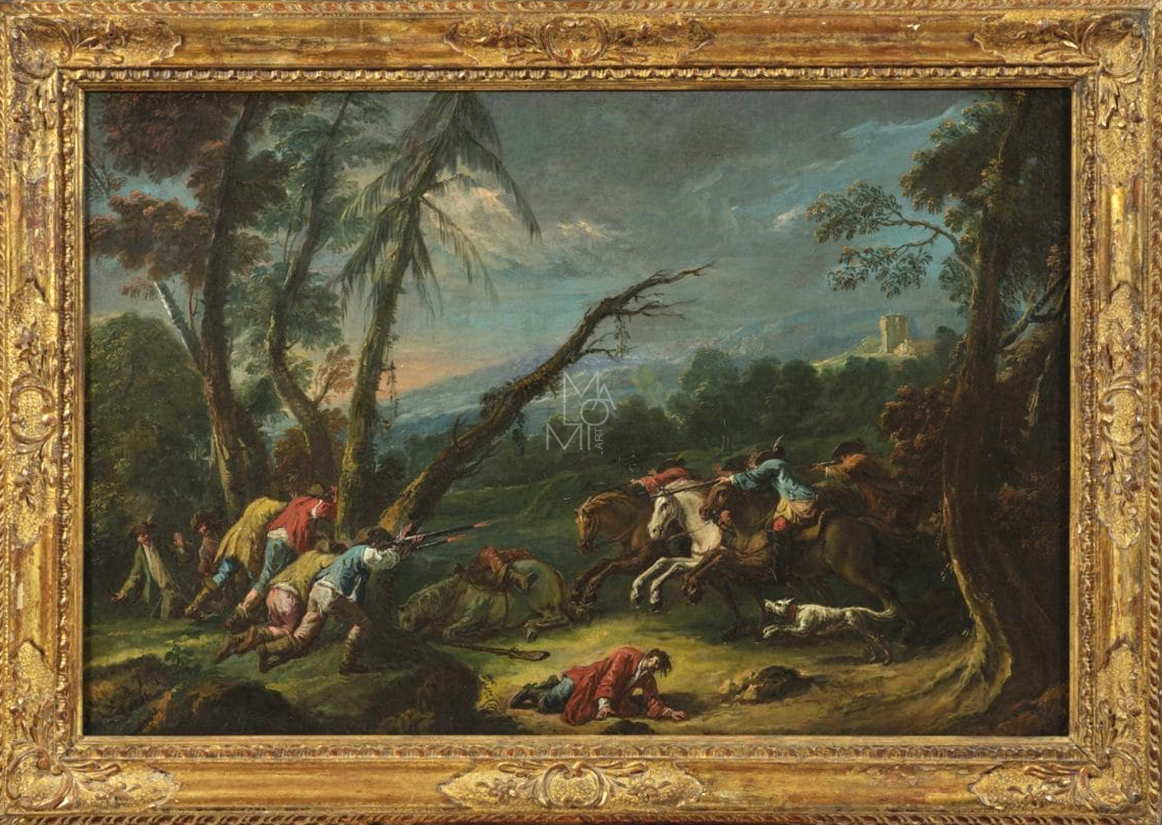
It is within this specific context that the Assault of Bandits (also known as Clash between Bandits and Soldiers) is situated—an oil on canvas measuring seventy by one hundred centimeters, historically documented in the prestigious private Orsi Collection in Milan. The work offers an ideal ground for inquiry to explore the internal workshop dynamics of Gaspare Diziani (Belluno, 1689 – Venice, 1767), one of the most prolific and versatile painters of the Venetian Rococo, and to map the complex stylistic and exegetical transition that separates his production from that of his son, Antonio.
- The Orsi collection and the critical fortune of Egidio Martini
The critical fortune of this painting is inextricably linked to the figure of Egidio Martini, an art historian whose contribution to the rediscovery and cataloging of seventeenth- and eighteenth-century Venetian painting remains fundamental [Pinacoteca Egidio Martini]. It was precisely Martini, in 1964, who published the work, noting its presence in the Orsi Collection in Milan, a private anthology renowned for the refinement of its selections and for the attention reserved for the masters of the Barocchetto and Rococo.
The identification of the painting within the Orsi Collection allowed scholars to rescue the canvas from the anonymity of generic "Venetian schools," inserting it into a precise philological debate. Martini immediately grasped its executive quality, discerning in it the distinctive traits of a mature and major artistic personality. The provenance from such an astute Milanese collection furthermore demonstrates the endurance of twentieth-century collecting interest in those compositions originally created for the porteghi and salons of the Venetian nobility and mainland aristocracy, who desired to possess works of strong narrative and formal impact.
- Philology of attribution: the dialogue between Gaspare and Antonio Diziani
One of the most complex nexuses in the art historiography of eighteenth-century Venice lies in distinguishing the individual hands within painting dynasties. The workshop of the Diziani is no exception. While Gaspare is the patriarch, celebrated for his grand frescoes and his vibrant modelletti derived from Sebastiano Ricci, his son Antonio Diziani (Venice, 1737 – 1797) specialized almost exclusively in pure or faintly historically-populated landscapes, looking toward the Arcadian models of Francesco Zuccarelli and Giuseppe Zais.
Often, critical literature has dismissed the genre scenes of the Diziani household as works born from tight academic collaboration: to Gaspare was assigned the design and execution of the figures (the so-called macchiette), while to Antonio fell the codification of the arboreal and hilly landscape. However, in the specific case of the Orsi canvas, Egidio Martini proposed an integral attribution to Gaspare Diziani.
Stylistic analysis supports this thesis through the very handling of the landscape, which does not present the lenticular sharpness and atmospheric softness typical of Antonio. On the contrary, the environment is assaulted by a broad, robust, and immediate brushstroke, which reflects Gaspare’s early training as a theatrical set designer. The plasticity of the forms is evident in the way the broken branches and rocks are modeled: through rapid touches of lead white and compendious applications, devoid of that idyllic lingering that would characterize the subsequent generation. This is a primordial nature, a dramatic mirror of the violent action consumed within it.
III. Iconographic genesis: between eighteenth-century chronicle and Salvatorian suggestions
The iconography of the Clash between Bandits and Soldiers responds to a dual track: on one hand, the echo of contemporary historical reality; on the other, a refined pictorial genealogy that sinks its roots into the preceding century.
In the eighteenth century, the phenomenon of banditry was not a remote literary abstraction, but a concrete plague that afflicted the land routes of the Republic of Venice, particularly the mountain passes of the Belluno area and the borders with Imperial territories. The chronicles of the time are rich with accounts of assaults on carriages and wayfarers. Gaspare Diziani, a native of Belluno, was well acquainted with the harsh morphology of those territories and the sense of insecurity that reigned there.
Under a strictly artistic profile, however, the work configures itself as a cultured "philo-bandit capriccio." The structural and psychological reference model is Salvator Rosa, the seventeenth-century master who had codified the aesthetics of the picturesque and the sublime through his famous scenes of bandits among rocks. This heritage, filtered into the Lagoon through the etchings and "terrible" landscapes of Marco Ricci, is reinterpreted here by Diziani in a Rococo key. The Rosaian drama loses its original existential and nihilistic charge to become a dynamic narrative, pure visual spectacle, where the violence of the assault is sublimated by the sophisticated Venetian palette.
- The impact of theatrical set design on perspective construction
To fully comprehend the spatial development of the Clash between Bandits and Soldiers, it is indispensable to trace back to the fundamental biographical and professional experience lived by Gaspare Diziani prior to his full pictorial establishment. Between 1717 and 1720, the artist traveled to Germany, working actively in the courts of Dresden and Munich at the side of the celebrated architect and scenographer Alessandro Mauro. This youthful apprenticeship in the field of ephemeral architecture and grand European theatrical stagings left an indelible imprint on his mind, translating into a habit of conceiving pictorial space according to the logistics of scenic impact.
In the Orsi canvas, the sensibility of the painter-scenographer emerges clearly in the perspective decomposition of the scene, structured through actual stage planes. Diziani does not adopt a unified geometric perspective of Renaissance extraction, but rather a telescope-like structure organized by successive flats. The dense woods on the right and the rocky crags on the left act as the lateral wings of opera houses, framing and narrowing the vision. The central plane is conceived as the proscenium, the illuminated downstage where the characters perform emphatic, almost choreographic movements. Finally, the tempestuous sky and the fortress perched in the background function as a painted backdrop, a distant scenery that closes the perspective retreat, amplifying the illusion of depth without resorting to analytical descriptions. This propensity for grand rendering allows Diziani to manage space with extreme ease, conferring upon the bandits' assault the visual force of a theatrical drama caught at its climax.
- Dynamic structure and unity of the paternal creative force
Unlike other workshop productions, in which an executive hiatus is perceived between the background and the human figures, the Clash of the Orsi Collection imposes itself through an absolute unity of intent and hand. Had the painting been born from the mind of his son Antonio, the episode of the bandits would likely have been reduced to an anecdotal pretext, a picturesque macchietta inserted within a vast, serene, and reassuring hilly or alpine view. In this canvas, conversely, the fury of the narrative entirely absorbs the space, bending the natural elements to the logic of the conflict.
The painting of Gaspare is recognized precisely by this all-encompassing impetus, in which the figure and its context merge their energetic vectors. The temperament of the father expresses itself in the agitation of the bodies, but also in the restlessness of the skies and the angularity of the rocks. This executive continuity allows scholars to identify the work not as an academic assemblage of disparate elements, but as the fruit of a single, vigorous aesthetic intuition by Gaspare, capable of mastering both human anatomy in motion and the vegetative anatomy of the surrounding landscape.
- Morphology of the pictorial space: compositional structure and chromatic dynamics
The Orsi canvas commends itself as a masterpiece of geometric and luministic direction, designed to catapult the spectator into the center of the action. The composition develops along a complex play of divergent vectors that amplify the perception of movement. On the left side, the group of riflemen and defenders is arranged along an ascending diagonal arc: their bodies, leaning forward and strained in the military effort, visually follow the inclination of the large bare tree trunk that cuts obliquely across the canvas, serving as the true dramatic fulcrum of the entire scene.
To this leftward thrust corresponds, on the opposite side, an overwhelming dynamic mass of contrary sign. The horsemen burst from right to left, guided by the sudden luminous flash of the white stallion, caught in the middle of a plastic leap. Beneath the hooves of the animals, the frenetic dash of the defense dogs accelerates the visual rhythm, creating a kinetic vortex that converges toward the center of the painting. The emotional and tragic barycenter of the work settles along the lower margin, where the motionless figure of the fallen soldier lies. The dramatic stasis of this body breaks the frenzy of the lateral charges and offers a point of rest for the viewer's eye, before the gaze is magnetized along the diagonal line of flight into the background, where the tempestuous clouds open to reveal the perched fortress.
The chromatic palette reveals Gaspare's consummate skill as a colorist: the dominant tones are the earths, browns, and dark greens of the thicket, applied with material density. Upon this almost monochrome base, Diziani detonates sudden flashes of pure light. The vivid red of the fallen man's jacket, the powder blue of the rifleman’s garment, and the silvery white of the steed are not mere decorative choices, but actual structural beacons that guide the reading of the narrative sequence. It is this technique of instantaneous contrast, united with a nervous and vibrant draftsmanship, that confers upon the work of the Orsi Collection its unmistakable stylistic signature.
Conclusion: the work as a synthesis of Gaspare Diziani’s maturity
In definitive terms, the Clash between Bandits and Soldiers formerly in the Orsi Collection represents a figurative document of primary importance for the reconstruction of Gaspare Diziani’s catalogue and for the study of genre painting in eighteenth-century Venice. The work emancipates itself from the dimension of mere workshop craftsmanship thanks to an extraordinary structural unity, where landscape and human figure fuse their energetic vectors into a single dramatic tale.
Through the philological validation of Egidio Martini, the canvas imposes itself as the ideal term of comparison to comprehend the stylistic transition between the scenographic magniloquence of Gaspare and the subsequent Arcadian lyricism of his son, Antonio. The painting thus remains to witness an artistic season in which Venetian painting, though aware of its own political twilight, still knew how to translate the chronicle and danger of reality into pure, aristocratic formal beauty.
Length 100
Height 70