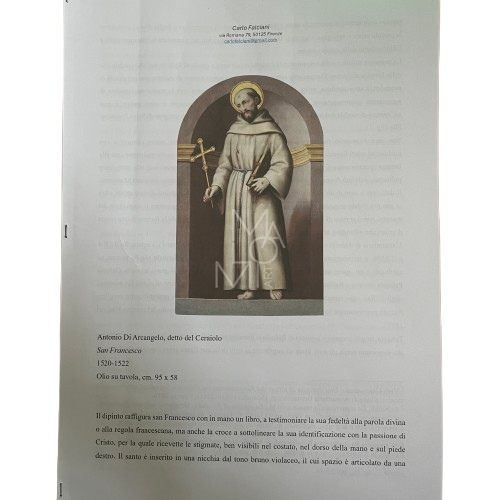
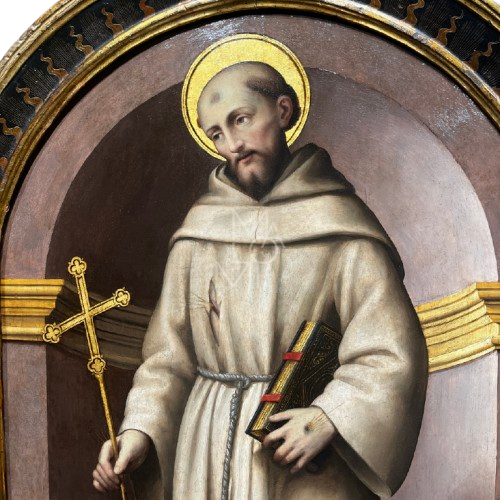
Antonio di Arcangelo, called il Ceraiolo (Florence, active 1510–1525)
- Artist: Antonio di Arcangelo, called il Ceraiolo (Florence, active 1510–1525) (Archival Document 2)
- Subject: Saint Francis of Assisi
- Date: 1521–1522
- Medium and technique: Oil on poplar panel
- Dimensions: 95 x 58 cm
- Current location: Private collection
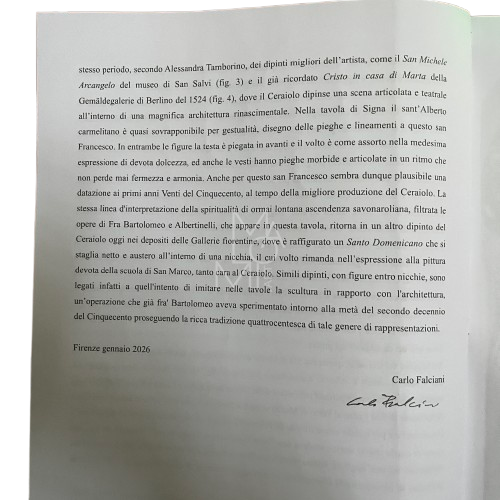
- Expertise: Prof. Carlo Falciani
Between Tradition and Mannerism: The Saint Francis by Antonio di Arcangelo, Known as il Ceraiolo (1521-1522)
Introduction and historical-artistic contextualization: the "maniera" in early sixteenth-century Florence
The third decade of the sixteenth century in Florence represents one of the most intense and fertile moments of transition in the history of Western art—a suspended season in which local workshops found themselves grappling with the monumental legacy of the great masters of the High Renaissance. Following the departures of Leonardo da Vinci, Michelangelo Buonarroti, and Raphael Sanzio, who had shifted the center of gravity of art toward papal Rome, the painters remaining along the banks of the Arno had to rework the models of the fifteenth-century formal tradition while simultaneously grafting onto them the first stirrings of what Giorgio Vasari would later define as the maniera moderna.
It is within this specific and fascinating panorama that the work of Antonio di Arcangelo, known as il Ceraiolo, is situated—an artist whose biographical trajectory perfectly embodies the continuity and resilience of the great Florentine painting workshops. He initially trained in the prestigious and pious workshop of Lorenzo di Credi, an environment renowned for its executive meticulousness and adherence to religious dictates, and later refined his skills under the guidance of Ridolfo del Ghirlandaio. Ridolfo’s workshop—son of the celebrated Domenico—was a center of crucial intellectual and artisanal importance, a true microcosm in which, as Vasari recalls, work was carried out on all kinds of artifacts and many young pupils frequented it, each learning the specialization that most suited them.
The artist's nickname, il Ceraiolo (the chandler), encapsulates a curiosity linked to the commercial and social dynamics of the time: his family was historically tied to the production and trade of candles and votive tapers, an activity that closely linked craftsmanship to the religious devotion of the city’s major churches.
The work examined here, a Saint Francis executed in oil on panel measuring ninety-five by fifty-eight centimeters, constitutes an excellent document of the artist's full maturity. Subjected to an accurate historical-critical expertise signed by Professor Carlo Falciani in Florence in January 2026, the painting reveals a masterly synthesis between the devotional composure of Savonarolian matrix—typical of the School of San Marco—and the earliest spatial and volumetric solutions of Tuscan Mannerism, establishing itself as a cornerstone for reconstructing the activity of this master of moderation.
Iconographic analysis and post-Savonarolian spirituality: the signs of the passion and the rule
From an iconographic standpoint, the panel condenses the fundamental theological nodes of Franciscan spirituality, filtered through the stylistic and moral temper of post-Savonarolian Florence, where the echo of the Dominican friar’s sermons on the return to evangelical poverty was still vividly alive in the hearts of the patriciate. The composition is governed by a rigorous handling, devoid of ornamental frills and compositional fractures, aimed at exalting a pure, intimate religiosity deeply connected to the great civic tradition.
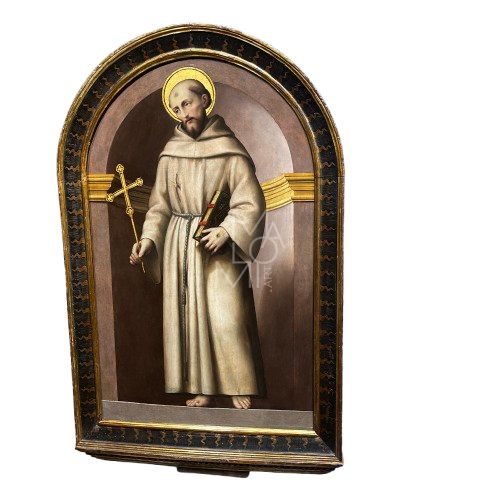
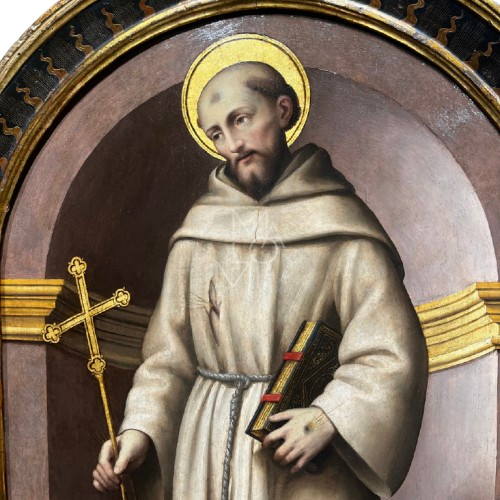
The book, held firmly in the saint's left hand, is not a generic sacred text but represents Francis's total and unconditional fidelity to the divine word and to the rule of the order he founded—a volume that the artist investigates with the precision of a miniaturist, describing its blind-stamped dark leather cover and its edges dyed a deep red.
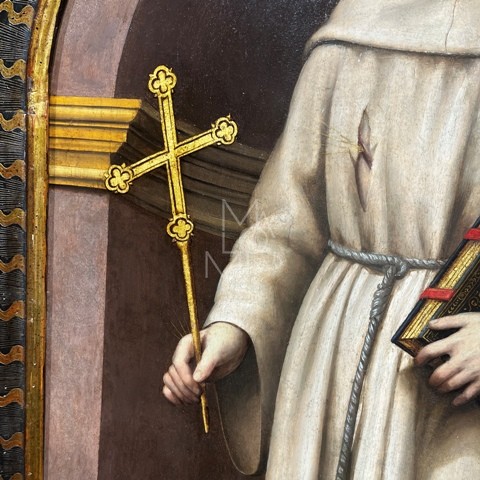
The slender processional cross, held in his right hand with elongated, elegant fingers, underscores the core principle of the imitatio Christi, demonstrating that Francis is not merely a follower of the Redeemer but one who conformed entirely to his sorrowful mystery.
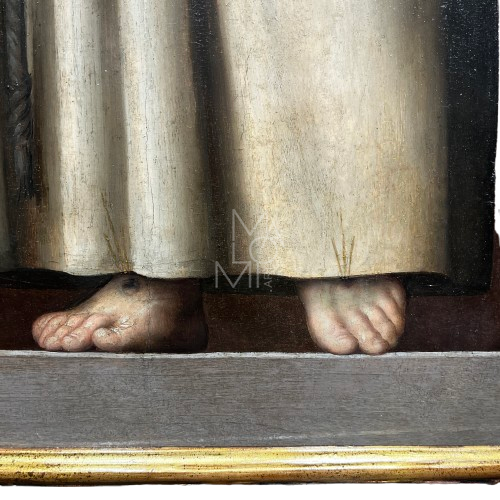
This identification with Christ finds its visual culmination in the signs of the Passion, which the artist investigates with an almost clinical and calligraphic precision. The miraculous wounds are impressed on the back of the left hand, on the advanced right foot, and, in a manner partially visible through a skillfully rendered tear in the habit, on the side, from which emanate three thin streams of blood painted in a dense, glossy red-brown tone.
The facial expression, characterized by a hieratic gaze yet pervaded by a subtle and composed melancholy, reflects the interiorization of pain and mystical ecstasy. As Carlo Falciani acutely notes, the figure shares an expression of devotional sweetness in which the face appears absorbed in a selfsame attitude of profound and silent spirituality—a face that deliberately avoids exaggerated drama to become a mirror of an entirely interior meditation.
Architectural spatiality and the illusionism of the niche: the dialogue between painting and sculpture
The figure of Saint Francis is placed inside a round-arched niche cast in shadow with a brown-violet tone—a structural choice that does not serve as a mere ornamental backdrop but assumes a precise plastic and theological value. The niche is defined by an upper architectural cornice and an aggrandizing geometric molding that punctuates the space. A formal anecdote of great significance lies in the fact that the archaizing gold-leaf halo and the small cross protrude beyond the outer edge of the niche, physically invading the space of the external wooden frame to heighten the monumentality and tridimensional illusionism of the composition, almost as if the saint were leaning out toward the viewer.
This expedient revives consolidated models from Ghirlandaio’s workshop and is directly influenced by the contemporary experimentation of Fra Bartolomeo and Mariotto Albertinelli. The insertion of figures within crisp, austere niches represents a formal operation intended to imitate sculpture in relation to architecture within painted panels—a pictorial pursuit that simulated the plastic relief of marble or terracotta statues but with the advantages of color and chiaroscuro manifested through painting.
Ridolfo del Ghirlandaio himself was accustomed to painting sacred conversations and isolated saints placed within rose-toned niches, such as the celebrated examples preserved in the Parisian church of Saint-Louis-en-l'Île, which must have served as a direct prototype for Ceraiolo. The illumination, arriving decisively from the left, generates a cast shadow on the inner wall of the niche—a luministic device that projects the saint’s body forward, amplifying his volumetric presence and isolating him in an atemporal, sacral dimension.
Style, influences, and figurative culture: the synthesis between Credi and Ghirlandaio
The painting clearly expresses the complex artistic genealogy of Antonio del Ceraiolo, formalizing itself into a stylistic score of extraordinary coherence. The pictorial handling, crisp, clean, and controlled, resents the long mastership of Lorenzo di Credi, from whom the author inherits formal clarity and analytical rendering of details, almost Flemish in its attention to microscopic particulars. However, the expanded volume of the drapery and the monumental stance of the figure reveal the direct influence of Ridolfo del Ghirlandaio and an awareness of the contemporary meditations of the School of San Marco.
The Franciscan habit, tied at the waist by the typical three-knotted cord symbolizing the vows of poverty, chastity, and obedience, is resolved through broad, heavy, rounded, and quiet folds that deliberately eschew the anticlassical formal shifts and anatomical torments of the radical early Mannerism practiced by contemporaries such as Pontormo or Rosso Fiorentino. Indeed, the garments display soft folds articulated in a fluid rhythm that lends the character a sculptural stability and a simple, devout gesturality.
The color palette, played upon the warm nuances of earths, grays, and browns, is interrupted only by the luminous gold of the halo and the metallic reflections of the cross, creating a perfect equilibrium between the naturalism of the flesh and habit and the sacral abstraction of the divine symbols. A technical curiosity lies in the halo, which features a double concentric circular punch-work marking the disk's perimeter—an intentional revival of archaizing fourteenth- and fifteenth-century Florentine techniques designed to bestow a specific sacral dignity upon the image, distancing it from the early foreshortened and transparent halos of secular art.
Comparative analysis and critical philology: the parallelism with the Madonna delle Selve
The cornerstone upon which the attribution and critical reconstruction of the panel rests is the direct philological comparison with another capital work by the master: the altarpiece depicting the Madonna and Child with Saints Lawrence and Saint Albert the Carmelite, executed by Ceraiolo for the church of Santa Maria delle Selve in Lastra a Signa around fifteen-twenty. The two works share the same intellectual and stylistic matrix, to the extent that specialized criticism, beginning with the historical studies of Serena Padovani and Alessandra Tamborino, has highlighted how the figure of Saint Albert in the Selve altarpiece is almost superimposable in gesturality, drapery design, and physiognomic features upon our Saint Francis.
This tight parallelism suggests the use of the selfsame workshop cartoon or a common graphic study, adapted from time to time depending on the monastic order represented. There is, however, a notable difference linked to the historical fortunes of the two artifacts. While the panel in Lastra a Signa has suffered over the centuries from conservative vicissitudes and aggressive overpaintings that led a strict connoisseur like Federico Zeri in the past to detect a certain weakness in execution, the work examined here restores the original glazes with greater freshness.
Indeed, the Saint Francis benefits from an excellent state of preservation of the oil film on panel, free from historical alterations following its latest critical restoration, allowing one to read the sharpness of the underlying drawing and confirming the judgment of Zeri himself, who defined this nucleus of Ceraiolo’s works as a precious document of Florentine painting, characterized by figures enclosed in rigid, almost archaic contours that lend a severe and monumental tone to the image. The artist's catalog is thus enriched by a fundamental term of comparison, also relatable to the Saint Michael Archangel in the museum of the Cenacolo di San Salvi and the Christ in the House of Martha in the Gemäldegalerie in Berlin, the latter dated fifteen-twenty-four.
Social context and patronage: the women of the Strozzi family as patrons
The element of greatest historical fascination resides in the recent discovery of the allocation documents for the work, which have permitted the identification of the patron as Selvaggia Strozzi and narrowed down the dating of the panel with absolute precision to the years fifteen-twenty-one and fifteen-twenty-two. Patronage from one of the most illustrious Florentine patrician families ennobles the destination of the work, which was likely born for private devotion or for the altar of a minor family chapel.
The figure of Selvaggia, widow of the great patron Filippo Strozzi the Elder and mother of Lorenzo Strozzi, perfectly embodies a specific socio-cultural phenomenon of early sixteenth-century Florence—namely, the preeminent role of patrician women as guardians of family memory and domestic spirituality following the fall of Girolamo Savonarola's theocratic republic.
While the men of the family were engaged in complex and often dangerous political and diplomatic maneuvers to defend their immense assets and negotiate with the restored Medici, the women of the family—frequently widows or cloistered nuns—became the primary mediators of sacred artistic patronage. Raised under the influence of Savonarola’s sermons on the purity of customs and the rejection of secular vanities, these matrons demanded an intentionally severe style from artists, devoid of concessions to the whimsies or sensualities of the nascent maniera. The sacred artwork had to be a mirror of recollection, morality, and geometric orthodoxy, and Ceraiolo’s Saint Francis, with its measured pose and its niche evoking the solitude of a monastic cell, responded perfectly to the spiritual requirements of Selvaggia Strozzi.
Diagnostic study and material analysis: the bookbinding and pigments
An integrated investigation combining scientific diagnostics on pigments with the study of liturgical sources allows us to penetrate the technical secrets of the panel, particularly in the section showing the binding of the book held by the saint. The volume held in Francis's hand reveals itself to be a masterpiece of micro-painting rather than a generic sacred representation. The analysis of the color palette and the refractive properties of the oil binders shows how, to obtain the dark brown-black tone of the leather cover, the artist utilized an application of carbon black mixed with Mars brown, blind-stamping the geometric Renaissance motifs of the cover before finishing them with dark glazes.
The characteristic bright red color of the edges of the pages, typical of ceremonial liturgical codices, is composed of a vermilion base, enriched and warmed on the surface by a precious glaze of organic red lake extracted from kermes. To simulate the brass or gilded bronze of the four corner bosses and the central closing clasp, Ceraiolo preferred not to use gold leaf, which would have flattened the volume, but instead applied giallorino—a lead-tin yellow typical of the workshops of the period—finishing the highlights of maximum reflected light with minute touches of lead white applied with body.
The morphology of the book and the presence of these specific structural elements allow for the identification of the text as a missal of the proper of the order or a copy of the Regula Bullata of twelve-twenty-three. The severity of the dark leather binding reflected the Franciscan ideal of poverty and decorum, while the fact that the saint keeps his thumb inserted between the pages symbolizes the act of opening the book of the Word—a clear theological reference to Francis's experience, who founded his entire existence upon a direct encounter with evangelical passages.
Physical and historical-collection analysis: material traces on the reverse of the panel
The examination of the physical object in its entirety, extended to the reverse of the wooden support, provides fundamental archeometric and historical data for the traceability and conservation history of the painting. The panel is housed within its precious original and coeval workshop frame, embellished with a refined decoration of gilded geometric wave motifs on a dark background that follows the arched trajectory of the painted niche, enhancing the picture-window effect.
Turning the panel, the wooden surface unveils its secular history through biological and inventory traces. The reverse exhibits the typical superficial tunnels and exit holes caused by ancient woodworm infestations, now completely stabilized, and a conspicuous natural horizontal split along the grain of the wood, consistent with the biological aging of an early sixteenth-century poplar support. In the upper section, one can appreciate the carving and semicircular shaping of the wood, tailored to match the shape of the niche.
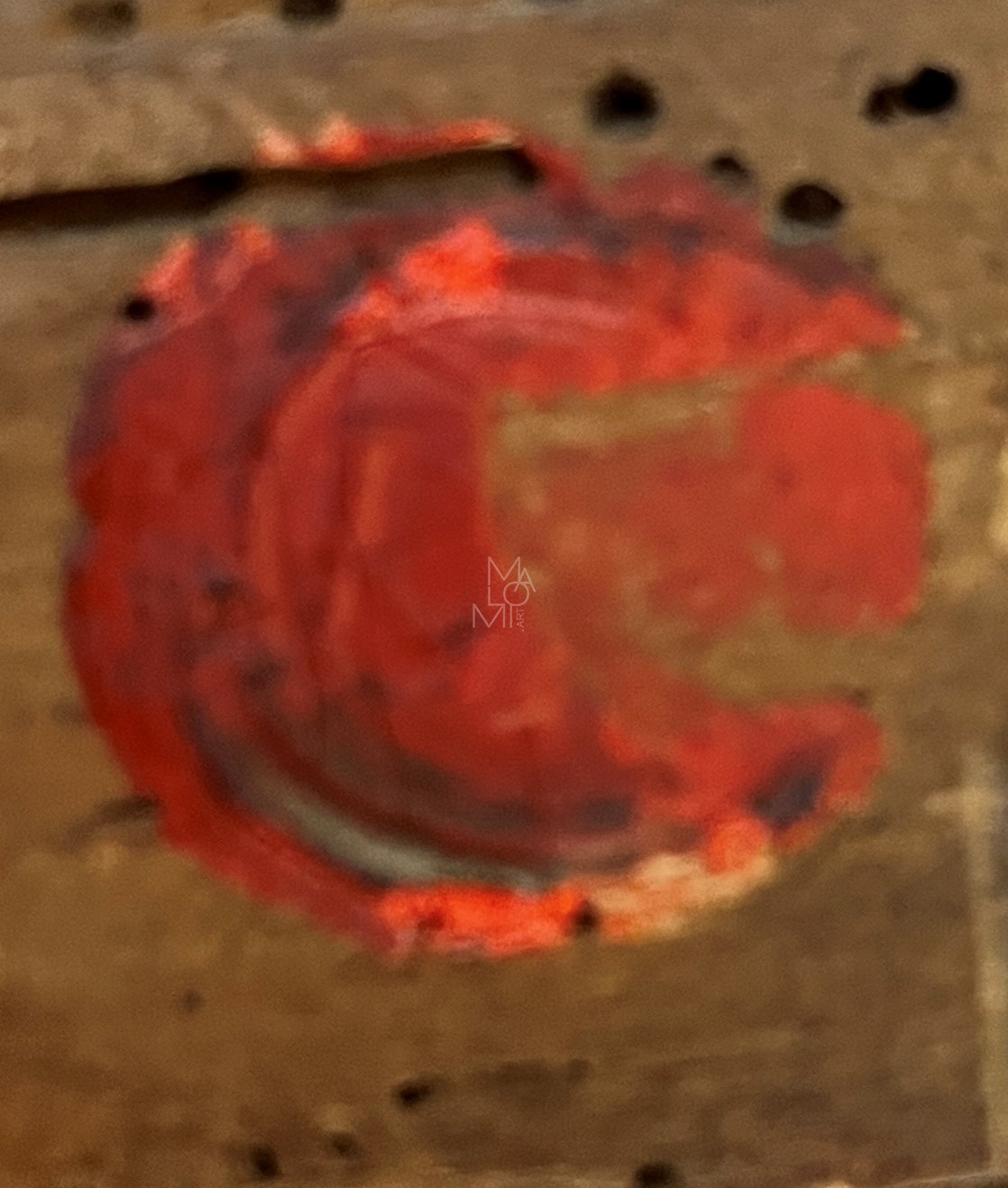
Two markings of extraordinary collector interest are present on the wood. The first is a circular seal in red sealing wax, partially fractured, bearing the reliefs of a coat of arms or an institutional monogram, affixed in antiquity to certify a transfer of ownership, a noble inventory, or a customs clearance.
The second trace is a rectangular paper inventory label with a serrated edge, characterized by a printed dark-ink geometric Greek key border, typical of the labels in use between the late nineteenth century and the early decades of the twentieth century in royal galleries or major private collections. Written inside it in iron gall ink with a cursive handwriting of the period are two clearly legible numbers: the code three hundred and nineteen, letter B, and the figure zero-two hundred and twenty-two with a final hyphen.
These numerical codes constitute tangible proof of the painting’s transit through a structured collection or an antiquarian sale, perhaps linked to the historic dispersals of Strozzi assets or the auctions of dealers like Stefano Bardini and Elia Volpi, who moved masterpieces of the Tuscan Renaissance into the international market between the nineteenth and twentieth centuries. Finally, the presence of a modern perforated metal plate secured with screws testifies to a recent and wise structural consolidation intervention, aimed at stabilizing the wooden fibers and preventing natural movements that could compromise the pictorial film on the front, sealing the panel in a perfect state of preservation.
Heraldic study of the sealing wax seal: identification and hypotheses on noble quarterings
The investigation conducted on the reverse of the panel finds an additional and precious field of research in the analysis of the fragment of the circular red sealing wax seal—a material element that serves as a true fingerprint for reconstructing the painting's ownership history. Beneath raking light observation and optical magnification, the crest impressed into the seal reveals a complex heraldic structure, referable to a blazon of the Florentine patriciate. Despite the loss on the right margin of the seal, the surviving portion clearly shows a Samnite-style shield, surmounted by a noble crown with eight visible points—a sign of marquessal or comital dignity acquired by the family at a later date relative to the creation of the painting. The shield appears divided into quarters, a configuration reflecting a matrimonial alliance or the fusion of multiple aristocratic lineages.
In the first quarter, at the upper left, one clearly recognizes the heraldic motif of three crescents increment and arranged in a bend—a visual evidence that leads unequivocally to the arms of the Strozzi family. This datum proves to be of extraordinary philological significance, as it creates a direct and tangible link between the historical provenance of the artifact and the documented initial patronage of Selvaggia Strozzi in the two-year period fifteen-twenty-one and fifteen-twenty-two. The presence of the Strozzi blazon within the seal testifies that the work remained inside the family’s palaces or chapels for a very long span of time, surviving the complex dynastic vicissitudes of the house.
The surviving second quarter shows a motif of alternating diagonal bars, compatible with the insignia of the Medici or the Ridolfi—two families historically and politically tied to the Strozzi by dense marital networks during the seventeenth and eighteenth centuries. This heraldic stratification suggests that the panel may have changed hands on the occasion of a marriage dowry, transiting from a branch of the Strozzi to another illustrious family of the Tuscan nobility, which subsequently affixed its own seal of possession. The definitive identification of all noble quarters will allow for the precise mapping of the painting's collecting itinerary from the Renaissance down to the nineteenth century, the era in which the work was finally cataloged with the numbered inventory label.
The political-social contingency: figurative ideology, the role of the church, and the symbolic value of gold
The gestation of the panel occurs at a crucial moment of political and cultural crisis for the Florentine community. The Medicean restoration of fifteen-twelve, which had interrupted the republican experiment, brought about a profound reconfiguration of the relationship between the patrician class and ecclesiastical institutions. The Church, no longer perceived solely as the guarantor of otherworldly salvation, became the privileged terrain in which to negotiate social order, legitimate the political preeminence of aristocratic families, and manifest loyalty to the new dynastic arrangements. In this complex juncture, the commissioning of a sacred painting by a member of the Strozzi house assumed a strong ideological value, proposing itself as an act of high cultural diplomacy aimed at re-establishing family prestige following tensions with the Medicean faction.
This political scenario exerted a decisive influence on the aesthetic choices and the employment of materials within workshops, directing the use of gold according to radically redefined logics. While on one hand the lesson of Lorenzo di Credi and the echo of Savonarolian rigor pushed toward a sober, chaste painting attentive to the naturalistic truth of fabric and flesh, on the other hand aristocratic patronage demanded the insertion of elements of absolute material value that would attest to the donor's social standing. Ceraiolo brilliantly resolves this apparent technical and doctrinal contradiction by integrating gold not as a decorative surface fine in itself, but as a circumscribed symbolic matter.
The application of pure gold leaf, concentrated in the halo and the processional cross, responds to a precise theological function, establishing an immediate visual hierarchy between the phenomenal world of the niche and the supernatural dimension of the sacred. Through the technique of punch-work and the profiling of the cross, the gold assumes a sculptural density that redeems its potential worldly vanity, transforming it into solidified spiritual light. The precious metal does not contradict the poverty exhibited by the Franciscan habit, but rather celebrates its mystifying triumph, accommodating the need of the early Counter-Reformation Church for images that were simultaneously severe in doctrine and exceptionally majestic in formal presentation.
Executive morphology, posture, and semantics of the figure
Under a strictly academic and compositional profile, the posture bestowed upon Saint Francis by Ceraiolo reveals a complex intellectual elaboration of Tuscan monumental statuary, mediated through the spatial research of Fra Bartolomeo and Andrea del Sarto. The saint is caught in a balanced attitude of contrapposto, with the weight of the body entirely supported by the straight left leg, while the right limb flexes slightly forward, protending the foot beyond the ideal limit of the slate step. This measured gait, defined as a step-by-step posture, lends the figure a solid tectonic stability evoking the gravity of sculptures by Donatello or Nanni di Banco, translating the character's moral steadfastness into physical equilibrium.
The arrangement of the arms responds to a precise geometric and semantic calculation organizing the reading of the image. The right arm flexes at an acute angle to raise the processional cross, positioning the attribute of martyrdom on a diagonal axis relative to the niche, while the left arm falls, bending at a right angle to support the sacred volume. The fingers of the right hand, described with an analytical and elongated drawing, clasp the wooden staff with a firm grip yet free from muscular tension, expressing the serene acceptance of the penitential ministry. This studied motor coordination reflects the precepts of Renaissance decorum, where every exterior movement of the body had to interpret the inner movements of the soul and the believer's internal harmony.
The deep semantics of the figure reside precisely in this convergence between the monumentality of the pose and the intimate sweetness of the facial expression. The face, rotated three-quarters and tilted downward, guides the viewer's gaze toward the cross and the wound in the side, establishing a closed visual circuit inviting the contemplation of redeeming pain. Francis is not represented in the dramatic and convulsed moment of receiving the stigmata on Mount La Verna, but rather as the eternal and conscious custodian of divine mysteries. The mud-gray habit, devoid of secular irridescence, and the severity of the architectural setting emphasize the saint's value as a prototype of civic and monastic virtue, offering the cultivated Strozzi patronage an ideal model of steadfastness, devotion, and spiritual dignity perfectly aligned with the Florentine figurative tradition.
Concluding considerations
In conclusion, the Saint Francis by Antonio di Arcangelo reveals itself to be a work of capital importance for understanding the evolution of devotional painting in Florence during the early fifteen-twenties. Far from the eccentric, tormented, and anticlassical experimentation of contemporaries such as Pontormo or Rosso Fiorentino—whose transalpine influences were already beginning to ripple the harmonious and quiet style of Ridolfo del Ghirlandaio—Ceraiolo chooses here a path of conscious and noble moderation.
The panel qualifies as a masterpiece of synthesis, capable of uniting the draftsmanship precision of the late fifteenth century with the spatial majesty and perspective illusionism of the maniera moderna. Thanks to the rigorous and definitive reconstruction by Professor Carlo Falciani and the diagnostic and archival findings, the painting is restored to art history at its moment of greatest expressive felicity, confirming itself as a testimony of rare spiritual and formal intensity, fully embedded within the rich Tuscan tradition of sacred representation in a niche.
Bibliography
Falciani, Carlo. Perizia storico-artistica e peritale sul San Francesco di Antonio del Ceraiolo. Florence: Unpublished manuscript, 2026.
Padovani, Serena, and Sandra Meloni Trkulja. Il Cenacolo di Andrea del Sarto a San Salvi: Guida al Museo. Florence: Becocci, 1982.
Tamborino, Alessandra. "Considerazioni sull'attività di Antonio del Ceraiolo e proposte al suo catalogo." Proporzioni: Annali della Fondazione Roberto Longhi 4, no. 2 (2003): 104–122.
Vasari, Giorgio. Le vite de' più excellenti pittori, scultori e architettori. Edited by Rosanna Bettarini and Paola Barocchi. Vol. 4. Florence: Studio per Edizioni Scelte, 1976.
Zeri, Federico. "Antonio del Ceraiolo." Gazette des Beaux-Arts 109, no. 1184 (1967): 139–154.