Adoration of the shepherds by Marco Pino | neapolitan mannerist painting
Academic cataloguing of the Adoration of the shepherds attributed to Marco Pino (Marco da Siena). study on counter-reformation mannerism, palette, and provenance.
- artist: marco pino (costalpino, 1525 – naples, 1587), attributed to.
- subject: adoration of the shepherds (cabinet-format variant in counter-part).
- date: late sixteenth century (circa 1575–1585).
- medium: oil on panel.
- dimensions: 75 x 96 cm.
- provenance: continental european private collection.
Mannerist Dynamics and Formal Synthesis in the «Adoration of the Shepherds» Attributed to Marco Pino da Siena
Historical-Critical Introduction: The Context of the Attribution
The artwork under examination presents itself to the observer as a precious oil on panel painting of medium dimensions, measuring seventy-five by ninety-six centimeters. This specific wooden support depicts the sacred theme of the Adoration of the Shepherds and integrates with absolute formal coherence into the corpus of works attributed to Marco Pino, universally known in artistic historiography as Marco da Siena. Born in Costalpino in fifteen twenty-five and passing away in Naples in fifteen eighty-seven, Pino represents one of the most fascinating and complex figures of Central-Southern Mannerism, capable of ferrying Tuscan-Roman plastic anxieties into the territories of the Spanish Viceroyalty.
His artistic training was completed within the fertile and visionary Sienese workshop of Domenico Beccafumi, between fifteen thirty-seven and fifteen forty-two. From this first and fundamental master, the young Marco absorbed an innate taste for unreal atmospheres, eccentric colors, and those effects of darting light that would remain a constant, albeit declined differently, throughout his mature production.
His subsequent relocation to Rome, occurring around fifteen forty-three, marked a radical shift in his stylistic vocabulary. In the city of the popes, Marco Pino had the privilege of collaborating with Perin del Vaga on the prestigious construction sites of Castel Sant'Angelo and forming a deep professional and intellectual partnership with Daniele da Volterra. It was precisely through the mediation of the latter that the Sienese painter came into direct contact with the titanic visual legacy of Michelangelo Buonarroti. Marco Pino became an indefatigable copyist of Michelangelo's cartoons, obsessively studying the musculature of the bodies in the Sistine Chapel and the Pauline Chapel. This fusion between Sienese-matrix visionary anti-classicism and Roman monumental plasticism constituted the unique stylistic cipher that the artist brought with him when, in fifteen fifty-seven, he decided to settle definitively in Naples.
In the viceregal capital, Marco Pino shortly became the most requested painter by great aristocratic families and militant religious orders, formalizing compositional models of enormous devotional impact. An anecdote reported by Neapolitan archival sources recounts that the master was so jealous of his own workshop secrets and anatomical inventions that he often worked behind closed doors, to prevent local rivals from stealing the poses of his bodies, which he himself defined as laboriously extracted from Michelangelo's marble.
The panel analyzed here belongs to the most fortunate season of this Neapolitan production, a period in which the demand for replicas and cabinet variations of his most celebrated subjects forced the master to structure an efficient workshop to satisfy the pressing requests of ecclesiastical and private patrons.
Iconographic Analysis and Compositional Syntax
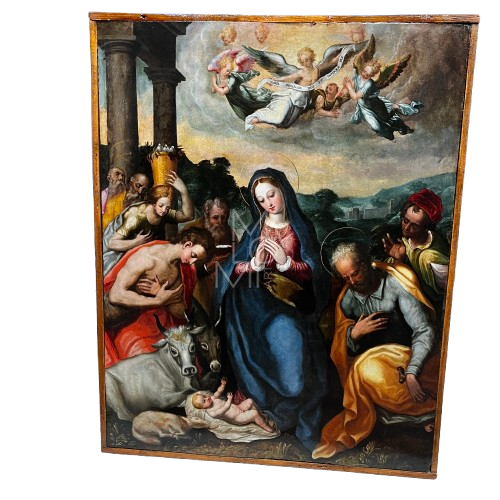
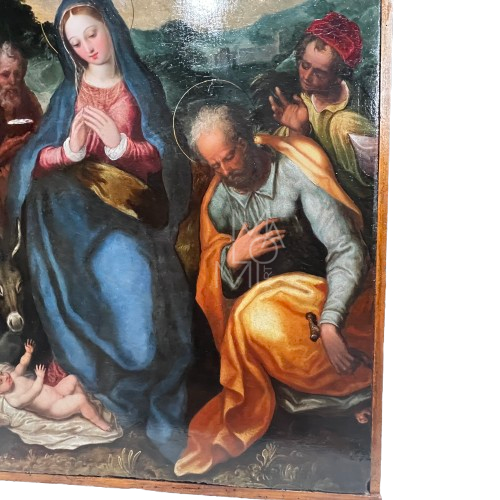
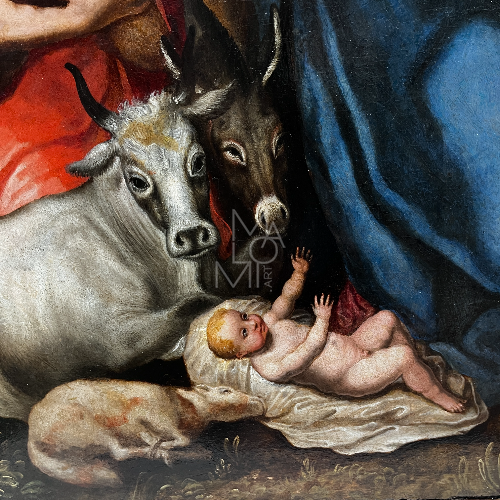
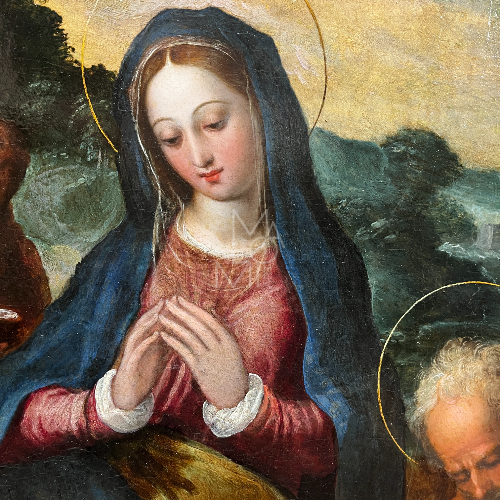
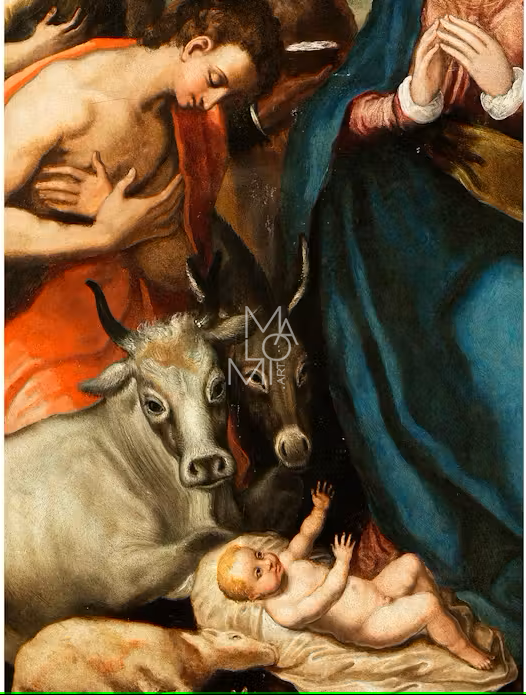
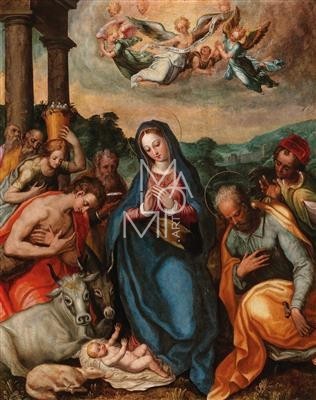
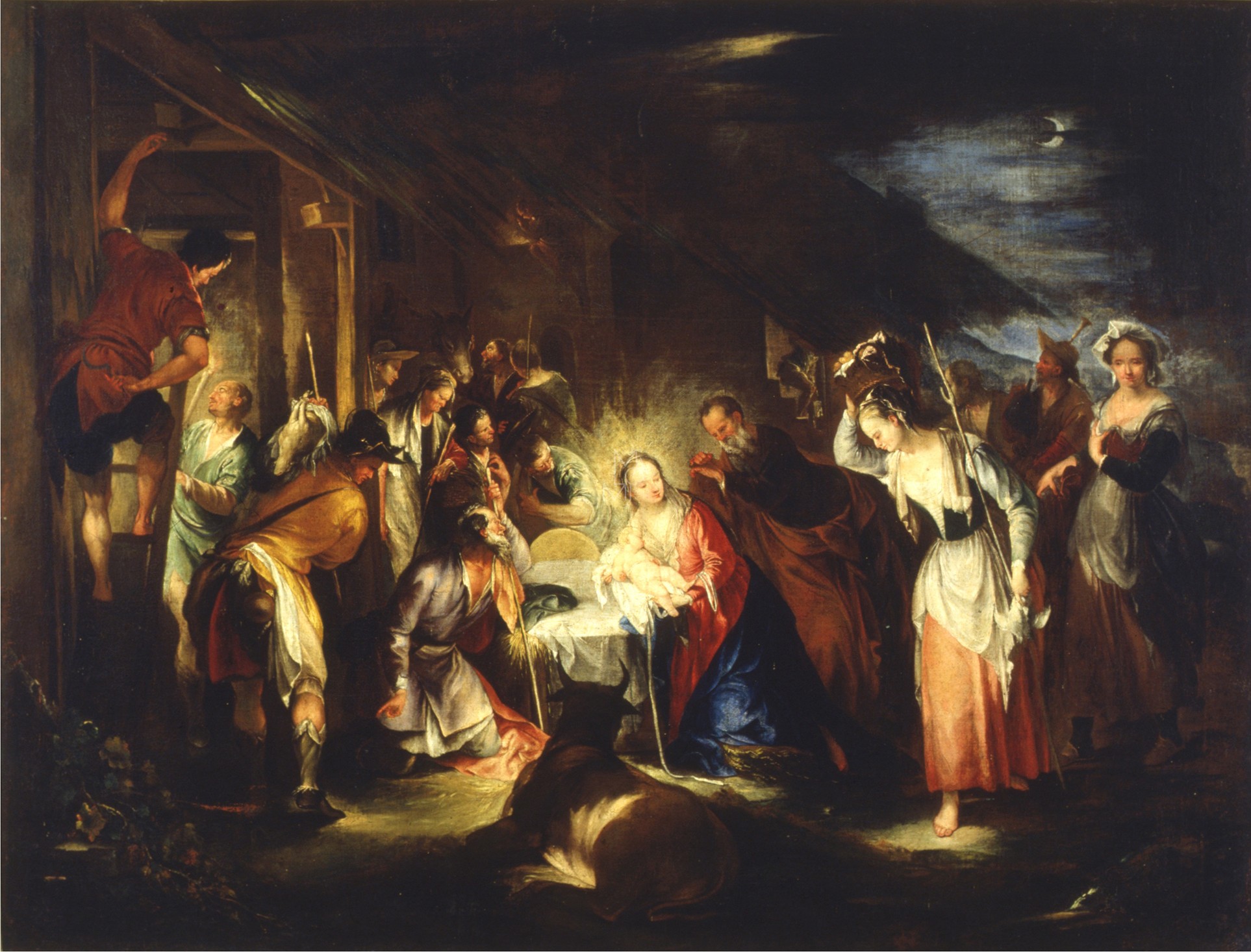
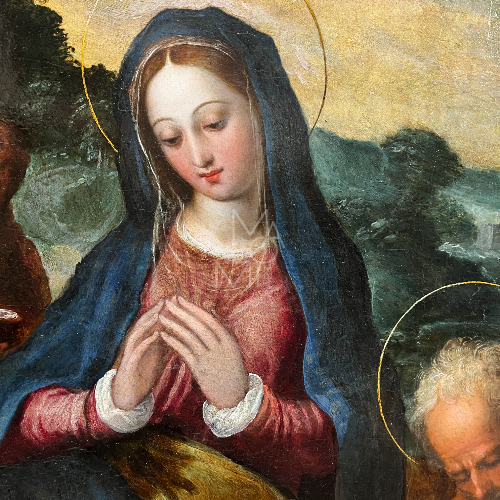
The composition of the panel proposes the scene of the Nativity structured according to a strongly centripetal and pyramidal geometric scheme. At the ideal apex of this visual pyramid stands the solemn and hieratic figure of the Virgin Mary, caught in an attitude of absolute prayerful concentration. Enveloped in an ample cobalt blue drapery deeply furrowed by sharp and metallic folds, the Mother configures herself as the true living throne of divinity. At her feet, the Infant Jesus lies naked upon a white linen cloth, positioning himself as the original luminous fulcrum from which the light that illuminates the faces of the bystanders radiates. Around this central sacred cell rotate the figures of the shepherds and saints, arranged according to a rhythmic trend that hints at those spiral spatial dynamics that the painter preferred for his major altarpieces.
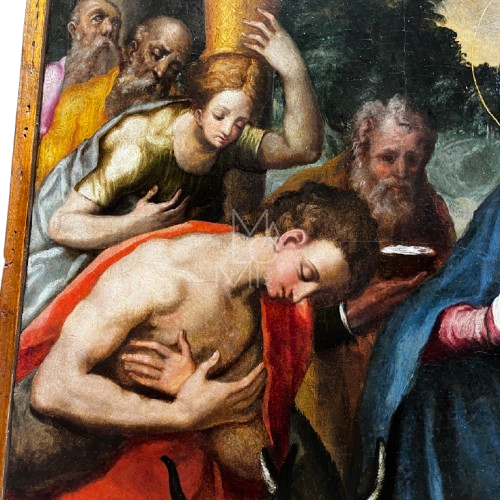
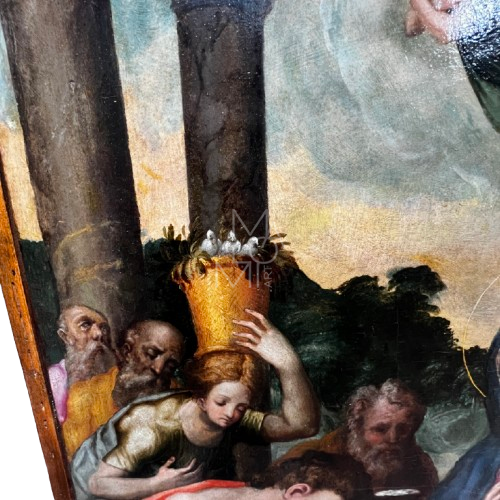
On the left side of the painting, the viewer's attention is captured by the figure of a kneeling, bare-chested shepherd. This anatomy exhibits a shapely and powerful musculature that betrays the direct influence of Michelangelesque models, particularly the Ignudi of the Sistine ceiling. Just above him, a female figure carries a large basket overflowing with first fruits on her head, an iconographic motif derived from classical art but reinterpreted here in a proto-Baroque key. From the darkness of the stable emerge the heads of the ox and the donkey, participating intimately in the sacred event with almost human gazes.
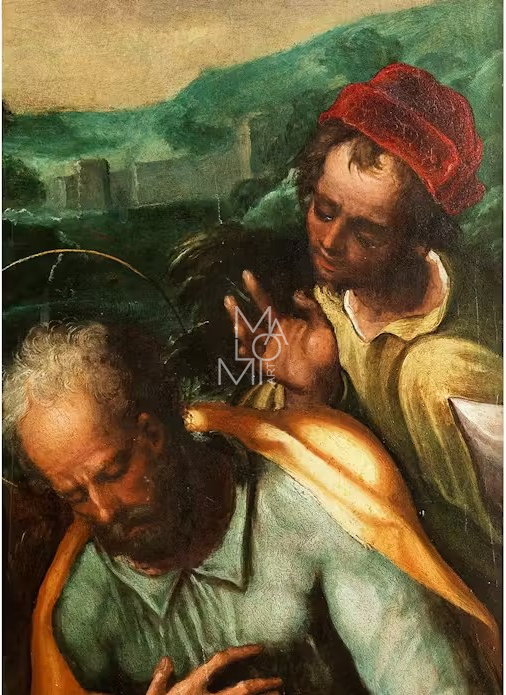
On the right side, acting as a perfect visual and monumental counterweight, is the figure of Saint Joseph. The saint is caught in a complex and dynamic pose, with his torso rotated sideways, acting as a true human wing to close the scene. His ample robes of an ochre-orange hue are treated with bold iridescent colors, typical of Tuscan Mannerist painting.
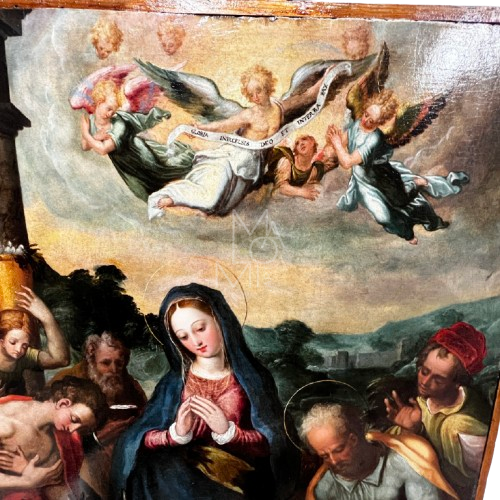
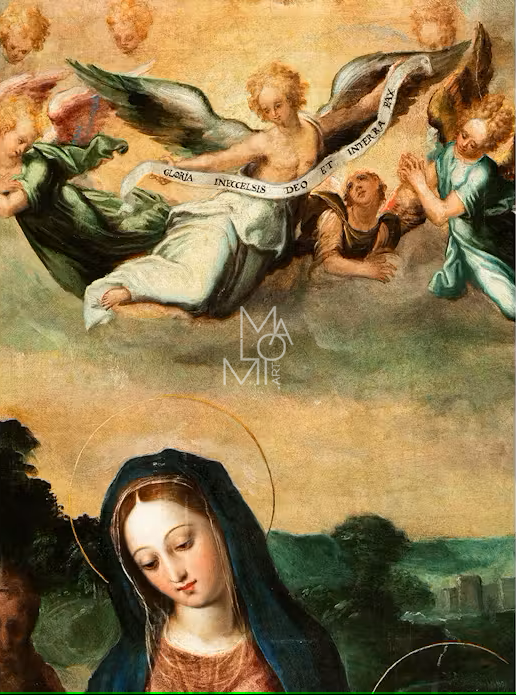
In the upper part of the panel, the celestial dimension bursts forth through a chorus of fluttering angels holding an unfolded scroll, upon which reads the liturgical inscription reciting the words of universal peace. These divine beings emerge from dense and stormy clouds, a visual expedient that accentuates the mystical and visionary character of the representation. An iconographic curiosity worthy of note lies in the fact that, unlike Renaissance representations where angels maintain ephebic and serene appearances, in this panel they display intense faces and bodies almost contracted in the effort to accommodate the metaphysical wind that moves their garments, a detail that reveals the spiritual restlessness of the era.
The Success of the Theme and Philological Comparisons with Neapolitan Prototypes
The subject of the Adoration of the Shepherds undoubtedly represents one of the most investigated, replicated, and meditated themes in the mature and late activity of Marco Pino. This specific biblical event configured itself for the Sienese master as a true testing ground to examine the evolution of his style and the endurance of his formal models in the face of the new demands of Counter-Reformation devotion. Artistic historiography has amply documented the main monumental variations executed by the artist in Naples, altarpieces that immediately became famous and served as archetypes for cabinet production.
Among these, the version created for the church of Gesù Vecchio stands out, dated around fifteen seventy-three, characterized by a complex theatrical framework where the bodies rotate with an almost hypnotic concentric motion around the cradle of the Child. No less important is the monumental canvas preserved in the church of Santi Severino e Sossio, a work where the brushwork becomes more fluid and overlapping glazes create bold chromatic combinations between metallic blues and golden ochres. In the church of Santa Chiara, a further redaction is preserved in which the spatiality becomes even more tightly knit and dramatic, focusing almost exclusively on the imposing physicality of the bodies in the foreground. Finally, one cannot ignore the prototype preserved at the National Museum of Capodimonte, datable to an earlier season, where the Roman and Michelangelesque legacy blends with an early search for atmospheric chiaroscuro and Flemish suggestions.
The panel under examination qualifies as a precious and refined cabinet redaction, conceived for the private devotion of a cultivated Neapolitan patron. The arrangement of the figures depends strictly on the graphic prototypes produced by Marco Pino's workshop. The most important philological link must be established with the famous preparatory drawing of the Adoration preserved in the Cabinet des Dessins of the Musée du Louvre in Paris, marked by the inventory number twenty-two thousand four hundred and seventy-four recto. This sheet, traced by the master in brown ink with lead white highlights, constituted the original model kept in the workshop, a precious matrix from which the artist and his assistants regularly drew to derive variations of a smaller format, adapting the grandiose monumental scale of the altarpieces to the needs of the domestic spaces of the Viceroyalty's nobility.
Morphological Analysis, Stylistic Composition, and Postural Syntax
From a strictly formal point of view, the painting reveals the characteristic traits of Marco Pino's mature manner in the articulation of lights and the complex management of postural syntax. The work programmatically rejects the geometric and linear perspective of fifteenth-century matrix; space becomes immediately saturated, pushing the figures into a monumental foreground that annuls any real inhabitable depth. The rhythm of the painting is entirely entrusted to diagonal lines of force that guide the spectator's eye along a centripetal path.
The morphology of the bodies expresses the culmination of the reception of Michelangelesque models, but deprived of their original titanic and heroic validity to be bent to purely devotional ends. The Virgin Mary is locked in a static arrangement that emphasizes her role as a column of faith. Her hands join in a stereotyped prayerful gesture with slender and elegantly elongated fingers, according to the canons of the purest Tuscan Mannerist abstraction. Conversely, the bare-chested shepherd on the left exhibits a nervous snap and a torsion of the torso that traces the famous figure serpentinata theorized by Giorgio Vasari. This muscular effort does not have an athletic or profane purpose, but visually translates the emotional impact, interior commotion, and spiritual wonder of the common man in front of the divine birth miracle.
The figure of Saint Joseph, on the opposite side, shows an unstable postural layout. The body is rotated sideways and the bent leg creates a broken line that dialogues with the swirling drapery of his robe, evoking a sense of reverent fear. Even the secondary characters, such as the shepherds crowding the background or the woman with the basket, are volumetrically interlocked one upon the other, eliminating any empty space. In the upper part, the angelic choir abandons the ascending momentum of youthful drawings to compress itself into a strictly horizontal band, imposed by the dimensions of the panel. The angels twist upon themselves amidst dense clouds, with elongated limbs and snapping draperies that seem moved by a metaphysical wind, creating an effect of vibrant mysticism.
Comparison with the Louvre Drawing and Derivation from Cornelis Cort
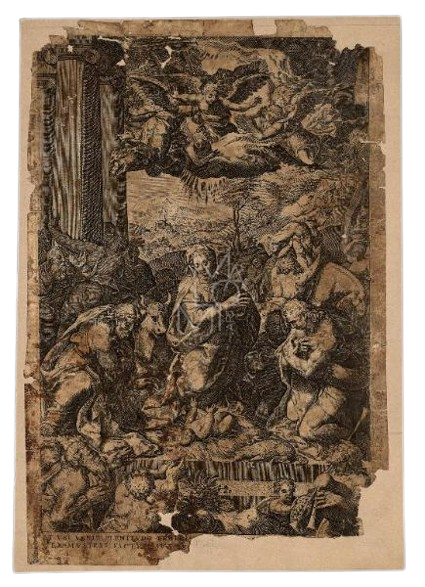
The detailed comparison between this panel and the graphic archetype of the Louvre allows for a thorough understanding of the mechanisms of image diffusion within late sixteenth-century workshops. Executed by Marco Pino around fifteen sixty-eight, the Parisian sheet served as a preparatory study but also as a direct base for a successful copperplate engraving signed in Rome by the celebrated Flemish master Cornelis Cort in the same year. This transition from graphics to printing and finally to painting explains the structural peculiarities of the panel under examination.
The first and most evident characteristic lies in the orientation of the figures, a phenomenon known to art historians as the counter-part effect. In the Louvre drawing, the Virgin and Child are oriented in one direction, while in our panel the composition turns out to be specularly reversed. Since the printing process reverses the image engraved on the copper plate, Cornelis Cort's engraving presents the figures in the exact same direction as our panel. This philological datum demonstrates unequivocally that the painter of this panel did not work having the original Louvre drawing before him, but rather used as a direct model the engraving printed by Cort, which circulated widely as an iconographic repertoire in the workshops of the period.
The painter of the panel also operated a decisive rectification of the format compared to his models. If the Louvre drawing presented a round-arched upper termination, Cornelis Cort straightened the composition, transforming it into a regular rectangle. Our panel inherits this orthogonal geometric setting but compresses space further to adapt to the easel format. The architectural background, which in the engraving showed detailed Roman ruins and a deep perspective according to Flemish taste, undergoes a drastic formal simplification here. The columns crowd onto the left margin in a block of shadow, turning into a theatrical wing that pushes the characters forward. It is precisely in this translation from the graphic medium to the pictorial one that the dense cross-hatching of the Flemish burin converts on the panel into sharp and darting highlights, crystallizing the engraver's linear inspiration into a solid and enameled pictorial matter.
Scientific Deep-Dive: The Chemical Palette and Iridescence Phenomena
An analysis conducted on the chemical palette used for this panel reveals the adoption of a complex technical transition that joins the ancient recipes of the Sienese school with the mineral pigments introduced in the major Roman construction sites. The timbric contrasts and iridescence phenomena that strike the observer are not simple aesthetic choices, but the result of precise stratifications of inorganic compounds endowed with different refraction indices of light.
The deep and monumental blue wrapping the Virgin Mary constitutes one of the most saturated fields of the painting. The chiaroscuro framework of the drapery was obtained by mixing the more economical azurite, a basic copper carbonate, with particles of carbon black or umber earth in the penumbra areas. On the points of maximum light and on the crests of the folds, the painter applied glazes of precious natural ultramarine blue, obtained from the grinding of purified lapis lazuli and imported to Naples through Venetian maritime commerce. The extremely high refraction index of lapis lazuli, applied over the dark base of azurite, generates that crystalline and enameled effect that isolates the figure of the Virgin as the theological fulcrum of the entire composition.
The most spectacular iridescence phenomena concentrate instead in the robes of Saint Joseph. The sudden transition between brilliant gold yellow, saturated orange, and brownish shadows is governed by the combined use of arsenic sulfides, particularly orpiment and realgar. Orpiment, an arsenic sulfide, was used pure for vibrant yellow lights, celebrated for its almost metallic and golden brilliance but also noted for its marked toxicity and chemical instability if mixed with lead- or copper-based pigments. Realgar, an arsenic disulfide, was instead employed in middle tones and orange passages. The Mannerist painter exploited the natural tendency of these pigments to vary shade under the action of light to create artificial and anti-naturalistic chromatic transitions, capable of giving the robe a rigid appearance that mimics the brilliance of oriental silks.
Finally, the anatomical rendering of the bare-chested shepherd and the articulation of the angels' folds are based on a structural use of lead white, basic lead carbonate. Marco Pino applied pure lead white through dense, short, and textured brushstrokes, the so-called highlights, rejecting the Leonardesque sfumato. This technique acts as an optical grinding: ambient light hits the irregular surface of the lead white and is reflected specularly, giving the characters' flesh and the draperies a sculptural appearance, as if they were cast in bronze or sculpted in marble.
The Hilly Landscape: Symbolic Topography and Stylistic Transition
The analysis of the hilly background developing on the right margin of the panel does not constitute a mere filling element or a decorative pretext, but represents a crucial node both for the theological-symbolic decoding of the painting and for understanding its exact placement in the transition from Tuscan-Roman Mannerism to Southern painting. While the left portion of the panel is sealed by the shadow wings of the stable and the monumental broken classical columns, the right opens onto a sudden perspective escape. The landscape is structured on multiple degrading hilly planes, resolved through a chromatic range of acid greens and leaden blues that directly evokes the Sienese tradition of Beccafumi.
In the intermediate plane, a dense and dark forest vegetation acts as a luministic contrast to bring out the profile of the shepherd with the red head covering and the silhouette of Saint Joseph. On the remote background, the hills slope toward the horizon where architectures sketched with rapid brushstrokes emerge. Here the light becomes diffused, almost twilight-like, blending with the dense clouds surrounding the angelic glory. This atmospheric rendering indicates that the painter is assimilating the early suggestions of Venetian-Marchigian naturalism, introduced to Naples precisely in those years by the circulation of works by artists such as Lorenzo Lotto and by the Flemish components active in the Viceroyalty.
On the summit of the furthest hill, a fortified town can be discerned, characterized by towers and crenellated walls evoking an ancient citadel or castle. This visual detail responds to a dual reading. On one hand, it represents the city of Bethlehem, described by evangelical texts as perched on the hills of Judea, but reinterpreted according to the appearance of the fortified villages of the Southern Apennines or the fiefdoms of the Viceroyalty's hinterland, offering local patrons a familiar landscape in which to project the sacred event. Under the iconological profile, the city on the mount is the allegory of the New Jerusalem and of the Church itself, founded by Christ and made visible to the world.
Furthermore, in the Marian literature of the time, the fortress and the tower were attributes of the Virgin Mary, celebrated as an impregnable bulwark against heresies. The fortified village places itself therefore in a visual and conceptual axis directly above the figure of Mary, reinforcing her protective and regal role. It is precisely in the rendering of the landscape that the painter exercises his greatest creative autonomy compared to Cornelis Cort's engraving, replacing the rigidity of the incised mark with a more liquid and abbreviated pictorial synthesis that prepares the ground for the subsequent generations of artists active in the Kingdom of Naples.
Chronological Placement and Insertion into the Panorama of Late Sixteenth-Century Naples
The definition of the temporal coordinate of this Adoration of the Shepherds requires a cross-analysis linking historical-documentary data relating to translation prints with the stylistic evolution of Marco Pino's painting in Naples. The publication year of Cornelis Cort's burin, fifteen sixty-eight, establishes an indispensable terminus post-quem: the panel cannot have been executed before this date, configuring itself as a direct reception of the Roman graphic model diffused by the Flemish engraver. In the Neapolitan panorama, the years between fifteen seventy and fifteen eighty-five mark the apex of maturity and critical success for Marco da Siena. In this specific decade, the master formulates his monumental responses to the theme of the Nativity for major public churches.
The painting under examination places itself ideally precisely in this happy season, presumably between fifteen seventy-five and fifteen eighty-five. In this late phase, Marco Pino's workshop responds to the massive demand of Neapolitan patrician cabinets through the production of medium-format panel paintings. From a philological point of view, the work testifies to the transition from the eccentric experimentation of youth to a more solid and volumetric handling. This partial simplification of architectural wings and background, compared to graphic prototypes, is a typical clue of works destined for the private devotion of the Viceroyalty's nobility, realized by the master with the competition of the workshop to capillary diffuse his successful compositional insights.
An interesting historical curiosity linked to this period concerns the pressing competition that Marco Pino suffered from other foreign artists active in Naples, such as the Flemish Teodoro d'Errico. This commercial rivalry pushed the Sienese master to standardize some successful models, entrusting secondary parts of the paintings, such as landscape backgrounds or stable animals, to the young talents of his workshop, among whom personalities of the caliber of Fabrizio Santafede were forming, thus guaranteeing a rapid production but with a very high visual impact.
Theological Instances and Devotional Aspects in the Light of the Counter-Reformation
The Adoration of the Shepherds in question is not only a precious artistic artifact, but configures itself as a true visual manifesto of the theological decrees emanating from the Council of Trent, concluded in fifteen sixty-three. In an era when the Catholic Church had to counteract the advance of Protestant doctrines, sacred art assumed a preeminent role as an instrument of catechesis, education, and propaganda of the faith. The work responds masterfully to three precise instances of the Counter-Reformation, starting from the centrality of the Incarnation and the Eucharistic dogma. The fulcrum of the composition is the naked and luminous body of the Infant Jesus, resting on a white cloth that explicitly recalls the corporale used on the altar during mass. This arrangement wants to reaffirm against Reformed theses the truth of the real presence of Christ in the flesh and in the Eucharist, offering the kneeling shepherds the perfect model of adoration and submission to the divine mystery.
The second instance concerns the hyperdulic cult of the Virgin Mary. At the center of the scene stands the monumental figure of the Madonna, whose attitude is not that of a mother caught in a moment of domestic intimacy, but that of the Regina Coeli and the first adorer of the Savior. Counter-Reformation historiography exalted the role of Mary as mediatrix between humanity and God, and Pino paints her proud, beautiful, and solemn, visually confirming the legitimacy of the Marian cult strongly opposed by Protestantism.
Finally, the neat division of space reflects the order of the celestial hierarchy and liturgical order. Above, the glory of the angels defines the transcendent dimension, conveying through the scroll the salvific message of universal peace. Below, the earthly dimension is represented by the silent sacred conversation between saints, shepherds, and animals. Even the figure of Saint Joseph loses the modest and marginal traits of medieval tradition to assume a monumental dignity, in line with the strong relaunch of his cult promoted by Jesuit theologians in the late sixteenth century. The use of a directional and contrasted light and the adoption of intense but controlled expressions concur to create that atmosphere of vibrant mysticism required by tridentine decrees, an art that must move the affections of the faithful and confirm them in correct Catholic doctrine.
Collecting History
The medium-format works produced by Marco Pino's Neapolitan workshop were destined for the private chapels and galleries of the Viceroyalty's nobility and court officials. Over the centuries, due to the dispersions of Neapolitan patrician collections following the political and social upheavals of the eighteenth and nineteenth centuries, many of these prototypes passed through the international art market, often losing their original documentary memory.
The recent traceability of this specific compositional prototype highlights a significant collecting path. The work remained kept for generations within a prestigious continental European private collection, protected from market alterations, before emerging in recent times on the official market. Art historian Vilmos Tátrai, viewing the piece, confirmed its high formal quality, suggesting a direct attribution to Marco Pino, recognizing in the vibrant handling of pigments and the complex postural syntax the hand of the Sienese master assisted for secondary parts by his Neapolitan workshop.
Critical Note on the State of Historical Restorations Detectable on the Surface
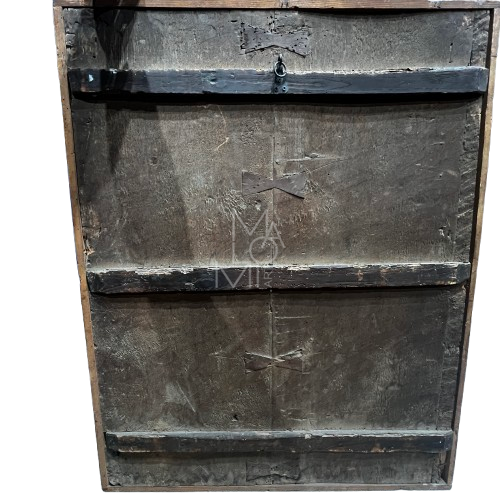
The superficial morphological analysis of the panel reveals a stratification of conservative interventions reflecting the complex material history of the artifact through the centuries. The wooden support shows the usual signs of hygrometric adaptation to environmental variations, partially stabilized on the reverse by structural consolidation interventions that have prevented the cracking of the planks. On the pictorial surface, signs of past cleanings are found which, if on one hand have removed deposits accumulated over time, on the other have partially thinned the most delicate glazes, particularly in the shadow zones of the background and in the chiaroscuro passages of the hilly landscape. However, the endurance of pure pigments in the main fields remains exceptionally solid and enameled.
Old protective varnish layers are also evident, which have undergone a natural yellowing process, beneath which small pictorial restorations are traceable, located mainly along the junction lines of the wooden planks and in the perimetral areas, regions historically subject to the friction of the ancient frame. The surface patina presents itself currently unified by a restoration varnish from the nineteenth or early twentieth century. This substance, although slightly oxidized, fully retains its original function of saturating chromatic tones, exalting the iridescence of the garments and the sharp highlights of lead white, restoring to the modern observer the dramatic expressive intensity of Marco Pino's Counter-Reformation painting.
The philological reconstruction of the work and its historical framing are based on the contributions of specialized criticism dedicated to Southern Mannerism. Francesco Abbate, in his thorough history of art in southern Italy dedicated to the sixteenth century, published in Rome by Donzelli in two thousand and one, masterfully analyzes the grafting of Tuscan-Roman culture onto the local Neapolitan substrate. Fundamental remains the pioneering study by Ferdinando Bologna, entitled Roviale Spagnuolo e la pittura napoletana del Cinquecento, published in Naples by Edizioni Scientifiche Italiane in nineteen fifty-nine, which opened the way to understanding the pictorial panorama of the Viceroyalty. Raffaello Causa, in his essay on sixteenth-century painting in Naples included in the monumental Storia di Napoli of nineteen seventy-two, traced the map of major ecclesiastical commissions linked to Marco Pino.
The complete corpus of the artist and the production of his workshop were definitively arranged by Pierluigi De Castris in his fundamental volumes, starting from Pittura del Cinquecento a Napoli, 1573-1606: l'ultima maniera, published by Electa Napoli in nineteen ninety-one, up to the definitive monograph Marco Pino: opera completa, published in two thousand and three, an indispensable text for verifying the evolution of the models of the Adoration of the Shepherds. The impact of tridentine decrees on the iconographic choices of the workshop was investigated by Giulia Fiore in the volume I Gesuiti e l'arte a Napoli nel tardo Cinquecento, published in Rome by Campisano in two thousand and fifteen. Finally, the Guida sacra della città di Napoli by Gennaro Aspreno Galante, in the critical edition edited by Nicola Spinosa in nineteen eighty-five, and the theoretical essays by Federico Zeri on Counter-Reformation painting remain primary sources for understanding the dogmatic context and original placement of these precious figurative testimonies of southern sacred art.