A pair of baroque still lifes by the Stanchi dei Fiori workshop: a study in composition, botany, and seventeenth-century framing
Luxury realism and baroque wonder: a critical study on a pair of still lifes from the workshop of the Stanchi dei Fiori
- Introduction to the landscape of Roman still life painting
The phenomenon of the Stanchi workshop and its rise in the Capitoline art market
In the diverse and competitive art market of seventeenth-century Rome, the still life genre underwent a profound conceptual and stylistic metamorphosis. It transitioned from early, rigorous naturalistic tendencies, heavily influenced by the austere and dramatic realism of the Caravaggesque tradition, toward the early monumental expressions of Baroque magniloquence. Within this landscape of stylistic transition, the workshop of the Stanchi brothers—historically known by the famous and fortunate antonomasia Stanchi dei Fiori—established itself as one of the most prolific, organized, and qualitatively significant production centers in the papal city.
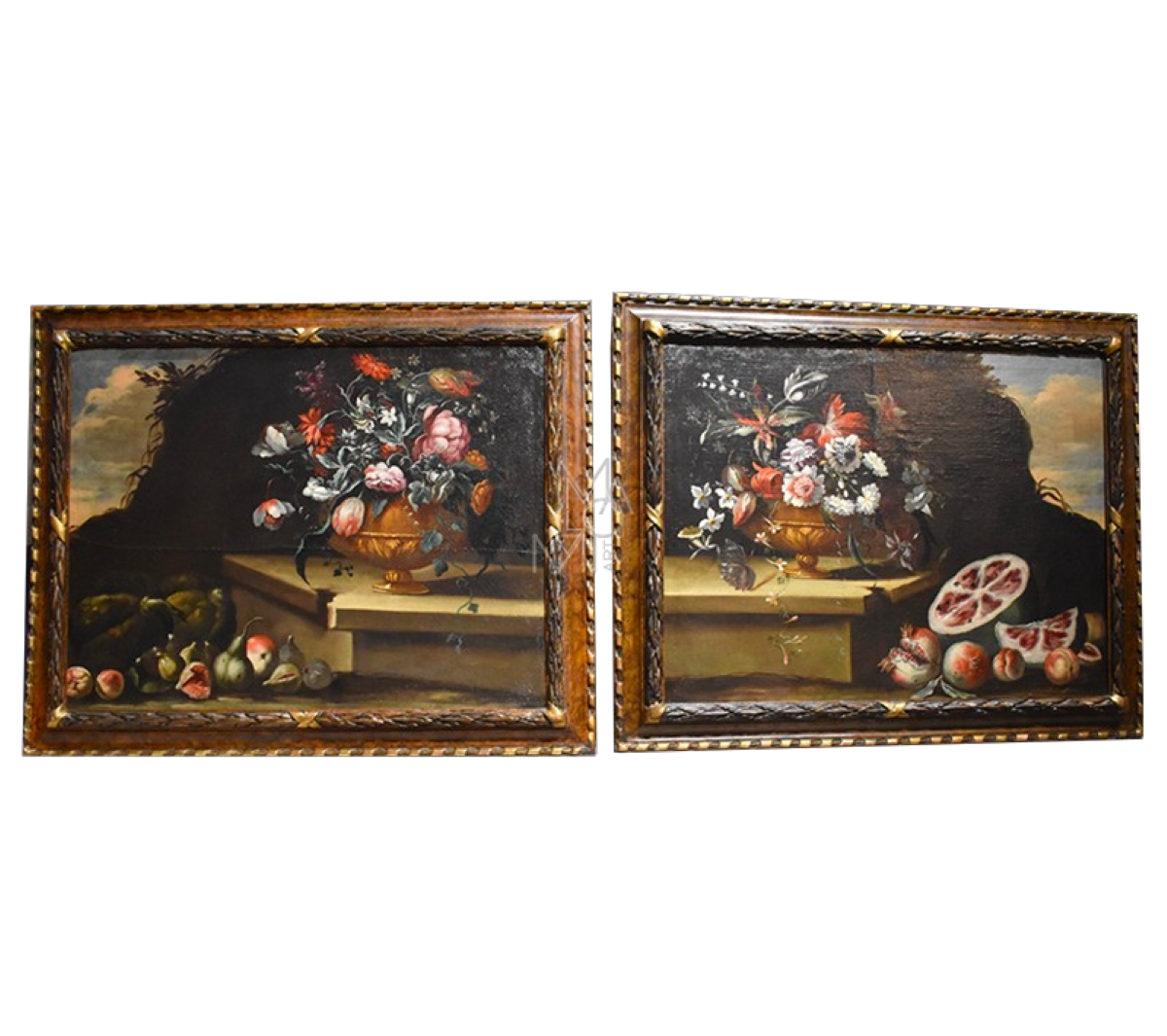
The family dynamic was firmly managed by the eldest brother, Giovanni, who was born in Rome in 1608 and remained active until after 1675, successfully channeling the talent of his younger brothers, Nicolò and Angelo, into the enterprise. Together, the three painters managed to fulfill the desires for opulence and self-aggrandizement of the highest Roman aristocracy, permanently linking their family name to legendary dynasties such as the Barberini, the Chigi, the Orsini, and the Medici of Florence. The magnificent pair of canvases under examination, featuring imposing measurements of one hundred thirty-seven by one hundred ten centimeters for the first painting and one hundred thirty-five by one hundred nine centimeters for the second, faithfully reflects the aesthetics and technical skill of this extraordinary atelier. Sheltered and enhanced by a precious coeval carved walnut frame, the two paintings are configured not as mere decorative objects, but as true manifestos of an era in which individual authorship dissolved into a collective production of the highest formal standard, celebrated in historical documents as a genuine trademark.
- Compositional analysis and post-Caravaggesque spatiality
The skillful spatial organization and the play of specular planes
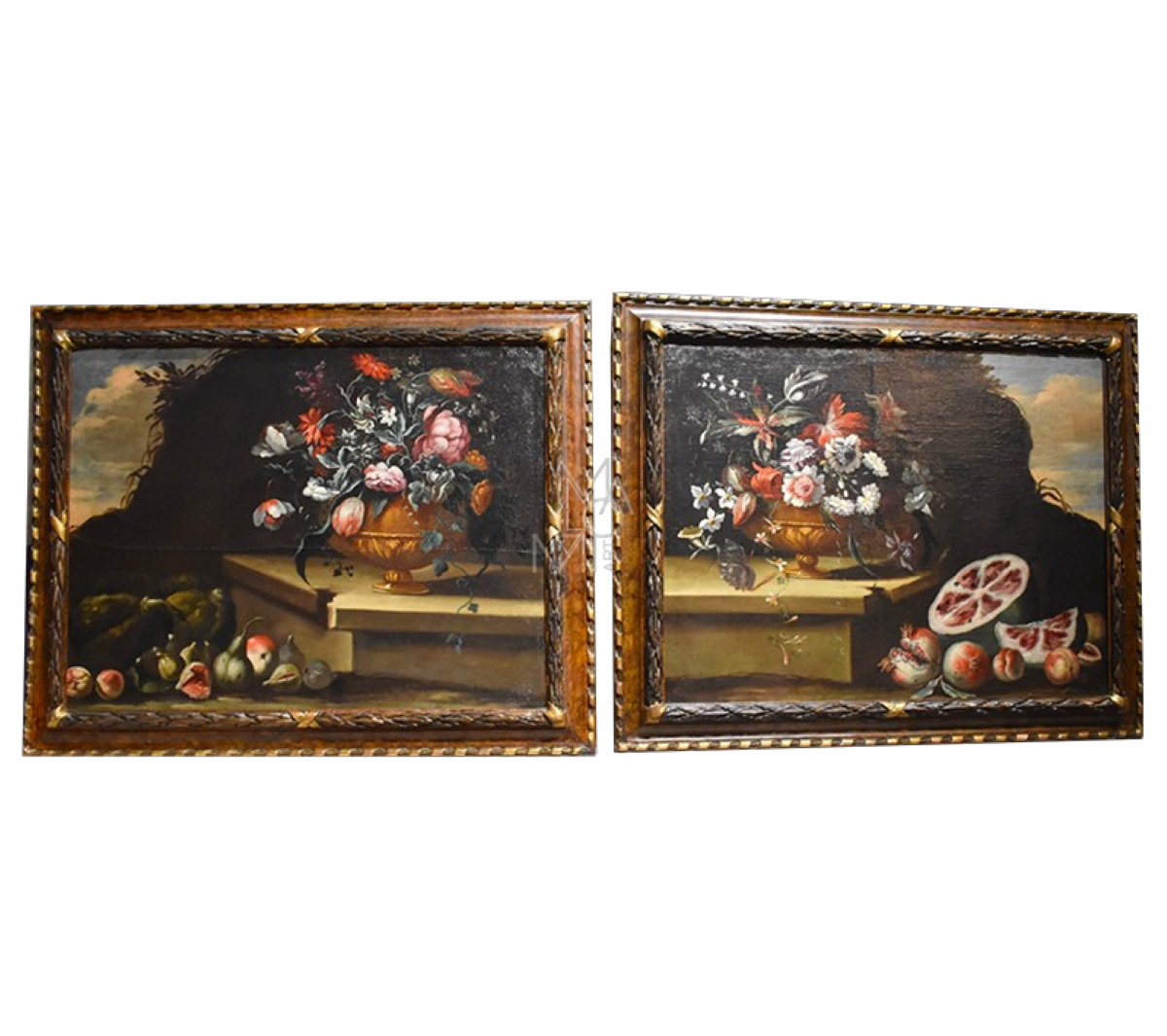
From a structural viewpoint, the two paintings reveal a sophisticated and calculated geometric arrangement, clearly conceived for joint display within the same noble hall. The organization of space is articulated through a succession of horizontal planes stepped in depth, a compositional invention of a clear post-Caravaggesque matrix that art critics confidently attribute to the inspiration and direction of the eldest brother, Giovanni. In each canvas, the scene is dominated by a monumental, finely chiseled metallic vase, filled to overflowing with a lush and diverse selection of floral species. The two vases are resting symmetrically on two slightly raised shelves, creating a perfect visual counterpoint that guides the viewer's eye from one painting to the other in an ongoing dialogue.
Beneath this main structure, on the rustic base in the foreground, a rich assortment of fruits is displayed with calculated casualness, where the volumetric weight of pumpkins and pomegranates contrasts with the delicacy of the overlying petals. Serving as a backdrop to the entire composition is a dark, rocky backlit setting, interrupted only by small tufts of wild grass and, in the furthest background, by a twilight sky streaked with light, pale clouds. This luministic expedient is not accidental, but responds to a specific desire to bring out the vibrant polychromy of the flowers and the plasticity of the fruits by contrast, isolating the vegetable matter in a suspended, almost theatrical atmosphere.
- Botanical virtuosity and the scientific enigma of the ancient watermelon
The analytical realism of still life and the genetic mutations of fruits
The element that catches the modern viewer's attention more than any other, while simultaneously arousing the interest of historians of science, is the descriptive virtuosity with which the Stanchi workshop immortalized botanical reality. The painters did not limit themselves to generic and idealized floral decoration, but conducted a true anatomical investigation of the different species. Among the foliage and buds, it is possible to identify with absolute scientific certainty roses, tulips, hyacinths, mullein, anemones, and tuberose, while the fruit section aligns plums, pomegranates, figs, peaches, and a massive ribbed pumpkin. This sober and essential realism did not retreat even in the face of nature's imperfections, as demonstrated by the pears minutely painted with small holes caused by worms, a detail that points directly to the great Flemish tradition of observational painting.
Within this catalog of nature, the depiction of the cut watermelon present in one of the two canvases represents a genuine historiographical curiosity. The fruit shows a thick, green rind, but the internal flesh appears radically different from what we are accustomed to today. It presents a pale, almost whitish color, interrupted by clear internal hollow cavities where the red veins articulate into small, fascinating geometric spirals, dotted with black seeds that testify to its full ripeness. Botanical historians have extensively demonstrated that this image is not a figment of the painter's imagination, but constitutes a faithful photograph of the seventeenth-century watermelon, a fruit originally from Africa and introduced to Southern Europe in the early years of the seventeenth century. At that time, the processes of intensive genetic selection and artificial hybridization aimed at making the flesh uniformly red, dense, and sugary had not yet begun. The watermelons of four hundred years ago, while apparently already possessing an excellent flavor not too distant from the current one, had much less red flesh and a significantly higher quantity of seeds. The almost obsessive precision with which the Stanchi replicated this phenotype, which can be found identically in other works of theirs that passed through the prestigious London auctions of Christie's, transforms the painting into a scientific document of invaluable worth for the history of agriculture.
- The carved walnut frame within the system of Baroque furnishings
The plastic function of the wooden artifact and its integration with the gallery space
In the opulent residences of the Roman aristocracy, a painting was never conceived as an artwork isolated from its context, but had to integrate perfectly within a complex program of interior decoration and furnishing. Viewed in this light, the splendid coeval frame in carved walnut that encloses this pair of canvases ceases to be a mere element of protection and transforms into a sophisticated visual and rhetorical device. The choice of walnut, a noble and dense wood essence, was particularly valued by seventeenth-century Central Italian cabinetmakers for its extraordinary aptitude for undergoing deep, sharp carvings capable of defying the centuries. Patiently polished with wax to bring out its warm, brown grain, the profile of the frame develops through a succession of molded hollows and tori that create a strong sense of tridimensionality.
The carving incorporates decorative motifs of stylized foliage that seem almost to dialogue with the leaves painted on the canvases, offering a sort of plastic and sculptural extension of the underlying still life. In Baroque furnishings, governed by the iron laws of symmetry and balance, this pair of canvases was intended to occupy a place of honor on the walls of a gallery or a reception hall, perhaps positioned on either side of a large fireplace or as monumental overdoors. The absolute executive and formal identity of the two frames performed the essential function of visually unifying the pendant, while the deep slant of the wooden molding channeled the viewer's gaze toward the interior of the painting, heightening the illusion of depth and the drama of the rocky backlighting.
- Workshop techniques and the division of labor among the Stanchi brothers
The secret of the trademark and the choral collaboration in managing the atelier
The workshop of the Stanchi dei Fiori functioned as a highly specialized family business, an organizational model that constituted the secret behind the success of many artistic workshops in the Rome of that era. For art historians, the minute distinction of the individual hands of the three brothers within the documented works remains a thorny and largely unresolved topic. However, this attributional difficulty should not be interpreted as a limitation of modern criticism, but rather as the culmination of a precise and deliberate commercial strategy of the atelier, aimed at offering a stylistically homogeneous product on the market that was immediately recognizable as a trademark.
Within this perfect machinery, roles were distributed with geometric precision according to the skills of each member. The eldest brother, Giovanni, took on the role of compositional director and artistic manager of the firm. Thanks to his extraordinary capacity to infuse light and vitality into fruits and flowers through complex illusionistic effects, he was responsible for designing the spatial layout of the canvases and painting the most complex pictorial passages, such as the glossy reflections on the metal vases or the transparency of the watermelon flesh. Alongside him, the younger brothers Nicolò and Angelo operated as specialists in analytical execution, rendering on the textile supports the botanical details drawn from a vast repertoire of shared preparatory cartoons and models. In addition to the artistic work, Giovanni held the legal and commercial responsibility for the workshop: the municipal archive of Rome preserves a record of the three painters living together in Strada Paolina in 1656, but the payment mandates from the great families were almost always made out solely to Giovanni, who, as the eldest brother, signed the contracts and collected the fees for the entire family group.
- The Flemish legacy and the lesson of Daniel Seghers
The assimilation of northern naturalism and its translation into Roman magniloquence
Although the pair of still lifes under examination belongs to the full maturity of the workshop, between 1660 and 1670, the deep roots of this style lie in a sophisticated and careful meditation on the models of Flemish painting from the first half of the century. Artistic historiography highlights how the work of the Stanchi drew crucial vital nourishment from the results achieved by the famous Jesuit painter Daniel Seghers and from the environment of the Accademia del Crescenzi. Seghers, a favorite pupil of Jan Brueghel the Elder, was famous across European courts for his flower garlands executed with almost microscopic scientific precision, paintings that also circulated abundantly within the collections of Roman cardinals.
Giovanni Stanchi assimilated from this northern tradition the love for minute detail and the tendency to consider every single flower or fruit not as a mere ornament, but as a fragment of natural truth to be investigated with analytical virtuosity. The true genius of the Stanchi workshop, however, lay in its ability to Italianize this Flemish lesson. Where the northern masters maintained a cold, crisp, and sometimes bidimensional compositional layout, the Stanchi grafted the magniloquence and warmth of the Roman Baroque. In the canvases under examination, the minutely reproduced botanical data abandons all scientific rigidity and acquires a new decorative meaning, transforming into a sort of luxury realism. The objects and fruits cast aside their merely edible characteristics to elevate themselves into phantasmagoric elements of Baroque wonder, designed to strike the viewer's imagination and celebrate the magnificence of the patrons.
- Archival evidence and the background of the Barberini and Chigi commissions
Roman account books and the protection of works within aristocratic entails
A thorough investigation of the archival documents and account books of the great Roman papal families allows us to shed light on the economic and collecting background that accompanied the production of works similar to our pair of canvases. The archival findings confirm that the Stanchi workshop occupied a position of absolute privilege in the preferences of the high nobility. The records of the Barberini family, linked to the pontificate of Urban VIII, preserve payment mandates in favor of Giovanni Stanchi dating back as far as 1638, the year in which the painter was compensated for executing a floral garland enriched by the family's heraldic coat of arms, thus uniting botanical homage with dynastic celebration.
Equally extraordinary are the data emerging from the historical inventories of the Chigi family, tied to Pope Alexander VII. A famous inventory compiled in 1692 upon the death of the cultured Cardinal Flavio Chigi describes in detail a series of six small canvases commissioned from Nicolò Stanchi, in addition to recording numerous other large-scale paintings assigned generically to the collective name of Stanchi. The inventory descriptions of the time frequently use formulas such as paintings with vases of flowers and fruits upon bases, expressions that perfectly echo the exact iconography and spatial layout of the canvases studied here.
A fascinating curiosity emerging from the Chigi papers is the mention of payments made to a mysterious female painter referred to as la Stanghi, an archival detail suggesting the involvement in the workshop's activities of a female family figure as well, probably a sister or a niece of the three brothers, engaged in painting the minor floral details. The constant presence of these works in the inventories was not dictated by a passing fashion: once they entered the collections of Palazzo Chigi or Palazzo Barberini, these monumental still lifes were protected by the legal bond of the fidecommesso, an aristocratic law that strictly forbade their alienation, sale, or hereditary division, ensuring that the pendants remained together to preserve the prestige of the family picture gallery intact.
- Direct stylistic comparison with Mario de' Fiori
The duel of Baroque aesthetics between monumental restraint and theatrical passion
In the art market of Baroque Rome, the only true rival capable of contending with the Stanchi for primacy in the still life genre was Mario Nuzzi, who went down in history under the famous pseudonym Mario de' Fiori. The direct stylistic comparison between the production of the latter and the pair of canvases by the Stanchi allows us to grasp two distinct and fascinating pictorial philosophies, both born to respond to the same demand for opulence from the patronage of the time.
The primary divergence lies in the approach to composition and space. The pair of canvases by the Stanchi examined here is based on a principle of sober and essential geometric balance, where nature is ordered through the skillful direction of horizontal planes and specularity, always maintaining a perfect legibility of every single element. Mario de' Fiori, on the contrary, pursues an aesthetic of Baroque passion and asymmetrical dynamism: in his canvases, flowers seem to explode and spill over in disordered and tumultuous cascades, overwhelming the vases and occupying the space with a dramatic theatricality that leaves little room for ordered contemplation.
The pictorial execution and the use of light also reveal two distant worlds. The Stanchi apply pigments with a crisp, almost pearly precision inherited from the Flemish tradition, utilizing a clear backlit illumination that defines volumes with the sharpness of a crystal. Mario de' Fiori's brushwork, instead, is impastoed, rapid, and summary—a style of touch where petals are evoked through clumps of color and strokes of flickering lead white, sacrificing the precision of botanical detail for the sake of an overall chromatic effect of extraordinary visual sensuality. While Mario de' Fiori was the artist sought after for the most daring and spectacular decorations, the Stanchi workshop represented the ideal choice for collectors who wished to combine Baroque decorative pomp with the intellectual pleasure of a scientific and truthful observation of nature, a perfect balance of which this splendid pair of canvases constitutes an insuperable example.
- Bibliografia / Bibliography
- Bocchi, G., & Bocchi, U. (2005). Pittori di Natura Morta a Roma: Artisti italiani 1630-1750. Viadana: Arti Grafiche Castello (pp. 245-328).
- Porzio, F. (A cura di). (1989). La natura morta in Italia (Vol. I). Milano: Electa.
- Ravelli, L. (2005). Gli Stanchi dei fiori. Bergamo: Grafica & Arte.
- Veca, A. (1982). Paradeisos: Dall'universo del fiore (Catalogo della mostra). Bergamo: Galleria Lorenzelli.
- Veca, A. (2002). I "Maestri del vaso a grottesche". In M. Gregori & J. G. Prinz von Hohenzollern (A cura di), Natura morta italiana tra Cinquecento e Settecento (Catalogo della mostra, Monaco di Baviera). Milano: Electa.
- Veca, A. (2003). La natura morta italiana da Caravaggio al Settecento. In M. Gregori (A cura di), Catalogo della mostra (Firenze). Milano: Electa (pp. 107-114).