Wardrobe Sacristy
THE BRESCIAN ALTAR-CABINET OF THE LATE SEVENTEENTH CENTURY
A Historical-Critical, Cabinetmaking, and Iconographical Study of a Private Devotional Artifact
METHODOLOGICAL INTRODUCTION
The scientific methodology applied in this study is situated at the disciplinary intersection of the history of decorative arts, the social history of Counter-Reformation worship, and the philological-stylistic analysis of material culture. This investigation rejects a fragmented approach that separates the wooden framework from the pictorial apparatus; instead, it examines the artifact in its complex totality as a Baroque gesamtkunstwerk (total work of art).
The research itinerary is structured across three fundamental analytical levels:
Historical-Religious Analysis: Contextualizing the furniture piece as a material response to post-Tridentine restrictions regarding domestic liturgy and private worship. Formal and Structural Connoisseurship: Examining the woodworking techniques of walnut, burl veneers (radica de noce), and external moldings, cross-referenced with the output of late-Seicento workshops in eastern Lombardy. Historical-Artistic Philology: Conducting an attributional and stylistic analysis of the interior paintings in light of the catalog and theoretical treatise of Francesco Paglia.The ultimate objective of this thesis is to elucidate the design complexity of a monumental cabinet (300 x 70 x 216 h cm) purposefully conceived for visual deception (trompe-l'œil) and theatrical astonishment (meraviglia) within the domestic sphere of the Brescian patriciate.
CHAPTER I
The Historical-Cultural Context: Private Devotion in Seicento Brescia
During the second half of the seventeenth century, the territory of Brescia was profoundly shaped by the spiritual and regulatory legacy of the Counter-Reformation. The mandates issued by Saint Charles Borromeo in his celebrated Instructiones Fabricae et Supellectilis Ecclesiasticae (1577) had imposed rigorous restrictions on the construction of private chapels and altars within aristocratic palaces. Indeed, the celebration of domestic Mass required a complex series of episcopal licenses and dispensations, which were granted with extreme parsimony to prevent liturgical abuses or the secularization of the rite.
To navigate these ecclesiastical restrictions without relinquishing the prestige and convenience of private prayer, the Brescian nobility commissioned a highly specialized typology of furniture: the altar-cabinet (armadio-altare). This avant-garde cabinetmaking solution simultaneously satisfied multiple societal and religious demands:
Preservation of Decorum: The sacred implements of the liturgy were shielded from dust and profane gazes during the mundane, daily life of the palace. Formal Dissimulation: When closed, the doors integrated the object into the secular furnishings of the room, adhering to the strict seventeenth-century aesthetic codes of discreet opulence. Spatial Flexibility: A state salon or a master bedchamber could be transformed, within a matter of moments, into a fully consecrated space for liturgy.
CHAPTER II
The Cabinet Exterior: Baroque Woodworking and Visual Deception
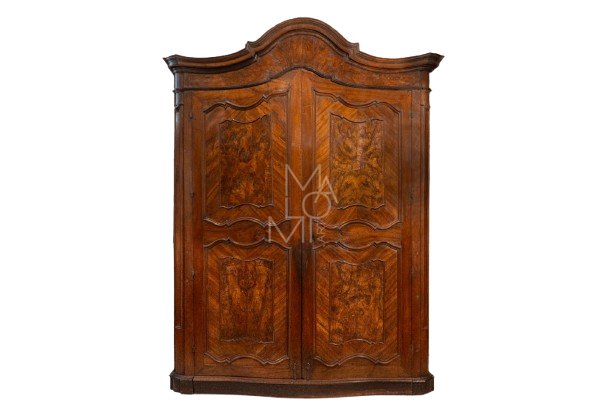
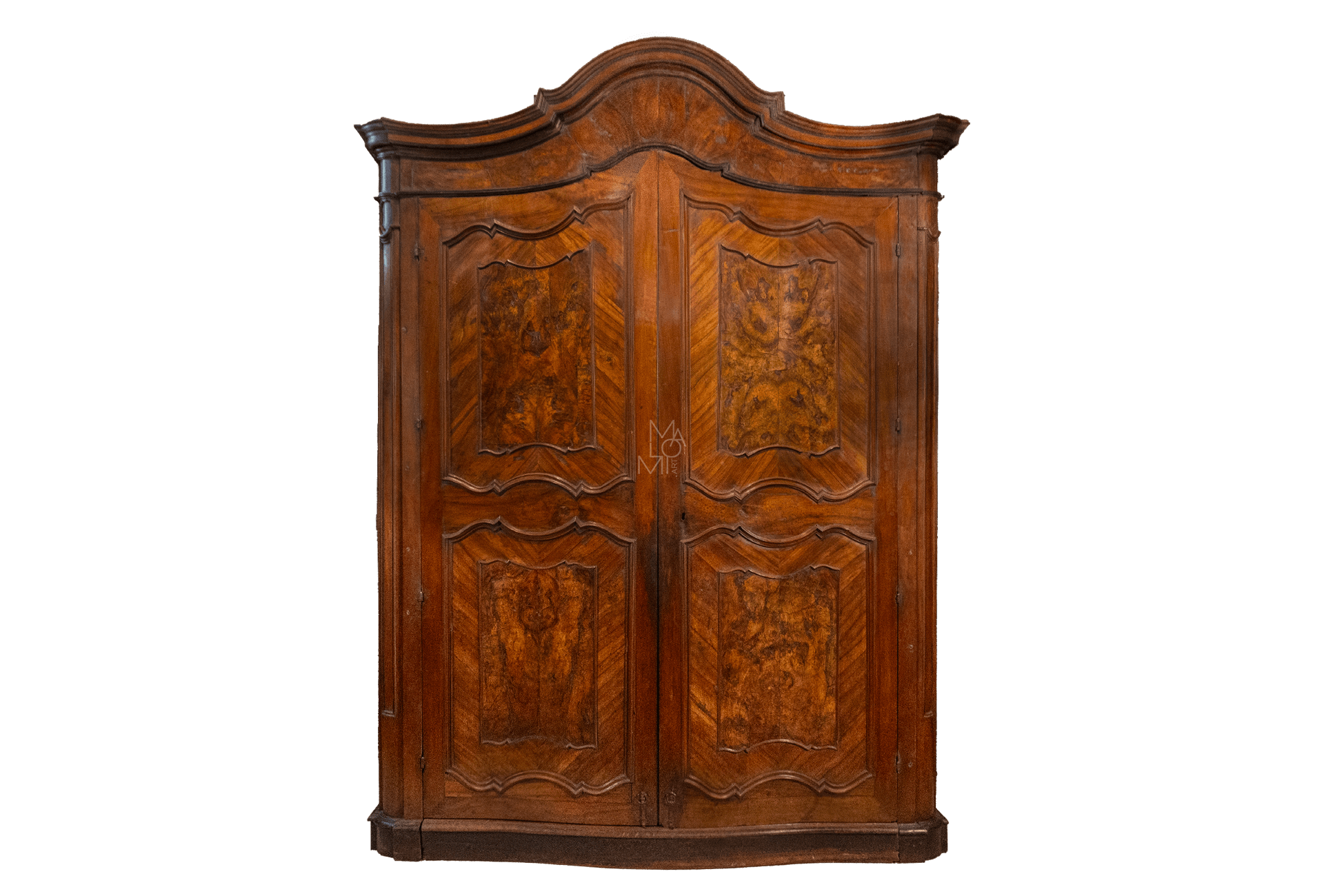
When its doors are closed, the artifact presents itself as a monumental salon cabinet of the highest quality of Lombard cabinetmaking. The structural composition rejects the rigid, geometric grid characteristic of Renaissance furniture, embracing the sinuous, vibrant rhythm of the mature Baroque period.
The selection of materials and their geometric arrangement obey precise criteria of symmetry and dynamism:
The Walnut Burl Veneer: The four large central panels (two per door) feature precious walnut burl veneer applied in an open-book layout (a macchia aperta). The natural grain patterns of the wood are mirrored perfectly across the axes to create organic, flame-like configurations—a distinctive hallmark of seventeenth-century Brescian and Bergamasque master ebanisti. Inlays and Moldings: The burl panels are framed by slender cross-banded inlays in darker wood essences and defined by stepped, mixtilinear moldings with canted corners, breaking the monolithic planarity of the facade. The "Cappello d'Andrè" Cornice: The upper cresting of the cabinet is dominated by a sweeping, broken mixtilinear arch. Its deep, projecting architectural moldings cast dramatic shadows across the facade, visually mitigating the imposing three-meter width of the structure. Supporting Elements: The lateral stiles are subtly rounded, fluidly transitioning the front panels toward the side flanks. The entire monument stands upon a low, projecting plinth base that mirrors the curvilinear undulations of the upper cornice, anchoring the structure.This strictly secular exterior embodies the Baroque concept of dissimulazione onesta (honest dissimulation). The cabinet feigns to be a high-status domestic storage piece—such as a credenza for silver or family archives—harmonizing with the civil architecture of a patrician room without betraying its latent sacred identity.
CHAPTER III
The Revelation of the Sacred Space and Liturgical Transformation
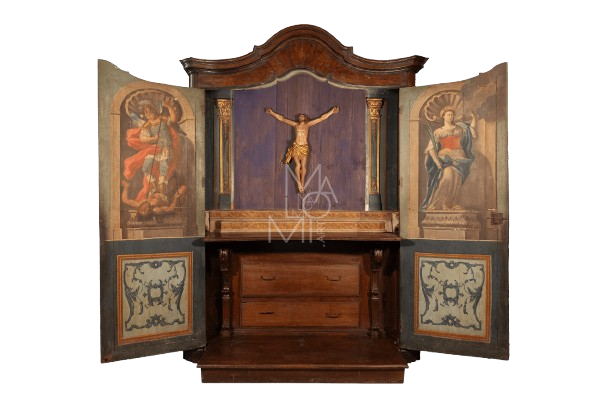
The un-hinging and opening of the expansive doors constitutes a calculated coup de théâtre, a threshold moment between the profane and the sacred designed to elicit meraviglia (wonder) from the seventeenth-century viewer. The interior reveals a complex, rigorously organized liturgical mechanism.
The structural compartmentalization of the interior space corresponds strictly to functional and ritual requisites:
The Lower Section: At the center lies an exposed solid walnut commode comprising two drawers with cast bronze handles. This section serves a dual purpose as a structural support for the upper weight and a secure repository for sacred vestments, missals, and chalices. The Altar Mensa: The upper surface of this chest of drawers is designed as the mensa, the consecrated horizontal plane upon which the priest offered the Eucharistic sacrifice. The Upper Niching and Backdrop: Above the mensa, the simulated chapel unfolds. The background is dominated by a deep, rich crimson-purple hue that throws the plasticity and gilding of a carved wooden Crucifix into high relief. Flanking this central recess, two carved and gilded wooden pilasters mimic the monumental marble altarpieces of coeval churches, elevating the artifact from a piece of furniture into a micro-architectural sacred space.
CHAPTER IV
The Pictorial Program of Francesco Paglia: Iconography and Style
The interior surfaces of the doors feature two splendid figural compositions attributed to the hand of Francesco Paglia (1635–1714). A prominent pupil of Guercino in Bologna, Paglia was a leading figure of the Brescian Baroque, celebrated for his fresco cycles in urban palaces and his contribution to art theory (Il Giardino della Pittura). In this compressed format, the painter deploys his signature theatrical sensibility and a warm, saturated color palette heavily indebted to his Emilian training.
The Left Door: Saint Michael the Archangel
The composition depicts the Archangel Michael casting down and subduing Satan. The narrative structure is built upon a dynamic diagonal axis that imparts momentum to the scene. The archangel is clad in classical military attire and enveloped in a voluminous, wind-swept mantle of vermilion red—a key chromatic signature employed by Paglia to capture the viewer's gaze. From an iconographical standpoint, the painting celebrates the triumph of the Catholic Church and true Faith over heresy and sin, a core thematic trope of Counter-Reformation art.
The Right Door: Allegory of Justice / Christian Virtue
In symmetric perspective, the right door displays a standing female figure positioned within a painted illusionistic (trompe-l'œil) niche. The figure, characterized by fluid drapery in shifting tones of azure and ochre and a soft, idealized countenance, is identifiable as an allegory of Justice or Moral Fortitude. This iconographical selection served to remind the patrician patron that the application of Christian virtues must govern all aspects of their public and private conduct.
On the lower registers of both doors, beneath the primary figural scenes, are painted panels featuring Baroque cartouches. These ornamental motifs function as visual transitions, softening the passage between the vivid colors of the upper paintings and the austere tones of the walnut woodwork below.
CONCLUSIONS
The altar-cabinet under examination represents a historical and artistic document of extraordinary significance within the artistic landscape of the Seicento in eastern Lombardy. The artifact demonstrates how Brescian cabinetmaking of the late seventeenth century had attained a technical maturity capable of engaging in equal dialogue with monumental figurative painting.
The exceptional state of preservation of this object, which retains both its original burl-veneered casing and the complete interior pictorial cycle by Francesco Paglia, offers an invaluable window into the mechanisms of patrician patronage. It illustrates a historical milieu wherein private opulence, the pursuit of visual astonishment, and a deeply felt—yet strategically dissimulated—religious devotion converged into a singular, consummate work of art.
SPECIFIC BIBLIOGRAPHY
Primary Sources (Baroque Era)
BORROMEO, Carlo, Instructiones fabricae et supellectilis ecclesiasticae, Milan, 1577; Latin-Italian critical edition edited by M. Marinelli, Vatican City, 2000. PAGLIA, Francesco, Il Giardino della Pittura, Brescia, manuscript (c. 1675-1713); critical edition edited by C. Boselli, Brescia, 1967.Cabinetmaking and Furniture History in Lombardy
ALBERICI, Clelia, Il mobile lombardo, Milan, Gorlich, 1969. BACCHI, Andrea (ed.), Il mobile veneziano e lombardo del Sei e Settecento, Milan, Artioli, 1995. CHINI, Ezio (ed.), Botteghe di ebanisteria nel territorio della Lombardia orientale, Brescia, Grafo, 1991.Francesco Paglia and Seicento Brescian Painting
ANZANELLO, Elisabetta, "Francesco Paglia (1635-1714): un pittore bresciano tra Bologna e Venezia," in Saggi e Memorie di Storia dell'Arte, vol. 28, 2004, pp. 115-182. PANAZZA, Gaetano, La pittura a Brescia nel Seicento e nel Settecento, Exhibition Catalogue, Brescia, 1974. SPADAFORA, Marina, L'allievo del Guercino a Brescia: Francesco Paglia e la decorazione dei palazzi cittadini, Milan, Electa, 2011.Typology of Domestic Sacred Artifacts
COLIVA, Anna (ed.), La devozione privata: arredi sacri e mobili-altare nelle dimore nobiliari italiane, Rome, De Luca, 2002. MONTAGU, Jennifer, Roman Baroque Sculpture: The Industry of Art, New Haven, Yale University Press, 1989.