Venetian sideboard from the 17th century
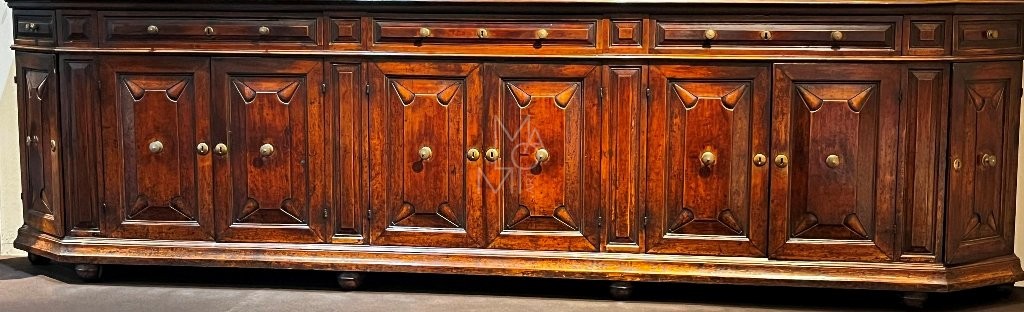
- Object: Low ceremonial sideboard (Porteghera)
- Typology: Horizontal, canted-side storage furniture
- Cultural Sphere: Venetian cabinetmaking (Venice area)
- Chronology: 17th century, mature Seicento (post-1650)
- Style: Architectural, geometric Baroque
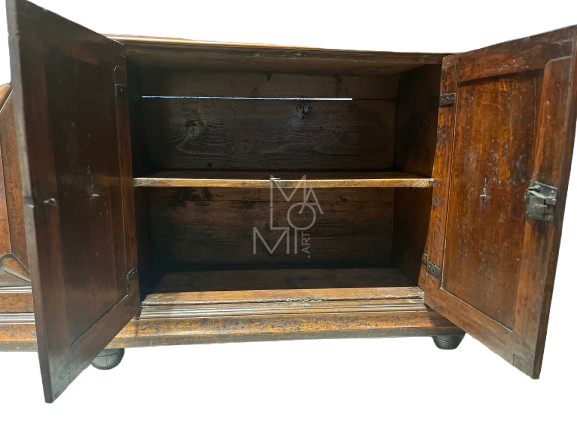
- Medium and Technique: Solid domestic walnut (noce nazionale) for all visible parts; poplar and fir wood for internal linings, partitions, and back panels. Hand-carving, applied raised bosses (bugne), and hand-forged iron hardware. Original surface finish executed with beeswax and shellac.
- Dimensions:
- Length: 405 cm
- Height: 115 cm
- Depth: 48 cm
The Triumph of Solid Wood: The Seventeenth-Century Venetian Monumental Credenza between Architecture, Cabinetmaking, and Social Space
The Historical Context and the Redefinition of Patrician Space
During the seventeenth century, the Republic of Venice underwent a delicate phase of geopolitical and economic transition. The progressive shift of commercial routes toward the Atlantic and the prolonged, exhausting conflicts against the Ottoman Empire for control of the Eastern Mediterranean forced the lagoon aristocracy to undertake a profound reconversion of their capital. Many patrician families chose to divest from historic maritime routes, seeking refuge in the security of landownership within the Venetian hinterland (Terraferma) or concentrating their wealth on the architectural and decorative renovation of their urban palaces. This political contraction did not coincide with a cultural decline; on the contrary, it translated into a monumental strategy of self-representation. Private luxury became the primary arena in which the Venetian nobility displayed the persistence of their social status and economic stability.
Within this complex sociological dynamic, domestic furnishings underwent a radical conceptual metamorphosis. While Renaissance furniture had maintained an isolated functional autonomy, in the seventeenth century it converted into a true spatial and architectural device. Reception furniture was no longer purchased as interchangeable elements but was commissioned to measure to engage directly with the specific volumes of Venetian palaces. This phenomenon particularly affected the typology of the low sideboard (credenza), which abandoned the restrained proportions of previous centuries to assume titanic dimensions, suited to the new rituals of Baroque hospitality and the display of immense collections of silverware, Murano glassware, and ceremonial maiolica.
The Architecture of the Artifact and the Secret of Slender Proportions
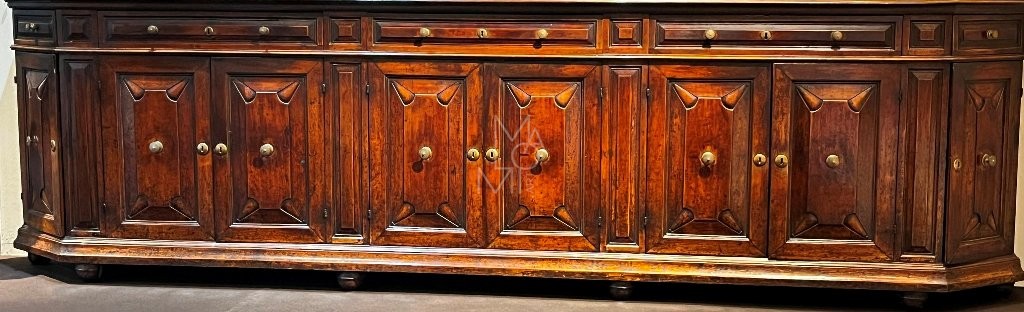
The artifact object of this study stands out within the landscape of early Venetian cabinetmaking as an authentic unicum, disrupting the canonical commercial metrics of seventeenth-century workshops. Boasting an imposing length of 405 centimeters, a height of 115 centimeters, and a depth of a mere 48 centimeters, the sideboard manifests a sophisticated and avowedly bespoke design. The exceptional longitudinal ratio between length and depth, which stands at a value close to 8.4 to 1, responds to a compelling logic of environmental integration. In the patrician residences of the Venetian area, the space intended for monumental reception and grand festivities was the portego, the central through-hall that cut longitudinally across the entire building, serving as the distributive axis for the side rooms.
The depth, contained within just 48 centimeters, constitutes the critical nexus of this ingenious furnishing solution. A piece of standard proportions, which usually oscillated between 60 and 70 centimeters in depth to ensure stability at greater lengths, would have formed a physical barrier and a volumetric hindrance within a transit corridor or a ballroom. By reducing the protrusion to less than half a meter, the designer allowed the sideboard to behave like a sumptuous low relief boiserie, capable of occupying and ennobling an entire wall of the portego without subtracting precious floor space from the transit of guests and servants. The height of 115 centimeters perfectly crowns this logic, offering the ideal display plane for ceremonial objects, strategically positioned at eye level for standing attendees during receptions.
Canted Geometry as a Baroque Optical Device
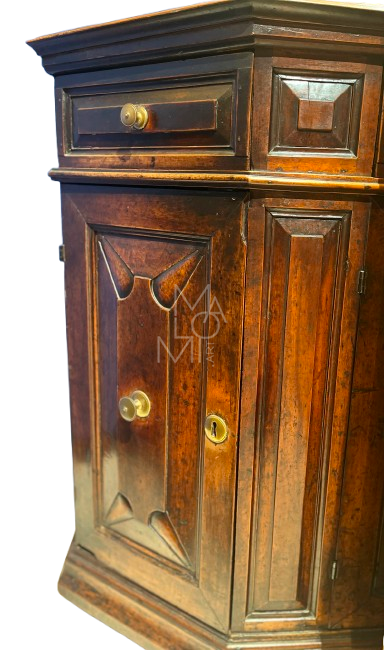
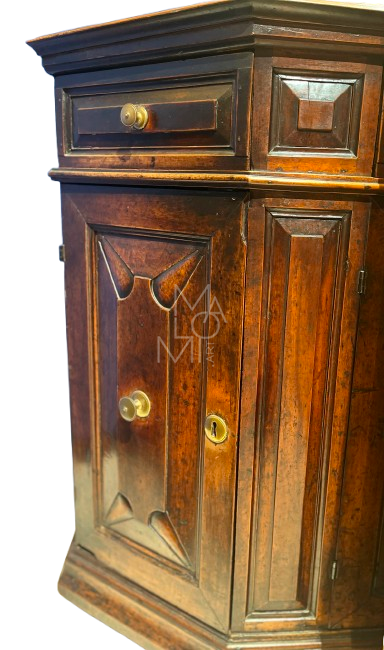
The monumentality of the horizontal development is masterfully mitigated by the adoption of 45-degree canted sides (scantonatura). This formal choice elevates the artifact from the rigid right-angled staticity characteristic of the late Renaissance and projects it fully into the visual culture of the Baroque. The canted corner fulfilled a dual function, simultaneously practical and aesthetic. From a purely functional and environmental safety perspective, eliminating the sharp edge on a piece of furniture over four meters long placed in a high-traffic area drastically reduced the risk of accidental collisions, fluidly accommodating the movement of people around the structure.
From an optical and perceptual viewpoint, the 45-degree angling of the end pillars generates an effect of lightening the wooden mass. The observer's gaze does not stop abruptly against a rigid geometric block but is guided through a soft and nuanced transition toward the surface of the wall behind. The facade of the sideboard thus loses its potential volumetric aggressiveness, transforming into a sinuous line that appears to flex to welcome the surrounding space. This geometric solution demonstrates the Venetian cabinetmaker's profound awareness of contemporary optical perception theories, borrowed directly from the grand experimentations of the coeval Baroque monumental architecture of masters such as Baldassare Longhena.
Structural Anatomy and the Excellence of Lagoon Cabinetmaking
The realization of a piece of furniture in solid walnut of such structural dimensions raised engineering challenges of extraordinary climatic and static complexity. The Venetian lagoon, characterized by sudden thermo-hygrometric oscillations and constantly high humidity levels, subjects wood fibers to continuous stresses of expansion and contraction. To prevent a top over four meters long from warping or cracking irreparably over time, the workshop had to select domestic walnut (noce nazionale) boards of exceptional quality and seasoning, assembling them using flexible geometric tongue-and-groove joints capable of tolerating the natural micro-movements of the wood.
The rigor of the facade is mirrored in the millimetric precision of the internal carpentry. While solid walnut defines the visible parts for aesthetic reasons and prestige, the internal linings, partitions, and back panel are made of local softwoods, specifically poplar and fir. This alternation of materials does not respond to mere domestic economy but to precise structural wisdom. Poplar and fir, being light and flexible woods, act as internal elastic shock absorbers, absorbing the formidable torsional thrusts exerted by the external solid walnut and ensuring the immutability of the structural framework over centuries. The entire system is held together by a dense nail work of hand-forged iron, crafted piece by piece, whose square or "wax-droplet" heads bear witness to the pre-industrial and entirely artisanal nature of the artifact.
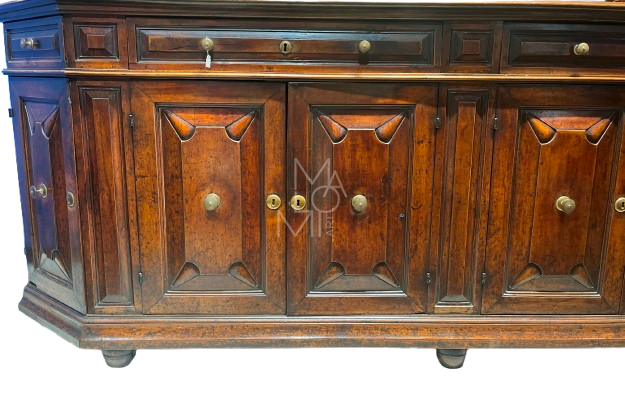
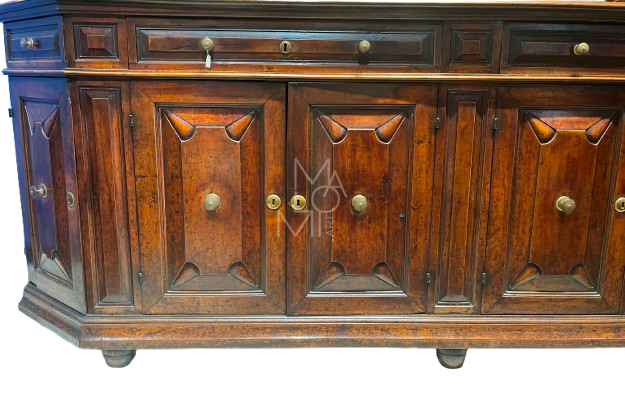
The organization of the front is dominated by rigorous symmetry: six drawers in line on the main facade and two shaped drawers arranged corresponding to the canted sides, making a total of eight elements below the top. Internal inspection of the drawers reveals the adoption of manually executed dovetail joints, characterized by the wide and deep pins typical of the mature seventeenth century. The most complex engineering challenge lay in the carpentry of the two side drawers: having to conform to the 45-degree inclination of the pillar, they present an asymmetrical trapezoidal plan. The cabinetmaker had to calculate the angle of the dovetails with millimetric accuracy so that the drawer could slide along the side runners without experiencing friction or axial deviation during opening.
Baroque Theatricality and the Light Analysis of Raised Bosses
The lower facade of the sideboard is treated in the manner of a sculptural elevation, where the aesthetic impact is not entrusted to polychrome inlays or exuberant gilding, but to the pure plastic modulation of the wooden matter. The doors are enriched with wide, rectangular geometric bosses (bugne) in high relief, bordered by prominent and accentuated moldings. This decorative layout obeys a precise visual directing that is fully revealed only when related to the actual lighting conditions of seventeenth-century Venetian residences. The salons of patrician palaces did not enjoy zenithal or diffused light; by day they were grazed by the shifting, raking light penetrating from the grand multi-light windows overlooking the canals, while by evening the atmosphere was illuminated exclusively by the mobile and punctiform light of candles, torches, and oil lamps placed on wall sconces or on the top of the sideboard itself.
Within this lighting context, the technique of the high-relief boss assumes an extraordinary dramatic and expressive value. The geometric projections act as genuine accumulators and reflectors of golden light. Under the effect of the fluctuating and warm candle light, the prominent parts of the solid walnut, skillfully polished with beeswax and shellac, gleam intensely, while the deep hollows of the moldings and the perimeter recesses sink into sharp, dark shadows. This exaggerated chiaroscuro contrast imparts movement and dynamism to the entire surface of the furniture, which appears to change its appearance as the position of the light sources in the room varies. The canted sides further disrupt the linearity of the luminous reflection, intercepting visual rays from a different angle and creating a soft zone of twilight that ideally connects the furniture to the darkness of the room's walls, enhancing the scenographic magniloquence of the ensemble.
The Guild System: The Ancient Scuola dei Marangoni and Workshop Hierarchies
To fully understand how such a work took shape, it is indispensable to analyze the rigid corporate system that governed manufacturing activities in Venice at the time. Woodworking was placed under the control of the ancient craft guild known as the Arte dei Marangoni. The corporation had its religious and institutional headquarters at the prestigious church of San Samuele, where members gathered under the spiritual patronage and protection of Saint Joseph. Administratively, the Arte was governed by a board called the Bancale, presided over by the figure of the Gastoldo, and operated under the strict state supervision of the Giustizieri Vecchi. During the seventeenth century, the guild was articulated into specialized branches or colonnelli: among these, the marangoni da noghera were the masters appointed to select and work walnut wood for high-ranking domestic furnishings.
Access to the profession and the possibility of opening an independent workshop were bound to an extremely selective hierarchical and training path. One began as a garzone (apprentice), a multi-year apprenticeship dedicated to elementary tasks and the study of wood species, before advancing to the rank of salaried lavorante (journeyman), tasked with the physical execution of complex pieces. The final milestone of achieving the status of Maestro demanded passing the dreaded masterpiece exam (prova del capolavoro or prova dell'arte), conducted in the presence of guild experts and state magistrates. Only upon passing this examination was it permitted to register in the official roll of the Marangona and stamp one's mark on the works. A monumental piece of furniture exceeding four meters required a geometric and static mastery such that it could only be conceived and executed by a Maestro of proven authority within this system.
The Seventeenth-Century Workshop as an Economic Space and Timber Supply Chain
The workshops of master carpenters constituted vibrant economic spaces, typically settled on the ground floor of residential buildings in the districts with the strongest artisanal vocation in the city, such as Cannaregio, Castello, or near the parish of San Samuele itself. Large street-facing portals opened directly onto the squares (campi) or waterfronts (fondamente) to capture diurnal sunlight, an irreplaceable resource for guiding chisel strokes and final wax polishes. The competitiveness of an excellent workshop depended closely on the efficiency of its raw material supply chains. Venice, reliant on timber imports, exploited a ramified river network: precious domestic walnut arrived from the controlled territories of Friuli and the pre-alpine areas of Bassano and Treviso, floating on large rafts down the currents of the Sile and Piave rivers directly into the lagoon canals.
Similarly, structural softwoods like fir and poplar, used for the internal partitions and back panel of our sideboard, descended from the alpine valleys of Cadore and the forests of Trentino. Customs monopolies protected by the Giustizieri Vecchi ensured that urban workshops had preferential access to the most elastic and best-seasoned timber in Europe. This superiority in material procurement represented the technical keystone that guaranteed the extraordinary long-term survival of large wooden structures exposed to the extreme hygrometric regimes of the lagoon, where the alternation of humidity and salinity constantly jeopardized the integrity of the fibers.
Artistic Transition and Professional Convergence with the Woodcarvers
The seventeenth century marks an era of jurisdictional and historical friction within the Venetian craft associations. The powerful emergence of Baroque taste, oriented toward animated profiles, deep projections, and strong plastic contrasts, disrupted traditional professional boundaries. While the marangone da noghera held a monopoly on joinery, orthogonal proportion, and structural stability, the execution of highly three-dimensional decorative elements theoretically fell under the competencies of the powerful guild of the Squeraroli e Intagliatori (Shipwrights and Woodcarvers). The recurrence of severe legal disputes before the Giustizieri Vecchi prompted workshops engaged in luxury production to evolve toward integrated and collaborative organizational formulas.
Within the most renowned workshops, the Master carpenter assumed the role of general architectural director, establishing the slender proportional ratios, the 45-degree canting of the sides, and the engineering of the internal trapezoidal drawers, while the carving of the prominent moldings and the geometric relief of the front bosses were entrusted to associated professional woodcarvers. The monumental sideboard of 405 centimeters masterfully expresses this happy workshop convergence, qualifying not as the outcome of an isolated joinery but as the product of a complex enterprise that summarizes the highest structural and plastic competencies of seventeenth-century Venice.
Socio-Economic Analysis of Cost and Status Symbol of Grand Furniture
From an economic perspective, the decision to commission such a sideboard responded to precise financial and elite strategies on the part of the patriciate and the wealthy class of the cittadini originari (original citizens). In a historical period marked by the redefinition of maritime trade axes and inflation, monumental furniture in precious woods represented a solid form of tangible asset hoarding and a safe-haven capital. Solid domestic walnut was a mobile capital, protected from degradation thanks to artisanal mastery and easily deployable as loan collateral or inserted with high monetary estimates in dowry contracts and hereditary successions. Often bound by clauses of fedecommesso (entailment) to prevent its sale or dispersal outside the household, these imposing pieces followed the fate of family palaces as perennial real estate assets.
The final cost of production reflected the complexity and prestige of the supply chain. Raw timber absorbed nearly forty percent of the total expenditure due to severe import customs duties entering the city, to which were added the logistical costs of internal softwoods and the metallurgical costs of hand-forged iron hinges and box locks supplied by the Arte dei Fabbri (Blacksmiths' Guild). The most significant share, however, consisted of the hundreds of days of specialized labor required to calculate the millimetric tolerances of the solid wood and the angle of the dovetails on the side drawers. Sustaining such an expense elevated the furniture to an authentic device of conspicuous consumption: displaying a piece of solid walnut furniture in the portego, which rejected the cheap disguises of gilding or lacquer to show only the substance and chiaroscuro of the pure material, communicated to visiting diplomats and patricians the immortal financial solidity and aristocratic taste of the dynasty.
Overall Historical Conclusions and Preservation Perspectives
In final analysis, the monumental seventeenth-century Venetian canted sideboard offers itself to the art historical discipline as a primary material and cultural document, capable of redeeming seventeenth-century wooden production from a partial and unjust historiographical shadow. This study has demonstrated how Venetian Baroque cabinetmaking was able to develop its own original path to monumentality, filtering the decorative exuberance and caprice of the era through a firm sense of measure and architectural order inherited from the great masters of lagoon classicism.
The furniture ceases to be interpreted as an isolated object to assume the status of a symbiotic component of patrician architecture. Every single metric and formal choice—from its exceptional length to its depth contained within forty-eight centimeters designed for transit corridors, to the canted corners and the luminous modulation of the bossed doors—responds to an integrated program of visual perception and social utility within the theater of the portego. The structural exceptionality and rarity of this unicum impose strict and rigorous preventive conservation strategies for the future. This research intends to stand not only as a cognitive milestone for the history of decorative arts but as a solid documentary tool designed to guide future philological restorations, so that the superb texture of this masterpiece can continue to testify over the centuries to the splendor, technical ingenuity, and immutable theatricality of the seventeenth-century Venetian civilization.