The Wooden Sarcophagus of the Late Renaissance
The Wooden Sarcophagus of the Late Renaissance
A Critical, Heraldic, and Structural Study of a Monumental Tuscan Cassone from the Second Half of the Sixteenth Century
1. Introduction: The Cassone as a Reflection of Patrician Prestige
In the domestic sphere of the Italian Renaissance, the cassone (or cassapanca) represented far more than a mere utilitarian storage chest. Considered the preeminent prestige furniture piece within patrician residences, it was primarily commissioned to celebrate matrimonial alliances, serving to safeguard the bride’s dowry while simultaneously displaying the socioeconomic and cultural status of the lineage. While the early fifteenth-century patronage favored painted surfaces or pastiglia gilding, the mature sixteenth century consecrated the absolute triumph of solid walnut wood. This hard, compact medium, uniquely receptive to a deep, lustrous polish, enabled period cabinetmakers (ebanisti) to achieve a monumental plastic rendering that engaged in a direct formal dialogue with both domestic architecture and contemporary monumental sculpture.
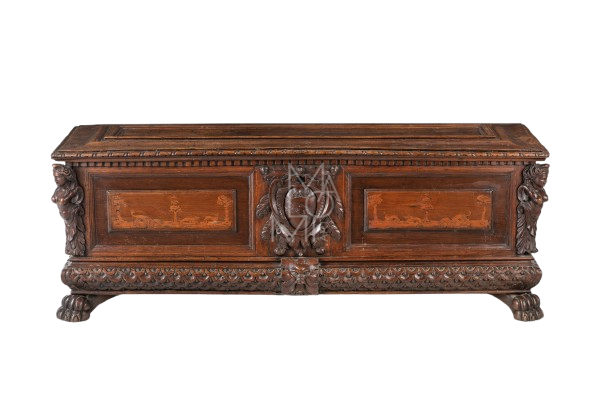
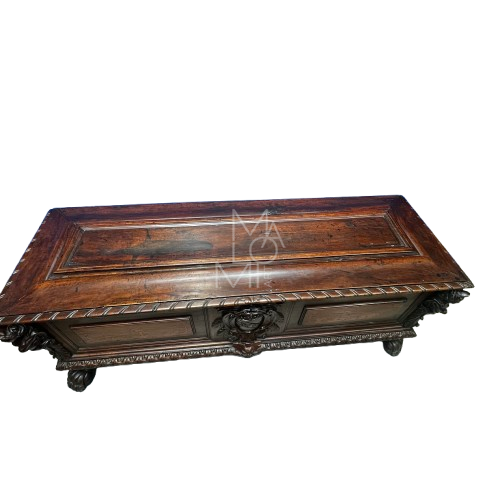
The superb exemplar under analysis masterfully aligns with this expressive tradition. Dating to the second half of the sixteenth century and attributable to the refined manufactures of Central Italy—with a distinct convergence toward the Tuscan region—the object is structured as a classical, wooden "sarcophagus" wherein Late Renaissance architectural rigor welcomes the first, vibrant undercurrents of Mannerism.
2. The Architecture of the Piece: Geometric Rigor and Plastic Vigor
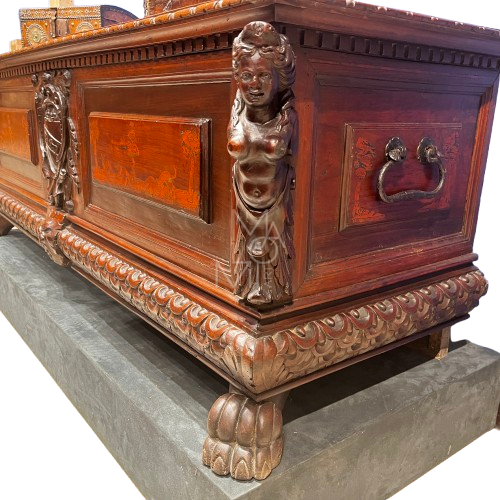
The monumental presence of the cassone is grounded in a rigorous geometric framework, tempered by a sculptural apparatus of extraordinary visual power. The chest rests upon imposing leonine paw feet (piedi ferini), carved in high relief with an anatomical force that imparts both upward thrust and stability to the entire structure. Immediately above the feet rises the lower plinth, enriched by a dense, molded band of continuous fluting (baccellature), an ornamental motif of clear classical derivation that serves as a solid basement for the central chassis.
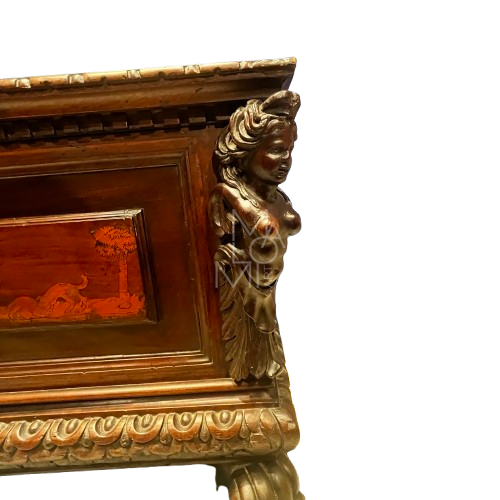
The facade is visually punctuated and flanked at its extremities by corner stiles conceived as anthropomorphic, half-length herm-caryatids emerging directly from the edges of the piece. These female figures perfectly embody the canons of late sixteenth-century Tuscan sculpture, heavily influenced by the artistic legacy of Michelangelo Buonarroti and the architectural inventions of Bernardo Buontalenti and Bartolomeo Ammannati. Moving away from the idealized grace of the Early Renaissance, the carver has imbued these busts with a vigorous, heroic nudity, distinguished by taut, compact breasts and pronounced facial features. The heads are surmounted by elaborate coiffures culminating in a faux-capital that supports the upper molding of the lid. Inferiorly, the figures hybridize, transforming into a densely folded drapery and, ultimately, into a cascade of acanthus leaves that seamlessly integrates with the corner. This design resolutely addresses the spatial transition between the chest's facade and its short lateral panels. On these flanks, the presence of large, original wrought-iron handles, secured by through-staples, testifies to the itinerant nature these chests maintained during the grand domestic relocations of the period's aristocratic families.
3. The Heraldic Enigma: Politics and Alliances in the Central Escutcheon
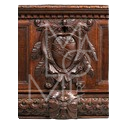
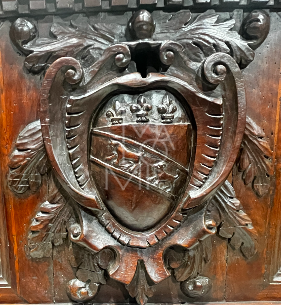
The conceptual fulcrum of the facade is the large, central noble coat of arms, which symmetrically bifurcates the surface of the chest. The oval shield (scudo a cartoccio) is nested within a sumptuous Mannerist cartouche, whose edges scroll inward to simulate the tactile quality of cut parchment or leather. Beneath it, a grotesque mask (mascherone) with a fierce, severe expression performs a classical apotropaic function, symbolically guarding the contents within.
The heraldic reading of the blazon offers decisive parameters for the precise geographical contextualization of the object, revealing an admirable geometric synthesis. The shield is parted per fess (troncato): the chief (capo, the upper section) displays three fleur-de-lis ordered in fess, configuring the celebrated "Chief of France" (Capo di Francia). In Italy, this inclusion represented a highly prestigious honorific privilege granted by the French or Angevin crowns to allied noble families. It stood as the quintessential political badge of the Guelph faction, which historically dominated the urban centers of Florence, Siena, Lucca, and Pistoia.
A notable and fitting Tuscan example is the coat of arms of the Canigiani family from Florence.
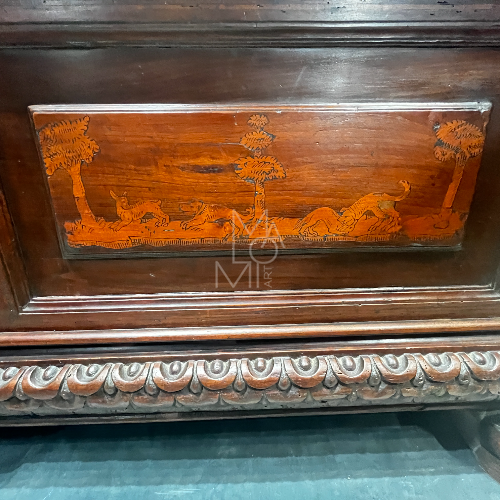
Conversely, the main field of the shield is traversed by a bend (banda), which in this specific instance is charged with only two running hounds (greyhounds) (cani levrieri passanti), arranged with rigorous symmetry along the axis of the ordinary. From a structural standpoint, the choice to introduce only two figures rather than the canonical ternary repetition allows the slender bodies of the greyhounds to occupy the space with greater dynamism and legibility. This visual expedient finds a perfect echo in the right-hand inlaid panel, where the identical hounds are depicted in a hare hunt. Cross-referencing these data with historical blazons from the Tuscan-Umbrian axis (such as the Ceramelli Papiani archives or patrician armorial rolls from Siena and Bologna) isolates the patronage to a family of the Guelph aristocracy. This lineage sought to fuse its dynastic emblem—the two hounds, symbols of absolute fidelity and vigilance—with the manifesto of international political alliance guaranteed by the sovereign chief above.
4. The Humanist Narrative: The Cycle of Inlaid Panels
While the carving asserts the power and authority of the patrons, the two large pictorial reserves, enclosed within heavy, molded frames, reveal the intellectual refinement of the work through the technique of wood inlay (tarsia lignea). Executed in accordance with the tradition of contrast-marquetry (commesso ligneo), the scenes utilize the dark walnut slab as a ground, into which silhouettes of light, soft woods (such as maple or poplar) are inserted. The internal details, the musculature of the animals, and the arboreal foliage are not painted but incised with a burin and masterfully shaded via pyrography (the selective scorching of the wood with hot irons), yielding a two-dimensional graphic effect analogous to contemporary woodcuts.
The left panel evokes an ostensibly contemplative atmosphere, displaying a doe or a roe deer resting beneath the shade of a large, leafy tree—a universal allegory for gentleness and purity of sentiment. However, the right panel unveils the true nature of the cycle: a vibrant and dynamic scene of a hare hunt (ars venatoria). Progressing from right to left, the narrative is punctuated by three stylized trees acting as perspective wings. Two hunting hounds, identifiable precisely as the greyhounds celebrated in the central escutcheon, are captured in mid-action. The first tracks the scent with its muzzle to the earth, while the second is unleashed in a desperate sprint, its sinuous body stretched low to the ground. Ahead of them, a hare with long, erect ears turns dramatically in mid-flight.
The cabinetmaker demonstrated supreme skill in selecting a walnut slab whose horizontal grain naturally conforms to and visually amplifies the sense of velocity and momentum of the chase. Within the context of matrimonial furniture, this splendid allegory merges the exaltation of noble status (hunting as an aristocratic prerogative) with the literary trope of the amorous pursuit and eventual conquest, wherein the hound personifies the tireless devotion and fidelity of the spouse.
5. Conclusion
In conclusion, this monumental cassone stands as a historical and artistic document of exceptional value. Its state of preservation, which retains a magnificent, deep brown patina born of centuries of natural oxidation and traditional beeswax finishes, enhances the perfect equilibrium achieved by its maker. The work admirably synthesizes the three great currents of the High and Late Renaissance: the geometric rigor of palatial architecture, the plastic power of Mannerist sculpture, and the graphic sensibility of the Tuscan humanist tradition.