The sixteenth-century farnese cabinet in solid walnut: a masterpiece of the Italian Renaissance
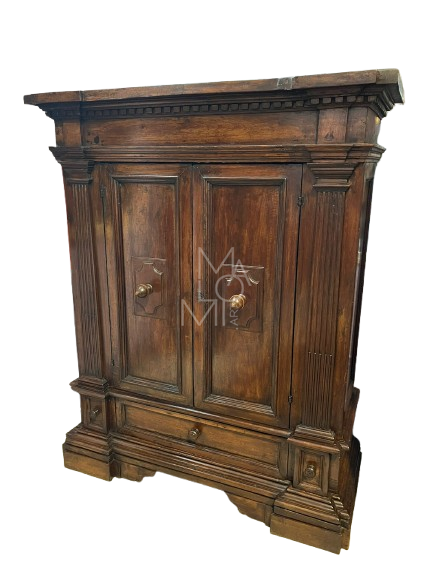
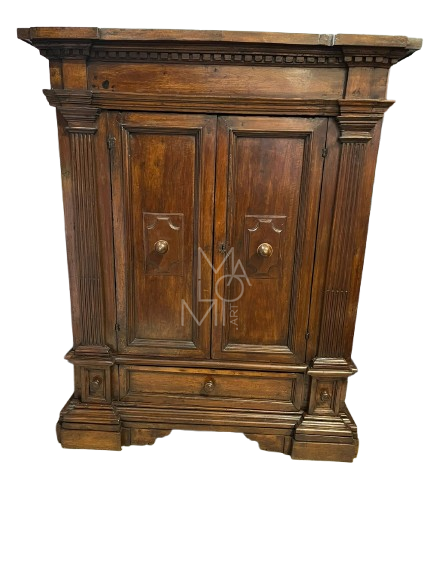
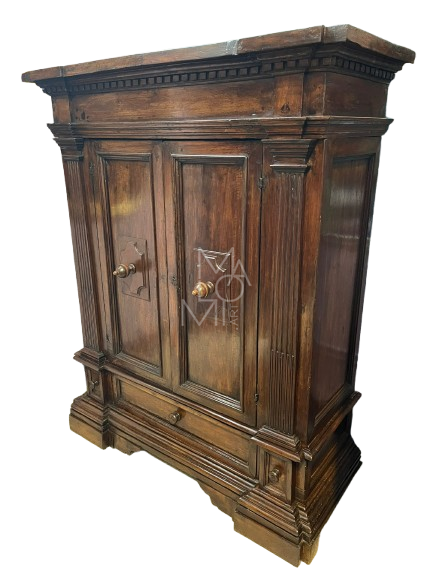
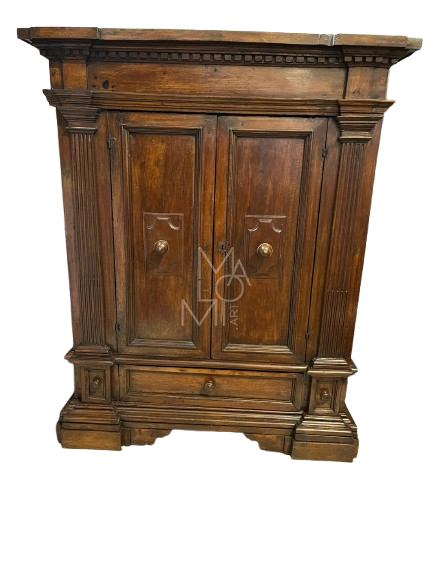
A rare late-Renaissance farnese parade cabinet crafted in solid walnut (Juglans regia) with an exceptionally preserved original period patina. This monumental yet finely proportioned piece (148x58x180 cm) features a striking architectural facade defined by fluted tapered pilasters and Doric capitals. The lower basement contains three drawers, showcasing an ingenious system of two concealed lateral secret compartments (segreti) disguised within the structural plinths. A premier specimen reflecting the courtly patronage of the Farnese dynasty and the architectural principles of Jacopo Barozzi da Vignola.
- Period: 16th century (late Italian Renaissance)
- Style: Renaissance / farnese mannerism (influenced by Vignola's treatises)
- Material: Solid walnut wood (Juglans regia)
- Finish: Authentic, well-stratified historical wax patina
- Dimensions: 148 x 58 x 180 cm
- Configuration: Two paneled doors with indented mistilinear moldings and three drawers (one prominent central drawer and two independent hidden drawers integrated into the corner plinths)
- Condition report: Excellent state of conservation, structurally sound with minor, minor historical restorations consistent with age and long-term domestic use
The Parade Furniture in the Italian Renaissance: The Sixteenth-Century Farnese Cabinet in Solid Walnut
Historical-Artistic Introduction and the Farnese Context
The sixteenth century represented a period of extraordinary transition for Italian cabinetmaking, an era in which furniture progressively abandoned the rigid, purely containment functions inherited from the Middle Ages to assume a distinct architectural and representative value. Within aristocratic residences, furnishings were no longer perceived as isolated blocks or simple tools for domestic use, but were transformed into a true extension of the monumental magnificence of the building that housed them.
In this scenario of profound artistic renewal, the patronage of the Farnese family left an indelible and deeply personal mark. Under the spiritual and political guidance of prominent figures such as Pope Paul III, born Alessandro Farnese, and Cardinals Alessandro the Younger and Odoardo, the dynasty promoted a monumental taste of astonishing coherence. This aesthetic drew its lifeblood from continuous Roman archaeological discoveries and the rise of major contemporary architectural treatises.
The Farnese court surrounded itself with the most brilliant minds of the time, entrusting the direction of its construction sites to architects of the caliber of Sebastiano Serlio and Jacopo Barozzi da Vignola, who did not disdain designing furniture, doors, and ceilings to uniform the decorative pattern of the rooms. The specimen under examination fits fully into this refined current of thought, reflecting those aesthetic canons in which the celebration of dynastic power passed as much through the majesty of a stone facade as through the solid and austere elegance of a wooden artifact intended for the private rooms of the palace.
A historical curiosity linked to this cultural milieu concerns the Farnese obsession with visual harmony. It is said that Cardinal Alessandro the Younger was so attentive to furnishing details that he personally supervised the cabinetmakers' drawings, demanding that even the grain of the walnut be oriented to complement the natural light coming through the windows of his residences.
Morphological Analysis and Proportions: The Exceptionality of the Dimensions
From a typological point of view, the work features measurements of one hundred and forty-eight centimeters in width, fifty-eight in depth, and one hundred and eighty in height—spatial coordinates that bestow upon the piece a status of distinct rarity within the antiquarian market and specialized studies. Indeed, the vast majority of monumental cabinets born in the late-Renaissance period developed to considerably greater heights, often exceeding two or two and a half meters, as they were intended for the main reception halls of city palaces, large libraries, or the sacristies of cathedrals.
The reduced and proportioned scale of this specific specimen suggests a radically different destination of use, linked to private environments of the highest rank, such as a personal study, a private bedroom, or a backroom intended for restricted diplomacy. In these gathered spaces, the same solemnity as parade furniture was required, but declined in a contained volume that could dialogue with lower ceilings and intimate spaces.
In the period art market, furniture presenting these proportions is considered a true treasure, as over the centuries many large cabinets were brutally truncated or adapted to the changing housing needs of subsequent eras, losing their integrity. This piece, conversely, preserves its original scale intact, demonstrating how the cabinetmaker was able to contract the monumental Farnese architectural module without sacrificing its overall harmony and majesty.
The Architectural Front and the Application of Classical Orders
The facade of the piece is conceived with the same design logic used to draw the facade of a Renaissance palace, dominated by a rigorous symmetry and a precise geometric scanning of spaces. The upper crowning is defined by a thick molded cornice, enriched by a dentil motif of clear classical derivation that serves as an ideal entablature and visually crowns the entire structure.
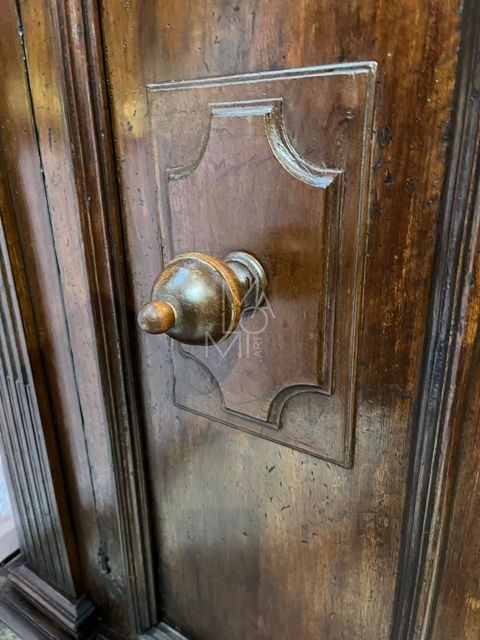
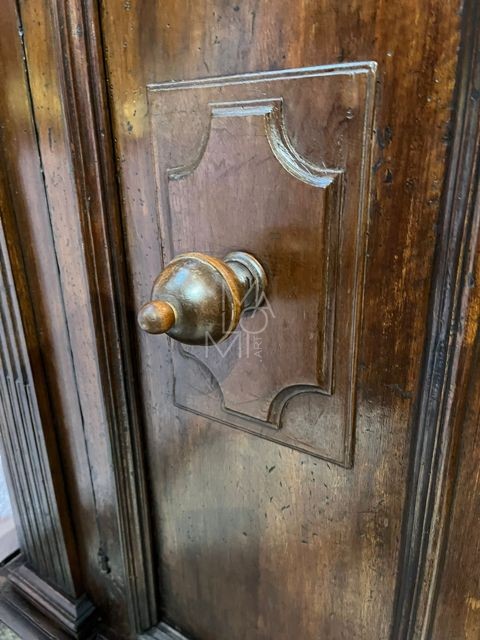
Immediately below, the central body is rhythmically divided by two large paneled doors, embellished with raised geometric moldings and adorned with turned central knobs. Scanning the facade vertically are the lateral pilasters, the true qualifying element of the front, which appear elegantly fluted and tapered toward the top, culminating in Doric order capitals. This specific decorative choice systemizes the direct reception of rigid Vitruvian canons within the field of applied arts.
Closing the composition is the lower basement, where geometric plinths mirror the vertical projection of the overlying pilasters, visually anchoring the mighty structure to the ground and bestowing upon the cabinet a stability that is not only physical, but above all aesthetic. The use of the Doric order is not accidental, as the treatises of the time associated it with concepts of strength, stability, and institutional authority—qualities that the Farnese family constantly intended to project onto their entourage and guests.
Material Aspects: Solid Walnut and the Preservation of the Patina
The choice of material for the creation of this piece fell upon walnut wood, the principal and undisputed essence of sixteenth-century Italian cabinetmaking. Appreciated by master woodwrights for its compactness, its extraordinary natural resistance to pests, and its exceptional aptitude for sculpture and fine molding, walnut allowed for the sharp, clean definition of the architectural profiles visible here.
The historical and artistic value of the artifact is further ennobled by the extraordinary preservation of its original patina, a period skin stratified over the centuries through the wise application of beeswax and the inevitable natural oxidation of the wooden fiber exposed to air. This patina gives the surface a deep luster and a warm, amber coloration dense with nuances, which the expert eye of the antiquarian can immediately distinguish from chemical stripping or artificial patinas executed in later eras.
A fascinating anecdote related to the processing of walnut in the sixteenth century concerns the seasoning times of the wood. The most renowned workshops purchased the tree trunks and left them to rest in the shade of sheds for over a decade before daring to touch them with a chisel, as it was believed that only a long sleep could free the wood from the internal tensions of the sap, ensuring that the furniture would not warp once completed. Preserving this original patina means safeguarding the very authenticity of the piece, protecting that microfilm of history that separates an authentic masterpiece of the Renaissance from a highly commendable nineteenth-century replica.
The Basement and the Configuration of the Secret Drawers
The lower part of the piece reserves the most fascinating constructive surprise, revealing an architecture of ingenuity typical of great late-Renaissance cabinetmaking. At a superficial glance, the solid basement seems to house only a large central drawer, framed and mirrored in stylistic coherence with the upper doors. However, structural analysis reveals that the two lateral plinths placed at the base of the pilasters are not blind support blocks, but hide two smaller drawers that can be extracted completely independently.
This configuration of three overall drawers responds to the refined culture of the secret, a practice widespread in sixteenth-century courts and particularly loved within the Farnese context. In an era marked by political plots, wars of influence, and subterranean diplomacy, these disguised compartments, historically defined as secrets, served to conceal the custody of confidential documents, encrypted letters, dynastic seals, or gold coins.
The lower waist line of the basement is then moved by shelf feet shaped with scroll profiles, which perform the task of lightening the geometric severity of the supporting structure without compromising its visual stability. The presence of these concealed drawers transforms the cabinet from a simple container into an ingenious safe, where security was entrusted not to the strength of iron or keys, but to the cleverness of the design and the blindness of the observer uninitiated into the secrets of the house.
State of Conservation and Restorations of Use
The overall examination of the furniture highlights the presence of small and physiological restorations of use, maintenance interventions that do not affect the historical value of the artifact but, on the contrary, testify to its secular functional continuity within the residences that hosted it. Over the course of more than four centuries, furniture made of solid wood inevitably undergoes small structural movements due to variations in humidity and temperature, causing micro-fissures or settling of the joints.
The interventions detectable on this cabinet are to be considered exquisitely conservative and limited, located mainly on the rotation pins of the doors, on the sliding guides of the internal drawers, or on the support blocks of the feet on the ground. A curious detail that emerges from the analysis of the interior of the drawers is the presence of a paper lining printed with geometric motifs, a subsequent decorative and protective addition attributable to the sensitivity of restorations executed between the nineteenth and early twentieth centuries to refresh the furniture.
These conservative touches guarantee the perfect stability and daily usability of the object, leaving the aesthetic integrity of the facade and the precious period skin intact, allowing the cabinet to reach us with its severe and fascinating Renaissance monumentality unimpaired.
Stylistic Comparison: The Farnese Design Culture between Rome and Caprarola
To fully understand the genesis and formal maturation of the cabinet under examination, it is necessary to ideally insert it into the dense network of monumental building sites promoted by the Farnese in the second half of the sixteenth century—building enterprises dominated by the titanic figures of the architects Jacopo Barozzi da Vignola and Giacomo della Porta. The furnishing does not configure itself as an isolated or autonomous object, but as an authentic microcosm that reflects the same syntactic and decorative choices adopted in the great factories of the house, particularly within the severe Palazzo Farnese in Rome and the spectacular Villa Farnese in Caprarola.
In the Roman context, the Farnese language distinguishes itself by a solemn austerity and the philological recovery of classical antiquities. The cabinet borrows from this specific environment the rigorous geometric scanning of the doors and the adoption of the Doric order, considered the most solid and institutional among architectural orders, perfect for visually expressing the imperishable authority and stability of the family.
The paneled doors with their indented corners recall directly the profiles of the wooden coffered ceilings designed by Antonio da Sangallo the Younger and completed by Daniele da Volterra for the rooms of the Roman palace, while the search for a strong chiaroscuro projection in the cornices mirrors the same plastic will that regulates the windows of the monumental internal courtyard. Conversely, if Rome represents rigor and the norm, the majestic residence of Caprarola introduces the most intellectualistic, capricious, and properly Mannerist component of the Farnese taste.
In Caprarola, fixed and movable furnishings were conceived by Vignola himself to blend harmoniously with the pictorial decorations and stuccos executed by the brothers Taddeo and Federico Zuccari. The pilasters of the cabinet, which show a slight and refined tapering toward the top, closely echo the architectural frameworks painted on the walls of the famous Room of the Farnese Deeds, where the simulated architectures served to dilate real space.
Furthermore, the very presence of dissimulated lower drawers perfectly responds to the courtly and theatrical culture of Caprarola, a residence steeped in scenographic devices, hidden passages in the wall, and furniture equipped with concealed compartments designed to guard the dense encrypted correspondence of Cardinal Alessandro Farnese. It is said that in Caprarola the cardinal amused himself by challenging foreign ambassadors to find secret documents inside his furniture, enjoying the bewilderment of others in the face of the perfection of the wooden disguises devised by his cabinetmakers.
The Figure of the Ebanista-Architetto in the Late Sixteenth Century
During the late Renaissance, a radical sociological and professional transformation occurred regarding the figure of the wood craftsman, marked by the transition from the carpenter and woodwright of medieval stamp to the multifaceted and learned figure of the ebanista-architetto (cabinetmaker-architect). This epochal shift was guided principally by the extraordinary dissemination of printed treatises and the pressing need of noble courts to uniform the so-called minor arts to the global design of the aristocratic building.
The cabinetmaker of the second half of the sixteenth century was no longer a simple material executor working by empirical approximation or following customs passed down orally, but possessed a solid training in drawing (disegno), theorized by Giorgio Vasari as the true father of the three major arts. The sixteenth-century workshop adopted the architectural treatises of Sebastiano Serlio, particularly the Regole generali di architetura of 1537, and of Vignola, with his famous Regola delli cinque ordini d'architettura of 1562, as true manuals of geometric modeling on a reduced scale.
The analyzed Farnese cabinet offers a clear demonstration of this widespread theoretical competence, since the calibrated tapering of the pilaster and the millimetric calculation of the modules of the Doric capital do not stem from artisanal improvisation, but faithfully follow the precise proportional plates provided by court architects. The complexity of such a monumental cabinet in solid walnut also required the convergence and wise coordination of various specialized artisans within the same workshop space.
The square carpenter (legnaiolo di dritto) dealt with the choice, seasoning, and initial cutting of the large solid walnut planks, guaranteeing the geometric solidity of the supporting framework of the piece. Alongside him operated the turner, a figure specialized in working on the lathe the projecting and spherical elements, such as the top-shaped or acorn-shaped knobs visible at the center of the door panels.
Finally, the carver dedicated himself to the patient chiseling of the longitudinal grooves of the pilasters and the meticulous finishing of the molded dentil cornices, operating like a sculptor on the wooden support. The cabinetmaker-architect assumed the role of director of this articulated creative process, translating the monumental and solemn language of stone, marble, and stucco into the flexible, warm, and daily-use modules of wood, giving life to furnishings conceived to all intents and purposes as true domestic monuments destined to conquer time.
Archival Evidence and Regulations of the Guilds of Woodwrights in Rome and Parma in the Sixteenth Century
During the sixteenth century, the production of furniture of monumental rank was rigidly regulated and overseen by the guild system, an ancient institution that guaranteed both the absolute technical quality of the artifact placed on the market and the ironclad socio-economic protection of the artisans regularly registered with the guild. The comparative study of the regulations of the guilds of Rome and Parma highlights two distinct city realities, yet constantly connected and influenced by the commissions of the Farnese family.
In Rome, carpenters, cabinetmakers, and carvers were united in the powerful Università dei Legnamari, officially established at the beginning of the fifteenth century and subsequently reorganized and endowed with new statutes precisely under the pontificate of Paul III Farnese. The Roman guild possessed its own spiritual and administrative headquarters in the suggestive church of San Giuseppe dei Falegnami, built above the Mamertine Prison in the Roman Forum, a place that symbolized the sacredness and centrality of the craft within city life.
The Roman statutes of the sixteenth century imposed severe financial penalties and the seizure of goods on anyone who used wood that was not perfectly seasoned or essences other than those agreed upon in the contract with the client. For furniture of aristocratic rank, the use of national walnut had to be rigorously free of sapwood, which is the outermost, lightest, and softest part of the tree trunk, to prevent premature attack by insects and ensure maximum durability through the centuries.
Furthermore, to obtain the title of master and be authorized to open an independent workshop equipped with a public sign, artisans had to pass a strict practical examination before the Consuls of the University. This exam consisted of the creation of the so-called masterpiece (capolavoro), which was often identified precisely in an architectural cabinet or a molded sideboard, artifacts in which the commissioners evaluated the perfect execution of dovetail joints and geometric precision in cutting cornices according to classical canons.
Parallelly, in Parma, following the birth of the Farnese Duchy, local guilds underwent a profound restructuring guided by the central power to conform to the qualitative and ceremonial standards of the great European courts. The Arte dei Legnaioli di Parma possessed extremely rigid workshop specifications that required registered masters to affix a hot brand or a workshop punch on furniture intended for sale, allowing the Consuls of the Art to track production and collect the relative corporate taxes.
However, furnishings made by direct ducal commission and intended for the family palaces often enjoyed a special exemption from the internal regulations of the Art. This special safe-conduct allowed court architects to employ foreign craftsmen—particularly trusted Tuscan and Roman makers—without incurring the sanctions of the local guild, favoring a fruitful contamination of styles and techniques that made Padan Farnese cabinetmaking a unique phenomenon in the artistic panorama of the late Renaissance.
The Historical-Social Context of the Late Sixteenth Century
The creation of a Farnese cabinet of this specific typology and rarity is situated within a historical and social fabric deeply marked by the redefinition of the concepts of private space, status symbol, and visual expression of political power in Counter-Reformation Italy. The Council of Trent did not solely discipline the dogmatic, theological, and religious sphere of Christianity, but exerted a pervasive and profound influence on daily customs, lifestyle, and the aesthetic choices of the aristocracy linked to the papacy.
Roman and Padan nobility progressively conformed to a model of public behavior marked by maximum gravitas and a severe and composed external dignity. This shift in moral sensitivity translated into interior decoration with the abandonment of the exuberant polychromies, multicolored perspective inlays, and rich gildings that had characterized the early Renaissance of Tuscan matrix.
In their place stepped the monumental purism of solid walnut left in its natural coloration, whose solemnity and beauty were entrusted exclusively to the geometric perfection of proportions and the rigor of architectural details. In this context, the cabinet, in its rare and wisely collected dimensions, responds to a crucial social transition, namely the birth and development of private rooms and apartment studies within large aristocratic palaces.
While in the fifteenth century court life and representation took place almost entirely in large, public, and accessible halls, the late sixteenth century saw the flourishing of reserved and protected wing environments, where the cardinal or the lord of the palace retired to manage secret diplomacy, study the classics, or receive only the most intimate and influential guests. In these protected spaces, walnut furniture assumed a double and fundamental social value.
On one hand, there was a clear exhibitive and cultural value, since the piece showed the refined humanistic culture of the owner, capable of reading and decoding the learned Vitruvian and Vignolesque references impressed on the fluted pilasters and dentil cornices. On the other hand, an absolute functional and fiduciary value emerged, as the cabinet became the material custodian of state secrets and family finances.
The sophisticated engineering of the drawers disguised in the basement configured itself as the perfect mirror of an aristocratic society dominated by suspicion, prudence, and the constant need to protect one's political papers from the eyes of rivals, transforming a piece of furniture into a silent and faithful accomplice of dynastic history.
Bibliography
Alberici, Clelia. Il mobile del Rinascimento in Italia. Milan: Electa, 1996.
Antonelli, Giovanni. "Gli statuti delle corporazioni artigiane nella Parma farnesiana del XVI secolo." Archivio Storico per le Province Parmensi, n. s., XXIV (1977): 115-142.
Barocchi, Paola, ed. Scritti d'arte del Cinquecento. Volume III: Arti minori, ecfrasi e trattatistica. Milan-Naples: Ricciardi, 1977.
Bertolotti, Antonino. Artisti urbinati in Roma prima del secolo XVIII: Notizie tratte da documenti d'archivi romani. Urbino: Tipografia editrice russa, 1881.
Colli, Luisa. "L'Università dei Legnamari di Roma e i suoi statuti cinquecenteschi." Rassegna degli Archivi di Stato XLII, no. 2 (1982): 201-235.
Feigenbaum, Gail, ed. Display of Art in the Roman Palace, 1550–1750. Los Angeles: Getty Research Institute, 2014.
González-Palacios, Alvar. Il tempio del gusto: Le arti decorative in Italia fra classicismo e barocco. Milan: Longanesi, 1984.
Lotti, Pierluigi. San Giuseppe dei Falegnami e la sua Università a Roma. Rome: Edizioni d'Arte, 2003.
Praz, Mario. Filosofia dell'arredamento: I mutamenti del gusto nella decorazione interna attraverso i secoli. Milan: Garzanti, 1981.
Santi, Bruno, ed. I Farnese: Arte e collezionismo. Milan: Electa, 1995.
Vignola, Jacopo Barozzi da. Regola delli cinque ordini d'architettura. Rome: s.n., 1562. Facsimile reprint with critical commentary edited by Christoph Luitpold Frommel. Milan: Il Polifilo, 2002.