The seventeenth-century Tuscan walnut center writing desk: a masterpiece of Florentine Baroque
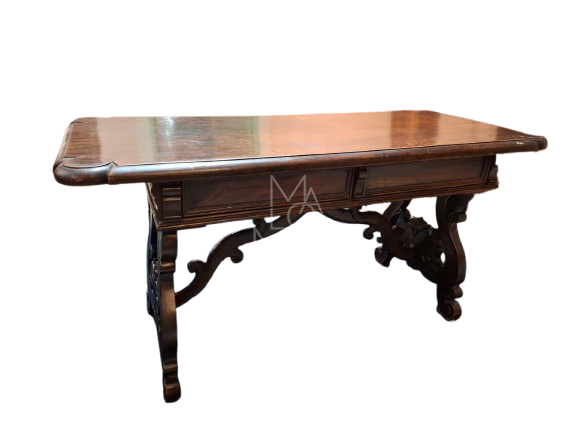
- Typology: center writing desk (patrician library table)
- Period: 17th century (Baroque era)
- Origin: Italy, Tuscany (Florentine area, grand ducal workshop influence)
- Material: solid walnut wood (Juglans regia)
- Dimensions: 178 x 76 x 86.5 h cm
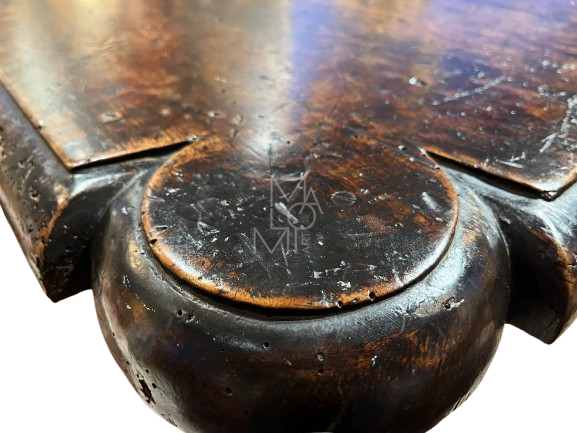
- Tabletop features: single monumental plank of solid walnut, characterized by molded rounded edges and four eared, rounded corners executed with masterly hand-tooling.
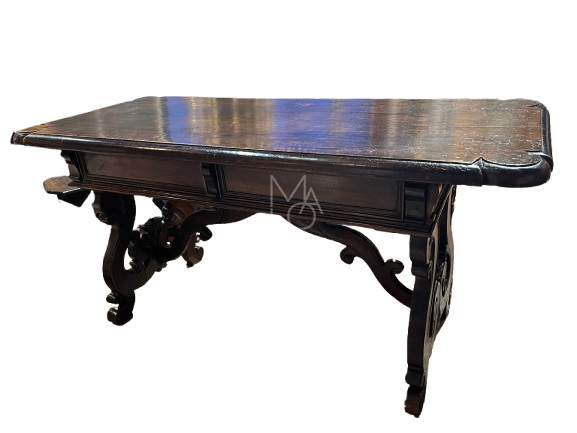
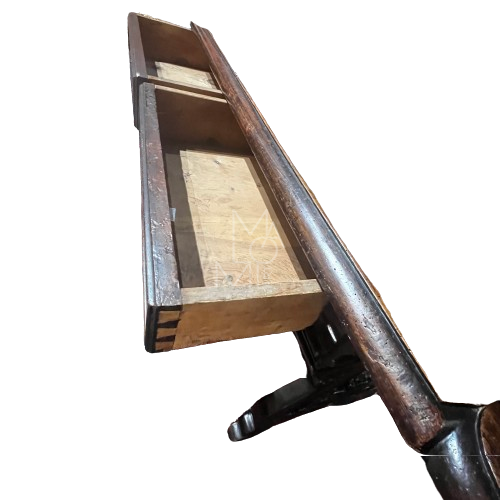
- Apron configuration: the façade houses two functional, side-by-side drawers with an internal structural partition; the reverse is immaculately finished with raised mitered moldings simulating drawer fronts for comprehensive center-room display.
- Undercarriage: supported by two lateral, sculptural trestles in the shape of a lyre (or kithara) exhibiting high-relief perimeter moldings; tied together by a double-curved longitudinal shaped stretcher, centered by an intaglio depicting a floral vase.
- Conservation report: excellent structural stability, historicized natural patina with stratified beeswax layers, old stationary wood-boring insect exit holes partially occluded by wax, minor secular abrasions consistent with age and authenticity along the exposed perimeters.
The Seventeenth-Century Tuscan Center Writing Desk: A Historico-Artistic, Typological, and Structural Analysis
Introduction: The Historical and Cultural Context of the Tuscan Baroque
The seventeenth century represents a period of complex cultural and artistic transition for Tuscany, and specifically for the Florentine area. Under the consolidated Medici Principate, Florence ceased to be the epicenter of the Renaissance revolution, transforming instead into a highly refined center for the formulation of Baroque taste. This new stylistic paradigm was characterized by an elegant moderation and a profound continuity with classical and sixteenth-century traditions.
The wooden furnishings of this era faithfully reflect this dynamic. In contrast to the magniloquence and theatrical exuberance of Roman or Venetian Baroque, Tuscan cabinetmaking countered with a geometric, structural rigor, wherein monumentality was mitigated by composed lines and the superb quality of the raw material.
Historical records reveal that this formal restraint was not merely an aesthetic choice, but a precise political directive. The Medici sought to project an image of institutional stability and dynastic continuity through a moderated taste, deliberately avoiding the dramatic excesses of rival courts. The center writing desk under examination fits perfectly within this cultural milieu, condensing both the representative status and functional requirements of the seventeenth-century Florentine aristocracy and upper bourgeoisie.
The Raw Material: Solid Walnut and Construction Technique
The utilization of walnut wood (Juglans regia) constitutes one of the defining traits of high-end furniture production in central Italy during the Seicento. Chosen for its compactness, resistance to wood-boring pests, and, above all, its extraordinary suitability for carving and polishing, walnut allowed the stipettai (cabinetmakers) of the period to achieve silken surfaces and deep, rich reflections. Craftsmen of the era jokingly referred to walnut as "the wood of lords," as its prohibitive cost and the difficulty of sourcing unblemished trunks restricted its use strictly to patrician commissions.
The presence of a tabletop crafted from a single, monumental plank of walnut—measuring one hundred seventy-eight centimeters in length and seventy-six centimeters in width—is indicative of an artifact of the highest caliber. Repercussing trunks of such dimensions free of structural defects required a rigorous selection of timber and a flawless seasoning process that could last up to a decade within workshop repositories. The molding of the rounded edges and the refined carving of the four eared, rounded corners do not merely serve an aesthetic function; they soften the visual impact of the wood's thickness, imparting a sense of plasticity and geometric continuity uniquely characteristic of Florentine design.
Typological Analysis: The Center Writing Desk
The designation "center" attributes a precise spatial and social function to this piece of furniture within the seventeenth-century residence. Unlike wall-bound furniture, such as monumental cabinets or sideboards, a center piece is conceived to be observed and utilized from a three-hundred-sixty-degree perspective. This necessitated that the reverse side of the desk receive the identical executive care, polishing, and aesthetic dignity as the façade.
The history of this typological form is intertwined with a fascinating transition of domestic customs. Until the late Renaissance, the act of writing was considered a purely laborious exercise, and scholars frequently composed while standing at tall lecterns. In the seventeenth century, however, the desk evolved from a simple monastic or notarial workstation into the very hub of the nobleman's intellectual and political life. Collocated at the center of a domestic hearth, a library, or a formal reception hall, the writing desk became the stage upon which contracts were signed, correspondence was drafted, and familial authority was exercised.
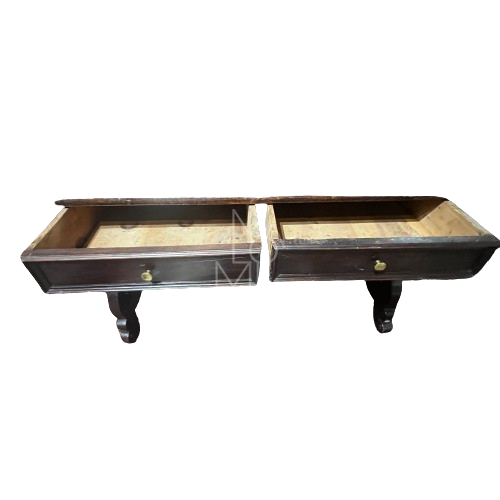
On the façade of the piece, the under-top frieze houses two functional, side-by-side drawers equipped with small, geometric metallic pulls. These elements satisfy the practical necessity of storing documents, inkwells, and writing instruments, integrating seamlessly into the overall architecture of the apron without disrupting its clean lines and rigorous symmetry.
The Decorative Repertoire: Lyre Supports and the Floral Vase
The decorative and structural apparatus of the lower base represents the expressive zenith of the piece, combining classical antique citations with seventeenth-century naturalistic elements. The lyre (or kithara) shape of the lateral supports traces its roots back to classical archaeology, rediscovered during the Renaissance and reinterpreted through a Baroque lens. This sinuous, eurhythmic silhouette channels the immense weight of the solid top via a vector logic that unifies static stability with visual elegance, replacing traditional vertical legs with a dynamic, sculptural profile.
Positioned centrally on the connecting stretcher, a carved vase with floral motifs introduces an element of vibrant naturalism. This decorative theme mirrors the profound passion of the Medici court for botany and still-life painting. Notably, the grand dukes amassed rare floral specimens within the Boboli Gardens and various Medici villas, prompting master carvers to reproduce buds and corollas in wood with near-scientific precision. The carving, executed in high relief upon the central longitudinal stretcher, alleviates the inherent robustness of the supports and establishes a visual vanishing point that captivates the observer, counterbalancing the geometric severity of the tabletop above.
Dimensional Synthesis and Spatial Proportions
A geometric analysis of the writing desk reveals a meticulous calculation of proportions. The length of one hundred seventy-eight centimeters combined with a width of seventy-six centimeters yields a rectangle that guarantees an expansive workspace, ideal for simultaneously accommodating volumes, manuscripts, and the physical presence of interlocutors seated frontally.
The height of eighty-six and a half centimeters stands slightly above contemporary ergonomic standards, yet it remains perfectly coherent with seventeenth-century seating, which was frequently outfitted with thick, high cushions. Furthermore, it accommodated the formal, upright posture required during official proceedings of the era. The synthesis of these dimensions yields a piece of grand volumetric impact, capable of commanding its surrounding space without becoming visually oppressive, precisely due to the calculated interplay of solids and voids generated by the carved leg supports.
Critico-Visual Appendix: Surface Analysis and Historical Patina
Radiant Analysis of the Single-Plank Tabletop
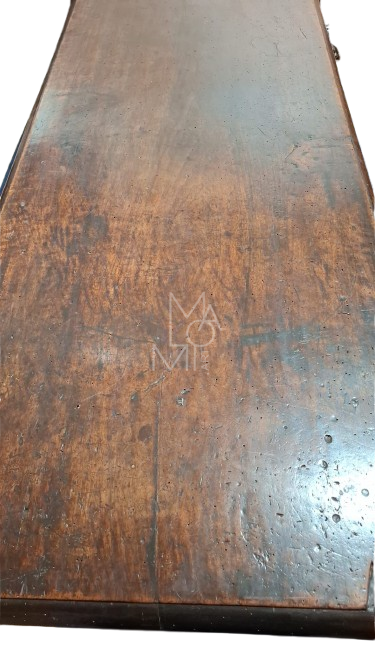
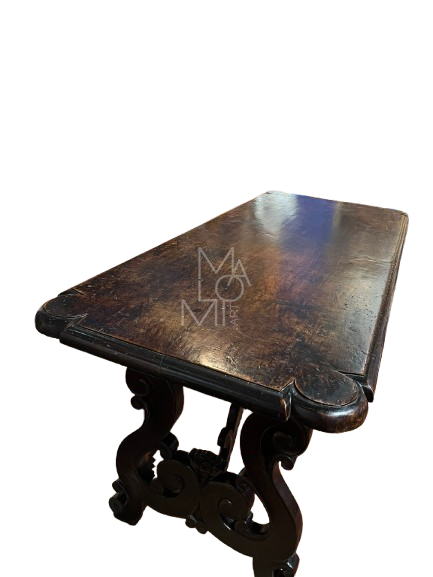
An angled perspective accentuates the flow of the walnut grain and the natural irregularities of the surface, accumulated across nearly four centuries of domestic history. Slight undulations and depressions are discernible upon the plank. These minor hollows are the tangible signatures of the solid wood naturally bowing and settling in response to historical relative humidity and temperature fluctuations—a phenomenon cabinetmakers poetically termed "the breathing of the wood."
The surface reflects ambient light in a soft, diffused manner, typical of the stratification of historical wax layers. Micro-scratches, minor candle-burn marks, and signs of friction do not mar the piece; rather, they certify its intellectual and administrative utility, heightening its historiographical allure.
Investigation of the Carved Edges and Eared Corners
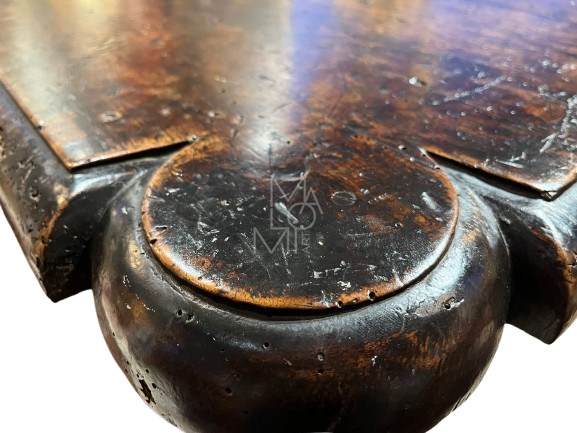
A close-up examination permits an appreciation of the masterly execution of the perimeter molding. The projection of the four eared, rounded corners protrudes with geometric vigor against the straight axis of the frame. This stylistic treatment softens the overall contour, creating a dynamic chiaroscuro contrast between the mass of the top and the negative space beneath. The rounded edge exhibits a distinct darkening at points of historical contact and friction, serving as a primary indicator for authenticating seventeenth-century Tuscan patinas.
Sculptural Dynamism of the Lyre Support
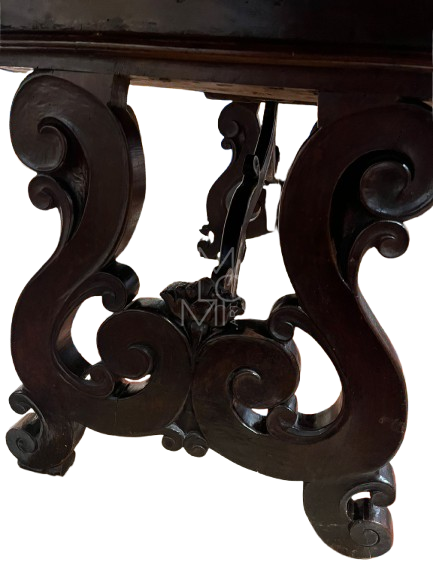
From a low angle, the tridimensionality of the inferior support structure emerges clearly. The lyre profile is far from a simplistic, bidimensionally jigsawed silhouette. The carving boasts a pronounced relief wherein curves twist into volutes that impart plastic tension and kinetic energy to the framework. The junction where the central longitudinal stretcher meets the decorative node of the support is clearly visible. This structural element secures the equilibrium of the desk, preventing the lateral sway that would otherwise be induced by the monumental weight of the solid tabletop.
The Position of this Stylistic Form within Florentine Museum Collections
Palazzo Pitti and the Royal Apartments: Historical Furniture in Habitual Contexts
The solid walnut center writing desk finds precise typological parallels within the network of monumental residences and museum complexes of Florence, most notably within the state system of the Uffizi Galleries, which encompasses the palace of Palazzo Pitti. The transition from the celebratory, rigid furnishings of the late Renaissance to the moderated Tuscan Baroque is comprehensively documented across these collections, echoing the refined taste of the Medici grand ducal court. Within the piano nobile of Palazzo Pitti, the opulent spaces of the Royal Apartments offer an ideal spatial contextualization for this specific genre of furniture .
Inside the dayrooms and private studies of the palace, the walnut center desk operated as the axis of the prince's bureaucratic and intellectual endeavors. Affined examples in terms of scale and timber treatment coexist alongside the celebrated pietre dure masterworks produced by the Galleria dei Lavori. While Palazzo Pitti is widely renowned for its imposing, heavily gilded Roman-style consoles or magnificent late-historical pieces from the Lorraine and Savoy periods, the presence of carved walnut furniture represents the autochthonous Tuscan current of stability and architectural sobriety. This style served as an elegant, austere foundation before the decorative stratifications of the eighteenth and nineteenth centuries overrode the rooms.
The Museum of the Opificio delle Pietre Dure and Center Tables
A critical key for interpreting the trestle supports and substructure of this writing desk is provided by the collections of the Museum of the Opificio delle Pietre Dure. Many of the majestic tabletops inlaid with Florentine mosaic (commesso fiorentino) or polished scagliola produced during the seventeenth century for the court demanded exceptionally stable bases. These were frequently commissioned from Tuscan woodcarvers who favored solid walnut and fashioned supports with turned balusters or sweeping, scrolled lyre profiles. The botanical culture embodied by the central floral vase intaglio dialogues directly with the ornamental naturalistic repertoires characteristic of the grand ducal workshops, which were celebrated for depicting flora and fauna to satisfy Baroque connoisseurship.
Medici Villas and Extra-Urban Residences
The optimal placement for a solid walnut table featuring a single-plank top, characterized by sculptural elegance devoid of excessive gilding, finds its zenith within the Medici Villas, such as the Villa Medicea della Petraia. In these suburban, hilly retreats, seventeenth-century furnishings retained a more intimate connection with the visible, natural grain of the wood. Refectory tables (tavoli fratini) and writing desks featuring lyre or cetra supports were positioned squarely in the center of salons for private study or for receiving guests during the court's seasonal villeggiatura. A famous archival anecdote notes that the grand duke himself preferred to retreat to La Petraia to escape the rigid protocol of Palazzo Pitti, utilizing large, un-gilded walnut tables to conduct his private, extensive letter-writing campaigns.
The Museo Nazionale del Bargello and Palazzo Davanzati
Regarding high-period Tuscan furniture, the typological transition from the sixteenth to the seventeenth century is further documented within other state-run collections of antique decorative arts. Palazzo Davanzati, operating as the Museum of the Florentine House, charts the typological evolution of the simple trestle-board table toward the modern writing desk equipped with drawers, revealing the structural genesis of the fluid, Baroque contours that define the specimen under analysis.
Techno-Morphological Appendix: Structural Focus on the Lyre Support
The Evolution of the Baroque Lyre and the Geometry of Volutes
A low-angle, axial view of the undercarriage offers a detailed disclosure of the furniture's complex plastic architecture, allowing an examination of the nexus where static functionality yields to Baroque sculptural expression. The visual data showcases the skill of the Tuscan woodcarver in manipulating solid walnut into fluid curves that defy the inherent rigidity of the wood. The design of the support unfolds through an intertwined system of opposing C-scrolls and S-scrolls. This alternation creates a sinuous, undulating contour that shifts vertical loads from the top down toward the scrolled feet resting upon the floor. The perimeters of these supports are heavily articulated with raised moldings that track the entirety of the silhouette. This technique enhances the chiaroscuro value under direct lighting, visually lightening the mass of the timber structure.
The Floral Vase and the Stretcher Mortise
The geometric center of the base reveals the critical locus of both mechanical joinery and ornament. At the core of the composition, the carving blossoms into a stylized chalice or botanical bud, from which the inferior volutes diverge. The execution details exhibit minor gouge strokes (colpi di sgorbia) that substantiate an entirely manual, artisan execution. Immediately behind this central decorative element inserts the robust longitudinal stretcher, visible in the background, which ties the two halves of the desk together. This bracing element, typical of fratini tables and center desks, thwarts lateral racking and ensures the long-term equilibrium of the structural frame.
Conservation Status of the Base and Inferior Patina
The feet and lower profiles supply pivotal evidence regarding the antiquity of the artifact. Within the recesses and crevices of the carving, a natural accumulation of ancient wax and historicized dust has settled—a parameter paramount for experts verifying the legitimacy of an early patina. The lower scrolls serving as feet manifest minor abrasions consistent with centuries of friction against floors, long antedating the modern application of the wheeled dollies visible in the photograph. A curious detail linked to these markings stems from domestic history: house servants in aristocratic palaces, when washing floors with mixtures of water and vinegar, inadvertently corroded the bases of furniture. Consequently, workshop masters began fashioning easily replaceable block feet or highly elevated scroll terminals to protect the primary carvings from moisture.
Micro-Structural Analysis: The Eared Corner and the Tabletop Surface
Joinery and Carving of the Eared Corner
A macro-photographic view of the corner offers a privileged look into the structural matrix of the piece, revealing details regarding seventeenth-century Tuscan joinery techniques and the archaeology of its surfaces. The close-up exposes the intricate geometric transition between the primary plank and its corner projection. The demarcation line where the central core of the top meets the circular protrusion of the corner is clearly observable. This configuration, traditionally classified as an "eared corner" (angolo orecchiato) or a "boss" (formella), was executed either by tongue-and-groove insertion of separate blocks or by carving directly from a massive, oversized blank to deliberately break the monotony of a strict rectangular perimeter. The edge slopes outward through a pronounced scotia (hollow) molding and a bulbous torus. This profile, accomplished manually via specialized molding planes and scrapers, imbues the perimeter with a plastic, sculptural quality distinctive of Florentine Baroque design, which systematically abandoned sharp edges in favor of enveloping contours.
Macro-Analysis of the Surface: Patina, Wear, and Wood-Boring Pests
The surface of the solid walnut presents itself as a historical palimpsest rich in conservation data. The wood exhibits the characteristic diffuse porosity inherent to Juglans regia. The historical finishes that saturated these fibers highlight dark grain lines and prized natural variegated figuring. Numerous small, circular exit holes are plainly visible, signifying historical infestations of wood-boring beetles (Anobiidae). The partial occlusion of these exit holes by subsequent generations of wax polish serves as an excellent benchmark for authenticity; it proves that the biological activity is ancient and that the piece has undergone repeated conservation and maintenance cycles across centuries. The surface is further peppered with micro-dents, historicized scratches, and localized losses of wood fiber. These markings, concentrated heavily along the vulnerable perimeter, constitute the true "patina of use," documenting the protracted functional life of the desk.
The Treatment of Light and Surface Finish
The refraction of light across the corner section highlights the specific qualities of the historic face finish. The luster is explicitly non-reflective—whilst a modern spirit-based French polish yields a mirror-like sheen—presenting instead a satin, waxy, and deep luminescence. This aesthetic effect is achieved only through the secular accumulation of beeswax and carnauba wax, applied warm and buffed intensely with stiff brushes, which seals the pores without obliterating the natural tactile texture of the wood grain. An old workshop secret records that Florentine artisans would rub raw walnut timber with green, unripened walnut husks to enrich and deepen its dark color tone prior to applying the protective wax coats.
Static and Structural Analysis: The Stretcher and Load Dynamics
The Longitudinal Shaped Stretcher: Morphology and Function
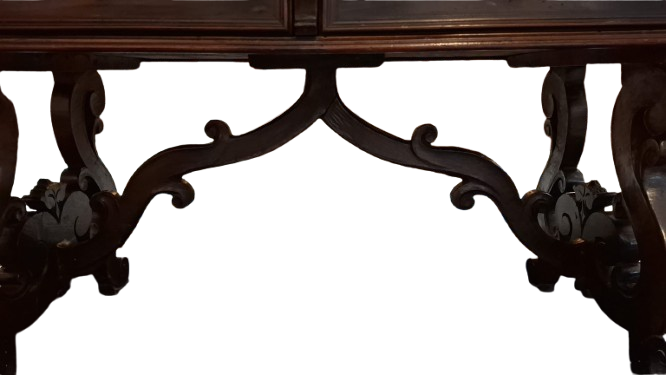
A low-angled, axial viewpoint reveals the internal engineering of the undercarriage, exposing the complex wooden framework that ensures the stability of the writing desk and ties the two massive lyre supports together. Spanning the lower void is the grand connecting stretcher, an element that bridges pure engineering with high aesthetic value. The stretcher eschews a straight path, tracing instead a low-sprung arch that bifurcates and flexes at its terminals, culminating in elegant scrolls and counter-volutes. This broken line mirrors the silhouette of the lateral leg units, establishing a formal correspondence that alleviates the visual weight of the empty under-top space. In a center piece of these dimensions, the monumental weight of the solid top and the downward forces exerted during writing activities generate significant lateral stresses, which are structurally balanced on the façade by the robust drawer apron. The stretcher operates as a critical tensile tie-rod, neutralizing these racking forces and preventing the lyre supports from bowing outward or rocking during use.
The Central Support System and Under-Top Joinery
The camera alignment allows an evaluation of the upper point of contact between the support system and the drawer chassis. At the apex of the stretcher's arch, a localized wooden block or block-cleat is fitted, abutting directly underneath the center line of the drawer frame, aligned precisely with the internal partition separating the two front drawers. This component transfers a portion of the top's dead weight directly down onto the stretcher arch, curbing the natural sag (inflessione) that walnut timbers might experience at their midpoint over centuries. At both ends, the stretcher expands to optimize the surface area contacting the lyre legs. The union is achieved through through-mortise and tenon joinery—a hallmark of high-tier carpentry that ensures exceptional mechanical strength without relying on iron fasteners, completely in line with the tenets of seventeenth-century Tuscan woodwork.
Chiaroscuro Values and Spatial Perspective
The configuration of the wooden members creates a compelling "telescopic" perspective effect. The shaped profile of the stretcher silhouettes against the background, elevating a piece of structural framing into a theatrical backdrop. It is critical to observe that the decorative carvings and geometric moldings continue onto the interior and inferior faces of the stretcher. This reinforces the "center-room" identity of the object; every square inch visible from any vantage point—even a subterranean one—was required to reflect the social standing of the patron and the virtuosity of the Florentine workshop.
Undercarriage and Perspective Appendix: The Reverse Façade and Center-Room Finish
The Reverse Apron: Symmetry and Architectural Continuity
The rear view of the writing desk definitively validates its typological categorization as a center piece, revealing a complete absence of executive neglect or shortcut methods. The rigor of Baroque formal design is extended across a full three-hundred-sixty-degree field. Unlike furniture intended to be placed flush against a wall—whose backs were traditionally left in a rough-sawn state using secondary woods like poplar or fir—the reverse of this desk receives the identical species selection and processing as the front façade.
The rear walnut apron faithfully replicates the geometric division of the front. Although it does not physically house the two functional drawers, the walnut surface is articulated with raised, molded mitered frames that visually simulate drawer fronts, maintaining an absolute optical symmetry. The solid walnut on the reverse mirrors the identical warm coloration and deep wax polish found on the front. This degree of finish ensured that the desk could stand unattached within a noble salon, offering an uncompromised view whether to the scholar seated at work or to the guest entering the room from the opposite portal.
Perspective Study of Tabletop Overhang and Edge Profile
The view from this specific angle elevates the plastic momentum calculated by Tuscan cabinetmakers. From this perspective, the substantial overhang (aggetto) of the tabletop relative to the chassis beneath can be properly appreciated. This architectural cantilever not only accommodated the user by providing essential legroom but cast a crisp shadow line over the apron, augmenting the overall chiaroscuro depth of the form. The continuity of the four eared corners stands out brilliantly; they operate as visual capitals, bridging the linear geometry of the main tabletop to the dynamic sinuosity of the lower supports.
Tridimensionality of the Base within the Domestic Space
The raking light highlights the sculpteo-structural profile of the lyre legs when viewed from the interior perspective of a room. The high-relief perimeters of the leg units exhibit a distinct tapering toward their midsection, before flaring outward with stable poise near the floor. This volumetric play distributes mass with great visual ease. From this viewpoint, the curved lower stretcher lifts the composition from the floor line, creating an architectural frame that interacts with the textiles and rugs below, effectively lightening the intrinsic weight of the solid walnut.
Critico-Documentary Section: Florentine Workshops and Furnishing Inventories in the Seicento
Historiographical Analysis of seventeenth-Century Florentine Woodcarving Workshops
The comprehensive and rear analysis of the writing desk allows its stylistic and constructive peculiarities to be anchored to the historical fabric of seventeenth-century Florence. To comprehend the genesis of such an artifact, one must investigate the socio-industrial network of the grand ducal workshops and the organizational logics of inventories within noble palaces. By the mid-Seicento, Florence was enjoying a flourishing artistic climate in the decorative arts, steered by the cultural policies of Grand Duke Ferdinando II de' Medici and his brother, Cardinal Leopoldo. The city was not merely the cradle of commesso work in hardstones; it hosted an intricate web of specialized woodworking ateliers—comprising stipettai, legnaioli (carpenters), and intagliatori (carvers)—working both for the sovereign court and the wealthy urban patriciate (such as the Corsini, Riccardi, and Gerini families).
During the seventeenth century, the primary catalyst for Florentine Baroque taste was the Galleria dei Lavori (the grand ducal manufacture situated within the Uffizi complex). Under the artistic oversight of court architects and sculptors, notably the plastic innovators Iacopo Maria Foggini and later his son Giovanni Battista Foggini, monumental design templates migrated from permanent stone architecture into movable furniture. Court carvers translated architectural scrolls and botanical motifs into wooden structural members of exceptional vigor.
Parallel to the official state manufacture, independent workshops flourished across the Arno river (Oltrarno), clustering around Piazza Santo Spirito and Via Maggio. These artisans, frequently cataloged as maestri di legname (masters of timber), assimilated the court's elite design language, adapting and simplifying it for a wider patrician clientele. They prioritized the innate nobility of carved solid walnut over the opulent glare of gilding or imported lackers. Archival court records indicate that these independent Oltrarno masters operated in fierce competition with the royal carvers, leading to commercial disputes regarding the procurement rights for prime walnut logs harvested in the Casentino and Apennine forests.
Art-historical historiography demonstrates that mid-Seicento Florentine carving maintained a unique geometric discipline compared to contemporary Italian centers. While in Rome the Baroque manifested through asymmetrical curves and fleshy, folded cartouches, the Florentine carver retained a Renaissance sense of measure. The lyre scrolls of the writing desk under review embody this specific attribute: the line is robust and Baroque, yet the development of the counter-volutes complies with a strict architectural symmetry. Artisans utilized an array of highly specialized gouges to carve prime walnut. The central botanical motif and the perimeter edge profiles, observed in close-up analyses, confirm a plastic technique known as "high relief," capable of trapping ambient light and producing deep voids without resorting to composition or gesso applications.
Inventory Concordance: Private Chambers versus State Rooms
Period inventories drafted by notaries during estate settlements or dowry registrations, alongside the daybooks of the Medici Guardaroba, offer a sociological mapping of Seicento interior design. They reveal a rigid spatial hierarchy that governed urban palaces and rural villas alike. A sharp division existed between furnishings designated for state reception rooms—such as ballrooms, long galleries, and antechambers—and those destined for private quarters, including studies (studioli) and bedchambers.
In state rooms, the decorative scheme was dominated by massive wall consoles, formal parade tables, and towering architectural cabinets. These pieces were typically constructed from softwoods (such as poplar or linden) that were fully carved and gilded with gold leaf, topped with slabs of rare marble, hardstones, or lustrous scagliola. They were wall-bound units built with rough, unfinished backs, engineered solely to project the family's financial and political prestige during official galas.
Conversely, within private apartments, the typical layout comprised center writing desks, canopy beds, and chests of drawers. The preferred materials were solid walnut, root burls, and fruitwoods, treated with understated finishes such as hand-rubbed beeswax. These pieces stood unattached, positioned in the open center of the room, and were meticulously finished on all four sides to accommodate intellectual research and the auditing of estate ledgers.
Within this framework of historical inventories, the Tuscan writing desk occupies a position of elite rank. The presence of a tabletop sourced from a single piece of timber measuring one hundred seventy-eight centimeters, coupled with the structural sophistication of the legs and the inclusion of two functional drawers on the front, qualifies the piece as an asset of high fiscal value. It was routinely recorded in inventories with assessments far exceeding standard wall tables. The flawless execution of the reverse side proves that this desk was not intended for a dim service antechamber, but rather stood at the epicenter of a high-ranking private study or a private morning room where a nobleman received select dignitaries and exercised intellectual authority.
Baroque Trattatistica: Spatial Codification and the Role of the Center Furniture Piece
Literature on Decorum and Interior Space Distribution
In the course of the seventeenth century, interior architecture and interior design decoupled from their subservience to fixed masonry, evolving into a complex science of Baroque decoration and spatial stagecraft. The layout of furnishings inside rooms was codified by theorists, architects, and court chamberlains through treatises that dictated the rules of societal etiquette and material display. The central tenet of Baroque theory was decoro (decorum)—the strict appropriateness of an interior's furnishings relative to the social rank of the occupant and the specific function of the room.
The Roman architect Giovanni Battista Soria, renowned for his designs of temporary festival architecture and ecclesiastical fittings, focused theoretical attention on the perspective integration between architectural room moldings and the silhouettes of furniture. A piece like this Tuscan writing desk, with its eared corners and rounded profiles, corresponds directly to Baroque theories that mandated the softening of right angles within a room to foster a fluid, dynamic visual trajectory. This design allowed the observer to circumambulate the object, capturing shifting chiaroscuro profiles from different angles.
The theorist Charles-Augustin d'Aviler formalized practical layout regulations derived from the great Italian Baroque traditions of the mid-century. In his writings, he theorizes the institutionalization of the cabinet d'étude (the study or reading cabinet) as an isolated, protected sanctuary positioned within the palace's enfilade (interconnected suite of rooms). According to d'Aviler, while grand reception salons demanded that furniture be aligned flat against walls to maintain unobstructed passage for formal processions, the private study required a breaking of this perimeter. The layout dictated that the writing table occupy the open center of the room, directly illuminated by the primary window aperture.
The Courtier and Reception Etiquette: Conduct Treatises
The distribution of furniture was not merely a matter of aesthetics; it was rigidly prescribed by manuals of courtly etiquette and international diplomacy. Texts such as L'Uomo di Lettere (1645) by the Jesuit scholar Daniello Bartoli describe the meticulous stagecraft of political and intellectual power. The center writing desk in solid walnut operated as an explicit hierarchical frontier. The nobleman or statesman sat behind the desk, physically buffered by the expansive width of the tabletop and the architectural projection of its moldings. The guest or petitioner, remaining standing or seated upon a lower stool on the opposite side, perceived the stability of the institution through the monumentality of the lyre legs and the grounding axis of the lower stretcher.
Baroque conduct codes strictly forbade exposing unfinished or crude joinery to guests, as doing so compromised the palace's over-arching principle of magnificenza (magnificence). The mirror-smooth polish and simulated paneling of the reverse face of this Tuscan desk demonstrate the practical application of these rules; the piece was required to look impeccable even if a guest circumnavigated the study.
An archival curiosity reveals that during tense diplomatic audiences, Florentine secretaries used to store sensitive, confidential state documents inside the two front-facing drawers. Because these could be securely locked from the master’s side, they became vaults for family secrets. Meanwhile, the seamless rear façade shown to the visitor betrayed no seams, keyholes, or points of entry, projecting an image of absolute inscrutability.
Architectural Influence and the Theory of the Cabinet
By the mid-seventeenth century, French architectural treatises heavily influenced by Italian design redefined the functionality of the workspace. Jean Marot, in his architectural folios, illustrates the ideal furniture configurations for aristocratic interiors. Inside private cabinets, the center table is systematically paired with an armchair featuring an elevated backrest (chaise à bras), surrounded by walls entirely clad in tier-shelved wooden bookcases or dense tapestries. The walnut center desk, with its dark and deep wood tone, created a strong chromatic contrast against floors of Tuscan terracotta or polished marble. It emerged as the undeniable focal point of the entire room, fulfilling the principal Baroque mandate of the "visual focus" (fuoco visivo).
Critical and Analytical Appendices: Terminology, Geometry, and Regional Comparisons
Nomenclature within the Medici Guardaroba Registries
Seicento registries within the Medici Guardaroba employed a standardized, bureaucratic vocabulary to catalogue furnishings. An object exhibiting the attributes of the desk under review was typically processed under the formula: Tavolo da centro a foggia di scrittoio (A center table in the fashion of a writing desk), wherein the qualifier da centro certified its dual-sided finish [antiques-magazine.com]. The phrase di noce nostrale indicated the use of premium local walnut, distinguishing it from imported West or East Indian varieties or secondary softwoods.
The descriptive line con gambe a cetra intagliate e sua catena designated the scrolled leg supports and the central longitudinal stretcher, respectively. Meanwhile, the formulation con due cassetti nella fascia sul fronte e mostre di cornici sul retro detailed the exact functional distribution of the piece, explaining that simulated moldings were executed on the rear to preserve the object’s geometric balance and symmetry.
Geometric Analysis and Proportions: The Golden Ratio in the Seicento
In the seventeenth century, furniture design was profoundly anchored in classical architectural theory derived from Vitruvius and Vignola. Evaluating the dimensions of this writing desk uncovers the practical execution of these period geometric canons. The top measures one hundred seventy-eight centimeters in length by seventy-six centimeters in width. Calculating the ratio yields a coefficient that departs from the pure Golden Ratio (1.618) to fulfill a logic of modular space planning: the top is conceived by joining two perfect squares (a 2:1 ratio) with the added fractional dimensions of the exterior molding profiles and the eared corners.
The monumental height of eighty-six and a half centimeters underscores a deliberate search for vertical lift. Within a Baroque interior, this loft served to isolate the fluid line of the lower stretcher from the floor plane, producing that telescopic perspective effect championed by interior architects of the era.
Furniture Design Drawings in the Late Florentine Seicento
Toward the close of the seventeenth century, the structural restraint of the mid-century style evolved under the influence of major sculptors and architects attached to the late Medici court. The design folios of Foggini introduced a fleshier, more exuberant Baroque style to Florentine furniture. The lyre supports, which at mid-century retained a clean, architectural silhouette, became heavily laden with tridimensional acanthus foliage, grotesque mascarons, and festoons of fruit.
The writing desk under analysis represents an earlier phase, retaining the late-Renaissance architectural lessons of Bernardo Buontalenti. The eared corner and the planar cleanliness of the apron derive from late sixteenth-century archetypes, proving how mid-Seicento Tuscan cabinetmaking favored historical continuity over the sudden bizarre exaggerations seen in contemporary Roman or Northern European furniture schools.
Stylistic Contrast with the Bolognese Cabinetmaking School
The seventeenth-century production of Emilia and Bologna shared the widespread use of solid walnut with Tuscany, yet it diverged sharply in decorative and plastic philosophies. While the Florentine desk champions the fluidity of open profiles—such as the negative space framed by the lyre legs—the Bolognese school preferred enclosed, compact volumes. Bolognese writing tables typically feature exceptionally deep aprons decorated with heavy, architectural geometric raised panels, such as the famous diamond-point motifs (punta di diamante). In place of the sinuous Tuscan lyre support, mid-Seicento Bolognese workshops frequently utilized heavy turned balusters or architectural columns anchored to massive, square-plan plinth bases, imparting a more severe, fortress-like monumentality to the furniture.
Stylistic Contrast with the Bergamasque Cabinetmaking School
The seventeenth-century Bergamasque and Lombard school represents a third regional current of extraordinary interest, heavily influenced by its geographic proximity to Venetian territories. While the Tuscan school focused on plastic sculpture and carving directly into the solid mass, Bergamasque cabinetmaking—which reached its zenith through the multi-generational workshops of the Fantoni and Caniana families—distinguished itself through geometric joinery and complex marquetry using contrasting timbers like maple, boxwood, and stained veneers. Bergamasque writing desks of this period rarely abandoned the traditional structure of vertical legs or squared trestle bases. When they did incorporate shaped lyre supports, the outlines remained strictly geometric, rigid, and less plastic compared to the sinuous, fluid Baroque scrolls of the Florentine tradition.
Typological Comparison with the Ligurian-Genoese "A Bambocci" Writing Desk
Morphology and Decorative Ideology: Visual Synthesis versus Micro-Sculpture
A comparison with the famous a bambocci genre of furniture, which flourished across Liguria and centered in Genoa between the late sixteenth and the first half of the seventeenth century, exposes two diametric artistic responses to identical functional briefs and an identical primary material: solid walnut. While the Florentine specimen relies on the eurhythmia of structural lines, the Ligurian school unleashes a decorative horror vacui that morphs the piece into an architectural frame teeming with anthropomorphic sculptures.
On the Tuscan desk, ornament remains subservient to structure; carving is concentrated at key structural junctures, leaving the lower undercarriage dominated by open space. Conversely, a Genoese a bambocci desk is literally overrun by dozens of small human figures carved in high relief or completely in the round out of solid walnut blocks. These figurines—depicting putti, captured soldiers, nude allegories, or angels—are not merely stuck onto the surface; they perform structural duties, operating as vertical pilasters, framing drawer boundaries, or serving as drawer pulls where the head or torso of the figure is grasped to open the compartment. A linguistic curiosity reveals that the term bambocci (ragdolls/chubby infants) originated within popular workshop slang to describe, with benevolent irony, the stocky, childlike proportions of these wooden sculptures, which resembled tightly swaddled infants.
Furniture Architecture: Center Pieces versus Wall Cabinets
The intended spatial destination of these two regional styles dictated their volumetric engineering. The Florentine desk displays a visually light, elongated architecture engineered to stand isolated in open space, where the total finish of its reverse side mandates a center-room placement. The Ligurian-Genoese model, by contrast, found its ultimate typological expression within massive, single-bodied cabinet-chests, drop-front desks, or vertical scarabattoli (display cabinets) characterized by a pronounced verticality. The Genoese piece is a compact, closed block containing a labyrinth of tiny drawers and hidden compartments. These cabinets were engineered to stand flush against the walls of the golden palaces lining Genoa’s Via Nuova, and consequently, their backs were left rough and unfinished.
Treatment of Timber and Patonal Intent
Both regional schools celebrate walnut, yet they exploit its material properties differently. Tuscan cabinetmaking exalts expansive planes and the natural grain of the wood; selecting a single-plank top serves to spotlight grain continuity and the silken depth of a hand-waxed face finish. Ligurian cabinetmaking fragments the surface. The walnut is chiseled into minute segments to capture microscopic anatomical details, drapery folds, and hair textures on the figurines.
These stylistic divergences reflect the political climates of the two Baroque capitals. Commissions tied to the Medici court sought a sobriety that projected institutional endurance and continuity with the Renaissance, choosing an intellectual, measured luxury. The financial aristocracy of Genoa, operating as international bankers to the Spanish Empire during their siglo de oro, demanded the absolute maximization of material display. The a bambocci style perfectly answered this opulent, spectacular taste: the furniture was designed to stun visitors through manufacturing complexity and the sheer quantity of sculptures embedded within it, effectively transforming a tool for writing into a miniature curiosity cabinet to be displayed in a formal salon.
Reference Bibliography
For further philological study, historical contextualization, and technical analysis of Baroque furniture from the Tuscan and Emilian regions, readers are directed to the following foundational texts in Italian decorative arts historiography:
- Alberici, Clelia. Il mobile italiano nei secoli. Milan: Martello, 1969. (A cornerstone text for tracing the structural evolution of forms from the High Renaissance into the Baroque era).
- Chiarugi, Simone. Botteghe di ebanisteria a Firenze. Florence: Olschki, 1994. (The most exhaustive archival study documenting the independent artisans active across the Oltrarno district and their socio-economic friction with the grand ducal workshops).
- Colle, Enrico. Il mobile barocco in Italia: Arredi e decorazioni d'interni dal 1600 al 1738. Milan: Electa, 2000. (An encyclopedic repertoire dedicated to regional variations, offering vital nomenclature and analysis regarding structural frames featuring lyre and cetra undercarriages).
- González-Palacios, Alvar. Il tempio del gusto: Le arti decorative in Italia fra classicismo e barocco. Milan: Longanesi, 1984. (An indispensable study charting the operations of the grand ducal manufactures and the direct role of the Medici court in formatting Baroque decorative taste).
.