The seventeenth-century roman coin cabinet of the del drago lineage
Academic catalogue entry
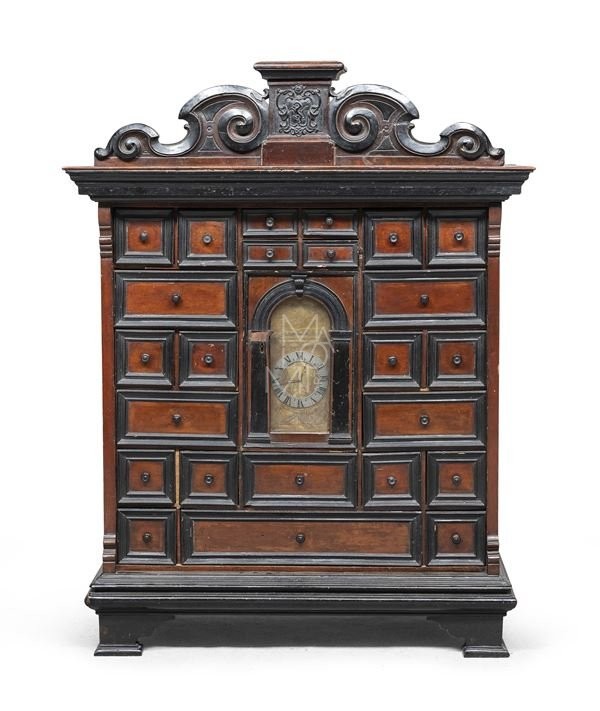
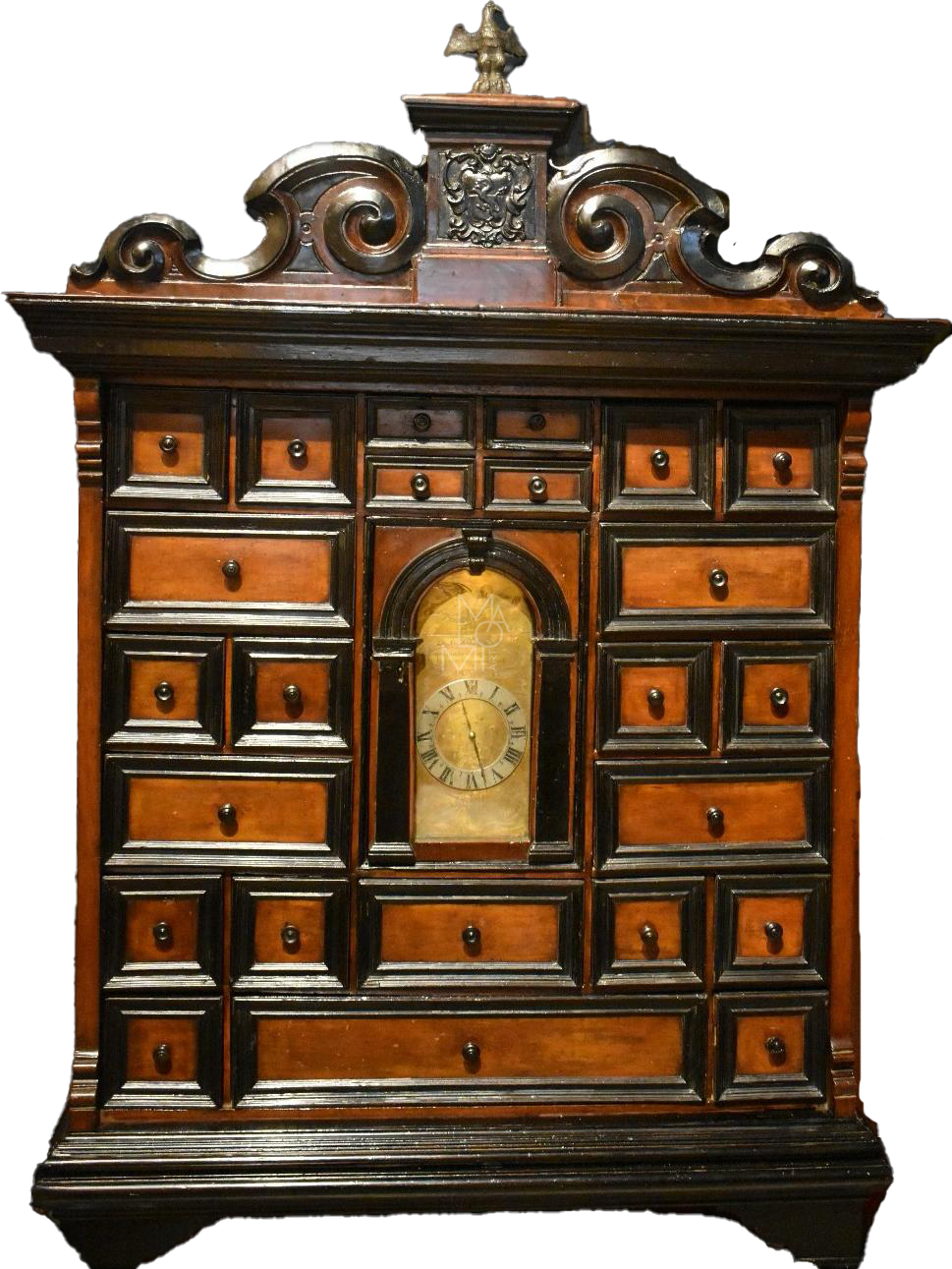
A monumental seventeenth-century Roman coin cabinet (monetiere) in solid and veneered walnut with ebanized pearwood profiles, originating from the prestigious collections of the princely house of Del Drago. The architectural facade is centered around a gilded bronze clock finely engraved with the allegory of Chronos, a skeletal personification of Death (vanitas), and an elegiac distich from Ovid's Fasti. Characterized by an extraordinary marriage of art and engineering, the cabinet conceals a sophisticated centralized locking mechanism at the rear, operated via a lateral master lock and vertical iron rods connected to individual drawer lances. Reflecting the design principles of the regia barocca spearheaded by Matthia de' Rossi, the reverse of the piece preserves an early paper inventory label inscribed "Roma 47", confirming its original provenance from the family's Roman palace in Via dei Coronari.
The coin cabinet of the princely house of del drago: a masterpiece of seventeenth-century roman cabinetmaking
Historical context and princely patronage
The Roman seventeenth century represented a period of extraordinary artistic fervor, an era in which the language of the Baroque thoroughly permeated not only monumental architecture and grand altarpieces, but also the production of ceremonial furniture. In the rooms of noble palaces rising in the shadow of Berninian bell towers, furniture never responded to a merely functional need, but rather configured itself as a fundamental piece of a complex strategy of dynastic self-celebration. Into this cultural milieu fits the majestic coin cabinet in walnut wood that belonged to the princely house of Del Drago, an artifact that combines fine cabinetmaking with the micro-engineering of the period. With its monumental dimensions, this piece of furniture was not a simple container, but a microcosm reflecting the economic power and scientific erudition of one of the most influential lineages in the papal orbit.
The Del Drago family, whose origins root in the Viterbo area as far back as the twelfth century before permanently transplanting to Rome in the fifteenth century, experienced an exceptional phase of patrimonial and social consolidation during the second half of the seventeenth century. The possession of a coin cabinet of such importance, documented by archival chronicles, indicated the need to safeguard the lord's most precious collections, which at that time consisted not only of gold or silver coins, but also of antique cameos, commemorative medals, engraved gems, and small encrypted diplomatic documents. The choice of domestic walnut wood, carefully seasoned for decades in the fiefdom's warehouses to prevent warping and movements due to humidity, demonstrates the extremely high qualitative standard imposed by the masters of the House of Del Drago upon the cabinetmaking workshops.
An illuminating anecdote related to the daily life of the palace reminds us that, during visits by cardinals and foreign ambassadors, the prince never displayed the entirety of his treasures in a static manner. The opening of the coin cabinet transformed into a true theatrical act, in which guests were invited to observe the complexity of the facade before the lord revealed, with a single and calibrated turn of the key, the innermost compartments. This ritual of unveiling was part of the codes of hospitality of the Roman aristocracy, where the wonder aroused by the mechanical ingenuity of the furniture counted as much as the intrinsic value of the gold coins or gems contained within it.
Morphology and architectural syntax of the facade
The visual composition of the coin cabinet is distinguished by a rigorous monumental layout that tends to conceive the furniture as the facade of a Roman palace in miniature. The upper part of the furniture is dominated by a majestic shaped cresting, characterized by sinuous and broken scrolls that impart plastic dynamism to the entire structure, culminating in the heraldic coat of arms of the Del Drago family, surmounted by an eagle or a figurative element in cast bronze. This architectural crowning did not merely serve an ornamental purpose, but was functional to visually balance the dense geometric grid below, counterpoising the verticality of the furniture with a plastic crowning that evoked the pediments of contemporary churches.
The front of the furniture is punctuated by a rigorous symmetry where the arrangement of the drawers alternates between square and rectangular formats. Each drawer front is framed by thick moldings in ebanized pearwood, an extremely refined technique that involved the hot staining of the wood with vegetable extracts and iron salts to imitate the luster of exotic ebony, which was then highly expensive and difficult to procure. This strong chiaroscuro contrast between the deep black of the frames and the warm amber grains of the solid walnut reflected the pictorial research of Caravaggism and the play of shadows in contemporary Baroque architecture. The small metallic knobs placed at the center of each drawer were not simple pulling elements, but were positioned with millimetric precision so as not to alter the overall geometric balance.
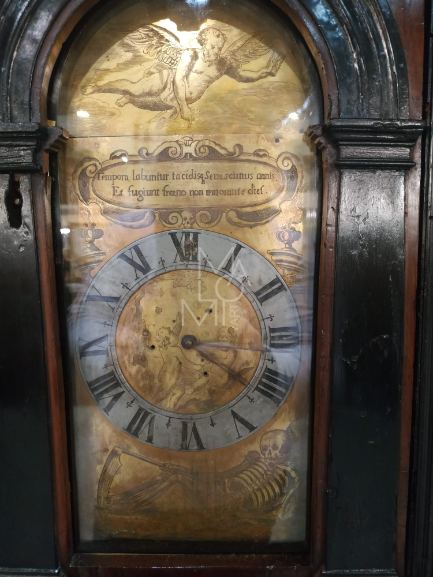
The focal point of the entire facade consists of the central bronze clock, inserted within a rounded niche that simulates a classical portal. In the seventeenth century, horology was not considered a mere artisanal craft, but a cutting-edge science linked to astronomy and natural philosophy. The insertion of a chronometric instrument into a coin cabinet enriched the object with a profound meaning, transforming the repository of material wealth into a warning about the transience of earthly life. The bronze and brass dial dialogues chromatically with the details of the upper cresting, creating points of golden light that broke the severity of the dark wood and captured the glow of the candles illuminating the state rooms.
Cabinetmaking engineering and concealed security systems
Beyond its unquestionable aesthetic and proportional qualities, this coin cabinet reveals itself to be a masterpiece of mechanical micro-engineering. The need to protect the most precious assets and diplomatic secrets of the lineage prompted seventeenth-century artisans to conceive centralized locking systems of incredible complexity, completely invisible from the outside so as not to compromise the aesthetics of the furniture and to disorient any malicious individuals or unfaithful servants. One of the most fascinating technical curiosities of this specific specimen resides in the rear mechanism governing the security of the small drawers, a device that required perfect synchronization between the wooden carpentry and the metallic ironwork.
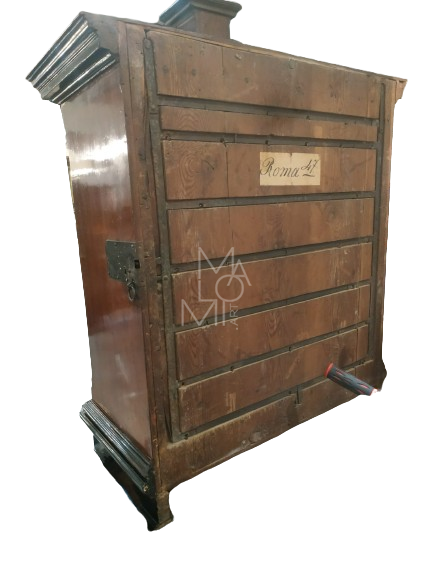
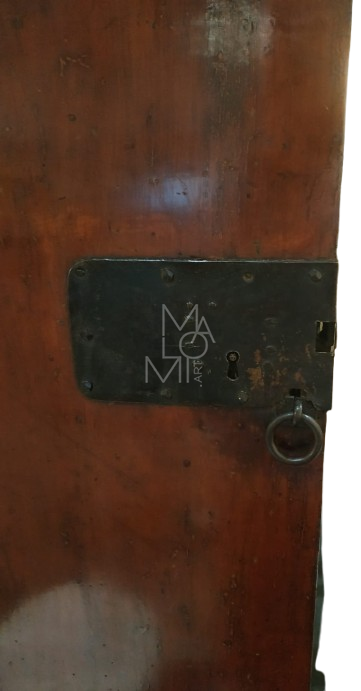
A small metallic lance terminating with a hook at its base is attached to the back of each small drawer. When the drawers are fully inserted into their housings, these lances penetrate into a hidden cavity within the back of the furniture, where a mobile vertical rod made of wrought iron is located. This internal rod is equipped with locking slots and is operated exclusively by a large lock positioned laterally and dissimulated within the side of the furniture. By turning the key in the side keyhole, the internal rod performs a vertical slide that simultaneously intercepts all the hooks of the rear lances. This system prevents the forced opening of the drawers from the front, making the piece of furniture a veritable impenetrable safe for the technologies of the era.
Roman cabinetmaking historiography reports that for the realization of these complex devices, master cabinetmakers frequently collaborated with blacksmiths operating in the construction sites of large theatrical machinery or papal fountains. The precision required to ensure that all the rear lances engaged simultaneously without forcing the wood was millimetric; it was enough for just one of the blades to be slightly misaligned due to the natural movement of the wood to lock the entire system. To obviate this problem, cabinetmakers inserted small elastic slats of ash wood or forged steel springs inside the frame, which accommodated the movement of the drawer, ensuring the fluidity of the metallic click and reducing friction on the internal components.
Historical-heraldic analysis of the symbols of the dragon and the eagle
The decorative and plastic apparatus crowning the coin cabinet responds to precise symbolic and genealogical codes consolidated within the Roman patriciate. In heraldry, the adoption of specific animal figures was never purely ornamental, but rather encapsulated the synthesis of family history, political alliances, and the dynastic aspirations of the lineage. The golden winged dragon that features prominently in the coat of arms constitutes, first and foremost, a famous canting arm, which is to say a coat of arms in which the principal charge graphically reproduces the surname of the Del Drago family. From a strictly symbolic perspective, the dragon assumes profound meanings related to guardianship and fidelity. Since classical antiquity and medieval bestiaries, the mythological creature was considered par excellence the guardian of hidden treasures, making its presence on the cresting of the coin cabinet perfectly coherent with the function of the furniture itself.
The eagle placed at the very top of the furniture introduces a second level of interpretation linked to the family's prestige within the papal court. For families of the Roman patriciate, the use of the eagle was linked to honorary concessions from the Holy Roman Empire or the Papal States, symbolizing high jurisdiction, nobility of blood, and protection from above. The visual combination of the coat of arms of the dragon and the overlying bronze eagle expressed the double soul of the princely patronage: the eagle incarnated public authority and papal legitimization, while the dragon reaffirmed the power of the house's name and the rigorous surveillance of state secrets. In the context of Baroque furniture, this iconographic union served to remind the observer that the chest was not merely a container of material wealth, but a speaking monument of dynastic glory.
An interesting heraldic curiosity concerns the subsequent evolution of this coat of arms. In the second half of the eighteenth century, following the marriage between the last heiress of the exceedingly noble Roman Crescenzi family and Paolo Del Drago, the lineage assumed the double surname Del Drago-Crescenzi. This transition determined the insertion into the coat of arms of heraldic elements of the Crescenzi, such as the famous lunar crescents and the tower. The total absence of these symbols on the cresting of the coin cabinet, where the dragon appears in purity surmounted by the imperial eagle, offers art historians overwhelming proof to confirm the correct dating of the furniture to the second half of the seventeenth century, excluding eighteenth-century alterations or modifications and linking the artifact to the period of maximum splendor of the original branch of the family.
Stylistic comparisons and the figure of Matthia de' Rossi
To fully comprehend the technical refinement of the coin cabinet, it is indispensable to place it within the landscape of Roman furniture manufacture of the time, comparing it with the commissions of the most illustrious families of the papal court, such as the historical collections of the Borghese and the Pamphilj. The Roman workshops operating for these families tended to conceive large ceremonial furniture pieces as monumental backdrops or miniature theatrical wings. While many workshops linked to the Pamphilj made extensive use of exotic and sumptuous materials such as tortoiseshell, pietre dure inlay, and lapis lazuli, the Del Drago specimen distinguishes itself through a more severe and aristocratic predilection for bare wood, entrusting the precious metallic component exclusively to the central clock and the heraldic bronzes of the cresting.
This specific design sensibility leads us directly to the cultural influence of Matthia de' Rossi, a pivotal figure of late seventeenth-century Roman architecture. The favorite pupil and principal assistant of Gian Lorenzo Bernini, De' Rossi inherited from his master the concept of the Baroque regia, the idea that architecture, sculpture, and the minor arts should merge into a single coherent vision. Having become the trusted architect of the Del Drago family on the occasion of the total refoundation of the fiefdom of Filacciano, De' Rossi did not limit himself to designing the masonry structures of the Sabine village and the baronial palace, but personally coordinated the art workshops, frequently providing precise drawings for the sacred and secular furnishings of the lineage.
The choice of the shaped cresting with broken scrolls and the rounded arch framing the clock on the coin cabinet are direct citations of the portals and windows that De' Rossi realized in his urban and rural architectural sites. In the sacred space of the collegiate church of Santa Maria Assunta in Filacciano, De' Rossi applied the same compositional approach, utilizing dark, veined marbles for the architectural frames of the altars to bring out the brilliance of the gilded bronzes of the tabernacles. This identical visual syntax is found on the facade of the coin cabinet, where the dark ebanized structure sets the central bronze clock, demonstrating how great papal architecture and high secular cabinetmaking responded to the very same intellectual matrix.
Archival analysis and historical destination of the furniture
The reconstruction of the material history of the coin cabinet requires a cross-examination between the patrimonial events of the lineage and the analysis of the accounting ledgers preserved in Roman documentary funds. The documents useful for tracing payments to master cabinetmakers, carvers, and bronze workers active for the family are principally located in the core of the Del Drago Secret Archive, today largely consolidated at the State Archives of Rome. In the registers of the seventeenth century, payments linked to the manufacture of ceremonial furnishings followed a rigid bureaucratic process. The family architects were tasked with providing the models and performing the final appraisal of the completed work to certify its fair price, while the cabinetmakers received monetary advances staggered over time, recorded in payment mandates with descriptive formulas drawn up by the notaries of the era.
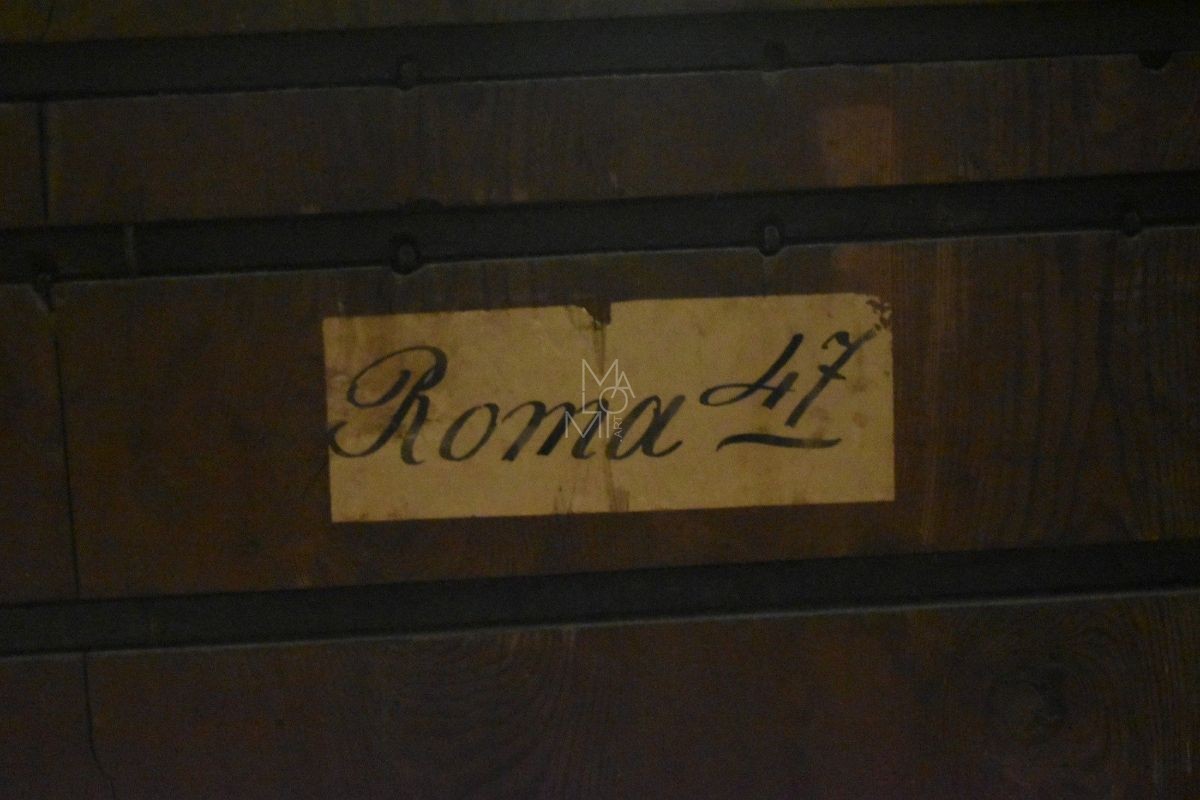
An element of exceptional historical-documentary value confirming this complex administrative network is visible on the back of the furniture, where a period paper label applied directly onto the wood features prominently, bearing the calligraphic ink inscription "Roma 47". The paleographic analysis of the handwriting reveals an Italian cursive used for bureaucratic and inventory purposes, characterized by a marked fluidity of the ligatures between letters, typical of the administrative script in use between the end of the eighteenth century and the first decades of the nineteenth century. The use of iron gall ink, which over the centuries has undergone a natural oxidation process turning from its original black to a characteristic rust nuance, confirms the authenticity of the label and its nature of patrimonial traceability.
The explicit wording "Roma" combined with the progressive number "47" allows art historians to clarify the historical destination of the furniture within the family properties. This number refers directly to a family inventory compiled to protect assets subjected to fideicommissum. The mention of the city of Rome attests that the furniture was originally destined for the reception rooms of the urban palace located in Via dei Coronari, the hub of the lineage's business and political relations within the papal orbit of the seventeenth century. Only in the mid-nineteenth century, following complex hereditary events and the family's entry into the sumptuous palace at the Quattro Fontane, was the coin cabinet transferred to the new residence on the Quirinal hill, transforming from a functional piece of office and security furniture into a supreme object of historical and collecting admiration.
Iconography of the dial and the aesthetics of vanitas
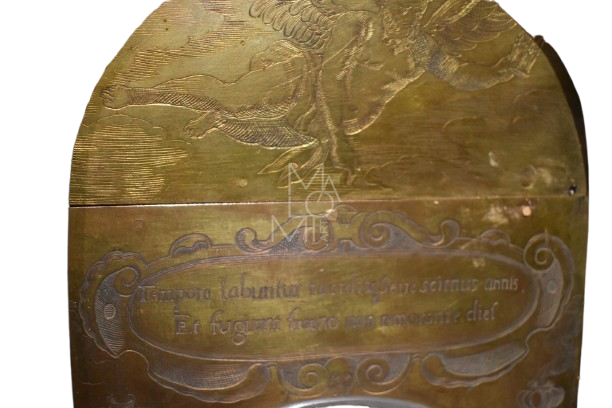
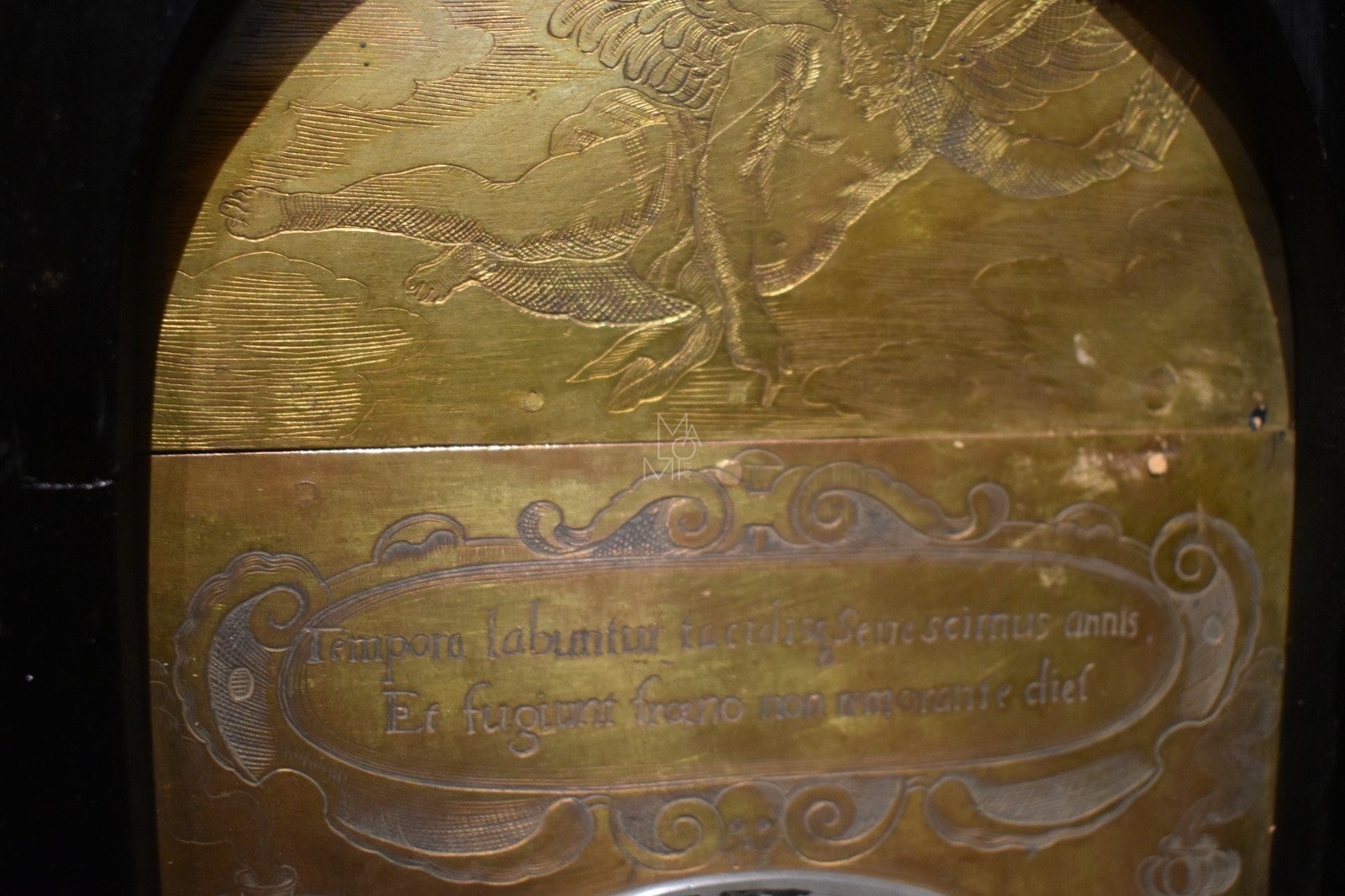
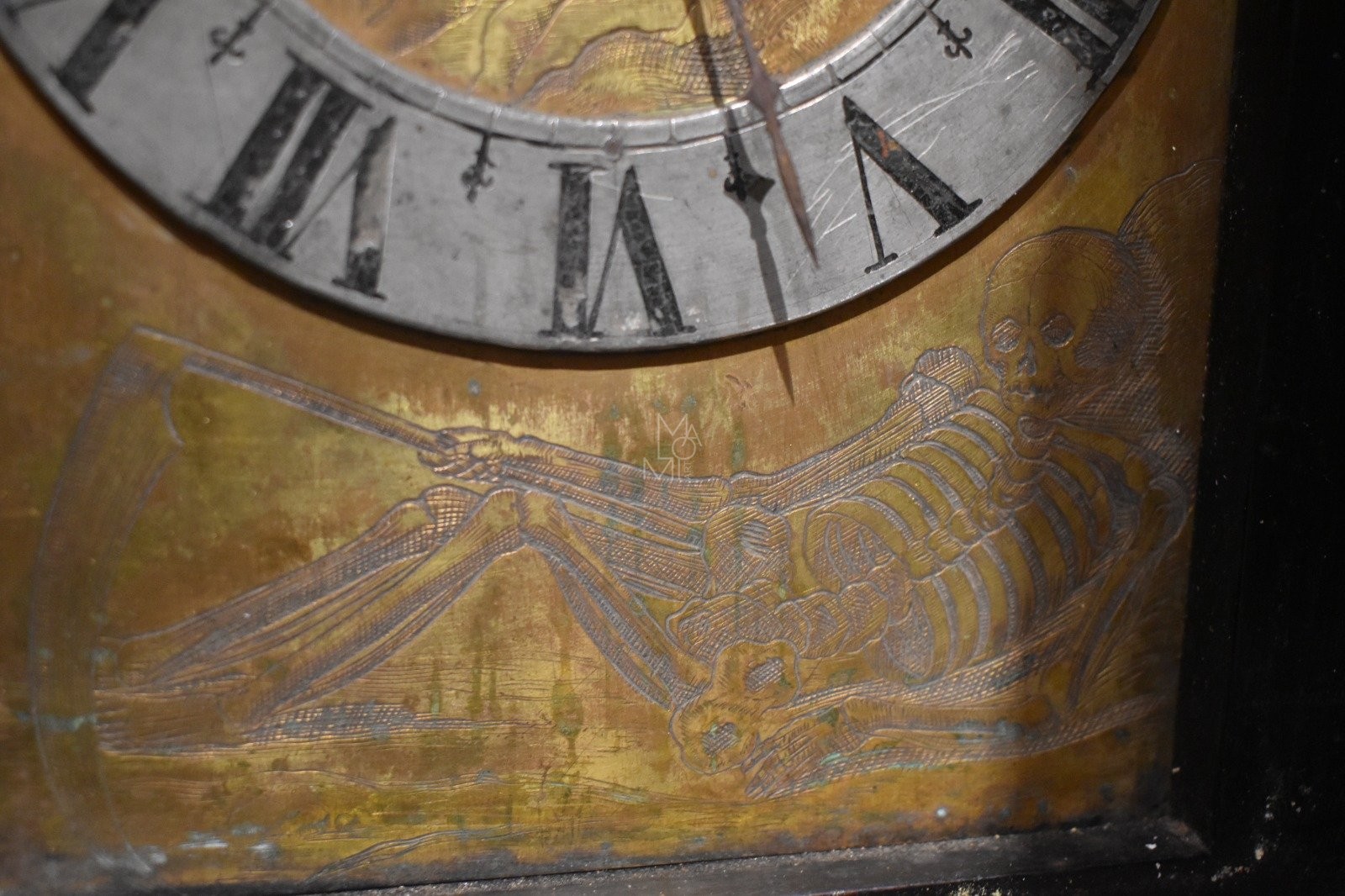
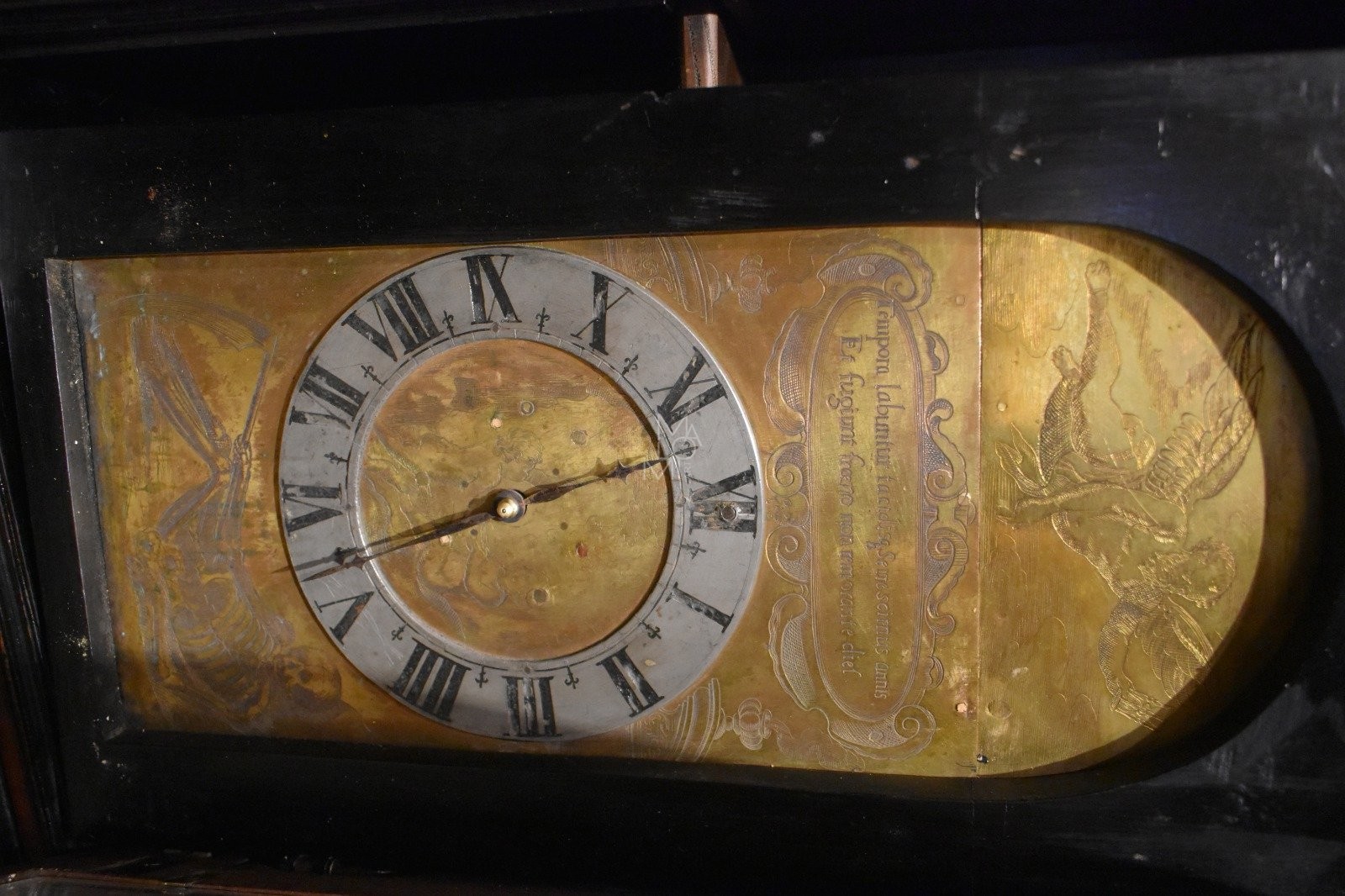
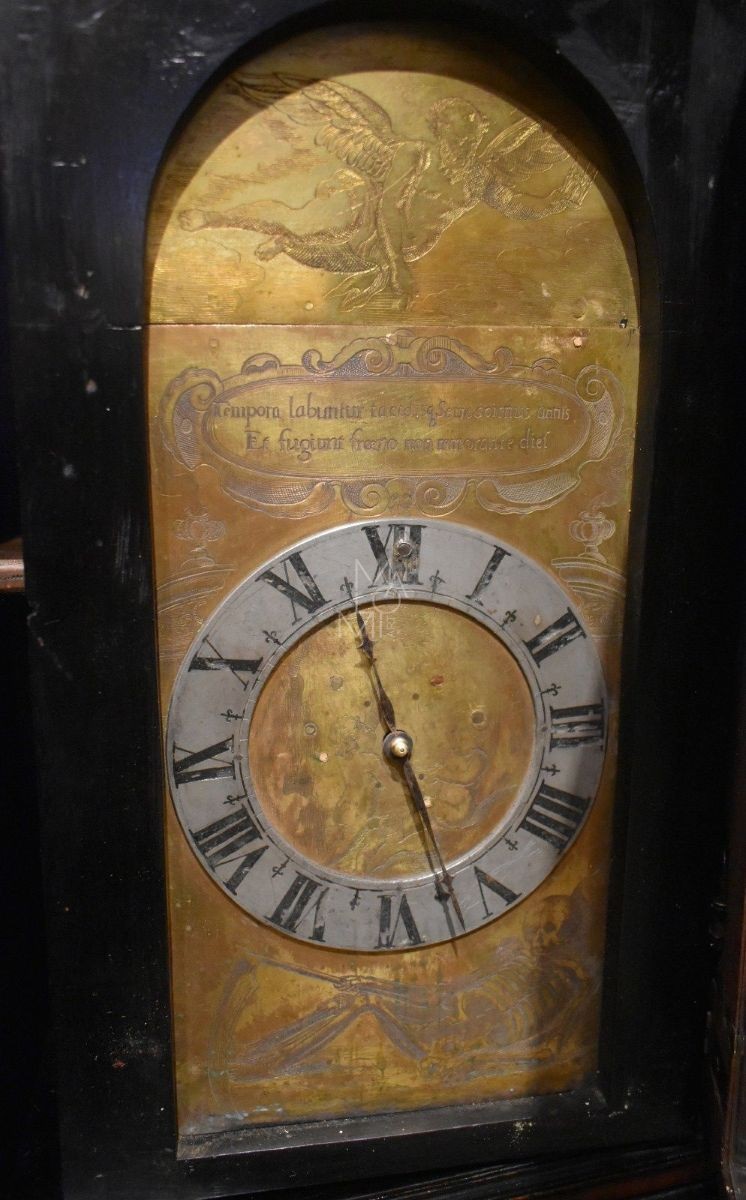
The close-up documentation of the clock dial unveils the entire iconographic and philosophical program governing the visual centerpiece of the coin cabinet, revealing an extraordinary conceptual machine centered on the Baroque aesthetics of vanitas and memento mori. The gilded bronze and brass plate, worked entirely cold with steel points and burins, is divided into complementary registers where allegorical images dialogue closely with a learned literary inscription, offering a solemn meditation on the caducity of earthly glories and the inexorable passing of time.
The lower half of the plate displays an accurate engraving depicting the skeleton of death lying in profile in the act of wielding a large scythe, the iconographic tool destined to sever human existences without distinction. This dramatic image is located immediately below the circular hour band in silvered bronze, engraved with large Roman numerals and small plant motifs. On the upper and right portion of the plate, conforming to the rounded curvature, the full figure of Chronos is engraved instead, represented as a vigorous elderly man endowed with large feathered wings, caught in a dynamic flight among the clouds while lifting a hourglass with his hand. The visual and conceptual contrast is total: above, Chronos incarnates time in motion that measures action, while below, the skeleton represents the final and perennial result of time that has completed its reaping work.
At the center of the dial, enclosed within a rich Baroque scrollwork cartouche, is engraved a Latin inscription arranged on two registers, which reproduces a famous elegiac distich taken directly from Ovid's Fasti. The text states that times slip away and we grow old in the silent years, and days flee without any brake restraining them. The choice of this classical maxim establishes a profound connection between the mechanical movement of the clock hands and the existential experience of the prince. The clock constantly reminded the owner that the accumulation of material wealth preserved in the surrounding drawers was ephemeral in the face of the action of time. This figurative and epigraphical palimpsest definitively elevates the coin cabinet of the House of Del Drago from a valuable piece of furniture to a true philosophical and humanistic object, a perfect mirror of the complex spirituality and cultural erudition that animated the Roman nobility of the seventeenth century.