The evolution of the corner cabinet in late eighteenth-century Lombardy
The evolution of the corner cabinet in late eighteenth-century Lombardy: a historico-artistic and structural analysis of a two-tier inlaid angoliera
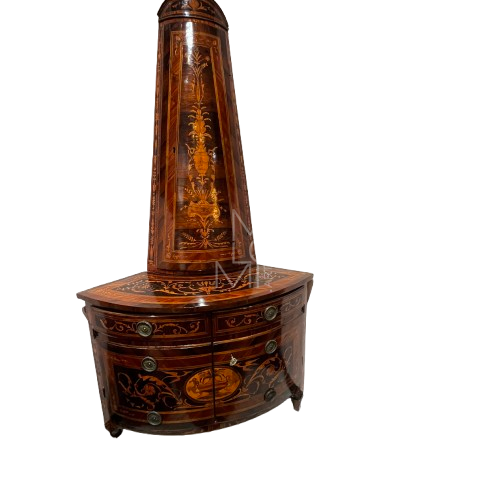
The production of art furniture in Lombardy during the second half of the eighteenth century represents a crucial nexus where cabinetmaking expertise, the evolution of geometric taste, and the rationalization of architectural space converged. Within this context, the corner cabinet—historically termed angoliera or cantonale—ceased to be a merely subsidiary piece of corner furniture, evolving into a scenographic protagonist of aristocratic interiors. The artifact under examination—a two-tier corner cabinet finely decorated with marquetry, featuring faux drawers on the lower double doors and a prominent curved door on the upper section—perfectly embodies the complex transition from the late Barocchetto style to the geometric rigor of Milanese Neoclassicism.
Typological genesis and spatial function of the two-tier structure
Historically, the corner cabinet emerged to resolve the spatial and aesthetic criticality of orthogonal wall intersections. Over the course of the eighteenth century, with the introduction of specialized rooms dedicated to conversation and private comfort, such as boudoirs or drawing rooms, the necessity of optimizing floor plans merged with a quest for rigorous symmetry. The structural choice of a two-tier configuration reflects both plastic and functional criteria, organizing the piece according to a precise volumetric hierarchy.
The lower section functions as a base; it features a contained height and a greater depth, measuring fifty-four centimeters, which visually anchors the piece to the floor and serves as a solid podium. Above this, the upper section slenders upward to reach a total height of two hundred and twenty centimeters, matching a width of one hundred and seven centimeters. The tapering and curvature of the high hinged door alleviate the overall volumetric impact, transforming the corner of the room into a polymaterial column of pure ornament that adapts seamlessly to the lines of the surrounding architecture.
The historico-geographical context: Lombardy between Barocchetto and Neoclassicismo
The second half of the eighteenth century in Lombardy was profoundly shaped by the enlightened reforms of the Habsburg administration under Maria Theresa of Austria and Joseph II. Milan became a primary European cultural hub, where architects of the caliber of Giuseppe Piermarini redefined the aesthetic standards of both public and private ornamentation, enforcing a return to the rationality of antiquity.
Until the mid-century, Lombard cabinetmaking had been dominated by the sinuous, asymmetrical, and fluid lines of the Barocchetto style. However, starting from the late eighteenth century, a progressive purgation of free-flowing curves occurred in favor of a stricter geometric and architectural layout. The present piece occupies a delicate transitional phase. It preserves the three-dimensional curvature of the door and profiles, a clear legacy of Rococo taste, but constrains the surface within a rigid framework of geometric reserves and banding characteristic of early Neoclassicism, resolving the contrast between structural plasticity and decorative rigor.
Morphological analysis and decorative schema
Exhibiting slender yet monumental proportions, the surface of the corner cabinet is articulated by a complex decorative program that distinctly differentiates the two tiers while maintaining absolute stylistic coherence. The lower base section features two doors that simulate a facade of stacked drawers. This formal artifice addresses a requirement of exquisite utility, as hinged doors allow full access to the acute-angled corner compartment, which would otherwise be severely restricted by the straight tracks of functional drawers. At the same time, this optical illusion breaks the monotony of the vertical plane through the use of faux division strips, accented by gilded bronze escutcheons and handles that establish a rhythmic visual cadence and simulate the presence of a commode.
The upper section is instead dominated by a single, large, convex door displaying a slightly ogival taper. Executing this curved wooden surface demanded extraordinary technical skill in preparing the structural substrate, which is constructed entirely of solid walnut wood. The core timber was thoroughly seasoned and shaped to receive the subsequent thick veneer and marquetry. The utilization of solid walnut rather than softwoods as the structural core guarantees superior physical stability and testifies to the elite executive quality of the workshop, which was fully capable of mastering the organic tensions and splitting inherent to noble hardwoods over the course of time.
Analytical focus: iconography and technique of wooden marquetry
The surface decoration of this corner cabinet constitutes its highest historico-artistic value, revealing a rigorous geometric underlying grid that organizes and balances the ornamental exuberance of the individual inlaid reserves. The marquetry is articulated through a precise visual hierarchy. On both the upper door and the lower base, large reserves of dark walnut burl act as a dramatic backdrop for the lighter inlaid wood motifs, yielding a stark chiaroscuro contrast that enhances the legibility of the design from a distance. These fields are demarcated by intricate geometric stringing and herringbone banding, while at the corners of the upper door the inlay forms Greek keys and dentil patterns that visually stabilize the curved perimeter of the piece.
The vertical axis of the upper door hosts a monumental candelabrum motif of Renaissance derivation, filtered through late eighteenth-century Neoclassical sensibilities. The base of the candelabrum rises from a stylized acanthus cluster from which mirror-image rinceaux diverge. The central nexus features a large classical urn or vase adorned with fluting, a direct reference to antiquity and the archaeological discoveries of Herculaneum and Pompeii that captivated the elite clientele of Lombardy. The terminal peak of the candelabrum extends upward, alternating nodes, floral calyxes, and suspended geometric details, culminating in a crown that adapts seamlessly to the tapering upper architecture of the piece.
In the lower section, the decorative narrative shifts to a horizontal orientation. Centered across the two doors is a large oval medallion encircled by a leafy garland, inside of which an inlay depicts a monumental footed bowl flanked by vegetative elements. To the sides of the medallion, the surface expands into symmetrical acanthus scrolls ending in open blossoms, introducing an elegant fluidity that softens the rigid geometry of the faux drawer layout.
From a purely executive standpoint, the master cabinetmaker employed a sophisticated pieced marquetry technique, seamlessly fitting light-colored wood veneers of maple and boxwood into matching cutouts carved out of the walnut and burl foundation. The exceptional plasticity and three-dimensionality of the vases, leaves, and blossoms were achieved not through engraving lines with a burin, but via fire-toning, also known as hot-sand shading. Individual fragments of light wood were partially immersed in scorching sand prior to assembly; this controlled scorching produced graduated brown gradients capable of simulating the volume, depth, and chiaroscuro values found in contemporary sculpture and painting.
Stylistic comparison: the artifact and the workshop of Giuseppe Maggiolini
Attributing and contextualizing an inlaid piece of furniture from late eighteenth-century Lombardy requires an indispensable dialectical comparison with the production of Giuseppe Maggiolini and his workshop in Parabiago, the undisputed pinnacle of Italian Neoclassical cabinetmaking. The corner cabinet reveals a clear assimilation of the maniera maggioliniana in several technical aspects, starting with the joinery precision itself. The tight fit of the wood fragments, devoid of visible filler pastes, and the microscopic precision of the acanthus tendrils demonstrate an extremely high standard of craft, directly inspired by or modeled after the Parabiago masters. The choice of materials, combining walnut, burl, maple, boxwood, cherry, and stained woods to execute mid-tone color transitions in the floral inlay, also mirrors the extensive timber index codified by Maggiolini using native and rare woods.
The primary departure from_orthodox Maggiolinian models lies, however, in the piece's structural morphology. Maggiolini, fully aligned with the mature Neoclassicism of the late century, systematically abolished the tridimensionality of the Rococo curve, favoring strictly flat, parallelepiped, or pure cylindrical surfaces, as seen in his famous rectilinear commodes. The presence of a pronounced convex door and sinuous corner shaping points to a contemporary Milanese or regional Lombard workshop active in the final quarter of the century. While updated on Maggiolini’s highly successful decorative patterns, this workshop remained bound to an aristocratic provincial clientele that still favored the spatial movement and fluid, plastic volumes of the traditional Barocchetto.
Assessment of graphic sources and design models: between French influence and local genius
The decorative lexicon expressed across the marquetry of this corner cabinet is not an isolated invention; rather, it reflects the reception of specific engraved sourcebooks circulating through the artistic workshops of the Duchy of Milan. The second half of the eighteenth century witnessed the pan-European spread of the Goût Grec and the early Louis XVI style, disseminated through the prints of French ornamentists such as Jean-Charles Delafosse and Jean-Denis Le Pautre. The profiles of the vases inlaid within the cabinet's medallions, characterized by rectilinear handles, swags, and austere geometry, derive directly from these ultramontane design plates, as does the practice of framing reserves with interlocking ribbon borders or Greek keys, which mirrors French structural motifs originally designed for interior boiseries.
These French influences were radically reinterpreted in Lombardy starting from the establishment of the chair of Ornamentation at the Brera Academy, directed by Giocondo Albertolli. Albertolli purged French classicism of its heavier excesses, championing an ornamental style characterized by crystalline geometric purity and crisp chiaroscuro definition. The candelabrum inlay on the upper door of this angoliera is a tangible translation of this ethos. Its strict axial arrangement, the symmetrical counterweight of the acanthus scrolls, and the progressive vertical thinning correspond precisely to the plates published by Albertolli in his treatises, such as Ornamenti diversi. The Lombard cabinetmaker masterfully converted the engraver's graphic line into organic matter, orchestrating a highly sophisticated synthesis between international classical archaeology and the innate structural equilibrium characteristic of Lombard design.
The integration of the corner cabinet within the choreography of the Milanese interior
To fully grasp the historical and functional significance of this two-tier corner cabinet, its structural configuration must be evaluated against the strict spatial layout governing late eighteenth-century Milanese interior design. Under the influence of the Neoclassical architectural revolution led by Piermarini and his contemporaries, the domestic spaces of the Lombard aristocracy underwent a profound process of alignment and symmetrical codification. Interiors were no longer treated as casual enclosures for loose furniture, but rather as total artistic environments where every console table, mirror frame, and stuccowork border was bound to a cohesive wall composition.
Within this rigid layout, the corner of a grand room or a private reception apartment posed a significant decorative challenge, risking the disruption of the room’s required linear continuity. The two-tier corner cabinet was engineered precisely to convert these architectural dead ends into focal points of visual interest. Unlike the freestanding chest of drawers, which occupied the center of main wall expanses beneath imposing pier mirrors, the angoliera was designed to work in perfectly balanced, symmetrical pairs flanking a principal door or facing a window wall. Its remarkable height of two hundred and twenty centimeters allowed it to engage directly with the vertical scale of the room, often matching the exact height of neighboring doorframes or the upper molding profiles of a fireplace mantle.
Furthermore, the strategic placement of these cabinets played an essential role in the optical dynamics of the room. The convex, undulating surface of the upper tier acted as a dynamic surface that caught and reflected light across the room, which was usually illuminated by large window panes or candlelight. While the flat surfaces of the main wall consoles anchor the architecture to its horizontal parameters, the curved, vertical rise of the corner cabinet visually softened the right-angled intersections of the perimeter walls. This created an illusion of greater spatial flow and circularity. The cabinet also acted as a bridge between the architectural structural shell of the room and the portable personal objects of its inhabitants. The lower section provided concealed storage, while the upper tier—often containing precious china or glassware visible when opened during social gatherings—served as a domestic showcase. In this way, the piece did not simply fill an empty corner space; it served as a crucial spatial pivot that unified the horizontal sequence of wall paneling and enhanced the overall balance of the classicist interior.
Functional destinies: from the public pageantry of the ballroom to the privacy of the boudoir
Beyond its purely architectural implications, the structural physiognomy of this corner cabinet reveals a refined versatility of use, intimately bound to the socio-cultural differentiation of interior spaces within the Lombard nobility. Aristocratic palaces of this period were strictly divided into apartments of state, designated for official representation and public reception, and private quarters, dedicated to domestic life, study, and the restricted social interactions of the family. Depending upon its placement, a piece of such visual prominence assumed radically different functional and semantic nuances, directly dictating the typology of objects it was called upon to protect or display.
When positioned within grand ballrooms or long reception galleries, the cabinet operated as a monumental political manifesto of the family lineage. In these public spheres, the angoliera remained predominantly closed, acting as an architectural extension of the inlaid wall paneling; its primary role was to overwhelm the spectator through the absolute perfection of its Albertollian marquetry and the richness of its rare burls, asserting the economic preeminence of the patron. On specific occasions, such as official banquets or gala receptions, the large upper doors were thrown open to reveal inner shelves loaded with porcelain tea and dinner services from Meissen or Doccia, fine Bohemian crystal, and intricately chased silver holloware, orchestrating a theatrical display of luxury that complemented the choreography of the feast.
Conversely, if destined for the inner corridors of the family apartments, small library cabinets, or the refined domesticity of a lady’s boudoir, the corner cabinet shed much of its ceremonial severity to capture an intimately confidential dimension of use. Within these protected enclosures, the piece became a keeper of daily secrets. The faux drawer fronts of the lower section could conceal internal locking compartments for the safe-keeping of personal accounts, sensitive legal documents, or private correspondence, secured by complex puzzle-key mechanisms. Meanwhile, the convex upper tier housed libraries of leather-bound volumes, rare cabinets of antique medals, or fine dressing sets and scent bottles. This double life of the object, split between the pageantry of public exhibition and the discretion of private utility, epitomizes the very essence of eighteenth-century culture, balanced between the strict duties of social decorum and the flowering of individual interiority.
Essential academic bibliography
- Albertolli, G. Ornamenti diversi inventati, disegnati ed eseguiti da Giocondo Albertolli. Milano: Stamperia di Alberto De Stefanis.
- Beretti, G. Giuseppe Maggiolini: i disegni dell'officina. Milano: Iniskeen.
- Beretti, G. Il mobile neoclassico in Italia: arredi e decorazioni d'interni dal 1775 al 1800. Novara: De Agostini.
- Colle, E. Il mobile neoclassico in Italia: arredi d'interno dal 1775 al 1830. Milano: Electa.
- González-Palacios, A. Il tempio del gusto: le arti decorative in Italia fra classicismo e barocco. Il Granducato di Toscana e il Nord Italia. Milano: Longanesi.
- Morazzoni, G. Il mobile neoclassico italiano. Milano: Görlich.
Critical conclusions on the work
This two-tier corner cabinet stands as a material document of exceptional value for understanding the high craftsmanship of late eighteenth-century Lombardy. Within its structure, the pursuit of Baroque scenographic splendor—expressed through the convex surfaces and its imposing height—happily coexists with the rationalist principles of the Enlightenment, manifest in the strict symmetry of the inlays and the geometric partitioning of space. The cabinet is far more than a utilitarian corner receptacle; it functions as an autonomous piece of domestic architecture, capable of defining the surrounding space and testifying to the social standing and cultural sophistication of its original owner.