Solid walnut late 16th-century Ligurian chest of drawers Adorno-Pallavicino (134x64x119 cm)
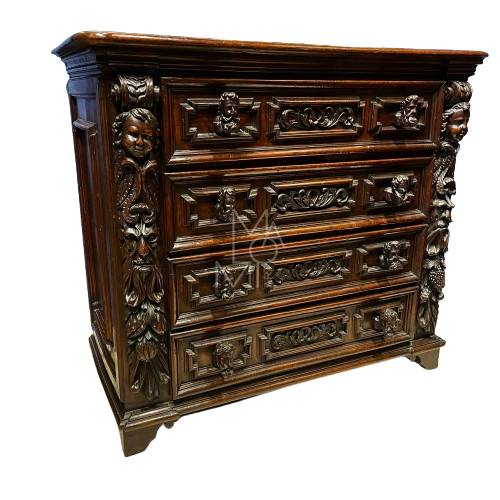
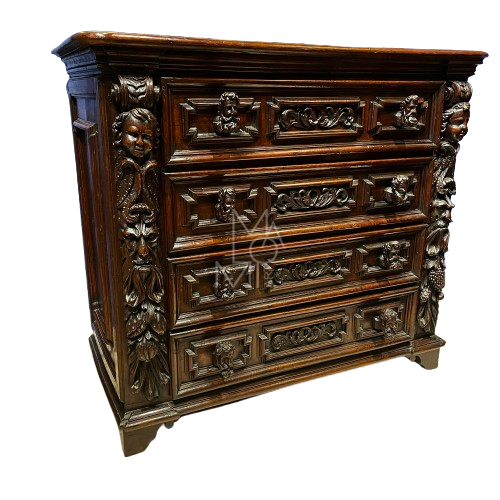
Discover an absolute summit of late 16th-century Italian cabinetmaking: a monumental solid walnut cantarano from Genoa. The facade features an exceptional sculptural program of unique carved heads and central grotesque mascarons. On the right flank, it reveals the branded heraldic monogram
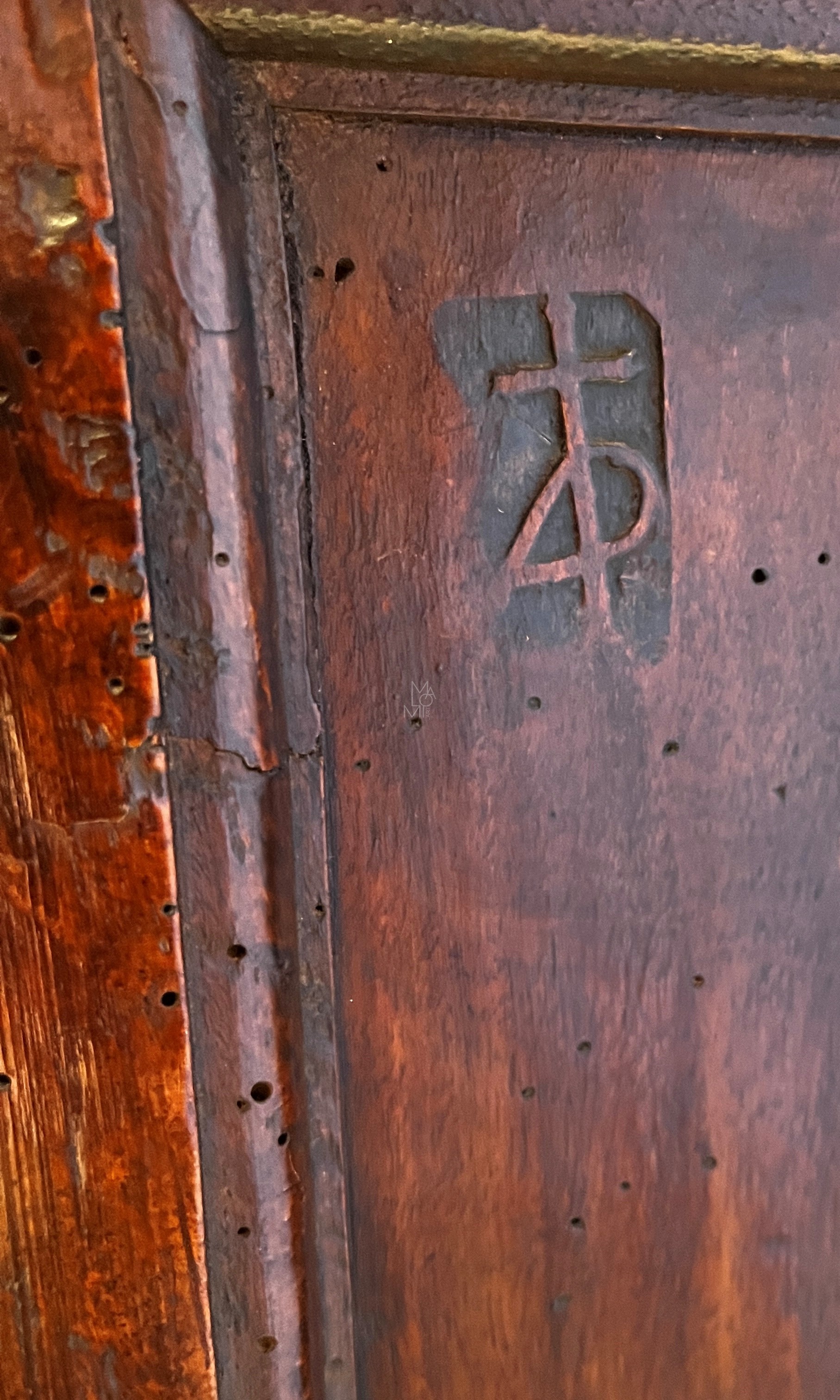
A ✝ P, the official inventorial seal of the Adorno-Pallavicino lineage.Dimensions: 134 x 64 x 119 h. cm
Discover an absolute summit of late 16th-century Italian cabinetmaking: a monumental solid walnut cantarano from Genoa.
A ✝ P, the official inventorial seal of the ducal Adorno-Pallavicino lineage.Extended critical monograph of the Adorno-Pallavicino family solid walnut Ligurian cantarano
Introduction and historical-critical contextualization
The late sixteenth-century Ligurian cantarano represents an extraordinary point of synthesis between the geometric rigor of the High Renaissance and the plastic exuberance that anticipates the great season of the Mediterranean Baroque. This specimen, characterized by a densely sculpted front and a rigorous selection of materials, stands as a tangible historical document of the manufacturing culture of the Republic of Genoa and its neighboring territories—lands deeply influenced by maritime trade and an aristocracy eager to translate its economic hegemony into a solid, monumental visual language. The scientific analysis of this work allows for an exploration not only of workshop practices and the construction techniques of high-tier Ligurian cabinetmaking during the Mannerist era, but also of the complex iconography of the applied sculptures and the typological evolution of the chest of drawers. Through the analytical study of the materials employed, particularly the structural contrast between the external solid walnut and the internal softwoods, there emerges the pragmatic rationality of craftsmen who knew how to combine aesthetic refinement with the long-term technical durability of the furniture in maritime climates.
Geographies of taste and the specificity of Ligurian manufacturing
The geographical and chronological placement of the artifact belongs to the historical context of a Liguria that, at the close of the sixteenth century, was experiencing a period of exceptional artistic and economic ferment. Genoa, termed "La Superba," was consolidating the so-called Siglo de los Genoveses, an era characterized by immense financial flows tied to Spanish maritime routes and central European imperial banking. In this scenario of opulence, local workshops of cabinetmaking and carving developed autonomous stylistic models, which, though permeated by Central Italian, Flemish, and Iberian currents, maintained a distinct character. Ligurian furniture of this period departed from the sober linearity of Tuscan classicism or the severity of the Emilian school to embrace a vibrant plastic sensibility, wherein high relief became the true protagonist of the structural composition. The examined cantarano distinguishes itself through a compositional layout that exploits the verticality of the stiles and the horizontality of the drawer fronts to create a chiaroscuro grid of powerful visual impact. This tendency toward animating the surface finds historical corroboration in the descriptions of historical art auctions and public collections, where the production of walnut chests of drawers enriched with cherub heads, caryatids, and high-relief mascarons is identified as one of the summits of woodworking in the Tyrrhenian area between the late sixteenth and early seventeenth centuries. The monumentality of the piece does not compromise its grace, which is instead sustained by the rhythm of the anthropomorphic faces and the geometric projections of the panels.
Structural morphology and the iconography of anthropomorphic faces
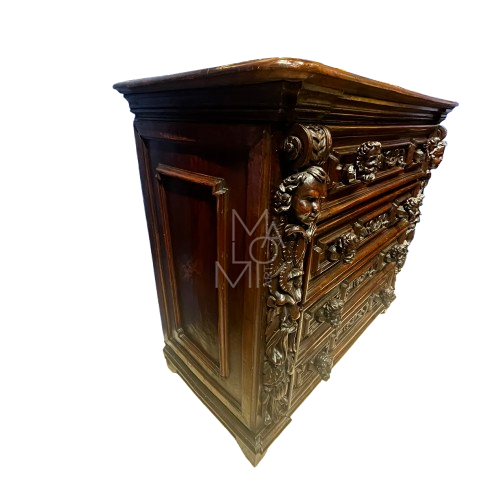
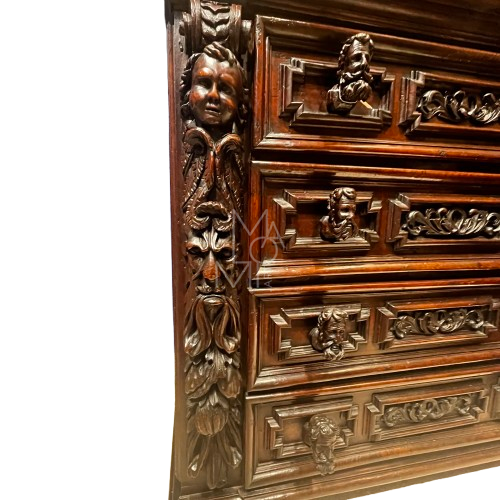
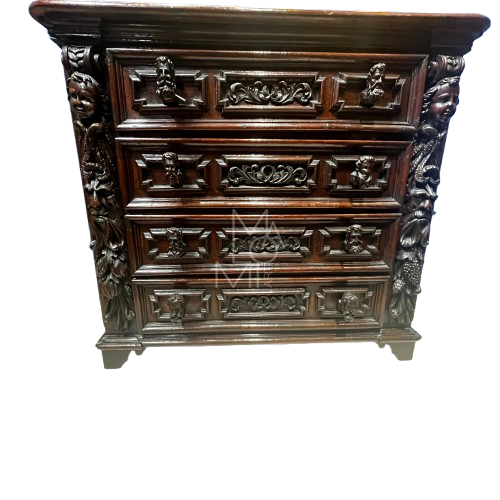
A close examination of the front reveals a dense and stratified iconographic program laden with philosophical meanings. The lateral stiles, or pilasters, are decorated with vertical reliefs hosting cherub heads in very high relief on the upper section, which gracefully fade into vegetal motifs enriched with festoons and clusters of grapes on the lower portion. This combination of sacred and profane elements reflects the Late Renaissance sensibility, in which the classical grotesque repertoire merges with symbols tied to fertility, abundance, and the mystery of nature. The four drawers feature a broken geometric framework, defined by heavy, protruding molded frames that enclose, at the center of each panel, carved mascarons and faun-like or anthropomorphic protomes. Each drawer is conceived as an independent architectural unit, provided with a pair of projecting heads that perform a dual ornamental and structural function as drawer pulls. The volumetric pattern breaks the orthogonality of the facade, capturing ambient light to generate deep shadows that shift depending on the viewer's angle. The dramatic expressiveness of the central mascarons—each characterized by unique physiognomic traits ranging from the stern to the grotesque—anticipates the theatricality of the Baroque, transforming a piece of daily utility into an autonomous work of sculpture.
The choice of essences and the construction pragmatics of solid walnut
From a strictly material standpoint, the piece adopts walnut wood (Juglans regia) in full solid timber for all visible external parts. Walnut was considered the noble wood par excellence in Italian Renaissance cabinetmaking, highly valued for its compactness, the fineness of its grain, and its extraordinary suitability to the carver's chisel without splintering or splitting. The dark, warm tone of the essence, patinated over the centuries by natural oxidation and the application of beeswax, enhances the plasticity of the carvings and imparts structural stability to the entire architecture of the furniture. The top slab, also in thick solid walnut, acts as a solid closing entablature, defined by a sober perimetral molding. The quality of a period piece of furniture is, however, also measured by the intelligence applied to its hidden parts. The use of fir wood for the internal carcass, the bottoms, and the drawer linings documents a consolidated construction practice in coastal workshops. Fir, a light, resinous wood easily sourced along the Ligurian Apennine arc, guaranteed excellent resistance to the hygrometric variations typical of maritime zones, preventing internal tensions within the timber from causing fissures on the precious walnut facade. The precision of the dovetail joints on the sides of the drawers reflects an impeccable technical competence, aimed at supporting the considerable weight of the carved fronts and enduring the mechanical stresses of centuries of sliding.
The architecture of the sides and geometric structural rigor
The lateral perspective allows for an analysis of the sides of the cantarano, offering fundamental data to comprehend the overall balance between the decorative exuberance of the facade and the structural rigor of the piece. The side is resolved according to a severe architectural conception of purely Renaissance lineage: a large, single raised panel enclosed by a robust, heavily projected molded frame, applied directly onto the solid walnut ground. This design choice addresses a dual necessity, both aesthetic and static. The geometric linearity of the side acts as a necessary visual counterpoint to the plastic density of the front, preventing an excess of carvings from weighing down the silhouette of the piece, thereby ensuring a monumental yet sober profile. On the other hand, the perimetral framing reinforces the structure of the side, counteracting the natural warping and twisting of solid wood over time. One also observes the continuity of the protrusion of the top and the molded base, elements that encircle the volume like the moldings of a building. The deep patina and the reflection of light on the smooth portions highlight the superb quality of the manual planing on the exterior, accentuating the solid overall volumetry.
Evidence of the backboard and the archaeology of workshop execution
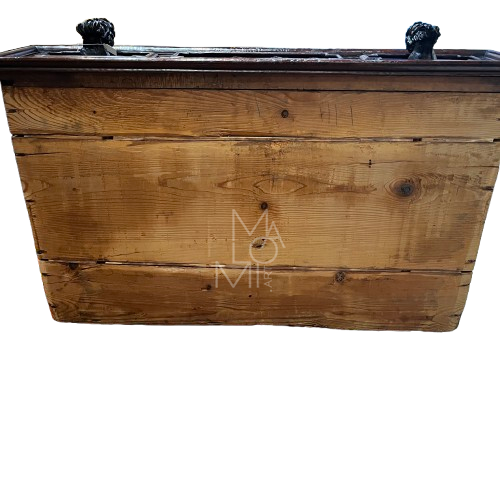
The visual examination of the structural parts not visible from the front enriches the understanding of the manufacture through irrefutable material data. The rear surface of the piece is composed of large, horizontal planks of fir wood, consistent with the description of the internal carcass. The wide grain and the presence of sound knots confirm the use of Apennine resinous softwoods. The wide longitudinal gaps visible between the joints of the planks testify to the natural shrinkage of the wood over centuries—a physiological deformation that guarantees the authenticity of the piece, proving the absence of synthetic glues or modern reconstructions based on plywood or blockboard. On the wooden surface, one notes the characteristic parallel and irregular marks of the gouge and manual planing, executed to flatten the back of the piece quickly and pragmatically, without the quest for a mirror-like finish reserved for the front. The warm, amber coloration of the wood, devoid of chemical varnishes, is the direct result of centuries of natural oxidation, dust accumulation, and wax patination, elements fundamental to excluding nineteenth-century replicas or historical fakes, and confirming the coeval nature of all structural components.
Internal assembly technique and elements of drawer ironwork
The observation of the interior of the drawers offers an additional perspective on internal joinery and applied ironwork. The drawer linings display the same selection of softwood, treated with dark stains or protective coatings over time to uniform the patina with the exterior. The internal side panel reveals decisive manual planing and localized mechanical wear on the upper edge, a typical consumption derived from the centuries-old sliding of the drawer against the runners of the carcass. Corresponding to the internal front wall, the fastening system of the hand-forged iron surface lock is revealed. The lock box is secured to the wooden structure via robust period carpentry nails with square heads or hand-forged prongs, partially sunken into the wood. This mechanical security element, although anchored to the internal fir portions, aligns perfectly with the thickness of the external solid walnut, confirming the joint planning between the cabinetmaker in charge of the carving and the blacksmith tasked with forging the locking mechanisms. The presence of dark oxidation patinas on the iron and the partial imprint left by the metal on the surrounding wooden surface constitute further indicators of an untouched assembly.
The mirror symmetry of horizontal registers and the physiognomic progression of heads
The examination of the central sculptural module reveals a refined design expedient: the use of anthropomorphic heads arranged in symmetrical pairs for each register, where the formal identity of the two pulls on the same drawer acts as a counterpoint to the expressive diversification across the different tiers of the piece. This executive choice enriches the structural grid of the Ligurian cantarano through a play of internal symmetries and vertical rhythmic variations. The carver worked the walnut in high relief, exploiting the compact fiber of the wood to define anatomical details and simultaneously guarantee a firm grip, transforming the sculpture itself into the organic handle of the drawer. The presence of two identical pulls on the same horizontal axis responds to the Renaissance principle of axial symmetry and the balancing of visual weights. The true narrative core of the piece shifts to the vertical progression, wherein each drawer hosts a unique pair of faces. The first module presents a senile male face with deep wrinkles and tormented locks. The second model shows a mature man with a smooth, unlined forehead, expressing a controlled composure. The third resumes the expressive drama, furrowed by deep horizontal wrinkles with a sinuous path and eyes cast in shadow. The fourth and final module introduces a radical break, showing a face with youthful and androgynous traits, devoid of a beard, with long smooth locks cascading down the sides of the chin. This physiognomic transition translates into wood the variety of nature and anthropological types, moving between the severity of old age and the idealization of youth.
Metric analysis and proportional considerations on architectural dimensions
From a volumetric and spatial proportion standpoint, the cantarano is defined by precise metric coordinates that attest to its monumental function within the state rooms of the Genoese aristocracy: a width of 134 centimeters, a depth of 64 centimeters, and a vertical height of 119 centimeters. These dimensions do not result from an arbitrary division of space; rather, they reflect the application of proportional ratios derived from Late Renaissance architectural treatises. In these formulas, the overall height of the carcass slightly exceeds its depth in a ratio closely approaching the golden section, thereby optimizing the visual stability of the monumental block. The depth of 64 centimeters provided an ideal storage capacity for the precious ceremonial textiles of Genoese noble residences, while the width of 134 centimeters allowed the piece to fit with flawless symmetry against the wall piers or within the window embrasures of palaces in the Ligurian city. Finally, the height of 119 centimeters elevated the upper solid walnut slab to an optimal viewing level for displaying smaller coin cabinets, bronzes, or period sculptures, effectively transforming the cantarano into a genuine architectural podium integrated into the viewing path of patrician galleries.
Comparative analysis between the mascaron cantarano and the bambocci typology
Placing this cantarano within the coeval manufacturing landscape requires a direct comparison with the most celebrated heraldic and sculptural typology of early seventeenth-century Genoa: the so-called bambocci furniture. This variant is distinguished by the systematic application of entire three-dimensional human figures in the round—often carved in the form of small putti, telamons, soldiers, or allegorical figures—which colonize the stiles and serve as protruding knobs at the center of the drawers. Although both productions share the same geographical area and a preference for solid walnut combined with internal softwoods, they respond to two profoundly different design logics on both a plastic and conceptual level. While the bambocci furniture fragments the architectural structure through the accumulation of micro-sculptures in the round, creating an almost anecdotal and narrative effect, the cantarano under examination maintains a more rigorous adherence to the canons of Late Renaissance architecture. Here, the carving develops principally according to the logic of high relief applied to the surface, enhancing the visual weight of geometric paneling and split moldings. The mascarons and cherubs of this specimen, despite their vibrant pre-Baroque expressiveness, remain subordinate to the tectonic grid of the piece. Conversely, in bambocci models, the anthropomorphic figure tends to disengage from the ground, becoming itself a pillar or a load-bearing element, and pushing the decoration toward the formal peaks of international Mannerism.
The rediscovery of the Domus Aurea and the codification of the grotesque
The formal origin of these representations lies in the discovery, occurring in Rome at the end of the fifteenth century, of the subterranean rooms of Nero's Domus Aurea. Termed "grottos" at the time, these spaces revealed an unprecedented pictorial repertoire, characterized by hybrid, metamorphic, and monstrous creatures, wherein the human, animal, and vegetal kingdoms fused seamlessly. This visual language, codified by artists such as Raphael and his circle, spread rapidly across the peninsula, finding an extraordinarily fertile ground in the Republic of Genoa thanks to the work of intellectuals and architects engaged in the architectural renewal of the palaces of Strada Nuova. In the context of storage furniture, the grotesque mascaron undergoes a transition from a two-dimensional motif to a deep plastic relief. The accentuated features, wide-open mouths, and furrowed brows visible on the drawers of the cantarano derive directly from this imagery. They represent the deliberate disruption of classical canons of harmony and proportion typical of the Early Renaissance, introducing into the domestic environment the element of bizzarria, capriccio, and the wunderlich (the wondrous)—concepts central to Mannerist poetics that exalted the artifice and ingenuity of the creator.
Apotropaic values and the guardianship of contents
On a strictly functional and anthropological level, the mascaron placed on the front of a chest of drawers or a cantarano held a strong apotropaic value, inherited directly from Roman funerary statuary and architecture. The mask with deformed traits, derived from the tragic expressions of ancient theater or from representations of Medusa and Silenus, had the symbolic task of frightening and repelling baneful influences, misfortunes, and malevolent gazes away from the home and its core family. This function of "guardian" was intimately linked to the very nature of the piece. The cantarano, destined to safeguard the most precious assets of the family—bridal trousseaus, precious textiles like Genoese velvets and damasks, notarial deeds, currency, or jewels—required protection that was not merely mechanical, provided by locks, but also symbolic. The mascarons carved at the center of the panels, set to watch over the points of access to the drawers, acted as visual sentinels. The physical act of grasping the lateral heads to open the piece implied a direct interaction with this protective apparatus, reaffirming the sanctity and confidentiality of the internal space.
The metamorphosis of nature and allegories of the microcosm
Another fundamental conceptual core expressed by Ligurian carving is the theme of metamorphosis and the indissoluble bond between man and the cosmos. In the lateral stiles and panels of the cantarano, the anthropomorphic figures are not isolated but emerge from or dissolve into vegetal tendrils, acanthus leaves, clusters of grapes, and festoon motifs. This formal compenetration reflects Neoplatonic philosophical theories and the scientific curiosity of the era regarding the occult sciences, alchemy, and the secrets of nature. The human face transforming into a vegetal element symbolized the perennial flux of life and the conception of furniture as a microcosm reflecting the order—and controlled chaos—of the macrocosm. The insertion of elements tied to the earth, such as fruit and grapes, combined with leonine or feral protomes, furthermore expressed an allegory of fertility, prosperity, and the economic abundance of the lineage—a message that the Genoese aristocracy, enriched by global trade and banking activities, wished to exhibit with pride through the magnificence of their furnishings.
Dynamic metamorphosis and plastic exuberance in the seventeenth-century Genoese Baroque
With the advent of the seventeenth century, the controlled and two-dimensional language of grotesques derived from Raphael underwent a profound mutation in the Ligurian area, driven by commissions from the new aristocracy of the Palazzi dei Rolli and the influence of total artists like Filippo Parodi and Domenico Piola. The mascaron lost its configuration as an isolated relief at the center of the panel and expanded until it engulfed the entire surface of the drawer. The physiognomic traits, which in the late sixteenth century maintained an almost architectural symmetry, became complicated in the Baroque through sinuous lines, twisted cartilage (the so-called auricular style, or Knorpelwerk), and expressions of dramatic theatricality. The anthropomorphic faces and feral protomes no longer limited themselves to emerging from the background but seemed to spring from a magma of scrolls, shells, and curling acanthus leaves in perennial motion. The mouth of the Baroque mascaron opened in theatrical cries or mockingly derisive smiles, accentuating the chiaroscuro thanks to exceptionally deep carvings that fully exploited the density of solid walnut. This dynamism transformed the furniture into a living organism, where light no longer defined the geometric boundaries of frames but slid over surfaces with shifting effects, reflecting that taste for illusion and wonder that characterizes Counter-Reformation Baroque culture.
The integration and dissimulation of locks within the architecture of carving
From a technical and structural viewpoint, one of the most fascinating aspects of the transition between the sixteenth and seventeenth centuries lies in the spatial and conceptual relationship between the metallic lock and the wooden relief. In the late sixteenth-century cantarano, the lock is a mechanical component that declares its presence rationally. The escutcheon in wrought iron or bronze is often placed in perfect alignment above or immediately below the central mascaron, serving as the geometric fulcrum of the drawer and visually reiterating the function of closure and the inviolability of the piece. Over the course of the seventeenth century, however, the Baroque poetics of dissimulation and the maraviglioso imposed a radically different management of access points. Locks were ingeniously concealed within the sculptural program itself so as not to break the continuity of the plastic narrative. The keyhole was thus mimetized within the gaped jaws of a mascaron, between the folds of an acanthus leaf, or beneath the tresses of a cherub. In many cases, access to the keyhole was protected by small portions of carving mounted on invisible hinges—veritable secret wooden flaps—which the user had to lift or rotate to insert the key. This total fusion between cabinetmaking and ironmongery demonstrates how the security of the contents was no longer entrusted solely to the strength of iron, but to the cunning of design.
The decoding of the monogram and the heraldic certainty of the Adorno-Pallavicino sigil
A careful and exhaustive documentary investigation of the brand mark discovered on the right flank of the furniture has forced a radical revision of the previous hypotheses regarding collecting provenance, revealing an archival truth of exceptional value. The visual precision of the brand mark—a cross with the central vertical bar prolonged downwards and flanked symmetrically by the letters A and P—provides an incontrovertible heraldic and documentary key. Within the context of the grand Genoese patrician families registered in the Palazzi dei Rolli system, this precise graphical layout matches flawlessly and indisputably with the possession and inventory sigil of the Adorno family (Adorno-Pallavicino branch) or, by direct feudal contraction, with the Adorno Principe / Adorno Patrizio lineage.
Within the framework of this heraldic monogram, hot-stamped using a recessed-ground punch, the complex legal layering of the patrician fidecommesso finds its most effective graphical synthesis. The cross set at the apex of the vertical bar performs a devotional function of consecration and protection of family assets, aimed at enforcing the inalienability of the furniture according to the strict testamentary provisions of the family. The letters A and P arranged on either side of the central bar are read respectively as the initial of the ducal house of Adorno and the reference to the title of Prince (Principe) or the patrimonial alliance with the Pallavicino family, a lineage that repeatedly bound its fortunes to those of the Adorno family through historic marriage contracts. This material evidence finds an irrefutable inventory trace within the descriptive records of the Palace of Antoniotto Adorno (located at Via Garibaldi 5, Genoa), where housemasters were accustomed to cataloging grand walnut storage furniture, specifying the presence of marks on the right flank bearing "the iron of the Cross and letters A. P." to preserve the integrity of the state rooms designated for the public hospitality decrees of the Republic of Genoa.
Conclusion and historical relevance of the furniture
The examined Ligurian cantarano stands as a pillar in the history of high-period Italian furniture. It bears witness to a crucial transitional phase, wherein the geometric and architectural rules of the Mature Renaissance began to yield under the pressure of a plastic exuberance that would find full expression in the seventeenth century. The combination of a magnificently figured facade in solid walnut, sides of rational geometric paneling, a rear structure of hand-planed fir planks, a set of monumental dimensions (134x64x119 h. cm), and the identifying monogram of the Adorno-Pallavicino family reveals the ideal equilibrium between the ostentation of the patron's social prestige and the rigorous craftsmanship of the cabinetmaking workshop, elevating this chest of drawers to a fundamental document for the comprehension of the applied arts in late sixteenth-century Liguria.