Neoclassicism in Lombard Cabinet making
Neoclassicism in Lombard Cabinet making: A Historical-Artistic and Design Analysis of an Inlaid Cabinet from the Late Eighteenth Century
- introduction and historical-cultural contextualization
During the second half of the eighteenth century, Habsburg Lombardy emerged as one of the pivotal centers of the European Neoclassical movement. Under the enlightened governance of Maria Theresa of Austria and, subsequently, Joseph II, Milan and its surrounding territories underwent a profound urban, architectural, and philosophical transformation. The rejection of the sinuous lines and decorative excesses characteristic of the Barocchetto style prompted a return to order, symmetry, and rigid geometric structures—a paradigm shift heavily inspired by the contemporary archaeological excavations at Herculaneum and Pompeii.
This aesthetic renewal found its paramount expression within the decorative arts, particularly in the realm of fine cabinetmaking. Furniture pieces were no longer conceived as isolated objects; instead, they were designed as integral components of comprehensive interior schemes. These designs were dominated by straight lines, calibrated proportions, and flat surfaces that served as ideal canvases for master inlayers.
- functional typology and structural characteristics
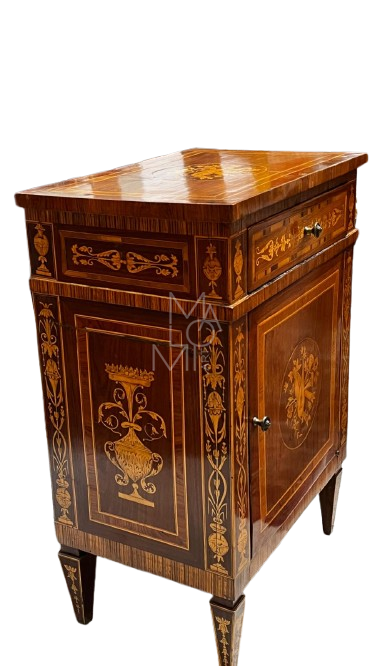
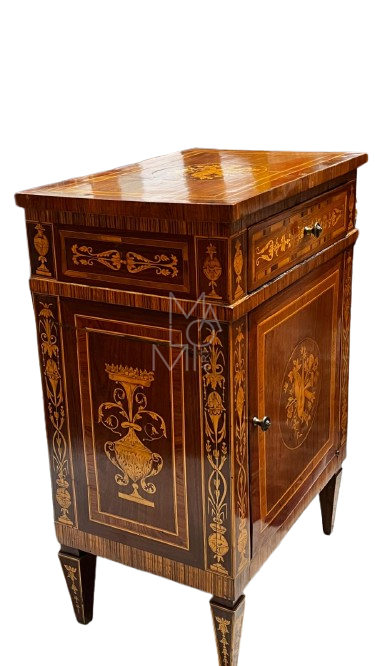
The artifact under analysis belongs to the category of bedroom furniture or small accent cabinets (comoncini d'appoggio) dating from the Lombard Louis XVI period. From a structural standpoint, the piece features a parallelepiped body horizontally divided by a drawer positioned directly beneath the top surface, while the lower section comprises a storage compartment enclosed by a single door.
The volumetric transition toward the base is supported by four tapered, square-section legs (piedi tronco-piramidali), a defining hallmark of Neoclassical production. This feature imparts a sense of verticality, lightness, and architectural rigor to the overall composition, standing in direct opposition to the sinuous cabriole legs of the Rococo era. In keeping with the established regional manufacturing traditions of the period, the internal carcass utilizes sturdy and compact indigenous timbers, predominantly walnut or poplar.
- the decorative program and iconography of the frontal elevation
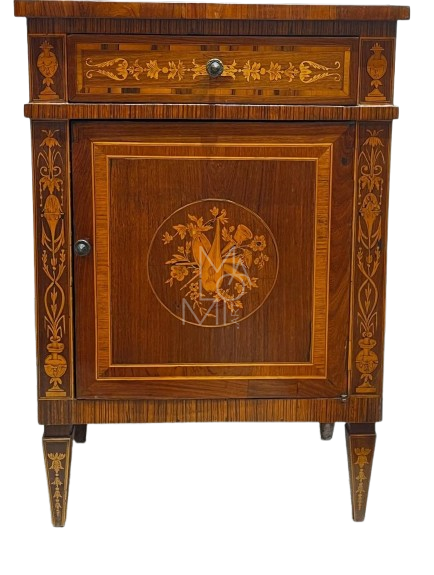
The frontal elevation of the cabinet constitutes the narrative and decorative focus of the entire piece, exhibiting a rigorous, mirrored symmetry typical of late eighteenth-century architectural repertoires. The composition is articulated through precise geometric divisions that guide the eye along the veneered surfaces:
- The upper drawer: It is adorned with a horizontal band enclosed within geometric reserves, dominated at its center by a period metallic pull knob. Branching out from this central element is a complex, symmetrical ornamentation of vegetative volutes and dense phytomorphic tendrils, finely pierced in light-colored wood against a dark background and punctuated by elegant floral corollas.
- The central door and the iconography of the medallion: The large quadrangular door features a peripheral geometric reserve in striped walnut. Centered within is a large circular medallion bordered by a fine, light-colored stringing. The interior inlay depicts an intricate trophy of musical instruments, a scholarly allegory rooted in Arcadian and Neoclassical themes. At the heart of the tondo, one can discern a long-necked lute (or mandola), a transverse flute, a hunting horn, and a rolled musical score, all partially enveloped and enriched by a dense composition of wild flowers and field leaves.
- The vertical stiles and pillars: The corner pillars function as architectural pilasters, framing the door panel. They host a vertically cascading (en chute) symmetrical decoration: candelabra motifs punctuated by antique-style amphorae and vases in the upper section, followed by cornucopias, flowering chalices, rhomboidal geometric elements, and dense groupings of overlapping acanthus leaves.
- The legs: The tapered, square-section legs also contribute to the ornamentation of the front elevation. Their visible faces feature refined vertical inlays of graduated drops and wheat-ear motifs that converge toward the lower block feet, thereby accentuating their geometric taper.
- the role of preparatory cartoons in the neoclassical workshop
The exceptional geometric rigor and near-pictorial precision observed in this cabinet derive directly from a systematic method of design based on the utilization of preparatory drawings and cartoons. During the eighteenth century, the status of the cabinetmaker underwent a definitive evolution: the artisan ceased to be a mere manual worker improvising directly upon raw materials, transforming instead into an executor—often a highly refined draftsman himself—capable of translating complex graphic repertoires conceived by architects, painters, and ornamentalists into wooden reserves.
The fundamental reference point for studying this design methodology is the renowned Fondo Maggiolini, an unparalleled graphic corpus comprising nearly 2,000 sheets (specifically 1,896) preserved within the Gabinetto dei Disegni at the Castello Sforzesco in Milan. Acquired by the Municipality of Milan in 1882, this visual archive represents the historical memory and workshop repertoire of the celebrated Parabiago atelier. The sheets within this collection are divided into three primary functional categories:
- Overall inventions (Invenzioni d'insieme): Preparatory sketches and volumetric designs for entire furniture pieces.
- Ornamental drawings (Disegni d'ornato): Repertoires of decorative details (fregi, candelabras, scrolls) rendered at a 1:1 scale.
- Tracings (Lucidi or Squinterni): Sheets of oiled or translucent tracing paper applied directly onto the wood surfaces to guide the precise, millimetric cutting of individual veneer pieces using a fretsaw.
- genesis of the trophy motif and artistic collaborations
The theme of the musical trophy enclosed within a tondo, visible on the cabinet's main door panel, corresponds precisely with graphic prototypes of the era and contemporary workshop repertoires. These decorative motifs were not isolated inventions; rather, they resulted from close collaborations between specialized workshops and the foremost figures of Lombard Neoclassicism:
- Giocondo Albertolli: A professor of Ornato (Ornament) at the newly established Brera Academy, Albertolli published influential suites of engravings (such as Alcune decorazioni di nobili sale). Cabinetmakers continuously drew upon these publications for their symmetrical grace, antique-style vases, paterae, and festoons.
- Giuseppe Levati: An accomplished painter and perspectivist (quadraturista), Levati served as one of the principal designers for contemporary cabinetmaking workshops. He was responsible for extraordinary cartoons depicting musical trophies, Neoclassical urns, and vertical candelabras designed specifically for the stiles and central panels of case furniture.
- Andrea Appiani: Frequently commissioned to produce cartoons with mythological or figurative themes (such as central medallions featuring putti or classical deities), Appiani left the definition of geometric borders and phytomorphic elements to Levati and Albertolli.
- wood repertoire, chromatism, and technical translation
To achieve the chiaroscuro effects and pictorial definition delineated in the preparatory cartoons, master cabinetmakers deconstructed the original designs (which often bore handwritten annotations such as "bosso" [boxwood] or "acero tinto" [dyed maple]) by employing a diverse array of wood species:
- Background woods: The use of rosewood, walnut, and ash, arranged with opposing grain directions (frequently in a herringbone or book-matched pattern), established deep, saturated tonal fields.
- Inlay woods: For the figurative decorations and the contours of the urns, light-colored woods such as maple, boxwood, pearwood, and applewood were preferred.
- The graphic shading via heated sand: In the original cartoons, chiaroscuro transitions were rendered using fine ink lines or sepia washes. The cabinetmaker replicated this volumetric depth in wood through the technique of partial scorching, dipping individual veneer pieces into hot sand. This process "painted" the fluting of the urn and the folds of the festoons with heat alone, avoiding the use of chemical pigments.
The overall composition and superior execution of this piece align directly with the production and graphic models introduced by Giuseppe Maggiolini (1738–1814), the most celebrated cabinetmaker of Italian Neoclassicism. Operating from Parabiago and appointed Intarsiatore della Regia Corte (Inlayer to the Royal Court) in Milan, Maggiolini revolutionized contemporary furniture design by indissolubly binding the drawn page to the final executed object.
While many period pieces of this typology are generically categorized as "Maggiolini-style" (maggiolinati), this specific specimen reflects the refined workshop culture of late eighteenth-century Milan or Monza. The sophisticated geometric schemes and the millimetric precision of the joinery demonstrate a flawless assimilation of Court decorative repertoires by high-level local master craftsmen. In conclusion, this small cabinet stands as an invaluable material document for the study of evolving taste and manufacturing techniques in late eighteenth-century Lombardy—an enduring testament to the Age of Enlightenment and Neoclassical formal rigor.