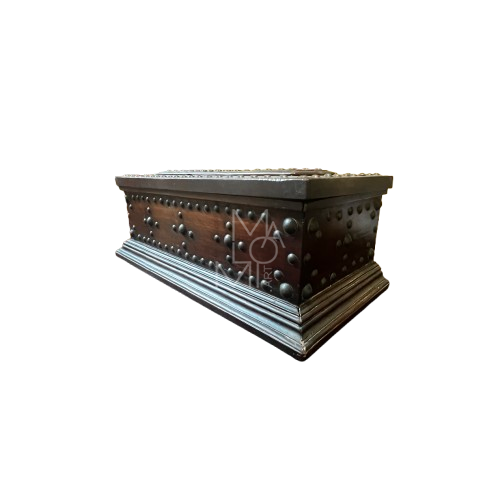
Late sixteenth-century walnut coffret from the Bolognese school
A critical study and catalogue raisonné: a late sixteenth-century walnut coffret from the Bolognese school
- Introduction and historical-artistic framework
Within the figurative and manufacturing culture of late sixteenth-century Emilia, the production of high-end wooden furnishings and containers vividly reflects the stylistic tensions between the geometric rigor of the High Renaissance and the emerging plastic-chiaroscuro accents of Mannerism.
The coffret under examination constitutes a material document of significant interest for the study of late-Cinquecento Bolognese decorative arts. Intended for the safekeeping of valuables—such as archival documents, precious objects, or private correspondence—the piece is typologically defined as a desk or studiolo casket, conceived for close inspection and destined for high-status domestic or institutional spaces.
- Material, structural, and dimensional analysis
From an ebanistic and typological perspective, the object is distinguished by the judicious combination of wooden species, selected based on criteria of both visual prestige and structural engineering. The visible external facings are crafted from solid walnut (Juglans regia), the wood of choice for Renaissance North-Italian cabinetmakers due to its density, resistance to wood-boring insects, and exceptional suitability for carving, polishing, and deep patination.
The recorded dimensions are as follows:
- Width: 54 cm
- Depth: 28 cm
- Height: 21 cm
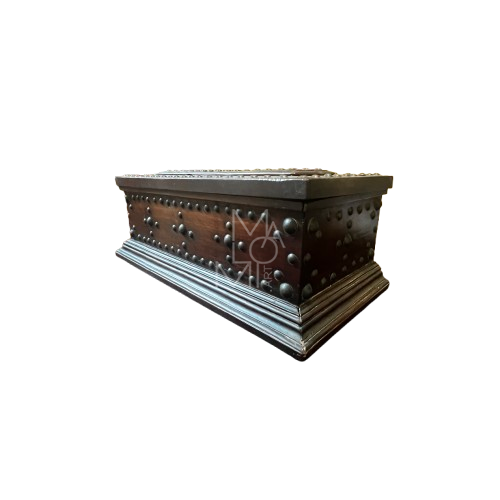
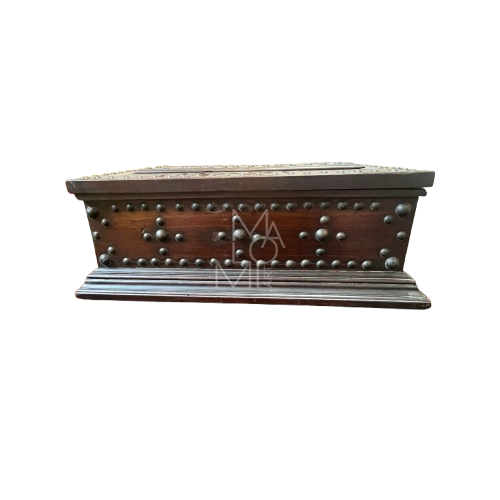
These proportions dictate a distinctly longitudinal development. The casket rests upon a substantial, projecting molded base, characterized by alternating scotiae and tori that visually anchor the structure to its supporting surface.
- The ornamental program: the use of inset iron bosses and attribution to the Bolognese school
The most distinguishing feature of the artifact lies in its decorative and structural program. The front, rear, and lateral panels are articulated by geometric cruciform or diamond-shaped compositions formed by raised wooden moldings, densely enriched and punctuated by a sequence of hemispherical iron bosses inset directly into the solid wood.
This ornamental and structural use of hand-forged iron studs recalls the sturdiness and vigor of monumental palace doors and travel trunks of the High Renaissance, scaled down here to a refined, miniature format. The shanks of the iron bosses, driven in while hot or clenched flat against the inner walls, act as critical mechanical anchors reinforcing the assembly of the solid walnut panels.
In the Emilian region, and specifically within the Bolognese district, this technical blending of solid walnut joinery and hand-forged iron mountings enjoyed immense popularity between 1570 and the early years of the seventeenth century. Bologna developed a sober yet powerfully sculptural school of cabinetmaking. It favored the tactile contrast between forged iron and solid wood carved into bold geometric reliefs or rustic rustication (bugne) over the pictorial delicacy of Tuscan or Venetian intarsia. The deep, dark, and highly structured patina of the walnut blends with the historical oxidation of the iron studs, accentuating the dramatic play of shadows under raking light.
- Analysis of the lid: the "sarcophagus" profile and the technical use of fir
The formal conception of the upper plane constitutes the architectural linchpin of the artifact's design. The lid is not a simple flat board but is structured as a sarcophagus (or with truncated sloping sides), a refined typological choice borrowed from monumental classical architecture and ancient sepulchral urns, which found widespread application in Emilian cabinetmaking during the late Cinquecento, appearing on both monumental cassoni and small desk caskets.
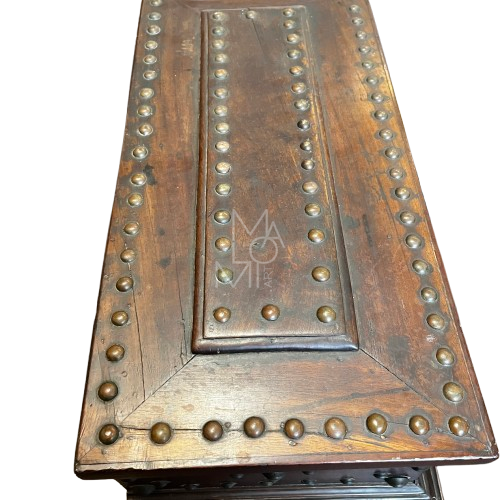
As evidenced by the zenithal examination of the exterior top, the geometric layout is strongly three-dimensional:
- The perimeter frame: A massive walnut frame, mitered at the corners with perfectly calibrated forty-five-degree cuts, creates a downward slope toward the outer edges.
- The raised central field: The inclined perimeter encloses and elevates a recessed, smooth central rectangular panel, mimicking the clean lines of classical moldings.
- The distribution of the bosses: The rhythm of the inset iron bosses faithfully follows the sarcophagus volumetry: a continuous line runs along the outermost edge of the frame, while a second compressed sequence outlines the raised inner field, leaving the transitional gola and the center of the panel smooth to emphasize the contrast between the hemispherical metal heads and the wood grain.
A close inspection of the underside of the lid reveals an ebanistic technique of exceptional philological interest. The central recessed field, corresponding to the deepest part of the sarcophagus carving, is constructed from silver fir (Abies alba). In late sixteenth-century Padan workshops, integrating a softwood like fir within the load-bearing walnut framework served a precise mechanical purpose:
- Mitigation of hygroscopic movement: Solid walnut, when carved and hollowed to varying thicknesses as required by a sarcophagus lid, remains structurally "live" and prone to warping, twisting, or splitting due to changes in relative humidity. The fir lining, with its flexible and stable fibers, acts as a structural counter-balance.
- Tongue-and-groove joinery: The internal construction demonstrates how the fir panel is deeply tongue-and-groove jointed into the massive walnut perimeter stiles, a technical solution that prevents the mitered forty-five-degree external joints from opening over the centuries and ensures the continuous flatness of the lid’s rebate.
- The locking mechanism: the missing lock
Archaeological analysis of the internal carcase sheds light on the object's original security apparatus. At the center of the inner front wall, corresponding to the upper lip, a geometric mortise specifically hollowed out of the wood is clearly visible. This structural evidence confirms that the artifact was originally conceived with a lock, which is currently missing.
The removal of iron locking mechanisms is a recurring phenomenon in antique furniture. Frequently, the deterioration or loss of the hand-forged keys led owners to extract the internal iron block entirely to avoid the accidental, permanent jamming of the heavy sarcophagus lid. Crucially, the cabinetmaker confined the mortise solely to the inner wall and the upper lip (where the locking bolt engaged), leaving the external front facade visually intact and preserving the uninterrupted rhythm of the wood carvings and metal studs.
- Analysis of the back and external state of conservation
The rear panel is consistent in thickness with the rest of the solid walnut carcase, displaying an intentionally rougher, unplaned surface finish typical of furniture intended to be placed against a wall.
The wooden surface exhibits the standard signs of natural aging:
- Historical patina: Fading, minor mechanical abrasions, and color variations resulting from centuries of natural oxidation.
- Xylophagous evidence: Old, inactive exit holes from wood-boring beetles (Anobium punctatum), typical of ancient seasoned walnut.
- Joinery lines: The lower edge retains its original hand-forged, rose-head iron nails used to anchor the bottom boards to the molded base.
- Conservation-mechanical study: the transition from ring hinges to strap hinges
The original rotation mechanism of late-Cinquecento Emilian caskets typically relied on pairs of opposing iron rings or eyelets (anellini) driven into the wood—one into the carcase and one into the lid—interlocked by a passing pin. This system, though historically accurate, suffered from severe mechanical fatigue under the weight of solid walnut lids.
The current strap hinges are flush-mounted into the upper profile of the rear panel. While these flat iron hinges are historical (likely dating to the eighteenth or nineteenth century), they represent a functional replacement. The evidence of this substitution is clearly legible in the adjacent woodwork:
- Traces of the original rings: Directly below the axis of the current hinges, circular recesses and scars left by the old iron loops are clearly visible.
- The mechanics of damage (Focus on the right hinge): The macro-photographic evidence of the upper right quadrant reveals a deep volumetric loss of wood due to mechanical tear. The continuous leverage exerted by the heavy sarcophagus lid caused the iron ring to violently pull away from the walnut grain, fracturing the surrounding fibers.
- Historical adaptation: To anchor the replacement strap hinge, the historical restorer moved the placement slightly to the left onto intact wood, hand-chiseling a new flush seat. The original damaged cavity was left exposed without modern wood fills or patches, leaving the historical stratigraphy of the repair intact.
- Internal analysis and material archaeology
8.1 Ancient paper lining and stratigraphic evidence
The interior retains substantial fragments of an early paper lining, a common practice in luxury caskets between the sixteenth and eighteenth centuries to protect delicate contents from direct contact with the wood's natural acids and tannins. This handmade, laid paper exhibits extensive losses, abrasions, and historical water stains, alongside localized degradation from past insect activity that affected both the paper and the underlying fir core of the lid.
8.2 Internal indicators of hardware alteration and boss mounting
The two iron strap hinges are secured to the wood via screws or rivets. Their installation required cutting through sections of the paper lining, definitively proving that the papering predates the current hinges. Along the upper edge of the carcase, small metallic remnants and starter holes align perfectly with the points where the stems of the original ring hinges were bent and clinched flat against the inner wall. Close examination beneath the damaged areas of the paper lining also reveals the historical anchoring and clenching points of the exterior iron bosses, confirming their passing, structural nature.
8.3 Planimetric analysis of the carcase and bottom board
The perimatral walls are joined at the corners using robust, traditional joinery (highly likely blind dovetails). The uniform thickness of the panels indicates manual pit-sawing, typical of quarter-sawn timbers from late Renaissance workshops. In contrast to the lined vertical walls, the bottom board is left bare, showing deep, circular water rings and dark staining caused by localized moisture or liquid spills over the centuries. The upper edges of the sides retain their original thickness and squaring, ruling out modern re-planing or dimensional reduction.
- General conclusions
The integrated analysis of this artifact allows for a definitive scientific profile:
- Authenticity and provenance: The consistency of the solid walnut exterior, the architectural precision of the sarcophagus lid with its internal fir core, the use of hand-forged inset iron bosses, and the Renaissance joinery securely place the object within the Bolognese school of the late sixteenth century.
- Material and structural engineering: The combined use of walnut for the sculptural facade, fir for the lid interior, and passing iron studs highlights a sophisticated understanding of timber mechanics, designed to stabilize and consolidate the complex sarcophagus form.
- Documentary value: The wear patterns, the inactive wormholes, the paper fragments, and the mechanical evolution of the hinges on the reverse constitute a textbook example of virtuoso historical stratigraphy, significantly enhancing the antiquarian and historical value of the piece.
Scientific catalogue sheet
Object identifier: CE-BO-XVI-0024
Identification and cronology
- Object type: Desk Casket / Document Box (Cassetta da studiolo)
- Materials and technique: Solid walnut (Juglans regia) exterior with raised wooden moldings; silver fir (Abies alba) core for the inner lid lining; hemispherical inset iron bosses, hand-forged; historical hand-forged iron hardware.
- Date/period: Late Renaissance (latter part of the second half of the 16th century, circa 1570–1590).
- Geographical origin: Padan region, Emilian school, Bolognese manufacturing district.
Dimensions and typology
- Width: 54.0 cm
- Depth: 28.0 cm
- Height: 21.0 cm
- Form: Rectangular with longitudinal emphasis, a raised sarcophagus-style lid, and a projecting molded plinth base.
Ornamental and morphological description
- Front and flanks: Sculptural decoration consisting of geometric cross and diamond modules defined by raised wooden moldings, densely enriched and punctuated by rows of hemispherical hand-forged iron bosses inset directly into the solid walnut.
- Lid (Sarcophagus top): Concentric geometric structure with truncated slopes. Features an inclined perimeter frame in walnut decorated with a row of inset iron bosses, and an inner raised molding enclosing a smooth, recessed central field bounded by additional hemispherical metal studs.
- Base: High molded plinth base featuring alternating scotiae and tori, secured to the bottom board with original rose-head forged iron nails.
State of conservation and historical restorations
- Wooden and metallic structure: Excellent overall structural stability. Presence of old, inactive exit holes from wood-boring beetles (tarlo). Deep, authentic historical patina on the walnut panels; the iron bosses exhibit stable, historical oxidation. The internal fir panel successfully ensures the structural integrity and flatness of the sarcophagus lid.
- Interior: Surviving fragments of an early handmade laid paper lining on the vertical walls and underside of the lid, showing historical losses, abrasions, and water staining. The bottom board is bare, showing dark circular stains and historical debris accumulation.
- Locking mechanism: Presence of the original internal mortise and strike cutouts for an iron lock on the front inner wall and upper lip; the period lock is currently missing/extracted.
- Rear hardware (Structural modifications): Historical replacement of the original iron ring hinges (anellini). The lid is currently mounted via two flat iron strap hinges flush-recessed into the reverse. This intervention is documented by the sheared remnants of the original iron loops and a significant wood loss on the rear right quadrant, caused by the mechanical failure of the original ring hinge under the weight of the sarcophagus top.
Historico-critical notes
This coffret stands as an exemplary model of late sixteenth-century Bolognese ebanistry. In contrast to coeval Tuscan production or Venetian designs, the Bolognese school prioritized a severe, monumental aesthetic directly derived from urban architecture, as epitomized by the complex "sarcophagus" construction of the lid. The bold sculptural character of the object is defined by the powerful material contrast between the solid walnut exterior and the dense sequence of inset forged iron bosses. Combined with the stabilizing fir core inside the lid, this technical configuration demonstrates a perfect marriage of tactile ornamentation and structural engineering. The internal evidence of the original lock mortise confirms its status as a high-value secure repository, while the layered modifications to the rear hinges record its continuous utility across the centuries, cementing its authenticity and historical importance.