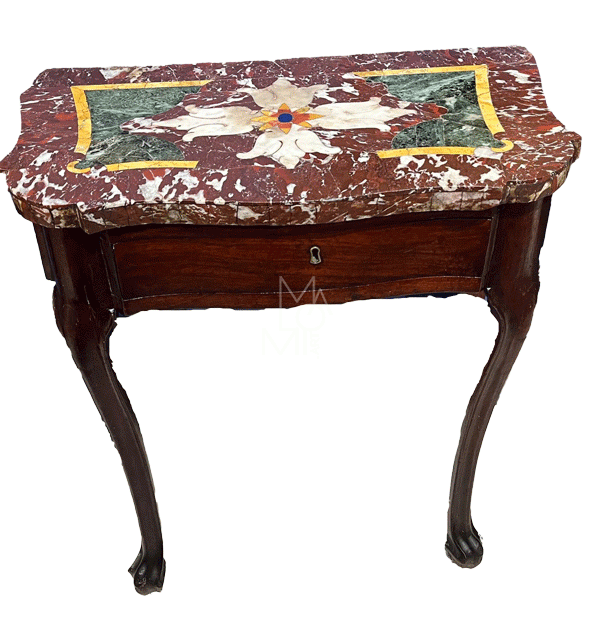
eighteenth-century venetian mahogany console table with ancient roman marble top
18th-century Venetian solid mahogany console table with an ancient Roman domus marble top. Measures 71x40x81 cm, features a central drawer and period patina.
Functional elegance and the historical artifact: a historico-artistic analysis of an eighteenth-century Venetian console table
Introduction: the furniture piece as a space of cultural synthesis
In the rich landscape of fine Italian antique furniture, the console table historically stands as the ceremonial piece par excellence, an item designed not only to fulfill specific practical functions but, above all, to display the social status, aesthetic taste, and humanistic erudition of the patron. The specimen under examination—a solid mahogany console table measuring seventy-one centimeters in width, forty centimeters in depth, and eighty-one centimeters in height, adorned with a sumptuous stone top featuring a veneer of ancient excavated marbles—represents an exceptional convergence between the masterly cabinetmaking skills of eighteenth-century Venetia and a profound fascination with classical archaeology.
The work presents itself to the scholar as a material palimpsest in which Baroque structural elements and early rocaille asymmetries dialogue directly with lithic fragments from a lost Roman domus, anticipating the collecting and intellectual dynamics that would find their full codification in the phenomenon of the Grand Tour during the Age of Enlightenment. Looking at this piece of furniture, one senses the hand of a craftsman who did not merely build a support but celebrated the triumph of ancient history, embedding the Roman past into the sophisticated frame of eighteenth-century lagoon life.
- Historical and geographical context: cabinetmaking production in the Venetian area during the eighteenth century
The lagoon environment and the luxury trade
The eighteenth century was a period of extraordinary cultural, artistic, and social flourishing for the Republic of Venice, serving as the true swan song of the Serenissima before its fall. Despite the progressive downsizing of historical commercial routes in the Mediterranean and geopolitical decline, Venice established itself as the European capital of taste, luxury, and entertainment, becoming an essential stop for the international nobility. Within this environment, furniture production distinguished itself through a striking originality compared to other European models. The Venetian area developed a unique taste for sinuous lines, structural lightness, and a profound integration between cabinetmaking and the plastic arts. Furniture was no longer conceived as a rigorous and heavy piece of architecture, but as a dynamic sculpture capable of interacting with the shifting reflections of water and light penetrating through the bifora windows of palaces overlooking the Grand Canal.
Ceremonial furniture in patrician residences
Within the rooms of Venetian palaces, furnishings had to astonish foreign guests and diplomats, turning every hall into a true wunderkammer or room of wonders. The console table under discussion, while maintaining a wise geometric composure necessary to display the precious stone top, was fully influenced by this vibrant eighteenth-century stylistic transition. A historical anecdote linked to the workshops of the Venetian marangoni, the Republic's carpenters, reminds us that the visual inspection of furniture was a state affair, regulated by strict guilds that forbade the use of low-quality woods for furniture destined for ceremonial reception rooms. This piece manifests the evolution toward more snapping and curvilinear forms, embodying that theatrical taste that sought to merge different materials to create an illusion of perennial magnificence in the century of Casanova and Tiepolo.
- Material analysis: solid mahogany and the transition of precious woods
The introduction of exotic timber to the lagoon
The use of solid mahogany in the load-bearing structure of this artifact constitutes an element of absolute historico-critical significance and a choice selection for the period. Although the most common Venetian production of the eighteenth century made widespread use of lacquered and gilded softwoods, the use of solid mahogany attests to the continuity of the maritime commercial channels of the Venetian Republic and its openness to Northern European markets. Venetian merchants were famous for their ability to intercept rare woods and exotic spices, and mahogany, imported from the Americas and intensively traded during the eighteenth century, was purchased at its weight in gold for ducal patrons or for the most influential patrician families, such as the Contarini or the Pisani, who desired furniture pieces capable of rivaling the prestigious English productions of the Queen Anne and Chippendale styles.
Structural qualities of the material
Mahogany, an exotic wood of extraordinary density, stability, and natural resistance to wood-boring pests, offered the cabinetmaker of the time an impeccable and insuperable plastic yield. Unlike local woods such as domestic walnut, cherry, or poplar, solid mahogany allowed for the creation of supports considerably reduced in thickness but equally capable of bearing extremely heavy loads. This characteristic was fundamental to sustain the imposing weight of the stone top. Its tight grain and deep coloration, enhanced by expert historical polishing, bestow an austere elegance upon the structure that acts as a perfect chromatic and visual counterpoint to the exuberant polychromy of the upper marbles, as if to establish a visual hierarchy where the solidity of the earth supports the splendor of history.
- The architectural structure: the central drawer and the arched supports
The harmony between utility and decorum
From a purely morphological point of view, the console table is articulated according to an advanced design for the height of the eighteenth century. The apron beneath the top houses a single central drawer, an ingenious element that combines a ceremonial and representative purpose with a distinct domestic functionality. This drawer, often intended to hold small precious objects, wax seals, or confidential documents, shows a sober external finish devoid of excessive carving. This was an intentional choice by the cabinetmaker, designed specifically not to distract the viewer's attention from the spectacular polychromy of the stone top above.
The dynamics of Baroque and Rococò lines
The stability of the furniture piece is entirely entrusted to a pair of arched supports with an elegantly inflected line. This curvature fully expresses the controlled dynamism and sinuosity typical of the Venetian eighteenth century, tempering the rigid static nature of wall furniture. The supports terminate at the bottom with a refined hoof foot, a stylized hoof that finds its iconographic roots in the evolution of zoomorphic models of classical derivation. This morphological detail elegantly transfers the weight to the ground and, at the same time, provides a remarkable vertical momentum to the entire structure. The final effect is a sensation of unsuspected lightness, surprising when considering the relationship between the height of eighty-one centimeters and the contained depth of only forty centimeters, making the piece appear almost airy despite the gravity of its materials.
- The stone top: the veneer of ancient marbles and the reuse of the Roman domus
The allure of ruins and the slab technique
The semantic and conceptual core of the entire work is undoubtedly the upper top, made using the technique of veneering ancient reused marbles. In the eighteenth century, at the height of the Grand Tour era and on the threshold of the rediscovery of Pompeii and Herculaneum, the practice of reusing classical materials excavated from Roman ruins responded to specific ideological, philosophical, and collecting desires of the aristocracy. The technique involved applying thin, expertly cut sections of rare and precious marbles onto a stable stone or cementitious support, creating a continuous, smooth surface. On the surface of this console table, one can read a true anthology of ancient petrography, a visual compendium of the trade routes of the Roman Empire that brings together lithotypes from three different continents.
A chromatic map of the Roman Empire
Among the identifiable marbles, the giallo antico stands out, known in antiquity as marmor numidicum, quarried in Tunisia, characterized by a golden, sunny background with reddish veins due to the presence of iron oxides. Next to it is the rosso antico, originating from the Peloponnese in Greece, a material of a deep, dark red color historically linked to Dionysian cults and imperial architecture. Visual dynamism is ensured by inserts of green cipollino marble, quarried on the island of Eubea, with its characteristic wavy veins resembling the section of an onion and shiny reflections due to the presence of mica. It is not uncommon to also glimpse small fragments of marmo africano, a dark-ground brecciated limestone from Asia Minor, and very rare inserts of Egyptian porfido rosso antico, the imperial stone par excellence.
For Venetian nobles, owning such a top was not a mere ornamental whim, but an explicit statement of erudition. During receptions in their palaces, owners loved to entertain guests by challenging them to recognize the different types of marble, transforming the console table into a sophisticated instrument of conversation and an affirmation of their own cultural prestige in the Age of Enlightenment.
- Conservation status: operational restorations and diagnostic conservation
The signs of time as historical value
The indication of operational restorations places the object in a correct and transparent dimension of material historicity. A wooden artifact with over two centuries of lived history, exposed to the inevitable thermo-hygrometric fluctuations of the Venetian lagoon and the mechanical stresses of daily life, necessarily suffers the action of time. Visual inspection of the back of the console table shows unmistakable signs of pre-industrial workmanship, with traces left by the gouge and manual plane on the backboards, usually made of secondary woods such as poplar or fir. The documented operational restorations do not diminish the economic or artistic value of the work, but on the contrary, they testify to the conservative care and loving protection it received over the generations.
Interventions and surviving hardware
Examining the rear part and the interior of the drawer reveals the small interventions necessary to ensure the functionality of the piece. The mortise and tenon joints have been periodically consolidated, and the drawer runners have been restored to remedy centuries of friction wear. An element of extraordinary curiosity is the presence, on the back, of an old metal ring or hand-forged iron eyelet screw, originally used to anchor the console table securely to the palace wall. This precaution was vital to prevent the furniture from tipping over, as its center of gravity was heavily unbalanced forward due to the enormous weight of the marble top.
The internal lock of the drawer, also made of hand-forged iron and mortised flush into the wood, retains its original dark patina, a sign that conservators preferred to clean and protect the period hardware with natural waxes rather than replace it with modern elements, thereby safeguarding the historical integrity of the artifact.
Conclusion: critical and museum value of the artifact
In the final analysis, this eighteenth-century Venetian console table stands as a total work of art on a reduced scale. Its harmonious proportions and contained dimensions make it an object of extraordinary spatial versatility, yet capable of captivating the gaze of anyone due to the complex historical narrative enclosed within its stone top. The happy union between exotic solid mahogany and ancient Roman marble makes this furniture piece a superb witness to the cultured and refined eclecticism that characterized the great patrician collections of the Serenissima. It is a piece of rare interest for the history of European decorative arts, a tangible bridge between classical archaeology and high eighteenth-century craftsmanship that continues to radiate its ancient and learned splendor.
References
Alberici, Clelia. Il mobile veneto. Milan: Electa, 1980.
Baccheschi, Edi, ed. Il mobile veneziano del Seicento e Settecento. Milan: Gorlich, 1962.
Borghini, Gabriele, ed. Marmi antichi. Rome: De Luca Editori d'Arte, 1992.
Colle, Enrico. Il mobile barocco in Italia: arredi e decorazioni d'interni dal 1600 al 1738. Milan: Electa, 2000.
Gnoli, Raniero. Marmora Romana. Rome: Edizioni dell'Elefante, 1971.
Lazzarini, Lorenzo. Poikiloi Lithoi, versicoloris maculae: i marmi colorati della Grecia antica. Pisa: Fabrizio Serra Editore, 2007.
Pavanello, Giuseppe, and Roma Gobbo. L'arredo della casa veneziana del Seicento. Venice: Istituto Veneto di Scienze, Lettere ed Arti, 2003.
Pensabene, Patrizio. I marmi di recupero nel Medioevo e nel Rinascimento. Rome: L'Erma di Bretschneider, 2002.