Eighteenth-century Lombard barocchetto burl walnut commode – Brescia art
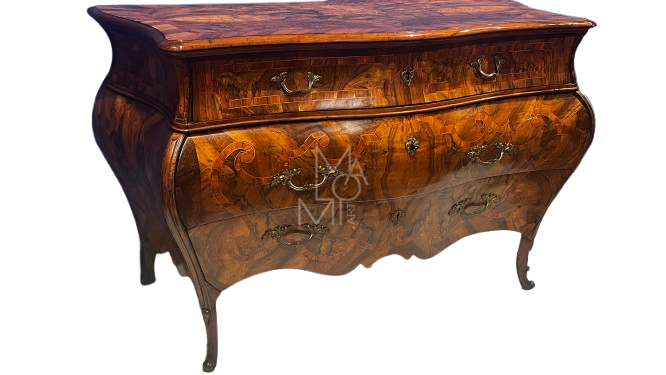
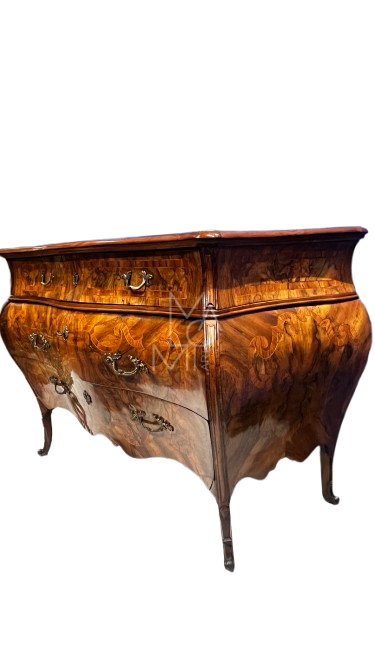
An elite mid-18th-century Lombard Barocchetto three-drawer commode veneered in book-matched walnut burl. Authentic structural framework and backboards in historical fir wood with hand-forged iron nails. Exceptional original patina and condition.
Lombard Barocchetto commode, 18th-century burl walnut chest of drawers, Brescian Rococo furniture, Italian showpiece commode, antique book-matched walnut veneer, historical fir wood joinery.
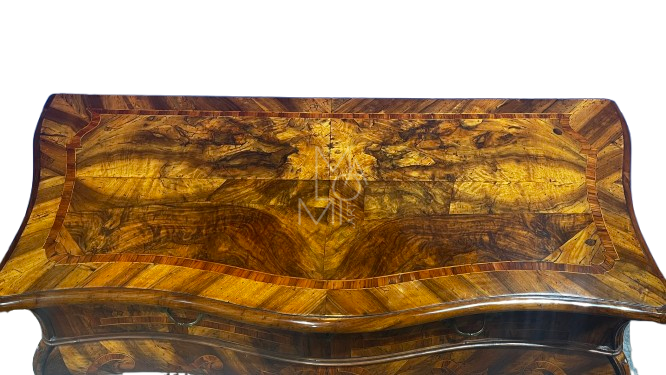
- Veneer and Marquetry: The exterior face is completely dressed in premium, indigenous walnut burl applied through millimetric book-matching (a macchia aperta). The rich, organic grain configurations are tightly framed by multi-wood herringbone stringing in contrasting fruitwoods (maple, cherry, and boxwood).
- Blind Carpentry (Internal Frame): Uniquely, both the internal framework and the raw backboards are crafted from historical fir wood (Abies alba). This serves as a vital territorial diagnostic indicator, identifying the piece with the Brescian school of the Venetian Terraferma.
- Joinery Techniques: The drawer bottoms are masterfully slotted into lateral interior grooves according to rigorous Lombard standards. The reverse features rough-sawn planks anchored by hand-forged, hot-hammered iron nails displaying authentic localized chemical wood-aging halos.
- Mounts: Equipped with original, lost-wax cast and hand-chased bronze drop-handles and escutcheons featuring asymmetrical rocaille and acanthus motifs.
Showpiece furniture in eighteenth-century Lombardy: a walnut burl three-drawer commode
Introduction and historical-artistic framework
Within the vast and complex landscape of eighteenth-century Italian decorative arts, Lombard furniture design holds a position of singular, multi-layered prominence, reflecting the shifting geopolitical, economic, and cultural dynamics of a critical frontier and transit territory. In the mid-eighteenth century, the wider Lombard region was fractured by complex political lines, caught between the direct administrative apparatus of Austrian Hapsburg rule in the Duchy of Milan and the long-standing, socio-cultural hegemony of the Republic of Venice in the westernmost domains of its Terraferma, specifically the dynamic borderlands of Brescia and Bergamo. Far from inducing artistic paralysis, this fragmentation allowed local luxury trades to fashion an autonomous and highly refined figurative language.
This historical crucible fostered the emergence of the Lombard Barocchetto, a remarkably sophisticated regional synthesis of the European Rococo that distinguished itself from its French, Genoese, and Piedmontese counterparts through an unprecedented, counter-intuitive fusion of underlying structural discipline and fluid ornamental fantasy. The style brilliantly managed to mediate between the residual, plastic solemnity of the Late Baroque, the calligraphic lightness of international curvilinear trends, and the early, rational promptings of symmetry and proportion that would later herald the onset of Neoclassicism. The object under examination—an elegant showpiece commode with three drawers, a fully shaped front, and curvilinear flanks—is completely embedded within this golden age of north-Italian cabinetmaking, wood choice, and ribbon marquetry. It stands as a paramount, definitive testament to the high-end material culture circulating across the Milanese and Brescian manufacturing axes during the middle decades of the Enlightenment.
Morphological and structural analysis: the curvilinear and bombé line
From a rigorous typological and architectural standpoint, the piece features the classic, highly sought-after configuration of three superimposed, horizontally elongated drawers. This specific modular archetype progressively supplanted the monumental, block-like seventeenth-century canterano (chest of drawers) over the course of the early eighteenth century, responding directly to updated aristocratic demands for domestic grace, dynamic spatial layout, and light-reflecting surfaces. The carcass is meticulously sculpted along both its frontal plane and its lateral flanks, executing a complex, multi-directional sinuous rhythm that represents the apogee of the Louis XV taste filtered through a northern Italian sensibility. The profile of the facade intentionally eschews any form of rectilinear rigidity; it articulates instead a continuous, rhythmic double curvature that expertly alternates dramatic swells (bombature) and subtle recessions. This calculated sculptural undulation generates a volatile, painterly chiaroscuro interplay across the grain of the wood, effectively weight-reducing the objective volumetric mass of the piece and endowing it with a highly animated, three-dimensional energy.
The plastic movement of the facade follows a strict, highly calculated geometric and volumetric progression, revealing the sophisticated underlying draftsmanship of the master craftsman. The upper drawer introduces the initial decorative movement with a gently undulating, low-profile curve that serves as a visual and mechanical transition to the upper top panel, which is itself finished with a deeply contoured, ogee-molded perimeter. The central drawer expresses the absolute peak of the carcass’s forward expansion, protruding decisively toward the viewer to anchoring the visual core of the piece and providing a wide, convex stage for the fiammatura of the book-matched burl veneer. Finally, the lower drawer expertly guides the downward volumetric retreat with an elegantly tapered, concave sweep, diminishing the gravitational weight of the furniture before it reaches the lower apron (grembiale), which is itself crisply outlined by a broken, mixtilinear carved edge.
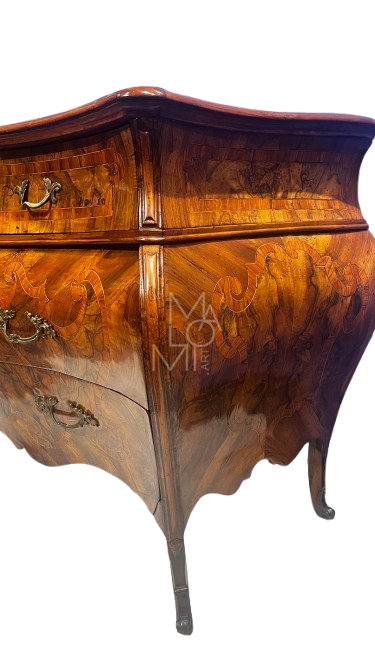
The transition between the frontal drawer faces and the side panels is deftly mediated by rounded, steeply receding corners. Entirely devoid of sharp corners or hard junctions, these transitional pilasters emphasize the overarching illusion of unbroken sculptural fluidity. The entire structural frame is lofted off the ground by four slender, gently splayed supports—the classic cabriole legs (piedi a capriolo)—which narrow down to delicate, calligraphic hoof or scroll terminals. This specific architectural anatomy satisfied the precise criteria of domestic splendor demanded by contemporary elites, who commissioned such furniture to define the grand state rooms or intimate bedchambers of their newly remodeled urban palaces.
Profilographic analysis and the showpiece flank: a stylistic and structural comparison
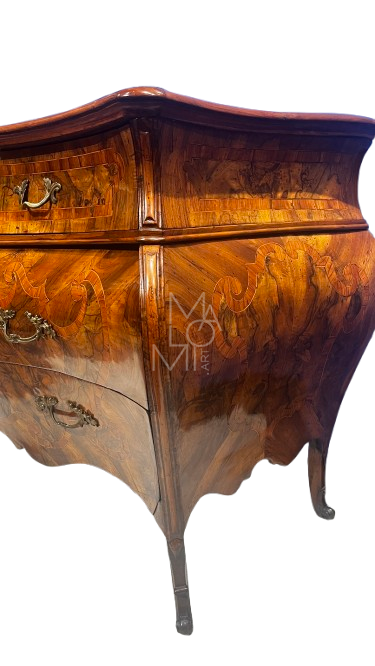
A close, forensic examination of the side profile offers critical diagnostic elements for deep art-historical inquiry, decoding the complex, multi-directional three-dimensional architecture that sets the Po Valley Barocchetto apart from neighboring schools. While a direct frontal view emphasizes the balanced symmetry, horizontal rhythm, and gilded focal points of the drawer pull hardware, an angular or profile perspective reveals a bold balestra (crossbow) or "courtisan's bust" volume of extraordinary plastic audacity. The piece does not confine itself to a simple, uniform swelling; rather, it punches through space via a pronounced, sweeping flare that expands dramatically from the upper molding toward the vertical center of the flank, before abruptly tapering inward near the lower skirt and the knee of the cabriole legs.
This aggressive, highly deliberate modulation of the flanks narrows the field of attribution, allowing for a precise comparative critique between the two major regional production hubs. In the cabinetmaking ateliers of Milan, the capital of the Hapsburg Duchy, the movement of the flank typically preserved a more restrained, architectural, and intellectually sober composure, deeply influenced by the sober, court-sanctioned models arriving from transalpine Austrian and German craft centers. Although undeniably curved, Milanese lines preserved a tight geometric discipline, which was frequently accentuated by thin, ebonized frames and strict internal reserves. In the commode under discussion, however, the sheer physical thrust of the lateral swelling appears far more energetic, muscular, and sculptural than standard Milanese production, implying either an exceptionally lavish private commission or the hand of an autonomous workshop working in the borderlands, fully capable of absorbing and magnifying the most flamboyant aspects of the international Rococo.
Conversely, this hyper-accentuation of the lateral curve, and the manner in which the fragile burl veneer seamlessly conforms to the severe, underneath convexity of the structural frame, aligns the piece directly with the Brescian-Bergamasque school. In these easternmost provinces of the Lombard plain, cultural, familial, and commercial proximity to the maritime Republic of Venice translated into a highly theatrical, painterly, and three-dimensional interpretation of the Rococo. The side panel ceased to be a passive structural closure; it became a brilliant secondary facade in its own right, a space where the dramatic tension of the curvilinear form reached its zenith. A further comparative element is found in the expansive, inlaid cartouche dominating the lateral shoulder. While classic Milanese masters utilized rigid geometric cross-bandings to frame highly predictable reserves, here the continuous ribbon marquetry unfolds in a free-flowing, calligraphic scroll that masterfully mimics the organic, asymmetric rocaille motifs of the cast-bronze mounts. The choice to deploy premium, highly figured, book-matched burl walnut across the entirety of the flanks confirms that the piece was intended for a freestanding or prominent angled placement within an interior, a position where every vantage point was calculated to broadcast the high socioeconomic standing and discerning eye of the patron.
The socio-political and cultural context of eighteenth-century brescia
To properly evaluate the historical weight of a decorative object of this caliber, it must be situated within the singular socio-political and economic context of Brescia and its contado during the middle decades of the eighteenth century. Geopolitically aligned under the rule of the Venetian Republic as part of its Domini di Terraferma, Brescia occupied a unique position as a highly privileged, semi-autonomous border province. The city’s ancient noble houses, fiercely proud of their Lombard lineage yet deeply integrated into the mercantile and political systems of the Venetian lagoon, maintained an extraordinary degree of economic wealth, largely derived from extensive agricultural estates in the fertile Brescian plain, iron mining in the sub-Alpine valleys, and state-sanctioned weapons manufacturing.
This hybrid socio-political positioning generated a competitive, highly dynamic cultural climate. The local patriciate—led by immensely wealthy dynasties such as the Martinengo, the Lechi, the Fenaroli, the Cigola, and the Averoldi—actively distanced themselves from the rigid, institutional court etiquette of Austrian Milan, while simultaneously refusing to blindly copy the lighter, purely ephemeral fashions of metropolitan Venice. Instead, the Brescian aristocracy forged an independent culture of magnificent display, which manifested in an unparalleled boom in private civil architecture. Monumental urban palaces, such as Palazzo Martinengo di Padernello or Palazzo Lechi, were radically redesigned or built anew, transforming the medieval fabric of the city into a theater of Enlightenment luxury. Simultaneously, this elite pioneered the construction of grand suburban villas of delight (ville di delizia) across the province—most notably the monumental Villa Lechi in Erbusco or the Fenaroli estates in Fantecolo—creating pastoral micro-courts dedicated to theatrical hospitality, musical academies, and agricultural management.
In this context of intense architectural self-representation, the acquisition of high-end furnishings was governed by a sophisticated form of cultural patronage. Furnishings were expected to project a sense of grandezza—a physical, muscular monumentality that reflected the territorial power of the Brescian landlords—while embodying the supreme grace and intellectual curiosity of contemporary pan-European trends. The local academies, such as the Accademia degli Erranti, fostered a cultured elite that was well-versed in French philosophy, British economic texts, and international design books. Consequently, a commode of this quality was not merely an addition to a room; it was a highly loaded cultural diplomat. Placed in a grand antechamber or a gallery lined with paintings by Faustino Bocchi or Giorgio Anselmi, it signaled a family that was politically aligned with Venice, materially rooted in the rich soils of Lombardy, and intellectually conversant with the courts of Paris and Vienna.
The evolution of costume and the culture of domestic life in brescia and its province
The mid-eighteenth century witnessed a profound revolution in the internal topography of the Brescian aristocratic home and the daily customs of its inhabitants. Under the influence of Enlightenment thought, the domestic interior was systematically reordered, breaking away from the vast, freezing, and purely ceremonial spaces of the high Baroque toward a new binary division: public rooms of dazzling representation and highly specialized private apartments dedicated to comfort, intimacy, and the cultivation of the self. The commode, as a furniture type, was the supreme instrument of this domestic transformation. Positioned in the alcova (the private bedchamber complex) or the salotto dei ricevimenti piccoli, it sat at the intersection of public vanity and the newly discovered luxury of personal privacy.
This architectural shift occurred in perfect lockstep with a radical transformation in contemporary fashion and bodily movement. The heavy, rigid, dark Spanish-style garments that had dominated the seventeenth-century Lombard elite were utterly discarded in favor of fluid, voluminous, and intensely colorful French fabrics. Noblewomen of Brescia adopted the robe à la française (or andrienne), characterized by sweeping, unstructured sack-backs and wide lateral panniers (panieri), which caused silk, damask, and brocade fabrics to float and undulate dynamically with every step. For men, the habit à la française featured flared, stiffened coat skirts (falde) that projected outward from the hips.
There existed a profound, symbiotic formal and volumetric relationship between the silhouette of the contemporary human body and the plastic architecture of the Barocchetto commode. The dramatic lateral swelling and the bold balestra flanks of the furniture perfectly mirrored the expanded, undulating contours of the garments worn by the people moving around it. The commode was physically designed to accommodate this new choreography of domestic life: its rounded corners and smooth, handle-less pilasters prevented the costly silk brocades of passing dresses from snagging, while the heights of the drawers were calibrated to allow a standing nobleman or a seated lady to access personal treasures with effortless, elegant gestures.
Furthermore, this period marked the rise of the conversazione—informal yet highly codified evening gatherings where the elite met to gamble, drink hot chocolate or coffee, and discuss literature. Within these intimate Brescian salons, showpiece furniture served as a critical conversation piece. The glittering reflection of candlelight across the mirror-polished walnut burl, the exoticism of the book-matched wood configurations, and the sheer tactile pleasure of running a hand over cold, expertly chased gilded bronze mounts were all vital components of a highly sensory, tactile lifestyle. In both the urban center of Brescia and the exclusive country estates of the province, the commode became the silent, elegant anchor of an elite lifestyle that balanced material indulgence with intellectual refinement.
Archaeology of furniture: differences in internal joinery and framework between Brescia and Venice
To formulate an attribution that is structurally and historically bulletproof, art-historical methodology cannot rely solely on the stylistic qualities of external surfaces; it must instead execute a rigorous, philological investigation into the non-visible components of the artifact. The analysis of the "blind carpentry"—specifically the cross-examination of primary structural species, drawer construction, and mechanical joinery—allows a sharp boundary to be drawn between the deeply ingrained execution habits of Brescian ateliers and those of metropolitan Venice, two entities that were politically bound under the same flag but remained radically distinct in their craft guilds and workshop traditions.
The defining, diagnostic material feature of the commode under examination is that both the internal structural framework and the primary carcass are constructed entirely of historical fir wood (abete). In the broader geography of north-Italian cabinetmaking, this material choice serves as a critical territorial indicator. While the core Milanese workshops and the neighboring Emilian schools relied almost exclusively on indigenous poplar (pioppo) to build their structural fusti, the presence of fir wood immediately shifts the technical horizon toward the Venetian lagoon. The Venetian metropolis, possessing direct, monopolistic control over the timber floated down from the Cadore and Alpine valleys via the Piave and Brenta rivers, utilized fir wood as its absolute standard for blind carpentry, backboards, and drawer runners.
However, the presence of fir within a piece whose external morphology and marquetry are so deeply rooted in the Lombard aesthetic serves as definitive proof of an origin within the high-end workshops of the Brescian territory. As the largest and wealthiest mainland province of the Venetian Republic, Brescia operated as a porous, highly fluid artistic laboratory. Brescian cabinetmakers enjoyed direct access to the commercial timber supply networks of Venice, readily adopting the lightweight, straight-grained, and resilient Alpine fir for their primary carcasses. Yet, they processed this imported material with a terrestrial precision, structural density, and long-term durability that was entirely alien to the hurried practices of the Venetian capital.
Forensic examination of the mechanical joinery of the drawers yields further evidence of this unique Brescian synthesis. Venetian masters in the capital, working within a hyper-commercialized, export-driven market that prioritized speed of assembly and external visual flash over internal longevity, tended to execute a highly relaxed form of carpentry: their drawer sides were joined using wide, sparse dovetails, and the drawer bottoms were almost always flush-mounted and nailed directly into the lower thickness of the side walls—a technical habit derived from the ship-carpentry traditions of the Venetian Arsenal. In the piece under discussion, conversely, the fir wood is worked with a rigorous, uncompromising discipline that mirrors the best traditions of Lombard engineering. The dovetail joints are sensibly tighter, denser, and cut with geometric, razor-sharp precision that renders excessive iron fastening unnecessary. Furthermore, the fir drawer bottoms are never crudely chiodati from below; they are carefully slid into dedicated lateral grooves (scanalature) plowed directly into the lower interior faces of the drawer sides, allowing the timber to expand and contract freely across seasonal humidity shifts without cracking the grain. The structural deployment of fir wood, when executed with this level of tight carpentry discipline, serves as the ultimate material proof of an elite Brescian workshop, masterfully fusing Venetian resource channels with the strict structural tenets of the Lombard tradition.
Organoleptic evidence and photographic readings of the fir structures: internal carcass, back panel, and drawer bottom
A close-up, diagnostic photographic reading of the hidden structural matrix of this commode provides an invaluable empirical confirmation of the foregoing storiographical and technical analysis. Inspection of the internal carcass reveals thick, structural planks of historical fir wood (Abies alba), arranged with parallel vertical grain lines. These planks exhibit highly specific organoleptic qualities: a dense distribution of sound, tight knots fully fused within the wood matrix, paired with a deep, amber-toned surface oxidation. This deep coloration is the direct result of a slow, multi-century degradation of the wood’s natural lignin, creating a genuine historical patina that completely rules out modern timber components, artificial staining, or chemical distressing.
This rigorous material consistency is perfectly matched on the massive external back panel of the furniture. The rear backboards display an un-planed, highly textured finish that preserves the explicit marks of historical hand-felling, split-wood techniques, or heavy adze work (asolatura). This treatment was standard in eighteenth-century workshops, which left unexposed surfaces entirely raw to save time and labor. The secolare accumulation of domestic dust, micro-carbon deposits, and natural wood oxidation has settled into these deep tool marks, forming a uniform, untouched "patina of the back" that is impossible to replicate.
A critical touchstone for structural authentication is found in the original iron hardware anchoring the rear frame: the presence of large, hand-forged iron nails, hammered hot into the carcass, shows a classic localized ring of chemical aging. Over generations, the iron oxide migrating from the nail head has deeply penetrated the surrounding pores of the fir wood, creating a dark, irreversible halo of localized biological rot that guarantees the structural integrity of the assembly. The reverse perspective also documents the precise mechanical connection with the inlaid top panel, highlighting the substantial thickness of the underlying core wood substrate and showing where the fine spirit-varnish coat abruptly ceases along the rear edge, indicating that the piece was polished before its final backboards were nailed shut.
Finally, an under-view of the bottom panel of the lowest drawer completes this exhaustive archaeological autopsy of the artifact. The drawer's bottom board confirms the exclusive use of historical fir wood, bearing the vigorous tooth-marks of an eighteenth-century frame saw and hand-plane. Flanking the bottom plank, the sturdy drawer runners stand out with surfaces visibly polished and darkened by centuries of continuous mechanical friction from sliding along the interior guides.
This perspective also allows for an appreciation of the impressive depth and mass of the drawer front itself: to accommodate the dual contours of the Rococo facade, the Brescian craftsman carved the complex undulating support directly from a thick, single block of solid fir timber. The precious walnut burl and fruitwood stringing were subsequently applied over this solid core with hot animal bone glue. This internal anatomy—wherein a theatrical, noble outer skin of burl walnut relies on a rustic, hand-wrought fir skeletal frame—certifies the commode as an authentic masterpiece of the Brescian school, harmonizing Venetian timber resources with the structural tenets of Lombard carpentry.
Materials and executive techniques: burl and marquetry
The absolute excellence of the commode manifests itself in the ultra-refined selection of timber and the breathtaking technical prowess of the surface decoration, a decorative scheme that presupposes both access to raw materials of the absolute highest grade and an intimate, generational knowledge of wood-seasoning timelines. The primary facing of the entire carcass is executed in precious walnut burl (radica di noce), harvested exclusively from the knotty, underground root swellings (ciocchi) at the base of historical walnut trees. This highly prized species is distinguished by swirling, highly turbulent grains, dense configurations of dark burl eyes (occhiolinature), and a rich natural chromatic range shifting from deep honey-blond to scorched umber and charcoal brown. The selection of burl perfectly answered the core aesthetic demand of the Barocchetto to create shifting, shimmering, and seemingly semoventi surfaces where the natural material itself becomes a painterly medium, completely superseding the heavy, relief-carved walnut ornamentation of the previous century.
The master cabinetmakers applied the burl sheets—reduced to a thickness of several millimeters using specialized, wide-bladed marquetry veneer saws—according to the complex technique of lastronatura and book-matching (a macchia aperta). This process requires the sequential slicing of consecutive sheets from the same block of burl and arranging them symmetrically, matching the raw edges so that the chaotic grain patterns align perfectly across a central axis. This method exalts the intrinsic symmetries of the wood, creating abstract geometric compositions, mirrored rorschach patterns, or subtle anthropomorphic and zoomorphic illusions of immense visual fascination.
The vast expanses of book-matched burl are rhythmically divided, bound, and brought into structural order by elegant borders and fine stringing executed in contrasting fruitwoods, such as wild cherry, stained maple, or boxwood. These precious inlays trace elegant motifs of fluid scrolls and continuous, interlocking ribbons, also known in north-Italian terminology as herringbone or feather banding (a spigata or a spina di pesce). These bands follow and accentuate with millimetric precision the curvilinear paths, sudden drops, and bold swells of the underlying structural groundwork, performing a function that is simultaneously decorative and highly architectural.
Bronzework elements: hardware and decorative mounts
A complementary yet absolutely fundamental role for the critical and stylistic reading of the commode is assigned to the metallic elements applied to the facade. Far from performing a merely utilitarian or protective function, these mounts complete the plastic balance of the front, acting as vital focal points within the overall composition. The large, sweeping drop-handles and the ornate keyhole escutcheons are cast in premium bronze using the ancient lost-wax method (a cera persa), meticulously finished with cold-chisels and chasing tools (cesellato), and subsequently mercury-gilded (dorato al mercurio) or finished with a rich, dark golden patina. The ornamental motifs of the hardware draw heavily from the rich repertoire of the French rocailles, though filtered through a distinct Central European and Venetian decorative taste, and are characterized by stylized, asymmetrical acanthus leaves, C-scrolls, asymmetric cartouches, split-shell valves, and organic rock-work motifs.
These metallic mounts function simultaneously as utilitarian points of mechanical leverage for opening the heavy drawers and as formal focal points of high visual impact. The strictly symmetrical arrangement of the handles across the three drawer levels establishes a precise geometric order and a severe, central orthogonal axis down the front of the piece. This structural stability beautifully counterbalances the volatile, fluid, and vibrant movement of the underlying burl wood. The flawless integration between cast, sculptural bronze and flat, highly figured timber bears witness to the high technical proficiency and professional articulation of eighteenth-century Lombard artistic workshops, where the cabinetmaker's atelier collaborated directly with local foundries, brass-turners, and professional chasers to achieve a finished product of absolute stylistic and material coherence.
Historiographical orientation and critical bibliography
The historical-critical reconstruction of eighteenth-century Lombard furniture has undergone a profound, highly necessary historiographical evolution since the second half of the twentieth century. For decades, the magnificent production of the Barocchetto remained partially eclipsed, overshadowed by the immense international fame of the Neoclassical intarsio work arriving from the Milanese workshop of Giuseppe Maggiolini, who dominated the final quarter of the century. Pioneering studies and subsequent archival discoveries have, however, successfully restored independent artistic dignity to the master cabinetmakers of the pre-Enlightenment and mid-century decades. This modern research has demonstrated that the extraordinary technical precision of Maggiolinian marquetry did not appear ex nihilo, but was rooted precisely in the expert, highly sophisticated material culture of burl veneering (lastronatura) and ribbon inlay native to the Milanese and Brescian workshops active between 1730 and 1760.
Modern critical inquiry has shifted away from purely formalist attributions toward a highly scientific methodology, focusing on the material analysis of secondary internal woods—such as poplar and fir—and the microscopic examination of dovetail joinery configurations. These physical indicators differentiate Lombard production from Piedmontese, Emilian, or Venetian counterparts and form the objective baseline for modern attributions in art market catalogs, insurance appraisals, and museum collections. For a scholarly contextualization of the furniture and its production milieu, the following reference texts are essential:
- Alberici, Clelia, Il mobile lombardo, Milan, Gorlich Editore, 1969. This is the seminal, pioneering text that first isolated the structural and decorative features of Lombard manufacturing from the Renaissance to Neoclassicism.
- Arisi, Ferdinando, Il mobile barocco e rococò nell'Italia settentrionale, Piacenza, Cassa di Risparmio di Piacenza, 1982. A valuable volume for understanding stylistic cross-pollination across the Po Valley axis.
- Baccheschi, Edi, Mobili piemontesi e lombardi del Seicento e del Settecento, Milan, Görlich, 1963. A study focusing on the close comparison between the fluid lines of subalpine production and the geometric discipline of Lombard design.
- Colle, Enrico, Il Mobile Barocco in Italia: arredi e decorazioni d'interni dal 1600 al 1738, Milan, Electa, 2000. A primary historiographical reference text tracing the evolution of parade and state furniture models.
- Colle, Enrico, Il Mobile Rococò in Italia, Milan, Electa, 2003. This volume specifically analyzes the transition from the canterano chest to the bombé commode, dedicating extensive chapters to the Milanese and Brescian workshops.
- Morazzoni, Giuseppe, Il mobile genovese e il mobile lombardo del Settecento, Milan, d'Arte Alfieri, 1952. One of the earliest studies to analyze the specific use of burl timbers and gilded bronze hardware across these two Italian centers of excellence.
Conclusion
In conclusion, this walnut burl three-drawer commode represents a primary historical and artistic document of the domestic culture, social pride, and material sophistication circulating within eighteenth-century Lombardy. Through the flawless synthesis of vigorous plastic forms, the exceptional material richness of the book-matched burl veneer, and the calligraphic elegance of the gilded bronze mounts, the piece expresses a high level of formal autonomy relative to international models. The furniture stands not merely as an object of utility or private luxury, but as a genuine piece of monumental chamber art. It remains perfectly capable of engaging with its surrounding architectural space and bearing witness, centuries later, to the cultured taste, stylistic currency, and visual refinement of the Brescian elite under the Ancien Régime.