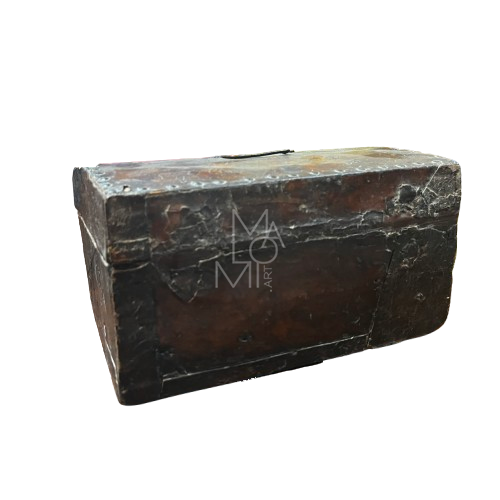
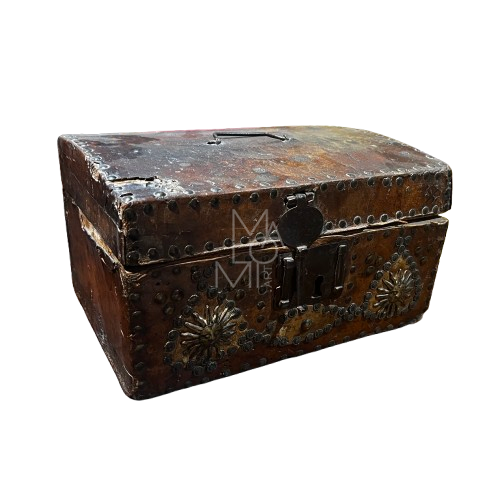
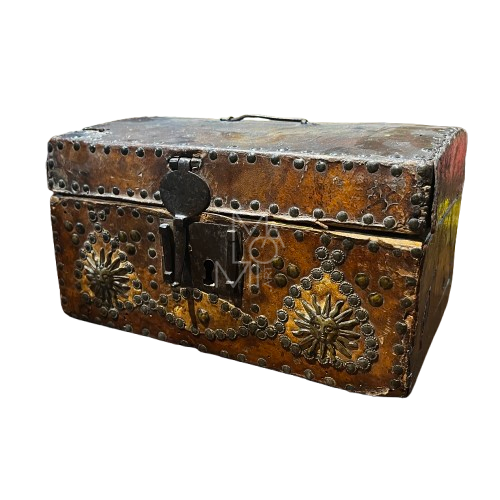
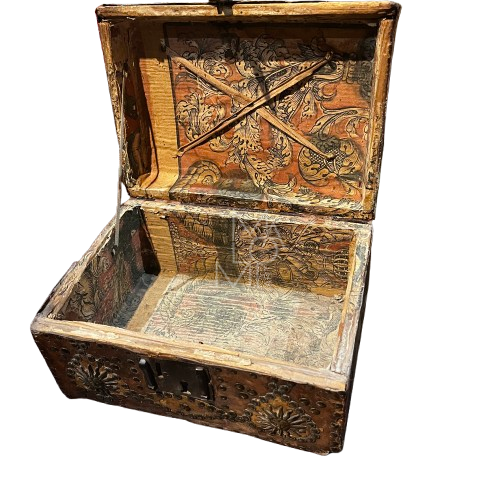
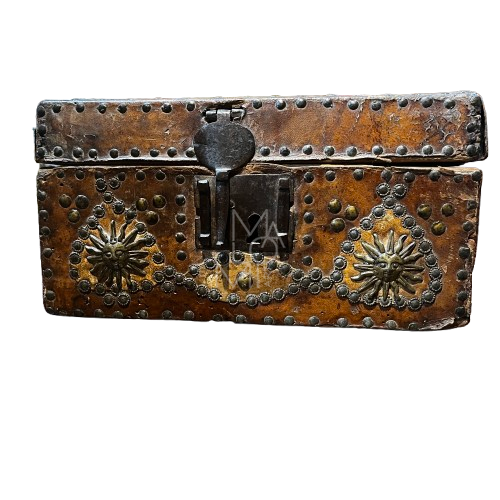
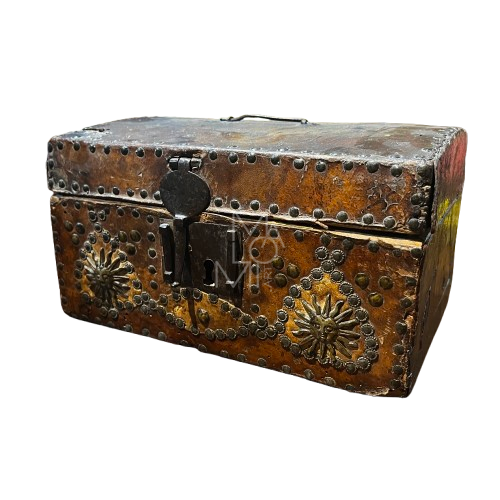
Baroque studded leather and wood letter casket, Florence XVII century
- Object type: table letter casket / traveling coffer
- Period: XVII century (circa 1650)
- Geography: Florence, Tuscany, Italy
- Dimensions: 25 x 18 x 14 h cm
- Materials: coniferous wooden core (fir/pine), vegetable-tanned bovine leather, hand-forged wrought iron hardware, woodblock-printed paper lining
- Condition report: excellent structural preservation for the period, leather showing rich original patina with minor abrasions consistent with use and age, original coeval lock mechanism, interior paper lining partially intact with excellent legibility of the Baroque acanthus scroll motifs
Artistic leather in Medici Florence of the XVII century: a historical and artistic analysis of a studded casket
Introduction to leather manufacturing in seventeenth-century Florence
The heritage of the guilds and the Baroque taste
During the XVII century, Florence experienced a period of extraordinary fervor in the field of minor arts, consolidating an international reputation that went far beyond painting and grand sculpture. Under the aegis and influential patronage of the Medici grand ducal court, particularly during the reigns of Ferdinando II and Cosimo III, the historic Florentine craft guilds successfully reworked austere medieval traditions to accommodate the new and exuberant Baroque aesthetic. Among the most celebrated productions was the artistic working of leather, a specialization in which Tuscan masters rivaled the famous workshops of Cordova and Venice.
The rectangular casket examined in this study fits with absolute coherence into this specific manufacturing panorama. The inventories of great noble families of the period, such as the Corsini, the Medici themselves, and wealthy merchants from the Oltrarno district, teem with mentions of small chests and travel caskets described as lined with stamped, gilded leather, or protected by metallic mounts. These objects responded to a dual and essential daily need. On one hand, there was the eminently practical necessity of possessing a sturdy, waterproof, and secure container for transporting or safeguarding goods of the highest value. On the other hand, in an era when the ostentation of personal wealth was a precise social duty, the casket was configured as a true status symbol to be proudly displayed on writing tables or inside ducal bedchambers.
Travel and the necessity of safekeeping
One of the most fascinating curiosities related to these small chests concerns the daily life of Florentine nobles engaged in the Grand Tour or in frequent diplomatic travel toward the courts of Rome, Paris, and Vienna. Seventeenth-century carriages, lacking efficient shock absorbers, subjected luggage to constant and violent jolts, while roads were perennially threatened by mud and bandit raids. The leather casket, therefore, was not a mere static ornament. It was conceived as travel armor. Leather, flexible yet incredibly resistant to abrasion and humidity, cushioned internal and external shocks, preserving the integrity of dynastic documents, sealing wax stamps, and family jewels that no aristocrat would ever dare leave behind in their unguarded residences.
Technical characteristics and workshop style in Florence
The secret wisdom of tanning along the Arno
The extraordinary longevity of this artifact is the direct result of slow chemical and artisanal processes, handed down from generation to generation and jealously guarded as state secrets. The hide used for the lining, of bovine or ovine origin, underwent a long vegetable tanning executed in workshops located close to the Arno river, where the availability of running water facilitated the washing and treatment of raw materials. Craftsmen used natural tannins extracted mainly from chestnut wood and Tuscan oaks, which gave the leather exceptional strength and a characteristic brown coloration destined to darken and grow richer over the centuries.
Once tanned and stretched over the wooden core, the skin was worked while still partially damp. This allowed the master leatherworker to model it with absolute precision around the corners of the casket, avoiding wrinkles or structural tensions that could cause subsequent cracking. The perfect adherence of the leather to the underlying wooden support was considered the invisible signature of workshop quality, the element that distinguished a work of art from a common market product.
The visual rhythm of studs and the illusion of tooling
The external decorative apparatus is based on a dense and studied grid of dome-headed metal studs that punctuate the surface according to a strictly geometric design. In the construction economy of the artifact, these metallic components performed a primary function that was both technical and aesthetic. On one hand, they mechanically secured the edges of the leather at points of greater stress, such as the corners and junction lines, preventing the natural movements of the wood from dislodging the lining. On the other hand, the close spacing of the nails created a dynamic chiaroscuro effect, a visual play that imitated the sumptuous embossed silver plates or the entirely metallic coffers imported from Germany and Flanders.
Alongside the studs, an even more refined decorative technique is visible only upon close inspection: blind tooling executed directly on the leather. Using small irons from shoemakers or bookbinders heated over a flame, the craftsman stamped tiny circular and starry motifs, as well as undulating cords, onto the surface. This procedure required an extremely steady hand and perfect control of the metal temperature. An iron that was too cold would not leave a lasting impression, while excessive heat would irremediably burn and pierce the leather, undoing weeks of meticulous work and forcing the workshop to discard the entire lining.
Solar iconography in the Tuscan Baroque
The echo of Galilean discoveries and court culture
The visual and conceptual focus of the front prospect is occupied by two large shaped metal plates depicting the anthropomorphic radiant sun. This precise iconographic choice does not respond to a mere ornamental caprice, but reflects the exceptional intellectual and scientific climate of seventeenth-century Florence. Under the protection of Grand Duke Ferdinando II, the city was the driving center of the new astronomical theories introduced by Galileo Galilei. The Pisan scientist, despite contrasts with the Holy Office, had revolutionized the perception of the cosmos by placing the sun at the center of the planetary system, a concept that deeply fascinated the writers, philosophers, and artists of the time.
The application of the anthropomorphic sun on Tuscan Baroque furnishings thus became an indirect tribute to this cultural revolution. The sun was no longer just an astrological element of the past, but the symbol of revealed truth, of the light of reason piercing the darkness of ignorance. Placing two suns on the front of the casket meant linking the object to the language of scientific modernity promoted by the Accademia del Cimento, transforming a simple domestic piece of furniture into an avant-garde philosophical manifesto.
Apotropaic value and the Bernardine cult
Parallel to the scientific interpretation, solar iconography preserved a deeply rooted and powerful religious and esoteric value. In Tuscany, the cult of the name of Jesus, spread in the XV century by San Bernardino da Siena, whose emblem was precisely a radiant sun bearing the sacred trigram at its center, was still very much alive. In the seventeenth-century mindset, the image of the sun maintained a strong apotropaic function of protection against evil forces, theft, and misfortune.
An anecdote common among the workshop chronicles of the era recounts that craftsmen loved to recite propitiatory prayers while fixing the solar plates to the front of coffers. The chest became a sacred microcosm, and the anthropomorphic sun acted as a mystical guardian. Anyone attempting to force the lock or steal the documents kept inside would find themselves committing the crime under the watchful and stern gaze of the solar face, which also symbolized the all-seeing eye of divine justice from which nothing could remain hidden.
The internal space and the woodblock printed paper lining
The secret microcosm of love and business letters
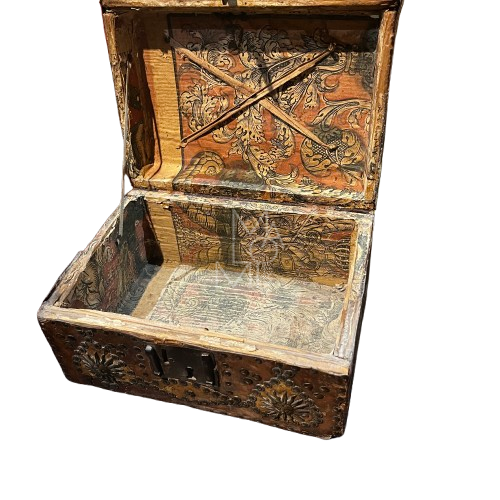
While the exterior of the casket appears solid, austere, and almost severe in its studded armor, the opening of the lid reveals a spectacular contrast, introducing the observer to a microcosm of extraordinary delicacy. The interior is entirely lined with precious woodblock printed paper, decorated with dense acanthus scrolls, Baroque floral elements, and faint hints of human profiles. This typology of lining paper, tinted in warm tones of ocre and black, represented a celebrated specialty of Florentine printing houses, which sold their decorated sheets to cabinetmakers and bookbinders to ennoble the interior of furniture and prevent the contents from coming into direct contact with the splinters or dust of the raw wood.
The most intimate aspect of the artifact consists of the system of leather straps crossed in the shape of an X, firmly fixed to the inner face of the lid. This technical device reveals the exact function of the chest, identifying it as a refined table letter-holder casket. Under these taut strings, owners slipped their most private missives, commercial contracts, or love notes so that they would not become disarranged upon opening. It is evocative to imagine that in an era of dense political and passionate intrigues, such as the Florence of the Medici, these straps held ciphered letters or confessions destined to remain forever secret, protected by the darkness of the chest and the strength of the external hide.
Portable wallpapers and clandestine trade
A curious detail linked to the use of woodblock printed papers inside caskets concerns the sumptuary laws and customs taxes of the Grand Duchy of Tuscany. High-quality printed paper was a luxury good subjected to strict fiscal monopolies. Often, to avoid paying duties on loose sheets upon entering cities, merchants ordered chests and boxes already lined inside. Once they reached their destination, if necessary, the precious decorative papers were sometimes carefully detached to be reused as wall coverings or covers for rare books, turning the casket into an ingenious Trojan horse for the smuggling of valuable graphic material.
Structural analysis of the base and period carpentry
The constructive honesty of coniferous wood
Turning one's gaze to the bottom face of the chest, a fundamental methodological aspect for the art historian is discovered: the absolute nudity of the raw wood base. Unlike the visible walls, the bottom shows a single plank of soft coniferous wood, identifiable as fir or pine, characterized by wide grain and natural knots left exposed. This apparent lack of finish must not be interpreted as carelessness or a manufacturing defect, but rather as a precise and rational choice linked to minor Tuscan carpentry of the XVII century.
Florentine cabinetmakers operated according to a principle of strict functionality and material economy. Lining and decorating the bottom of an object destined to remain perpetually resting on a piece of furniture would have been a senseless waste of tanned leather and precious time. Furthermore, the presence of metal studs on the base would have compromised the perfect flatness of the casket, irreparably scratching the wax-polished surfaces of the tables or cabinets on which it was placed. The raw wooden base thus shows us the most authentic and artisanal side of the artifact, revealing its original structure free from subsequent alterations.
Hand-forged nails and the traces of time
Along the edges of the wooden base, one can notice the small perimeter folds of the external leather, fixed to the support by means of hand-forged iron nails with their characteristic square or irregular heads. Each nail was forged individually by the local blacksmith, heating the metal and hammering it on the anvil until the desired point was obtained. The signs of wear accumulated on this surface, the small scratches caused by rubbing against furniture, and the natural oxidation of the iron constitute an irreplaceable historical identity card. These elements not only confirm the authenticity of the piece, excluding nineteenth-century restorations executed with industrial cylindrical nails, but visually tell us the centuries of history and movement that the casket has overcome to reach the present day intact.
Lock analysis and security mechanics
The art of wrought iron and the secrets of Tuscan blacksmiths
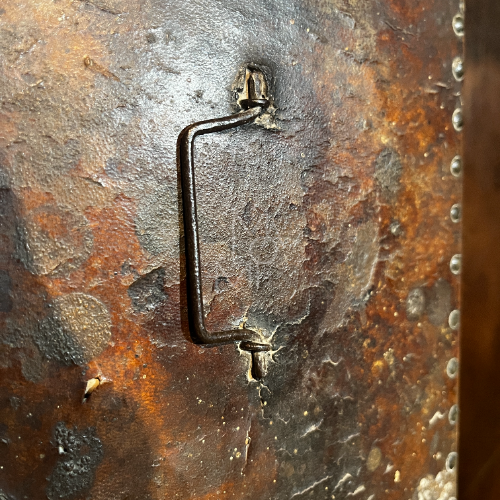
The large metal lock plate, placed on the front between the two solar plates, represents the engineering heart of the casket. In the XVII century, Tuscan metallurgy enjoyed an extraordinary reputation, fueled by the grand ducal foundries and workshops specialized in the production of weapons and precision mechanisms. The lock of this coffer, made of iron forged and cold-filed, presents a solid geometric shape conceived to resist tampering attempts and mechanical pressures.
The internal mechanism, operated by a key with a complex bit, featured a spring-lock system that firmly blocked the catch of the lid. Blacksmiths of the era often inserted small sound devices inside locks, such as taut springs that produced a loud and characteristic metallic click at the moment of locking. This acoustic noise acted as an additional primordial security element. In a silent room, the dull sound of the lock would immediately warn the owner that someone was attempting to open the chest, thwarting the theft at its inception.
The central keyhole as a visual and conceptual fulcrum
The keyhole does not only respond to functional criteria, but assumes a precise geometric and symbolic role in the aesthetic economy of the main prospect. Placed exactly at the center of the composition, between the two solar faces, the lock becomes the point of convergence for the gaze. An intriguing conceptual short-circuit is thus created. Access to the precious goods enclosed in the chest is simultaneously guarded on two distinct but complementary levels: on one hand, there is the physical, cold, and impassable protection guaranteed by the mechanical strength of wrought iron; on the other hand, there is the ideal and spiritual safekeeping offered by the sun, the star that illuminates all, sees all, and leaves nothing unpunished.
Conclusions
The balance between Baroque aesthetics and functionality
In conclusion, the studied studded casket is configured as an admirable and coherent material document of the artistic and manufacturing culture of seventeenth-century Florence. In it, a perfect balance is achieved between the needs of practical life and the visual imagery of the Tuscan Baroque. The austere and sturdy external armor, enlivened by the rhythm of the studs and the minute textures of the tooling, dialogues magnificently with the refined decorative richness of the internal woodblock printed lining and with the severe constructive honesty of the raw wooden base.
This object reminds us that in the XVII century, the concept of a work of art was not limited to major disciplines such as architecture or monumental painting. The taste for luxury, for philosophical metaphor, and for executive excellence capillarly permeated every aspect of domestic daily life, transforming a common container for letters into a precious chest of historical, scientific, and social meanings that continue to speak to us centuries later.
Detailed academic bibliography
History of furniture and furnishings in Tuscany
- Colle, Enrico. Il mobile barocco in Italia: arredi e decorazioni d'interni dal 1600 al 1738. Milano: Electa, 2000.
- Lapi Ballerini, Isabella. Il mobile fiorentino. Firenze: Polistampa, 1999.
- Praz, Mario. Filosofia dell'arredamento: la storia della casa attraverso i secoli. Milano: Longanesi, 1981.
Artistic leatherworking, gilded leathers and minor manufactures
- De Marinis, Tammaro. La legatura artistica in Italia nei secoli XV e XVI. Firenze: Alinari, 1960.
- Filippini, Laura. I cuoi d'oro e le manifatture di pelle decorata in Italia dal XIV al XVII secolo. Venezia: Istituto Veneto di Arti Grafiche, 1921.
- Waterer, John William. Spanish Leather: A History of its Use from 800 to 1800 for Walls, Screens, Chairs and Coffer. London: Faber and Faber, 1971.
Decorated papers and woodblock printing for lining
- Caporali, Antonella, and Milano, Alberto. Carte decorate: la produzione xilografica per la fodera e il rivestimento d'arredo nei secoli XVII-XIX. Milano: Il Castello, 1991.
- Innocenti, Clarice. Le arti fiorentine: la xilografia e la stampa su carta nel Seicento toscano. Firenze: Centro Di, 2004.
Social history, devotion and science in Medici Florence
- Bertini, Giuseppe. La casa fiorentina nel Seicento: inventari, arredi e vita quotidiana. Firenze: Leo S. Olschki, 2012.
- Galluzzi, Paolo. Scienza e corte medicea nel Seicento. Firenze: Giunti, 2002.