Antique Emilian baroque solid walnut cabinet | 17th Century Bugnato Stipo
emilian baroque cabinet, antique solid walnut stipo, 17th century rustication, modena bologna workshop, historical cabinetry, study room furniture.
- Title: Antique Emilian baroque solid walnut cabinet | 17th Century Bugnato Stipo
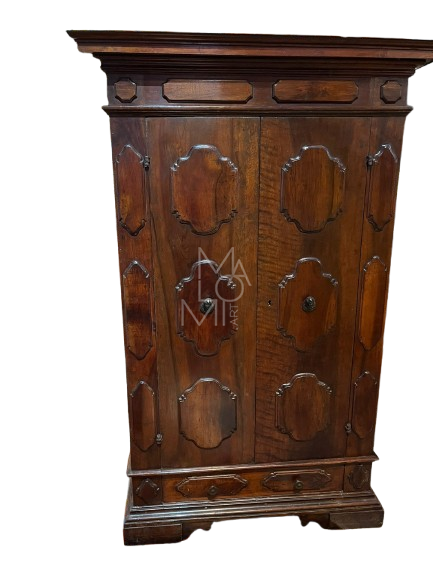
- Description: Rare small two-door baroque cabinet (stipo) in solid walnut (113x41x176 cm). Authentic late 17th-century Emilian craftsmanship (Modena-Bologna school) featuring three-sided rustication. Ideal for scholarly collectors and historical interiors.
- Keywords: emilian baroque cabinet, antique solid walnut stipo, 17th century rustication, modena bologna workshop, historical cabinetry, study room furniture. [1]
- Typology: Two-door cabinet (stipo)
- Period / Date: Late 17th century (mature Baroque)
- Geographical origin: Emilia-Romagna, Modena-Bologna manufacturing axis
- Primary timber: Solid walnut (Juglans regia)
- Secondary timber: Poplar and fir (internal framework and backboards)
- Dimensions (WxDxH): 113 x 41 x 176 cm
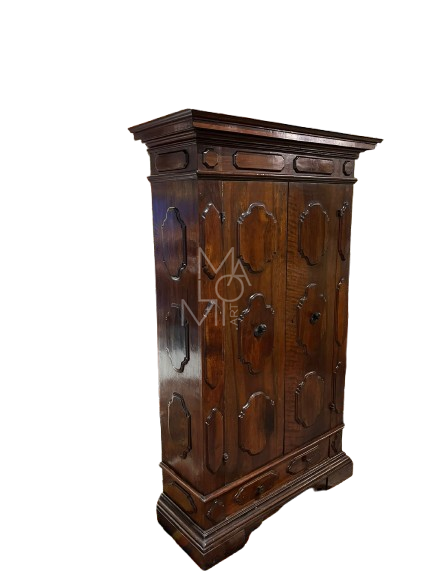
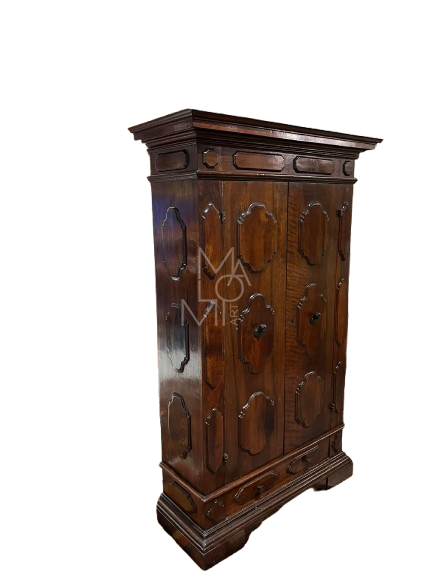
- Decoration: Geometric and mixtilinear rustication (bugnato) executed on three sides (facade and flanks)
- Finishing: Genuine historical patina resulting from walnut stain, linseed oil, and virgin beeswax
- Hardware: Coeval internal wrought-iron lock, eyelet hinges, and central knobs in burnished bronze
- Condition report: Excellent state of conservation, structural integrity preserved, coeval bracket feet, untouched natural patina
- Introduction and historical-geographical framework
The production of Italian furniture between the late Renaissance and the height of the Baroque period is characterized by a pronounced regional fragmentation. Each center of manufacture developed unique and immediately recognizable figurative and constructive styles.
Within this context, the geographic axis spanning from Modena to Bologna represented a hub of extraordinary excellence in woodworking. This territory was dominated by a demanding aristocracy and a wealthy mercantile bourgeoisie.
The artifact under analysis is a small two-door cabinet (stipo) measuring 113 x 41 x 176 cm. It fits perfectly within the refined and austere Emilian production of the late 17th century. This piece of furniture reflects the needs of a patronage that sought high-prestige furnishings suitable for private spaces and small studies (studioli).
- Morphology and typology of the furnishing: the small cabinet
In contrast to large sacristy wardrobes or monumental palace bookcases, this cabinet is distinguished by its restrained proportions. Its shallow depth (40 cm) and slender vertical development suggest a placement in intimate settings, such as:
- Patrician bedrooms
- Private studies
- Small representative offices
In these contexts, it was utilized to safeguard precious documents, collections of naturalia, coins, or high-value objects.
The architectural framework of the piece evokes a palatial facade in miniature. It is articulated into three macro-sections:
- A molded base equipped with lower drawers.
- A central two-door body that dominates the composition.
- A projecting crown featuring a pronounced cavetto cornice.
- The functions and use of the cabinet within the 17th-century baroque study
To fully comprehend the nature of this furnishing, it must be contextually placed within its ideal destination space: the private study. Over the course of the seventeenth century, this environment evolved from the humanistic Renaissance model, transforming into a space where intellectual rigor coalesced with Baroque theatricality and the owner's desire for self-representation.
The small cabinet fulfilled precise functional and symbolic requirements within this learned microcosm:
Preservation and classification of knowledge
The shallow depth and the internal division (historically organized into small shelves or micro-drawers, sometimes concealed behind the main doors) addressed the need to catalog minute objects. The cabinet functioned as an actual archive for:
- Secret documents: Notarial acts, ciphered letters, accounting ledgers, and testaments that required the protection of a robust lock.
- Mirabilia and naturalia: Small collectable specimens, such as fossils, rare minerals, exotic shells, or goldsmith artifacts, aligning with the taste for Wunderkammern (cabinets of curiosities) prevailing at the time.
- Numismatics and glyptics: Ancient coins, celebratory medals, cameos, and wax seals.
Ritual of use and private ostentation
Access to the cabinet was not public, but rather regulated by a strict social code. The owner would open the doors of the piece only to a highly selective circle of guests (scholars, political allies, or illustrious visitors).
The complex rusticated decoration (bugnato) on the three exterior sides visually anticipated the preciousness of the contents. The transition from the sober, geometric exterior to the interior, rich with compartments, created an effect of surprise and wonder typical of the Baroque. The cabinet ceased to be a mere container, becoming a scenic device that celebrated the cultural and economic status of the Emilian patronage.
- Emilian cabinetry: solid walnut and the rustication technique
The material of choice for this piece of furniture is solid walnut (Juglans regia). This timber is historically celebrated by Emilian cabinetmakers for its density, the silky luster of its grain, and its resistance to wood-boring insects.
The element of greatest artistic and technical significance is the rustication executed on three sides. This feature extends the plastic decoration not only to the main facade but also to the flanks, conferring a three-dimensional sculptural dignity to the object.
The geometry of the bosses
The decorative program unfolds through the application of raised wooden panels (bosses). These are shaped according to the mixtilinear geometries typical of the mature Baroque.
On the facade of the two doors, the central bosses feature a characteristic cartouche or shield-shaped contour, defined by concave and convex curvatures that generate a powerful chiaroscuro dynamism.
The upper register (beneath the cornice) and the lower register (on the drawers) display elongated octagonal and rectangular bosses instead. These serve as geometric transitions, visually stabilizing the entire composition.
- Period finishing techniques and the formation of historical patina
The final aesthetic outcome of the 17th-century Emilian cabinet depended strictly on rigorous chemical-physical finishing processes, executed manually in the workshop to enhance the depth of the solid walnut.
Surface preparation and coloring
Prior to the application of any protective layer, the surface was meticulously smoothed using sharkskin or metal scrapers. To uniform the tones of the timber or accentuate its warm brown hue, cabinetmakers employed natural vegetable dyes:
- Walnut stain (mallo di noce): Extracted from dried and boiled walnut husks, diluted in hot water to obtain warm, light-fast glazes.
- Iron mordants: Acidic solutions based on iron acetate, used to react with the natural tannin of the walnut, selectively darkening the grain.
Beeswax treatment and linseed oil
The standard finish of the period for furnishings of this typology excluded shellac, which only became widespread in the 19th century. Instead, the craftsmen proceeded with an application of boiled linseed oil, which penetrated the fibers, saturating and waterproofing them.
Subsequently, virgin beeswax was applied, sometimes blended with natural resins (such as Venice turpentine) to increase its hardness. The wax was applied warm and vigorously buffed with woolen cloths or sorghum brushes until a satin, non-reflective luster was achieved.
The genesis of antique patina
The "patina" visible on the artifact today is not merely the original finish layer, but rather the result of centuries of stratification. It is composed of the natural oxidation of the wood exposed to light, the absorption of atmospheric oxygen, and successive historical waxings. This process imparts to the walnut that characteristic visual softness and chromatic depth, termed the "skin of the furniture," which remains impossible to reproduce artificially in period counterfeits.
- Philological criteria for attribution to Emilian workshops
Since the vast majority of 17th-century woodmasters did not sign their works, the attribution of a cabinet of this caliber to specific circles or workshops along the Bologna-Modena axis must rely on strict philological, stylistic, and archaeometric criteria.
Taxonomic distinction of the rustication
The geometric behavior of the applied bosses constitutes the primary signature of the master cabinetmaker:
- Bolognese workshops (circle of Fra' Damiano da Bergamo and successors): Tended toward a strictly architectural, plastic rigor. The molded frames enclosing the bosses are thick, prominent, and stratified with clean geometric cuts (pure rectangles and octagons), faithfully replicating the rustication of Felsinean senatorial palaces.
- Modenese workshops (influences of the Este court): Introduced more sinuous and eccentric profiles earlier on. The presence of mixtilinear "cartouche" panels and fluid, lobed shields, such as those visible on the doors under examination, points the attribution toward the Modenese school. This school was inclined to temper Bolognese rigidity through a fluid line, influenced also by the designs of carvers active for the Ducal Palace of Modena.
Internal constructive grammar and workshop secrets
A scientific attribution requires the analysis of non-visible parts, where workshop customs were jealously passed down from father to son. Workshops of the Emilian area are distinguished by a specific use of secondary timbers (back panels and drawer bottoms): poplar and fir were processed in generous thicknesses with a typical gouge finish or roughly planed on the reverse.
The execution technique of the dovetail joints on the lower drawers, if displaying very narrow and slanted pins, points to the refined urban craftsmen of Bologna. Conversely, joints that are more massive yet impeccably calibrated bear witness to the solid manufacturing tradition of the centers within the Duchy of Modena, where the structural stability of the solid timber was given paramount importance.
- Stylistic analysis and territorial comparisons: the Modena-Bologna axis
The transition from the geometric rigor of the Renaissance to the plasticity of the Baroque is expressed in this area through a sober idiom, devoid of excessive gilding or polychrome marquetry. Local cabinetry preferred to exalt the density and natural color of the wood.
This cabinet manifests the salient traits of Modenese and Bolognese manufacture:
- Bolognese manufacture: Recognizable in the rigorous architectural scaffolding, the strong projection of the cornices, and the use of molded panels that recall the portals of the city's palaces.
- Modenese influence: Reflected in the predilection for slender proportions and a slightly more animated rusticated decoration, almost geometrically eccentric, which anticipates the fluidity of the 18th century.
The absence of solomonic columns or figurative carvings shifts the emphasis to the purity of the lines and the quality of the joinery—elements that certify the authorship of a first-rate artisan workshop.
- Construction details and coeval hardware
A close analysis of the previously examined artifact reveals construction details of significant antiquarian interest:
- The base: Rests on shaped bracket feet, typical of the Emilian tradition. These elevate the piece from the floor, ensuring visual lift and protection from ground moisture.
- The lower drawers: Set into the base plinth, they display manually crafted dovetail joints, visible upon opening the drawers themselves.
- The hardware: The central knobs in wrought iron or burnished bronze, positioned at the center of the bosses, serve both as pulling points and as visual fulcrums of the composition. The internal lock and the corresponding eyelet hinges reflect late-17th-century metallurgical techniques.
- Conclusion
In conclusion, this solid walnut rusticated cabinet represents a material document of exceptional value for the history of Emilian furniture design. Its small dimensions, far from diminishing its importance, enhance its rarity and collectable desirability, configuring it as a piece of furniture intended for contemplation and high representation.
The seamless fusion between the austere solidity of the walnut and the vibrant plasticity of the rustication on three sides testifies to the maturity achieved by the cabinetry workshops along the Modena-Bologna axis, which were capable of transforming a utilitarian storage unit into a work of refined domestic architecture.
- Academic reference bibliography
Monographs and survey texts on Emilian furniture
- Alberici, C. (1980). 18th-century Venetian lacquered furniture and Emilian baroque furniture. Milan: Görlich.
- Cuoghi Costantini, M., & Perogalli, C. (Eds.). (1995). The art of wood in Emilia-Romagna: from the Renaissance to Neoclassicism. Bologna: Nuova Alfa Editoriale.
- González-Palacios, A. (1986). The temple of taste: decorative arts in Italy between classicism and the baroque. Milan: Longanesi.
- Lodi, R. (1989). Emilian furniture: the art of woodwork in Bologna and Modena between the 16th and 18th centuries. Modena: Artioli Editore.
Typological studies on the study (studiolo) and curiosity cabinets
- Lugli, A. (1983). Naturalia et mirabilia: encyclopedic collecting in European wunderkammern. Milan: Mazzotta.
- Thornton, P. (191). The Italian Renaissance and Baroque interior: 1400-1700. New York: Harry N. Abrams.
Essays on historical cabinetmaking techniques and material science
- Mannoni, T., & Milanese, M. (1988). Archaeometry and the history of material culture: the scientific analysis of secondary timbers. Genoa: bUP.
- Turco, T. (1990). The restoration of antique furniture: woodworking, coloring, patination, and wax-and-oil finishing techniques. Milan: Hoepli.