An eighteenth-century Lombard architectural wardrobe in solid walnut
- Origin: Lombardy, Italy
- Period: 18th century
- Material: Solid walnut wood
- Condition: Excellent, with minor functional restorations of use
- Dimensions: Length 165 cm, Depth 70 cm, Height 225 cm
The Lombard Architectural Wardrobe in the Context of the Italian Eighteenth Century
The history of eighteenth-century Italian furniture is too often read through the distorting lens of a perpetually ephemeral Rococo, dominated by the sinuous lines of Venetian palaces or the shimmering lacquers of international courts. However, there is another soul to mid-century production, rooted in the solid reality of the Po Valley, which was capable of expressing an austere, monumental elegance deeply linked to earlier construction traditions. The architectural wardrobe in solid walnut of Lombard manufacture examined in this study magnificently embodies this second trend. We find ourselves before an object that, despite its restrained dimensions, rejects the fashionable lightness of its time to become a true piece of domestic micro-architecture, a miniature building conceived to challenge the centuries and to testify to the social stability of its patronage.
In the workshops of Milan and neighboring provinces, such as Bergamo and Brescia, woodworking was not a mere application of superficial decoration, but rather a structural art. Often the cabinetmakers of these areas worked in close contact with architects and master builders, breathing the same air as the construction sites of great patrician residences. It is in this way that forms originally intended for stone facades or church altars found a successful second life in walnut wood. A curiosity related to this type of production concerns the role of the so-called woodworkers and masters of the saw, who guarded the secrets of seasoning solid wood with an almost guild-like jealousy. A piece of furniture of this importance was not born of chance, but from a meticulous selection of the walnut tree, which had to be felled during specific winter lunar phases to ensure maximum grain density and prevent future pest attacks. The statutes of the artisan guilds of the era imposed strict rules on timber control, and using timber that was not perfectly seasoned could result in the seizure of the piece and heavy financial penalties for the master cabinetmaker.
The Monumental Structure and Geometric Layout of the Doors
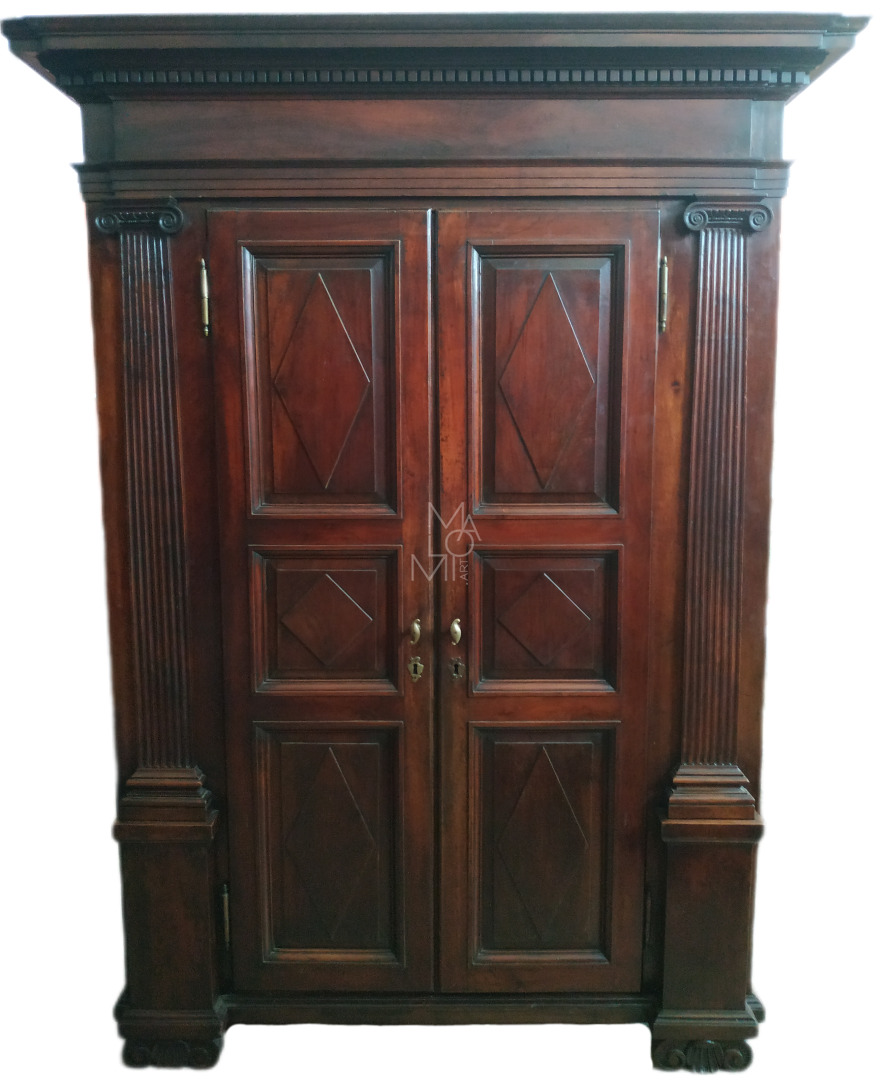
The layout of this wardrobe is based on a rigorous proportional balance that captures the gaze through a skillful alternation of projections and recesses. The front is dominated by two large paneled doors, whose decoration is entirely entrusted to geometric modulation. The diamond motif, also known as diamond-point or panel framing, is a refined legacy of the late Renaissance and the seventeenth century that survived with extraordinary vitality well into the eighteenth century in the Lombard territory. This choice did not respond solely to an aesthetic taste for symmetry, but concealed a technical expedient of great artisan intelligence. The central panel, inserted inside a sturdy wooden frame, was not rigidly glued but left free to make micro-movements invisible to the eye, a fundamental precaution to prevent the variations in humidity typical of the Po Valley climate from cracking the precious solid wood.
The resulting visual effect is a continuous dialogue of light and shadow that changes depending on the time of day. When sunlight penetrates obliquely through the windows of an eighteenth-century salon, the angled faces of the diamonds create chiaroscuro contrasts capable of enlivening the flat surface of the furniture without the need for expensive gilding or bronze applications. This predilection for the purity of wood also reflected the mentality of the provincial nobility or the upper landed bourgeoisie of Lombardy, a pragmatic social class, distant from the dissipations of the Bourbon court in Naples or the extravagances of Venetian patricians, which sought in home furnishings a symbol of moral severity and lasting wealth. Often these wardrobes were placed in entrance halls precisely to impress visitors, serving as actual calling cards of the financial solidity and rectitude of the owning family.
The Elements of the Classical Order and the Detail of the Shell
Architectural dignity is conferred upon the piece by the lateral ends, punctuated by two fluted pilasters that gently taper toward the top. This tapering process, borrowed directly from the architectural treatises of Andrea Palladio and Jacopo Barozzi da Vignola, serves to lighten the visual perception of the entire structure, drawing the gaze upward where a majestic, strongly projecting cornice pediment commands attention. The pilasters terminate with capitals of the Ionic order, carved into the solid wood with a sharpness that reveals the hand of an exceptional carver. In the workshops of the time, the carving of the capital was considered the examination par excellence for apprentices aspiring to the title of master: a single erroneous chisel stroke on the volutes of the walnut would have compromised the entire block of wood. An archival anecdote relates that young apprentices spent months copying drawings of capitals onto slate tablets before they were allowed to touch the noble wood with carving chisels.
The entire visual and structural weight of the wardrobe is discharged onto bracket supports enriched by a central shell. The shell motif represents the only, measured tribute to the formal innovations of the Lombard late Baroque and the international culture of the rocaille. The shell, however, does not assume here the asymmetrical and fluid forms seen in French designs, but maintains its own plastic symmetry. In the treatises and iconography of the time, the shell was linked to water and birth, a symbol of fertility and protection that was often placed in transitional areas or at the base of important furnishings as an auspicious sign for the house. Its presence introduces an element of organic softness that breaks the rigorous orthogonality of the piece, connecting it to the floor with extreme grace. This element, although discreet, reveals the subtle reception of European currents by local craftsmen, who were adept at mitigating the severity of the structure without ever yielding to the whims of exaggerated asymmetry.
The Lombard Furniture Compared with Venetian and Piedmontese Manufactures
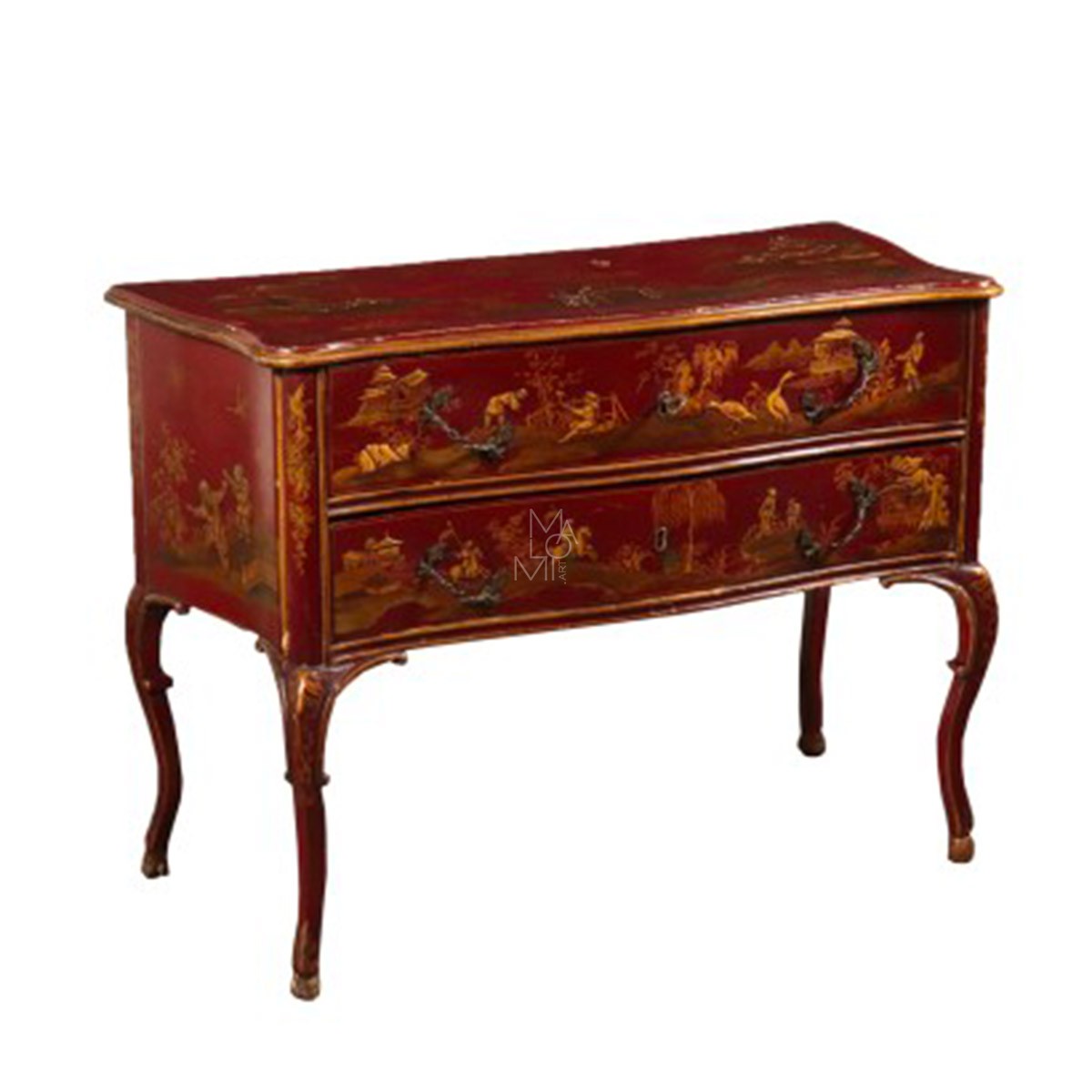
To fully understand the stylistic autonomy of this wardrobe, it is necessary to relate it to the coeval productions of neighboring regions, Venetia and Piedmont, which in those same years interpreted the eighteenth century according to diametrically opposed philosophies. If we ideally move eastward, into the Republic of Venice, we discover that furniture had completely renounced the right angle and the architectural structure. The eighteenth-century Venetian wardrobe is a supple creature, moved in three dimensions, bulging on the front and concave on the sides. In Venice, noble wood is concealed beneath layers of pastel lacquer and pictorial decorations, transforming the furniture into a canvas to be painted that must dialogue with the changing light of the lagoon. The Venetian shell is a light, gilded, and asymmetrical curl that seems to float on the surface without any load-bearing function. Venetian merchants loved to surround themselves with these ephemeral furnishings, whose thin leaf gilding served to reflect the glimmer of candles during nighttime celebrations on the canals.
If instead we turn our gaze westward, toward the Kingdom of Sardinia, Piedmontese cabinetmaking appears dominated by the magnificence of the Savoy court and the direct influence of Versailles. Piedmontese furniture, created by extraordinary masters such as Pietro Piffetti, abandons the simplicity of solid wood to clothe itself in complex marquetry of exotic woods, ivory, tortoise shell, and mother-of-pearl, all crowned by sumptuous mercury-gilded bronzes. Piffetti, appointed royal cabinetmaker by Charles Emmanuel III, worked protected by privileges that exempted his workshop from the strict rules of local guilds, allowing him unprecedented creative freedom. Compared to these two realities, the Lombard wardrobe stands as a monument of proud classicist resistance. It demonstrates how Lombardy, despite being under Habsburg rule and therefore exposed to the influences of Austrian taste, managed to maintain its own Italian way of furniture design, based on the enhancement of the raw material and loyalty to the great rules of classical architecture.
Historical Evolution and Preservation of the Artifact
A deeply fascinating aspect surrounding furniture of this importance is linked to its survival through the centuries and to the necessary restorations of use that have preserved its functionality. During the eighteenth and nineteenth centuries, wardrobes of these dimensions were often passed down from generation to generation within wills and dowry contracts, considered on par with actual real estate. It was not uncommon for the piece to undergo small adaptations to fit into new rooms on the occasion of a marriage or relocation to a new residence. Archival registers testify that the dowry of a noble Lombard maiden could include a single large walnut wardrobe, whose economic value estimated by the experts of the time was equivalent to that of a small agricultural estate. The dimensions of this specimen, featuring a length of one hundred sixty-five centimeters and a height of two hundred twenty-five, suggest that it was intended for a private room of high representation, such as the study of a noble jurist or the master bedroom of a city palace.
The restorations of use presented by the wardrobe are testimony to this long lived history. Solid walnut is a living wood that breathes and reacts to the climatic changes of the Po Valley seasons, expanding in summer and contracting in winter. The conservative interventions that over time have affected the hardware, such as the consolidation of the lateral hinges or the overhaul of the central lock, should not be considered defects, but rather historical scars that attest to its authenticity and continuous use. A piece of furniture that has never undergone restoration is often a piece that has never lived or, worse, a modern forgery. The deep patina covering the surface, achieved through centuries of polishing with beeswax applied hot and patiently rubbed with woolen cloths, gives the furniture that inimitable warmth which constitutes the true added value of a period piece, transforming a simple container into a silent tale of daily life in the Lombard eighteenth century.
Comparative Bibliography
Alberici, Clelia. Il mobile lombardo. Milan: Görlich, 1969.
Baccheschi, Edi. Il mobile settecentesco in Italia. Milan: Gorlich, 1962.
Colle, Enrico. Il mobile barocco in Italia: arredi e decorazioni d'interni dal 1600 al 1738. Milan: Electa, 2000.
González-Palacios, Alvar. Il tempio del gusto: le arti decorative in Italia fra classicismo e barocco. Milan: Longanesi, 1986.
Levy, Saul. Il mobile lombardo del Settecento. Milan: Gorlich, 1964.