Wooden Satyr
Dynamism and artifice: ligurian barocchetto wooden sculpture through the figure of the satyr
Introduction
Ligurian wooden sculpture constitutes one of the richest, most original, and most fertile chapters in the entire history of Italian art, having developed an aesthetic autonomy in constant dialogue with major Baroque building sites and transalpine influences. During the eighteenth century, and specifically in its mid-phase, the superb Genoese tradition of woodcarving achieved the refined outcomes of the so-called Barocchetto—a style characterized by sinuous lines, pronounced theatricality, and an unprecedented decorative lightness.
The work under examination—a refined lacquered wooden sculpture depicting a "Satyr" of Ligurian provenance, datable to the mid-eighteenth century—fits perfectly into this panorama of formal transition. Measuring a significant 80 cm in height, 42 cm in width, and 45 cm in depth, the artifact asserts itself within space through a precise proportional rigor. By investigating its stylistic and physiognomic aspects, the structural evidence yielded by the analysis of its reverse, and its specific metric and furniture-related parameters, this essay aims to analyze the artifact as an eloquent testament to the plastic taste and interior architecture of eighteenth-century Genoa.
- Iconography of the satyr between dionysian myth and late-baroque pathetique
The subject of the Satyr—a hybrid mythological creature, half-man and half-goat—roots its origins in classical antiquity and the ritual procession, or thiasos, linked to the god Dionysus. While in Renaissance art and seventeenth-century Baroque this figure embodied the primordial impulses of nature and brute force, the Ligurian eighteenth century operated a subtle metamorphosis, rendering it in a secular and elegantly decorative key without renouncing a vibrant expressive charge.
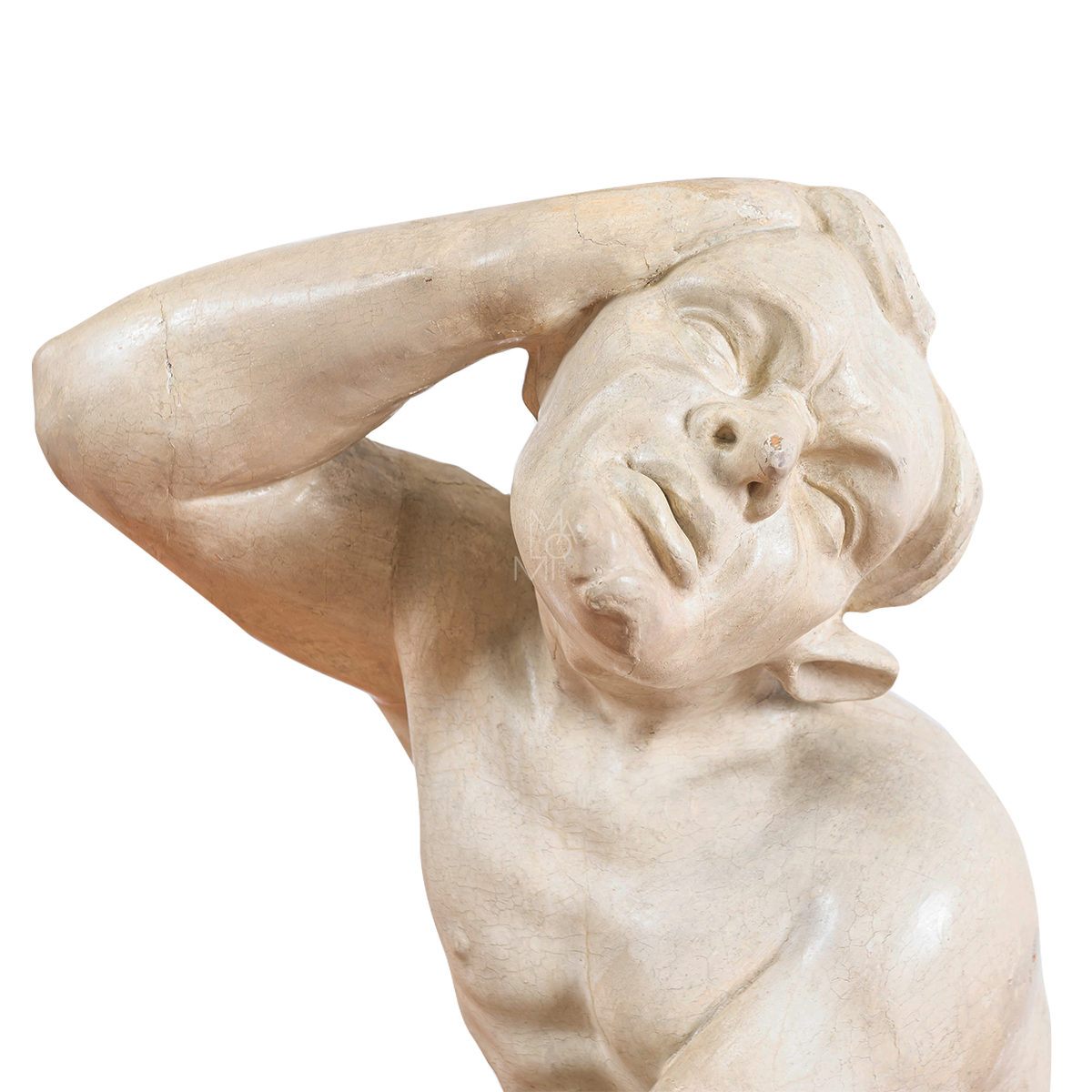
This iconographic transition emerges clearly upon a close-up analysis of the countenance. The creature's feral traits are not exaggerated into the grotesque but are instead judiciously measured: the mythological nature of the hybrid is subtly manifested in the pointed ear protruding from the short, wavy hair. The modeling of the face is dominated by a powerful theatrical pathos, expressed through contracted and tormented mimicry. The deep furrows lining the knitted brow and the nearly half-closed eyes convey the physical strain of the load-bearing element, while the semi-open mouth, which reveals the teeth, infuses the figure with a sense of vital suffering. This dialogues ideally with the tradition of Baroque telamones, though alleviated by the formal grace of the eighteenth century.
- Formal, metric, and dynamic analysis of the work
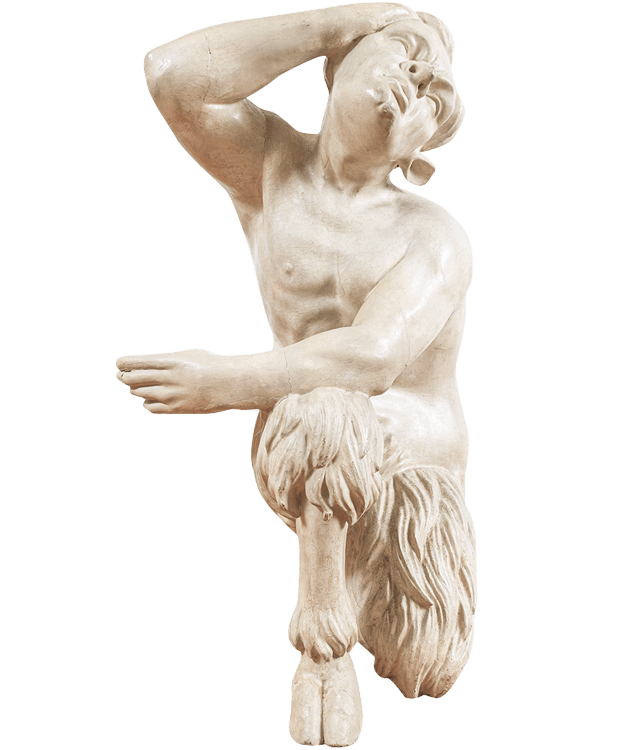
From a strictly formal perspective, the sculpture is dominated by a strong diagonal axis that imparts a serpentine, highly dynamic posture to the body. The figure unfolds within three-dimensional space through a calibrated torsion:
- The left knee is flexed and thrust forward.
- The left arm bends at a right angle across the chest, guiding the viewer's eye outward.
- The head is tilted backward and sharply inclined to the side, accentuating the emotional tension of the pose.
The dimensional ratio of 80 cm in height by 42 cm in width, combined with a depth of 45 cm, dictates crucial geometrical considerations. The third dimension, which exceeds the width itself, underscores a powerful jutting projection of the body into space. This volumetric depth is generated by the pronounced curvature of the torso and the forward thrust of both the lower and upper limbs. Consequently, this is not a flattened or two-dimensional relief carving, but rather a sculpture of profound plastic-volumetric impact, engineered to disrupt the rigidity of the supporting wall and conquer the surrounding space. Such a calibrated spatial distribution balances the structural compactness required by its original load-bearing function, lightening the visual weight through a sophisticated interplay of voids and solids.
The carving demonstrates extraordinary technical skill in modulating surfaces. A sharp volumetric and chiaroscuro contrast is observable between the epidermic smoothness of the nude torso—where the pectoral muscles and the abdomen are softly rendered—and the vibrant, painterly quality of the lower portion, stirred by the deep undercut furrows of the caprine fur. This plastic virtuosity mirrors the lessons of the great Genoese masters of wood, who were capable of breathing an extraordinary organic vitality into a rigid material such as timber.
- Internal structure and construction evidence of the reverse
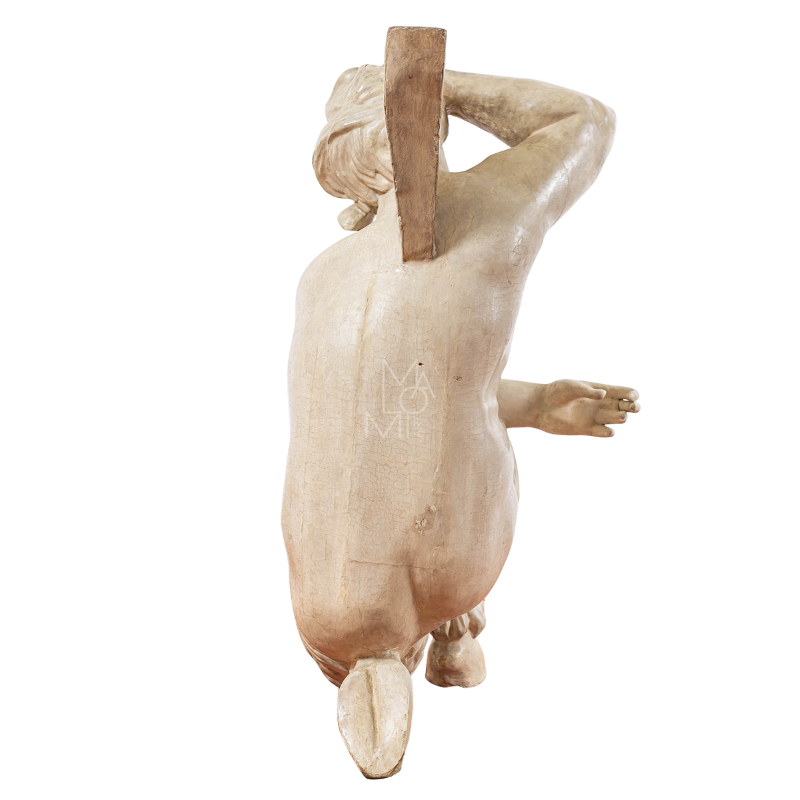
An examination of the rear portion of the artifact unveils the workshop secrets linked to eighteenth-century wooden joinery. Despite a partial simplification of anatomical volumes compared to the richness of the front, the figure’s back reveals a solid and careful modeling. Beneath the lacquered surface, a vertical join line can be discerned. This line attests to the assembly of multiple solid wood blocks, or anime, glued together prior to carving—a fundamental workshop practice designed to neutralize the natural hygrometric tensions of the material and prevent cracking over time across a block measuring a full 80 centimeters.
Currently, the sculpture is rendered self-supporting via a metallic pin anchored to a modern pedestal—a display expedient indispensable for an object born as a structural plastic element and subsequently converted into an isolated collector's piece.
- The technique of lacquering and the conservation state of the surfaces
A crucial element for the dating and aesthetic comprehension of the work is the utilization of lacquering. Over the course of the eighteenth century, the artistic workshops of the Republic of Genoa developed a renowned mastery in polychrome or monochrome varnishing and lacquering techniques, applied both to monumental statuary and to luxury furnishings for patrician palaces.
An detail of extraordinary relevance regarding execution and quality is the absolute homogeneity of the coating: the light lacquer, imitating marble, stucco, or porcelain, is not restricted to the front portion of the work but uniformly and continuously covers the entire back and the structural joint block itself. This technical choice not only protected the timber core from environmental variations on every side, but also addressed the necessity of seamlessly integrating the sculpture within the sumptuous decorative apparatuses of Rococo interiors, preserving an impeccable material illusion from any viewing angle. The lacquered finish softens the transitions of the carving and diffuses reflected light, nullifying the perception of the wood's weight.
A macroscopic observation of the surface reveals a dense network of craquelure, a sign of the natural settling of the timber and the underlying gesso preparation layers, running consistently across both the front and the back of the work. Small losses and historical thinning of the paint film, concentrated at points of maximum relief such as the tip of the nose or the rear joint edges, do not compromise the legibility of the work, but rather document its antiquity and precious temporal patina.
- Functional placement in light of metric data and the joint block
The most eloquent clue regarding the work's original destination is situated on the reverse, precisely beneath the curvature of the right arm: a massive wooden wedge shaped in relief. Far from being a rough or hidden element, this geometric solid is entirely finished with the same ivory lacquer as the rest of the body, integrating seamlessly into the sculptural design of the back. It functioned as a structural tenon, designed to be firmly inserted and locked into a corresponding mortise within a more complex architectural furniture framework.
The metric data of 80x42x45 cm offer a decisive interpretative key. A height of 80 cm corresponds almost perfectly to the standard measurement for the support legs of contemporary wall furniture or the height of a protective balustrade. In light of these technical and dimensional evidences, the work can be precisely mapped to two specific typologies of mid-eighteenth-century Ligurian furnishings:
- A load-bearing corner leg for a grand parade consolle: where the rear lacquered wedge engaged beneath the under-top apron of the wall-mounted table designed to support a heavy slab of marble, while the 80 cm height guaranteed the perfect leveling of the display surface.
- A terminative post or starting stanchion for a balustrade: integrated into the initial newel posts of the rich wooden interior staircases of noble palaces, where the width of 42 cm and the depth of 45 cm comfortably accommodated the flare of the ramp or the upper handrail.
- The satyr and the genoese gran consolle: integration within the parade furnishings of the barocchetto
To fully grasp the functional nature of the Satyr under discussion, it is necessary to contextualize the object within its original domestic setting: the ballrooms and galleries of Genoese patrician palaces during the mid-eighteenth century. In these spaces, governed by rigorous symmetry and monumental stage-craft, the wall-bound piece of furniture—and specifically the parade consolle—was not merely a decorative accessory, but an actual extension of the room's architecture.
The presence of the massive lacquered wedge on the reverse and the full three-dimensional application of the lacquer even over the interlocking surfaces indicate that the sculpture could be partially visible from a three-quarters perspective or reflected in mirrors, requiring an absolute finish of the highest level. Within the Ligurian workshops of the period, the transition from the solid, plastic taste of Filippo Parodi to the more weightless qualities of the mature Barocchetto saw the progressive replacement of architectural pillar legs with entirely sculptural supports. The figure of the Satyr acted as the front corner stanchion of one of these luxurious structures. In a typical Genoese workshop layout, the dynamics of the console articulated as follows:
- The distribution of structural forces: the wooden tenon, entirely lacquered and visible on the reverse of the arm, locked securely into the under-top frieze of the consolle, which was itself animated by rocaille carvings, foliated volutes, and shell motifs. The Satyr's raised and bent right arm created the perfect angular bearing surface to support the weight of the monumental marble slab above, often prized Spanish Broccatello or Portoro.
- The perspective and symmetrical dialogue: the sharp torsion of the torso and the backward, laterally cast gaze were not accidental; they were designed to accommodate the viewpoint of the guest entering the salon. Consolles were almost invariably produced in pairs, or sets of four, to be positioned within interfenestral spaces, the piers between windows. Consequently, the sculpture examined belonged to a specular system: a second Satyr, carved in a symmetrical and opposing posture, decorated the opposite corner of the furniture piece or the twin console placed on the facing side of the room, channeling the viewer's gaze toward the center of the wall.
- The material mimesis of lacquering: the finish in light or ivory lacquer, which unified the carving by concealing the grain of the wood on both the front and the back, adhered to a precise dictate of Rococo interior decoration. The console was required not to clash chromatically with the walls but to merge with the white and gilded stuccowork of the paneling and vaults. In this manner, the wooden furniture appeared to emerge directly from the masonry, producing a visual effect of plastic continuity that transformed the salon into a single, integrated, and spectacular domestic stage.
This profound interconnectedness demonstrates that in the eighteenth-century Ligurian tradition, the figure of the Satyr did not merely possess an autonomous statuary value, but was the linchpin of a sophisticated engineering and visual system, engineered to astonish the guest through artifice, light, and the illusion of motion.
Conclusion
The lacquered Ligurian "Satyr" of the mid-eighteenth century configures itself as an excellent example of synthesis among plastic vigor, physiognomic inquiry, and furniture engineering intelligence. The dimensional data of 80x42x45 cm, paired with the tormented expressiveness of the face and the total, masterful lacquering of the back and the structural joint block, reconnect the pure value of the sculpture to its actual artisanal and architectural dimension. The work reveals how behind the dynamic illusion and artifice of the surfaces finely lacquered in three hundred and sixty degrees lie strict rules of cabinetmaking and a profound understanding of the pathetic rendering of emotions. The artifact effectively witnesses a historical phase in which the language of grand Genoese monumental sculpture fused intimately with highly scenographic furnishings, transforming a load-bearing element into a sophisticated masterpiece of the Ligurian Barocchetto.
Reference bibliography
- Alizeri, F. (1870-1880). Notizie dei professori del disegno in Liguria dalla fondazione dell'Accademia. Genoa: Tipografia del Regio Istituto de' Sordo-Muti.
- Boccardo, P. (Ed.). (1999). I maccatela e l'arte dell'intaglio a Genova nel Settecento. Genoa: San Giorgio Editrice.
- Franchini Guelfi, F. (1977). Il Settecento a Genova: la scultura lignea. Genoa: Cassa di Risparmio della Liguria.
- Franchini Guelfi, F. (1999). Le botteghe di intaglio a Genova nel XVIII secolo: arredo, apparati effimeri e statuaria. Milan: Electa.
- Parma, E. (Ed.). (2002). Artigianato e arredamento nei palazzi di Genova: la scultura d'arredo dal Seicento al Neoclassicismo. Turin: Umberto Allemandi & C.
- Sanguineti, D. (2013). Scultura lignea a Genova tra Sei e Settecento. Proposte per un repertorio. Genoa: De Ferrari Editore.
- Ziliani, G. (2008). Tecniche storiche di laccatura e doratura mobiliari nella Repubblica di Genova. Milan: Mimesis.