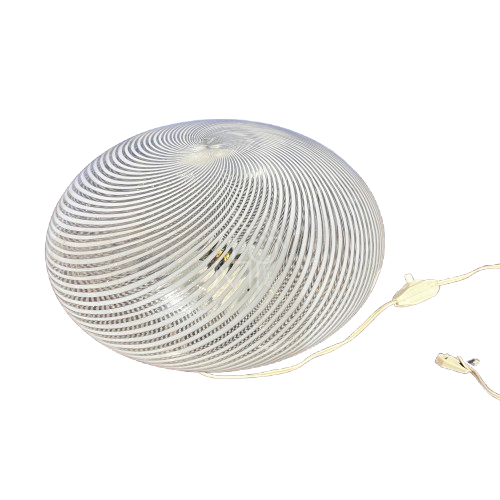
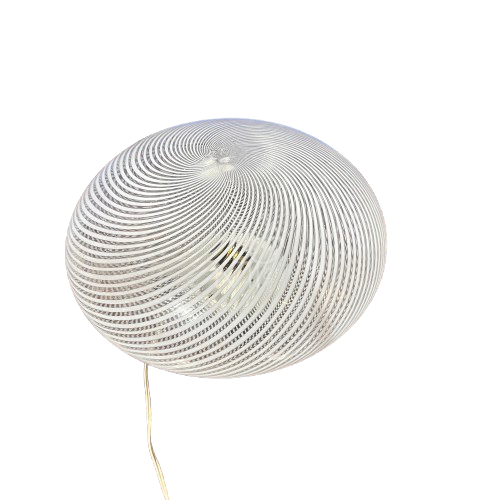
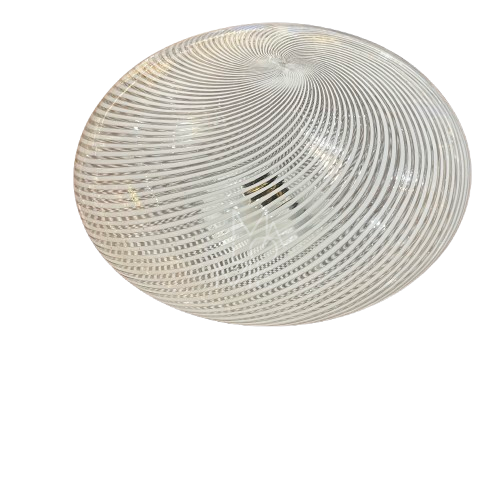
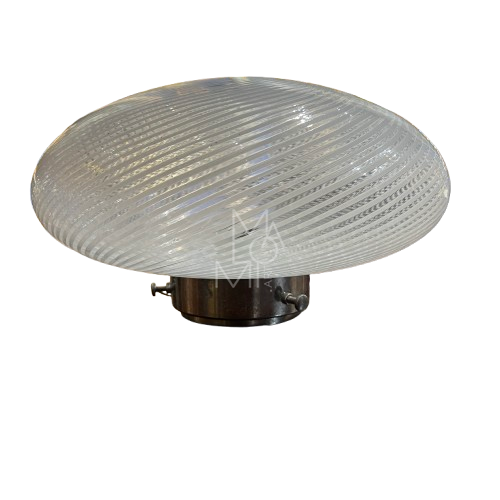
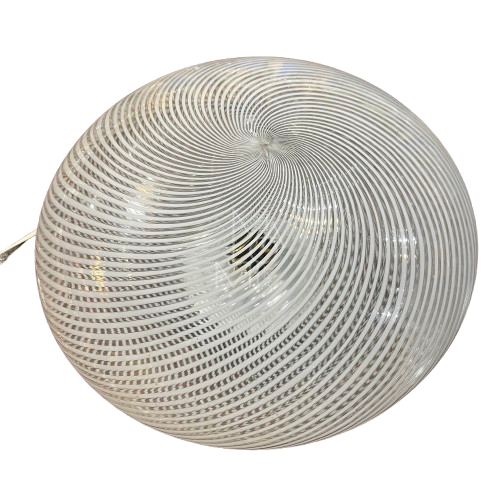
Vintage Murano swirl glass table lamp, Venini 1970s
Phenomenological and archeometric analysis of a Murano lighting artifact: formal study, typological evolution, and conservation protocols
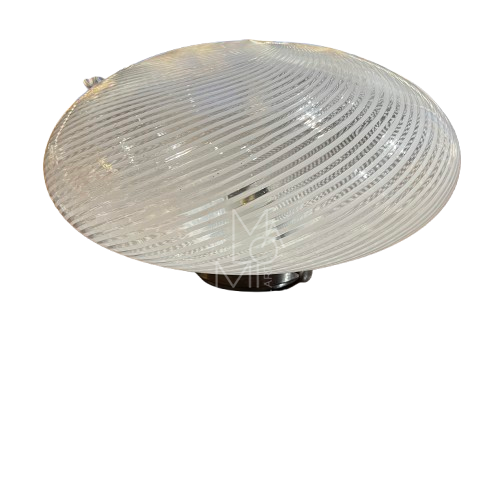
The table lamp under analysis, measuring thirty centimeters in diameter by seventeen centimeters in height, stands as an authoritative paradigm of late twentieth-century Italian design culture. This work manifests a symbiotic union between the centuries-old craftsmanship of Venetian master glassmakers and the rationalist and organic currents of mature modernism. It embodies a historical period when the island of Murano transformed into an open-air laboratory for avant-garde architecture. Within these Venetian furnaces, glass definitively abandoned Baroque opulence and nineteenth-century affectations to interpret a new spatial conception, one where light was no longer merely projected but captured, filtered, and molded by plastic surfaces capable of redefining the contemporary domestic environment.
Formal genesis and geometric syntax of the glass diffuser
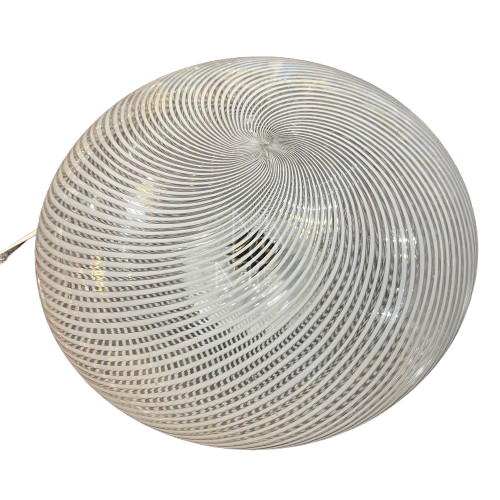
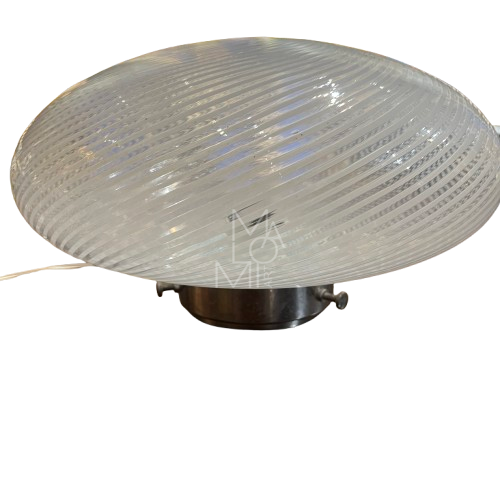
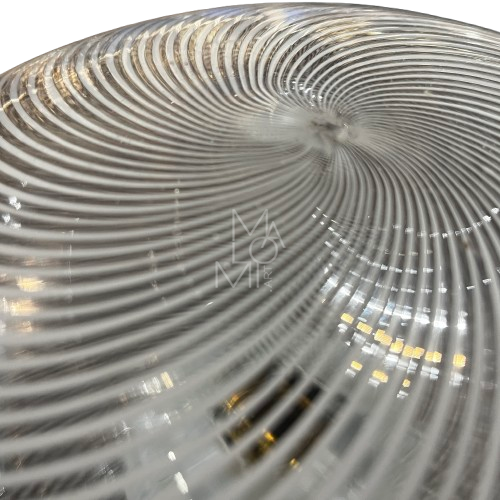
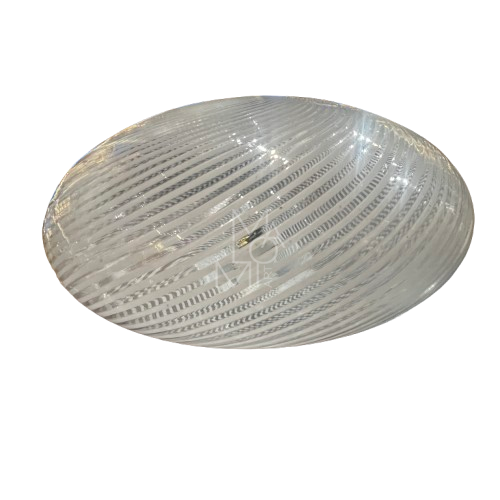
The lighting body adopts a refined, oblate spheroidal configuration, a formal choice that challenges geometric rigidity to align with fluid, organic morphologies. The glass envelope does not serve as a mere container for the light source; rather, it functions as a genuine spatial modulation device. The surface tension of the blown glass defines a pure volumetric form wherein radial symmetry is emphasized by the apical focal point, the closed node from which the entire decorative and structural layout unfurls. From a phenomenological perspective, the object establishes a dialectic of full and empty volumes through a compact, well-proportioned footprint that maximizes luminous efficiency relative to its dimensions, creating an immediate sculptural presence even when the internal light source is inactive.
Material analysis and technical secrets of the spiral mezza filigrana
The excellence of this piece lies in the application of the complex Murano technique known as mezza filigrana ritorta, recognized internationally by the English term swirl. This fascinating and laborious process requires an executory sequence bordering on artisanal virtuosity. It is based on the preliminary hot alignment of canes made of lattimo glass, a specific opaque white glass invented in Venice during the fifteenth century to mimic early Chinese porcelain. These canes are laid out parallel to one another on a refractory metal plate and, once heated to their melting point, are enclosed and welded within a subsequent pour of transparent crystal glass.
During the blowing process inside the furnace, the moment the master glassmaker imparts a controlled torsional rotation to the glass bulb using a blowing iron and metallic jacks. This swift, precise gesture, passed down through generations, generates the characteristic spiral motion that wraps the surface in virtual kinetic dynamism. The geometric alternation between opaque bands and transparent interstices fulfills specific micro-architectural criteria for refraction control and glare reduction, allowing the viewer to perceive the spatial depth of the artifact. The visual overlapping of lines from the anterior hemisphere with those of the posterior hemisphere generates a three-dimensional moiré effect of exceptionally high aesthetic impact.
A compelling historical note regarding this process is that while filigree was originally devised in Murano during the sixteenth century, it fell into near-disuse during the centuries of decline of the Venetian Republic. It was later rediscovered and restored to new glory in the 1930s by visionary designers such as Carlo Scarpa. From that moment onward, the glass spiral became the symbol of the rebirth of artistic glass applied to interior lighting, distinguishing the productions of historic lagoon furnaces such as Venini and Vistosi.
Historical-chemical evolution and blowing techniques of lattimo glass
A profound comprehension of the opalescent texture of this diffuser requires a chemical-physical digression into the historical blowing techniques of lattimo glass in Venice. This particular vitreous batch owes its opacity to the presence of microscopic crystals of calcium phosphate or lead arsenate. When these disperse homogeneously within the molten silicate matrix, they cause light to scatter without fully absorbing it, thereby endowing the artifact with that typical milky whiteness that historically rivaled Ming Dynasty porcelain.
The extraction process for the filigree canes in the furnace occurred through an operation known as tiratura (drawing). The master would gather a small quantity of lattimo from the crucible, shape it into a regular cylindrical mass, and, with the help of an assistant who attached a second iron to the opposite end, walk rapidly down the corridors of the glassworks. This rapid extension stretched the glass bulb until it transformed into a continuous, ultra-fine thread stretching over long distances, which was subsequently cut into rectilinear segments termed canes.
In the specific case of the mezza filigrana present on this lamp, the canes do not feature a colored inner core—a characteristic of retortoli threads—but consist of a solid cross-section of pure lattimo. Maintaining strict temperature control during the subsequent blowing of the oblate spheroid was crucial. Excessive heat would have caused the white lines to liquefy and blur into the surrounding crystal, whereas insufficient temperatures would have generated structural roughness and imperfections on the exterior surface of the dome, compromising the microscopically flawless smoothness of the artifact.
Sociocultural background of Murano furnaces and designer collaborations
The global success of lighting objects such as the one under examination was not a fortuitous event, but rather the outcome of a profound cultural revolution that saw the island of Murano open itself to unprecedented international collaborations. In the post-World War II era, architects of the caliber of Tobia Scarpa, Gae Aulenti, Angelo Mangiarotti, and the American designer Thomas Stearns began to frequent the furnaces regularly, challenging master glassmakers to push past the physical limits of the medium. The masters, initially protective of their trade secrets and reluctant to follow the geometric drawings of "mainland" architects, had to develop a new shared language. It is said that early discussions in the furnace were heated, as designers demanded millimetric thickness and absolute uniformity for serial lamp production, while masters defended irregularity as a hallmark of authenticity.
From this confrontation emerged an extraordinary compromise that allowed for the industrialization of the product without sacrificing its artisanal soul. The mezza filigrana spiral became a preferred technique because, while it demanded manual expertise impossible to replicate mechanically, it guaranteed a rigorous geometric control of the pattern, perfectly matching the clean, minimalist taste of the enlightened Milanese and Northern European bourgeoisie who were furnishing the new residential architecture of the era.
Engineering of the metallic support and archeometric investigation of the native tabletop base
The lower load-bearing structure, analyzed in detail by removing the diffuser, manifests a structural approach tied to the design honesty of functionalism. The circular base demonstrates a native tabletop conception, where the stamped and galvanized sheet metal serves as a stable center of gravity for the horizontal development of the table lamp. The stability of the glass diffuser is guaranteed by an external perimeter flange made of chrome-plated iron or polished steel, equipped with three manual thumb-screws spaced equidistantly. This system clamps the glass neck radially, distributing pressure evenly to avoid thermal tension or fracturing of the crystal induced by the heat of the internal light source.
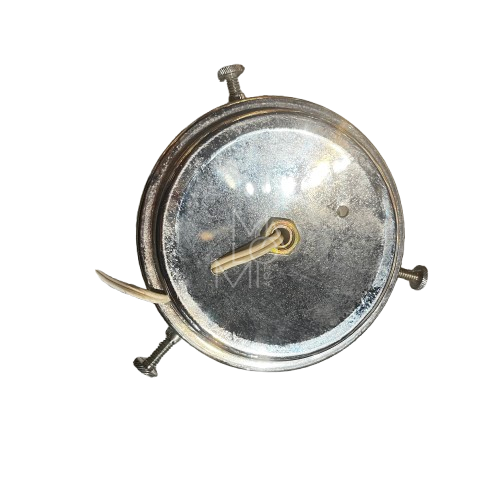
Autoptic examination of the bottom plate reveals the use of a cold-galvanized sheet iron that displays characteristic signs of pitting oxidation and natural dulling due to the aging of the metal. The absence of a protective painted finish on the non-visible side confirms an industrial production datable between the late 1960s and the mid-1970s. The fastening of the internal structure relies on a central flanged hexagonal nut, which receives the end of the threaded pass-through rod—the structural backbone of the entire electrical system and lampholder assembly.
The presence of an embossed keyhole slot stamped directly into the galvanized sheet metal does not indicate a wall-mount function in this model; rather, it functions as a multi-purpose technical solution for stabilization or securing the fixture on inclined surfaces, a practice found in certain naval supplies or contract furniture of the era. The routing of the wiring intentionally takes advantage of the millimetric clearance and elevation generated by the protrusion of the three external thumb-screws and the base edges. This clear lower space allows for the unhindered passage of the power cable without the overall weight of the lamp pinching or compromising the plastic insulation, confirming a workshop blueprint entirely consistent with modernist table lamps.
Diagnostics of the external electrical apparatus and conservation protocols
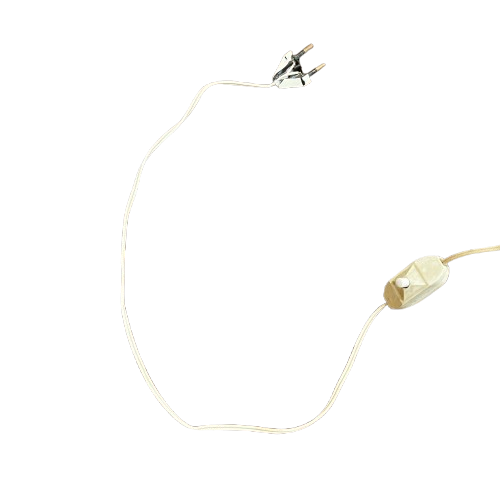
A review of the terminal components of the electrical system provides a clear diagnostic picture concerning the preservation status of the polymeric materials. The wiring consists of a flat twin-core cable with ivory-colored polyvinyl chloride insulation, interrupted by a rigid cord switch with a protruding toggle lever—a model commonly referred to as a "revolver" or "torpedo" switch due to its elongated geometric profile, which dominated the production of Italian electrical accessories during this period. Although the switch shows widespread surface dulling due to age, it preserves its structural integrity.
Conversely, the ten-ampere bipolar plug with brass prongs exhibits a critical, destructive state of degradation. The protective thermoplastic shell has partially disintegrated due to polymer crystallization, leaving the terminal clamping screws and internal copper conductors completely exposed. This condition presents an evident short-circuit and shock hazard, rendering the piece unusable in its current state.
Restoring such a collectible object dictates a methodological reflection regarding design conservation. A purely curatorial approach would dictate retaining the damaged original wiring for display purposes while prohibiting the lamp from being illuminated. To restore the artifact to its dual nature as both a work of art and a functioning lighting device, a philological replacement restoration is required. This protocol entails substituting the cable, switch, and plug with modern reproductions that comply with contemporary safety regulations while utilizing materials and color matches that faithfully replicate the original ivory aesthetic. The original components removed during the process must be cataloged and preserved alongside the piece, safeguarding the historical and documentary integrity of an excellent example of Venetian glassmaking and Italian industrial history.
Comparative archival diagnostics: discerning patterns between Venini and Vistosi
The correct philological attribution of an unsigned swirl filigree glass requires a careful comparative archival inquiry between the two greatest production hubs that celebrated this formal typology in the twentieth century: the manufacture founded by Paolo Venini and the glassworks of the Vistosi family, then guided by the design insights of Gino Vistosi. Although these period spheroidal diffusers may appear identical at first glance, an analysis of the decorative pattern reveals substantial executory differences that serve as a genuine fingerprint of the artifact.
The design tradition of Venini, historically tied to archival models derived from the insights of Ludovico Diaz de Santillana and Paolo Venini himself, favors a composition where the lattimo threads maintain an extremely thin, constant, and rigorous width that is almost micro-architectural. In a Venini pattern, the spiral winding tends to be very dense and tightly wound, reducing the transparent crystal space between individual canes to just a few millimeters. Furthermore, Venini models feature a millimetric and geometrically impeccable apical closure, where the final twist converges at a nearly invisible point, neutralizing any asymmetries generated during free-form blowing.
In contrast, Vistosi’s approach to mezza filigrana is distinguished by a bolder, more plastic, and tactile language, heavily influenced by collaborations with avant-garde Venetian and international designers in the 1960s. The lattimo canes utilized by Vistosi tend to be slightly wider, flatter, or subtly blurred at the edges, giving the pattern a softer, more fluid rhythm that accommodates the natural deformations of the glass as it expands within the blowing block. The transparent interstices are proportionally wider, amplifying direct luminosity at the expense of total shielding. The Vistosi spiral traces wider, more expansive orbits, and the apical convergence point frequently retains a more pronounced mark from its separation from the blowing iron, proudly displaying the artisanal nature of its execution.
Evaluating the morphology of the artifact under examination, the line density and regular geometric progression of the decorative motif suggest a strong affinity with the austere executory rigor of the Venini tradition.
Historical valuation of the artifact
In light of historiographical sources and critical literature on Italian design, this lamp stands as a significant material document mapping the transition from elite luxury to the democratization of Good Design in the 1970s. The object moves beyond the traditional conception of a lamp as a monumental glass sculpture, favoring an integrated, modular logic instead. Historically, art criticism of the era viewed these oblate spheroids as a departure from Murano historicism in favor of a pure spatial quality influenced by contemporary artistic research into Optical Art and kinetic visual perception.
The presence of a standardized industrial mount alongside a highly complex artisanal technique like mezza filigrana places this work at the heart of the theoretical debate advanced by Gillo Dorfles and Vittorio Gregotti concerning the unresolved tension between serial production and the uniqueness of an art object. From the standpoint of the market and museum conservation, the glass dome is considered the primary element of value. Meanwhile, the mechanical and electrical apparatus, though requiring conservation measures for safety compliance, serves as an irreplaceable chronological and technical marker. The work thus remains a vivid testament to that fertile era when high lagoon craftsmanship successfully married the structural demands of industrial civilization, creating timeless icons destined to redefine the international domestic landscape.
References
Barovier Mentasti, Rosa. Il vetro di Murano dalle origini ad oggi. Venice: Mondadori, 1982.
Deboni, Franco. Venini Glass: Its History, Artists and Catalogues. Turin: Umberto Allemandi, 2007.
Moretti, Giovanni. L'arte del vetro a Murano e il design industriale del secondo Novecento. Milan: Electa, 1994.
Pansera, Anty. Storia del disegno industriale italiano. Rome: Laterza, 1993.
Vignelli, Massimo. Vignelli: From Venice to New York. New York: Rizzoli, 2004.
Aloi, Roberto. L'illuminazione oggi. Milan: Hoepli, 1976.