The Walnut and Ivory Sculptural Group by Simon Troger
Polymaterial Virtuosity and Genre in the Late Baroque: The Walnut and Ivory Sculptural Group by Simon Troger
Painting accompanied by C.I.T.E.S.
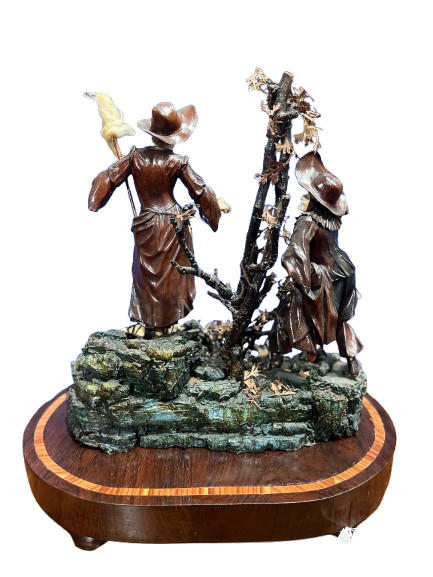
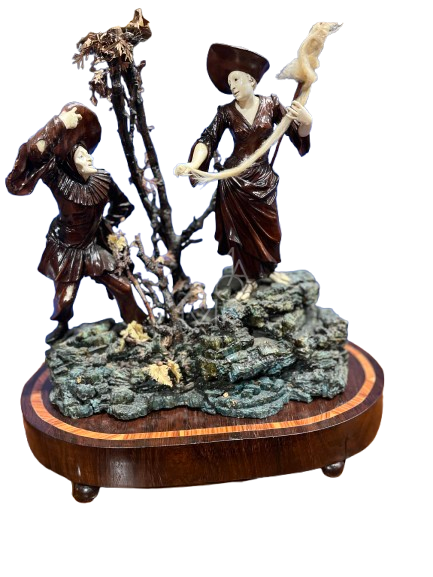
The work under examination constitutes a stellar example of Central European Late Baroque production, executed by the Tyrolean sculptor Simon Troger (1683–1768). Measuring 44 x 37 x 17 cm, this sculptural group fits organically into the category of polymaterial micro-sculpture destined for the Wunderkammern or cabinets of refined collectors North of the Alps. The work depicts two figures from the contemporary bucolic or theatrical tradition — a spinner and a wanderer in a dynamic pose — mounted on a naturalistic base simulating a rocky outcrop, which in turn rests on a fine wood plinth molded with geometric inlays.
Historical-Critical Profile of the Artist: Simon Troger and the Kombinationsfiguren
Born in Abfaltersbach in East Tyrol, Simon Troger initially trained in Innsbruck under Nikolaus Moll before moving to Munich, where from 1733 he established a flourishing and celebrated workshop in the suburb of Haidhausen. Protected by the Prince-Elector Maximilian III Joseph of Wittelsbach, Troger achieved international renown thanks to the codification and flawless execution of the so-called Kombinationsfiguren.
These are complex sculptures in which the visible anatomical parts, such as faces, hands, and limbs, were carved from pure white ivory, while the garments and structural elements were modeled using dark, warm wood essences, principally walnut wood, boxwood, or rosewood. This sharp chromatic and material contrast aimed to heighten the naturalism, expressiveness, and theatrical drama typical of Late Baroque and Rococo sensibilities, of which this masterpiece stands as a sophisticated and mature testament.
The Patronage of Munich: The Historical Link with the Wittelsbach of Bavaria
The artistically aristocratic career of Simon Troger reached the pinnacle of success thanks to the farsighted and lavish cultural policy of the Wittelsbach dynasty, the rulers of Bavaria who transformed Munich into one of the European capitals of the Late Baroque and Rococo. Moving to Munich around 1733, Troger quickly caught the attention of the ducal court, particularly Prince-Elector Charles Albert of Bavaria (the future Emperor Charles VII of the Holy Roman Empire) and, subsequently, his son Maximilian III Joseph.
The Wittelsbachs, deep admirers of technical virtuosity and serial collectors of artifacts for their Kunstkammern, saw in Troger's polymaterial sculptures the perfect embodiment of contemporary aristocratic taste. The sovereign granted the artist not only major direct commissions but also guild protection and exemption from the strict regulations of local guilds, allowing his Haidhausen workshop to prosper. Among the most famous works born of this partnership are the monumental sculptural groups with biblical and mythological themes (such as the Sacrifice of Isaac and the Rape of Proserpina), historically absorbed into the court collections and today the core nucleus of the Bayerisches Nationalmuseum in Munich. The favor of the Wittelsbachs acted as a formidable commercial catalyst for Troger, transforming his sculptures into prestigious diplomatic gifts and objects of desire for the entire high nobility of the Holy Roman Empire.
Iconographic Analysis, Theatricality, and Genre Scenes
The sculptural group brings to life two rural-popular characters caught in a moment of intense gestural dynamism and psychological interaction:
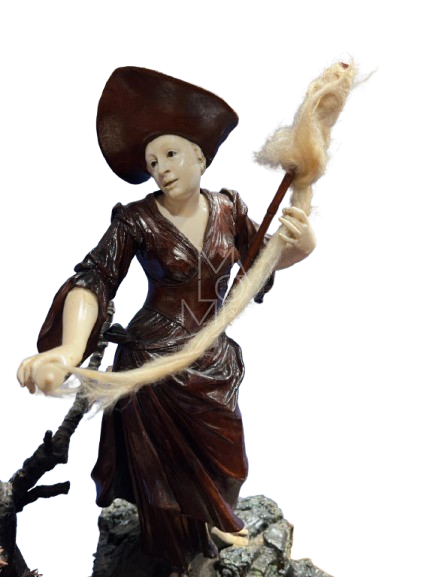
- The Female Figure: On the left (in the frontal view), she is depicted as a spinner, intent on holding a distaff wrapped with genuine raw textile fiber. The twist imparted to her body, the refinement of her wide-brimmed hat, and the flowing drapery recall the repertoire of pastoral or pastoral-mythological genre scenes, a recurring theme in the transition between Baroque and Rococo.
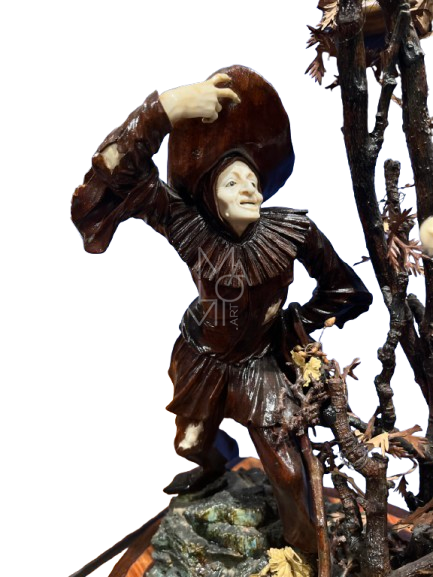
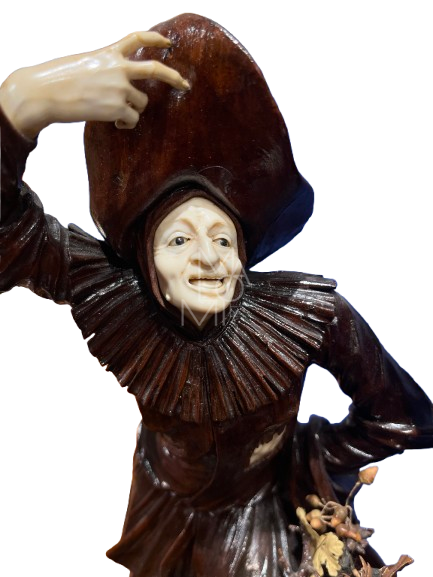
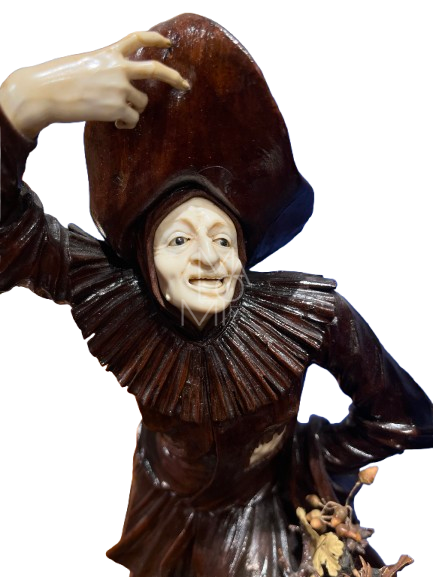
- The Male Figure: On the right, he assumes an asymmetrical and highly dynamic pose. With one hand lifting his hat, he displays a theatrical, almost caricatured expression carved into his face. This exaggerated realism, bordering on satire or the archetypes of the Commedia dell'Arte, is a hallmark of Troger's models, renowned for his series dedicated to beggars, peasants, and street vendors.
The surrounding wild nature — a barren tree with twisted branches enriched with applied leafy twigs — serves as an indispensable scenic backdrop, emphasizing the Baroque artifice of the whole and placing the characters within an idealized rural context.
Three-Dimensional Space and the Posterior View
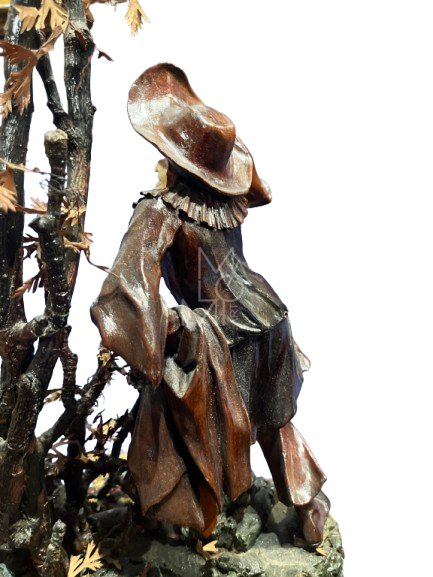
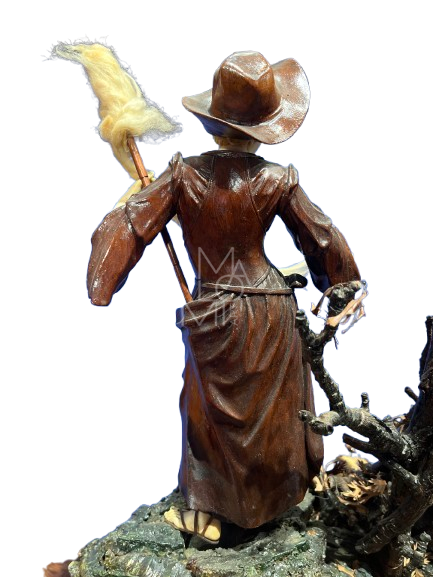
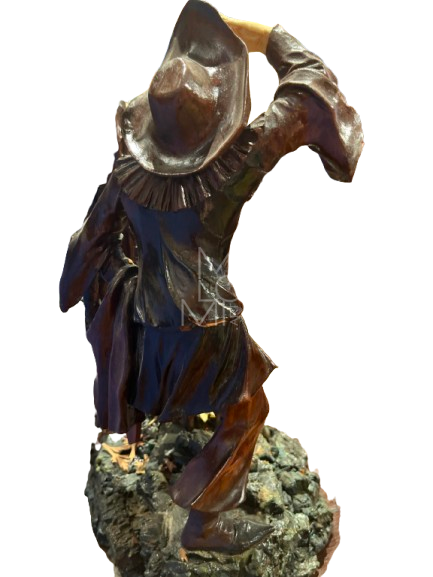
Examination of the dorsal portion of the sculptural group reveals that the work was conceived for a full three-hundred-and-sixty-degree spatial viewing, intended to be displayed at the center of a Wunderkammer table or a collector's showcase:
- Torsion and Chiaroscuro: The back of the female figure accentuates the pronounced "S-curve" torsion of her torso. Her back reveals a series of deep vertical folds converging toward the waistline, culminating in the billowing volume of the tunic opening at the rear. This device maximizes the play of shadows and light reflections upon the polished grain of the walnut wood.
- The Tree Trunk as a Compositional Axis: The twisted tree reveals itself from this angle as the true structural and aesthetic fulcrum dividing the two figures symmetrically. The carving of the bark creates a rugged texture that contrasts sharply with the smooth, textile-like surfaces of the clothing.
Executive Technique, Materials, and Joint Solutions
From a strictly technical standpoint, the work demonstrates a masterly control of differentiated carving and polymaterial craftsmanship typical of the master:
- The Working of Walnut and Ivory: The walnut wood is treated with fine gouges to render the deep, sharp folds of the fabrics, capable of catching the light in strong chiaroscuro. Conversely, the ivory yields to the epidermal smoothness of flesh, rendering the minute physiognomy of the faces and the tension in the fingers.
- Structural Virtuosity: The ivory portions are not mere superficial inserts, but load-bearing elements internally pinned to the main wooden structure through seamless interlocking joints, ensuring static stability to the forward-leaning figures. The shod feet are similarly jointed into the base.
The Diagnosis of the Naturalistic Sub-Assembly: Cork as Trompe-l'œil
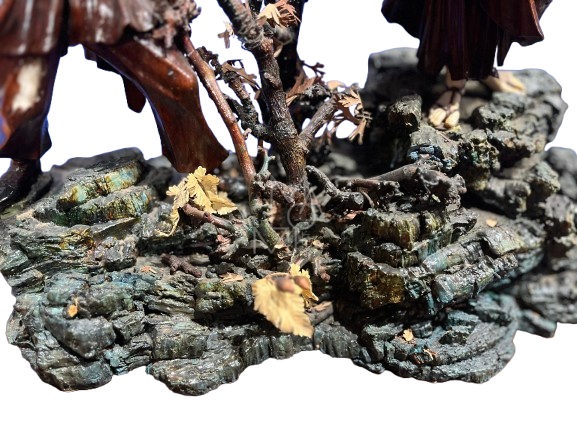
To simulate the rugged, mossy rock, cork was employed, shaped, stratified, and enriched with a polychromy of green-brownish tones that mimic lichen deposits and spontaneous vegetation. The horizontal, schist-like flow of the material is worked with dense lamellar cuts. The use of cork met a dual workshop requirement:
- Structural Lightness: It allowed for a drastic reduction in the total weight of the artifact (certified at 1936 g in total) to facilitate moving it while protecting the structural integrity of the inlaid wooden plinth.
- Optical Illusion: In an era dominated by a taste for artifice, the metamorphosis of cork into granitic stone represents the perfect plastic counterpart to trompe-l'œil.
Expressive Realism: The Micro-Sculptural Carving of the Male Face
The head of the male character embodies the peak of Troger's physiognomic expressiveness. The expression lines on the forehead, the marked nasolabial furrows, and the parted mouth revealing the lower dental arch constitute a superlative microscopic virtuosity. The use of deep, dark eye sockets infuses the face with psychological dynamism. The right hand, entirely free in three-dimensional space, shows tensed tendons on the back of the hand and a precise curvature of the fingernails, defying the native fragility of elephant ivory in contrast with the stiff brim of the walnut hat and the pleated collar of the walnut ruff.
The Pastoral Rococo Ideal and the Textile Insert of the Female Figure
In formal opposition to her companion, the female face conforms to the ideal grace of the Rococo transition: her features are soft and relaxed, with a hint of a serene smile. The ivory neck connects masterfully to the décolletage emerging from the V-neckline of the wooden dress. Her slender hands support a rod acting as a distaff, wrapped in an actual bundle of raw textile fiber that stretches physically across the space into her right hand. This hyper-realistic inclusion breaks the material boundaries of traditional Baroque sculpture, elevating the group to an absolute pinnacle of Cabinet collector's items.
Bibliographical and Museological Reference Points
For the critical and comparative study of eighteenth-century polymaterial sculpture from the Bavarian and Tyrolean regions, key scientific texts and international museum collections of reference include:
- Berliner, Rudolf, Die Bildwerke in Elfenbein und Bein (Kataloge des Bayerischen Nationalmuseums, Band IV), Augsburg, 1926.
- Theuerkauff, Christian, Nachrichten vom Bildhauer Simon Troger, in "Pantheon", XXXI, 1973, pp. 248–258.
- Philippovich, Eugen von, Elfenbein: Ein Handbuch für Sammler und Liebhaber, Braunschweig, Klinkhardt & Biermann, 1982.
- Kappel, Jutta, Elfenbeinkunst im Grünen Gewölbe zu Dresden, Dresden, Sandstein Verlag, 2017.
- Bayerisches Nationalmuseum (Munique): The museum institution holding the world's most significant corpus of documented works by Simon Troger, including his celebrated mythological groups and his series of beggars (Bettlerfiguren).