The Triumph of Arita Porcelain: A Historical-Artistic and Diagnostic Study of an Exhibition Charger from the Edo-Meiji Transitional Period (63x54 cm)
The Triumph of Arita Porcelain: A Historical-Artistic and Diagnostic Study of an Exhibition Charger from the Edo-Meiji Transitional Period (63x54 cm)
Introduction
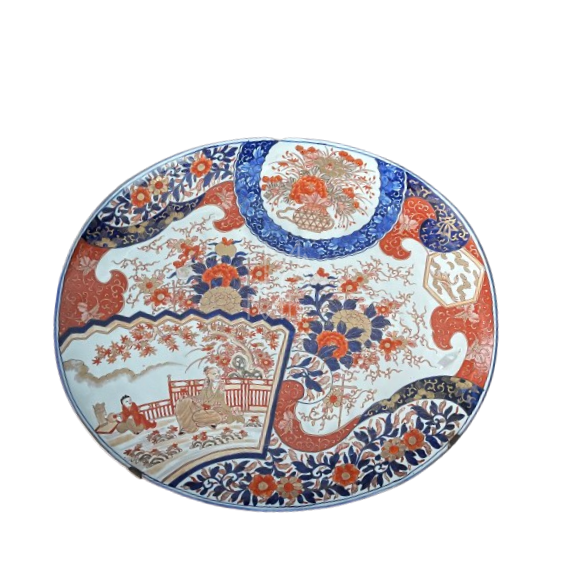
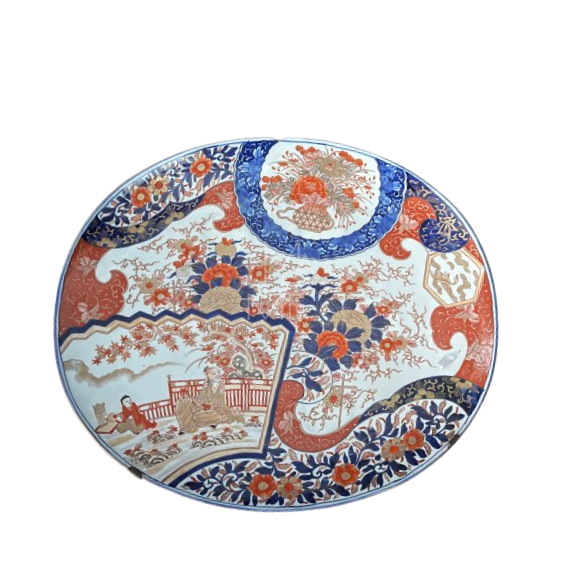
The monumental ovoid charger in Japanese Arita porcelain, characterized by its imposing dimensions of 63x54 cm, constitutes a material document of extraordinary significance for the study of East Asian applied arts. This work is deeply rooted in the Kinrande decorative tradition (literally "gold brocade"), a stylistic language developed to satisfy both the refined domestic market and discerning Western collectors. Employing a multidisciplinary methodological approach—combining socio-historical analysis, iconographic exegesis, and materials diagnostics—this essay aims to reconstruct the genesis, technological challenges, and anthropological context of this ceramic masterpiece.
- The historical-geographic context: the saga of Arita and the port of Imari
To comprehend the nature of this artifact, it is first necessary to deconstruct the terminological misconception that historically surrounds Japanese porcelain. The designation "Imari," which spread extensively across Europe from the 17th century onward, does not refer to the physical center of production, but rather to the port of embarkation situated on the northern coast of Kyūshū island. The true nerve centers of manufacture were located inland, nestled within the valleys of the town of Arita, in the historical province of Hizen (modern-day Saga Prefecture).
The birth of porcelain in Japan is linked to a specific geological and political event: the discovery, traditionally attributed to the Korean potter Ri Sampei in 1616, of rich deposits of pure kaolin stone on Mount Izumiyama. Under the strict governance of the local Nabeshima clan, the Arita district was transformed into a secure industrial fiefdom. The government monopoly isolated the production areas to protect the chemical formulas of glazes and enamels from rival clans' spies, establishing a specialized craft tradition that would redefine global trade flows following the decline of Chinese exports caused by the transition between the Ming and Qing dynasties.
- Materials geology and technological challenges of the large format
From a strictly technological perspective, Arita porcelain is distinguished by the use of crushed local stone (initially from Izumiyama and, subsequently, Amakusa) rather than the artificial blends of kaolin, quartz, and feldspar utilized in the West. This material guaranteed exceptional plasticity and structural strength post-firing. Nonetheless, executing an ovoid charger exceeding sixty centimeters in diameter pushed the limits of historical ceramic physics to extreme levels.
During the drying phase and the subsequent high-temperature firing (approximately 1300 °C), the clay body underwent radical volumetric shrinkage, ranging between 15% and 20%. For a vast and asymmetrical surface such as this ovoid form, the risk of warping, cracking, or internal structural collapse was exceedingly high. Firing success depended entirely on the empirical, generational expertise of master kiln-tenders managing the climbing multi-chamber kilns (noborigama). Constructed on hillsides to exploit the ascendant draft of heat, these kilns were meticulously fueled with red pine logs to precisely calibrate the internal reduction or oxidation atmospheres.
- Chemical-physical aspects and the Kinrande color palette
The decoration of the surface adheres to the strict tenets of the classic Kinrande trichrome palette, the execution of which required a methodical sequence of chemical-physical stages and multiple distinct firings:
- Underglaze Cobalt Blue (Sometsuke): This is the sole pigment applied directly to the raw or biscuit-fired body before glazing. Utilizing natural cobalt ore (gosu), painters drafted the deepest structural layouts and lobed reserves. The piece was then coated with a transparent feldspathic glaze and subjected to the primary high-temperature firing (1300 °C).
- Overglaze Iron Red (Aka-e): An enamel based on iron oxide, applied over the already vitrified glaze. Fired at lower temperatures (around 800 °C) in a muffle kiln, this pigment fused to the surface, yielding warm hues ranging from vibrant coral to burnt orange.
- Gilding (Kinjitate): Applied in the form of gold leaf or suspended powder, this constituted the final decorative pass. Fixed with a rapid, third low-temperature firing (around 700 °C), the gold embellished vegetal details and geometric diaper-pattern ground fills, creating the lavish "brocade" effect from which the style derives its name.
- Iconographic exegesis: organic asymmetry and suspended space
The composition of the charger challenges the tenets of perspective and centralized axial symmetry characteristic of European Renaissance and Baroque design, celebrating instead the core principles of Japanese aesthetics. The visual space is organized by large, overlapping panels (mado, literally "windows"), creating a sophisticated multi-layered narrative effect:
The fan-shaped reserve (Ōgi-mado)
Dominating the upper section is a large reserve shaped like an open folding fan (ōgi). In East Asian culture, the fan is a potent symbol of prosperity, evoking the expansion of life radiating outward from a single point of origin. Contained within it is a figurative scene of literary or courtly nature, depicting classical figures in traditional garments situated upon a veranda (engawa) overlooking spring blossoms. This iconographic genre invokes the realm of Miyabi (the courtly elegance of the Heian Period) and great literary classics such as the Tales of Genji (Genji monogatari).
The floral basket motif (Kabonzu)
The center and surrounding quadrants host a botanical explosion dominated by tree peonies (botan) and chrysanthemums (kiku). The peony, hailed as the king of flowers, embodies royalty, honor, and wealth; the chrysanthemum, emblem of the Japanese Imperial House, serves as a metaphor for longevity, purity of spirit, and the autumn season. The branches interlace with the scrolling foliate scrollwork (karakusa), an expression of familial continuity and eternity.
The concept of yohaku (negative space)
The work masterfully oscillates between the dense, ornamental fill (horror vacui) demanded by foreign markets and the pure, rarefied elegance inspired by Kakiemon traditions. The areas left undecorated highlight the role of negative space (yohaku), understood not as an absence, but as an active structural element that allows the composition to "breathe," evoking natural mist or the infinity of the sky.
- Structural archaeology and diagnostics of the reverse
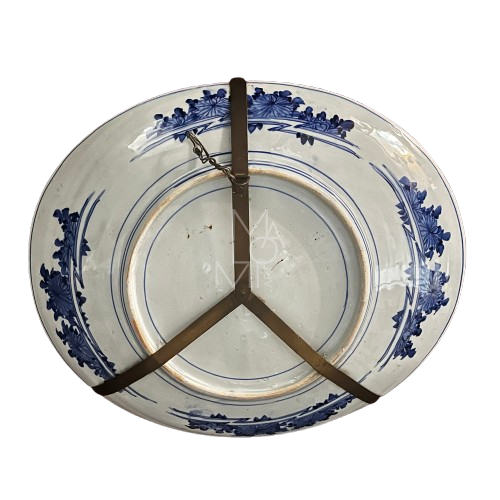
While the front of the charger celebrates pictorial virtuosity, the reverse preserves the material indices of its firing and provenance history:
- The Reverse Cobalt Decoration: The presence of broad scrolling floral sprays painted in underglaze cobalt on the back is a distinctive trait of export-oriented Arita porcelain. It was designed to dignify the object even when viewed from an angle or from the side while mounted on a wall.
- Anatomy of the Concentric Foot: The base exhibits a wide, unglazed footring (kodai). This feature distributed the immense weight of the clay body evenly across the kiln shelf, preventing central sagging during the pyro-plastic phase at peak vitrification.
- Spur Marks (Harime): Small, brown refractory points are visible on the white porcelain base both inside and outside the footring. These are the remnants of refractory spurs or "cockspurs" upon which the charger rested inside the saggar to prevent the molten glaze from fusing the vessel to the kiln shelf.
- The Glaze and Cobalt Texture: The glaze exhibits a subtle, micro-pitted texture known as "orange peel" (mikan-hada), characteristic of the slow cooling cycles inherent to traditional wood-fired kilns. The underglaze blue, free from the clinical, uniform purplish hues of late 19th-century imported industrial cobalt, reveals natural shading variations and dark iron-spotting spots resulting from the entirely manual application of native mineral pigment.
- The Hanging Cage: The robust, three-armed iron or brass mount joined by a central suspension chain is a 19th-century European addition, reflecting Western collecting habits. This armature allowed the charger to be safely hung on the walls of bourgeois salons, contextualizing the porcelain as a fine art painting.
- Chronology and social context: the Edo-Meiji transition (1860-1890)
The convergence of technological and stylistic data permits the dating of this artifact to a precise and tumultuous historical phase: the three decades spanning 1860 to 1890. This era marks the definitive watershed between the end of the Edo Period (the late Tokugawa Shogunate) and the dawn of the Meiji Era (the "Enlightened Rule" of Emperor Mutsuhito).
The status of painters from Akaemachi to the Koransha
During the Edo Period, enamel painters lived under a protective yet coercive regime of geographic segregation within the Akaemachi ("Red Painting Town") district of Arita, salaried by the Nabeshima clan to safeguard the chemical secrets of the kilns. Following the collapse of the Shogunate in 1868 and the abolition of the feudal system, these subsidies ceased abruptly, forcing independent artisans to band together into private commercial entities to survive on the global market.
The establishment of the Koransha (The Scented Orchid Company) in 1875, founded by Fukagawa Eizaemon alongside the elite painters of Akaemachi, revolutionized the industry. The company modernized enamel chemistry and initiated the production of colossal display wares specifically engineered to dazzle judges at the Great International Expositions (such as Paris 1878 and Philadelphia 1876). The charger under examination, with its ovoid form and magnificent proportions (63x54 cm), encapsulates the very essence of this transition: an object that retains the rigorous technical discipline of the feudal Edo period, while projecting it toward the commercial and celebratory dynamics of the newly globalized Meiji era.
- Condition diagnostics of the gilding
Because the fine gold decoration of the Kinrande style is applied over the glaze and fired at low temperatures, it lacks a protective vitrified layer, remaining the most physically vulnerable element of the vessel.
Close visual inspection reveals an exceptional state of conservation. The gold retains its original material thickness and luster across 90-95% of the gilded areas, particularly within the protective boundaries of the fan reserve. The total absence of concentric utensil scratches or extensive frictional losses categorically precludes any utilitarian domestic function, confirming the charger's historical status as an exclusive display piece. The minor, localized dulling observable near the outer rim constitutes a natural and consistent "patina of time"—a crucial diagnostic marker that validates the 19th-century authenticity of the piece, distinguishing it from the harsh uniformity of modern chemical reproductions.
Conclusion and analytical summary
The artifact examined stands as a ceramic masterpiece of outstanding historical and curatorial value, representing a perfect synthesis between bold large-format engineering and the meticulous delicacy of East Asian miniature painting.
|
Analytical Parameter |
Observed Evidence |
Historical & Curatorial Implication |
|
Morphology & Dimensions |
Monumental ovoid body measuring 63x54 cm |
An exhibition charger designed for presentation in Western World's Fairs. |
|
Style & Composition |
Kinrande palette with asymmetrical fan reserve |
A mature stylistic synthesis blending Imari opulence with Kakiemon restraint. |
|
Reverse Technology |
Unglazed concentric foot with visible harime |
Traditional high-temperature firing (1300 °C) within wood-fueled noborigama kilns. |
|
Cobalt Characteristics |
Natural indigo blue with tonal shading and iron spots |
Utilization of native mineral cobalt ore, indicative of pre-industrial preparation. |
|
Condition of Gilding |
90-95% preservation with genuine historical patina |
An intact gallery piece, never subjected to functional wear or aggressive cleaning. |
|
Attribution & Chronology |
Transitional style of the Arita workshops |
Optimal filological placement within the 1860–1890 date range. |