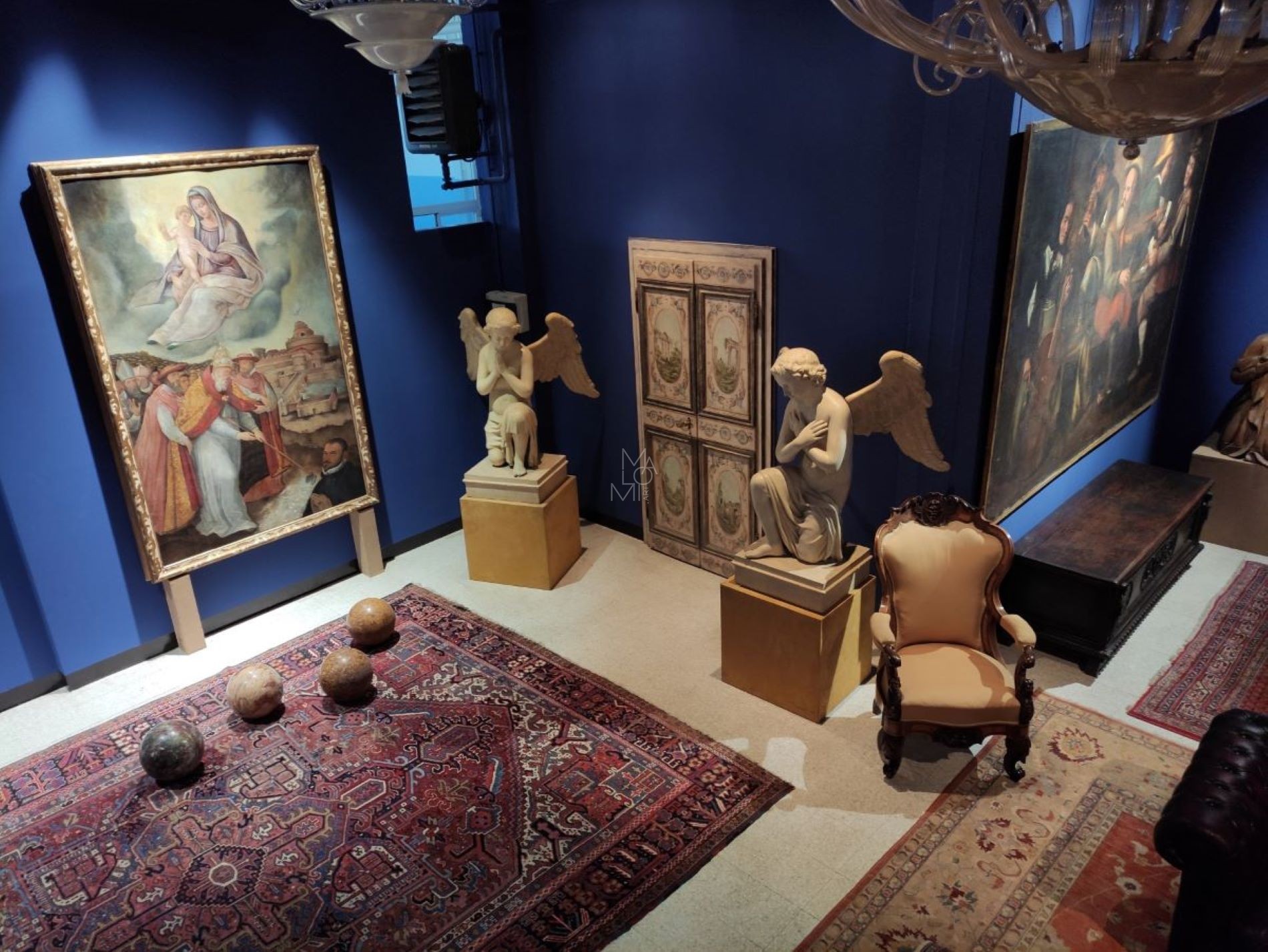
The Saint George Warrior of the Seventeenth-Century Genoese School
The Saint George Warrior of the Seventeenth-Century Genoese School: A Structural, Stylistic, and Formal Analysis of a Monumental Wooden Sculpture
Introduction and Historical-Artistic Framework
The work under examination is a full-round carved wooden sculpture depicting Saint George the Warrior, the historic patron saint of the Republic of Genoa and a central figure within the devotional pantheon of Baroque Liguria. Possessing monumental dimensions—measuring 176 cm in height, 100 cm in length, and 40 cm in depth—the piece exerts a powerful visual impact tailored to the scale of public statuary. Such works were traditionally designed to dominate an altar niche or to stand prominently atop the theatrical scaffolding of a confraternity processional float (cassa processionale). From a philological perspective, the execution demonstrates the full maturity of the seventeenth-century Genoese School. This period marked a golden age in which the Superba, driven by affluent aristocratic and religious patronage, developed an independent and extraordinarily vigorous plastic language. This vernacular successfully translated Counter-Reformation austerity into the magniloquent forms of the European Baroque.
Spatial Syntax: The Finished Reverse and the Autonomy of the Monument
The structural data retrieved from the analysis of the sculpture's reverse fundamentally redefines its spatial syntax and its relationship with the surrounding environment. The work was not conceived as a faux-two-dimensional relief nor as a high-relief applied to a backdrop. On the contrary, the artist's choice to meticulously finish the posterior portion—eschewing the common practice of hollowing out the wooden block—demonstrates that the carver approached the mass with a logic of absolute tridimensionality.
The metric data highlights a pronounced longitudinal and vertical development juxtaposed against a relatively shallow depth (40 cm). Rather than compressing the work, this technical constraint enhances its frontal and diagonal projection. The carver breaks the inherent static nature of the timber block by employing a complex "S-curve" that governs the figure's posture. The center of gravity shifts to the flexed right leg, which is firmly anchored to an inclined, rocky base, while the torso twists energetically in the opposite direction. This arrangement utilizes a Mannerist contrapposto updated to reflect a seventeenth-century sensibility. This dynamic tension resolves along a diagonal, ascending axis that culminates at the 176 cm mark of the raised left arm. This gesture originally engaged with the narrative focus of a spear piercing the dragon. By extending into space, the action projects the dramatic narrative beyond the physical perimeter of the sculpture, integrating the surrounding environment into an ongoing dialogue with the viewer.
As evidenced by the flow of the dorsal masses, the cloak completely encompasses the Saint's body, billowing into expansive, monumental folds. The chisel work on the reverse is by no means abbreviated; it exhibits the same constructive force found on the front. The wood is excavated deeply, creating dark recesses that accentuate the illusion of the figure floating within space. This considerable expenditure of raw material and specialized labor rules out an original placement within a blind niche. Instead, it points toward a freestanding installation, such as a monumental altar of Bernininesque design visible from 360 degrees, or the center of an oratorical choir, where the statue served as a visual pivot around which the sacred space revolved.
Morphology of the Drapery and Surface Treatment of Materials
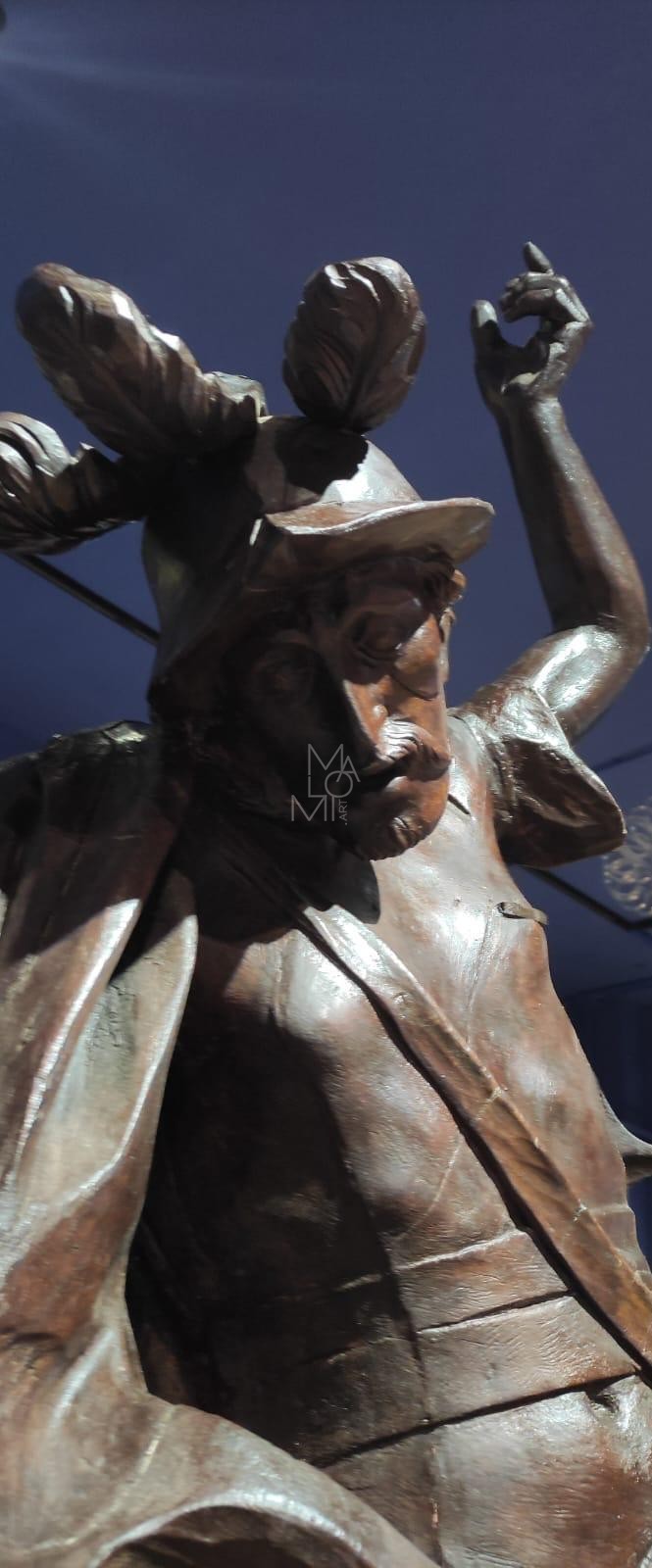
The primary chronological and stylistic indicator of the artifact lies in the technical virtuosity applied to the drapery. The monumental cloak, conceived as an autonomous piece of theatrical machinery, wraps around the saint's pelvis before cascading into wide, turbulent volutes. The artist carves the wood with deep gouges and sharp, abrupt cuts—akin to a "taglio a schiaffo"—that yield razor-sharp crests and profound channels. This formal strategy excludes an early seventeenth-century dating. It reveals a deliberate intent to generate an exacerbated chiaroscuro that captures and dramatically repels ambient light, mimicking the shifting luster of the heavy silks produced by the contemporary Genoese textile industry.
This plastic agitation stands in stark contrast to the rigorous treatment of the cuirass. The torso is encased in an all-antica anatomical harness that pays homage to the iconography of the miles romana. Its smooth, polished surface establishes a distinct material contrast against the fractured folds of the drapery and the wind-swept plumage of the headpiece. The ability to differentiate material textures within a single block of wood testifies to the hand of a master carver in complete command of the expressive capabilities of the sculptural medium. The structural transitions reveal that the artist worked with projecting volumetric blocks, accommodating the wood grain while forcing it into daring curves. Minor peg holes and structural joinery lines remain visible—physiological elements proving that the most prominent sections of the drapery were occasionally pieced and integrated into the central core to maximize dynamic expression without compromising overall structural stability.
Physiognomic Analysis and the Poetics of Pathos
The face of Saint George represents the expressive pinnacle of the entire composition, distinguishing it from serial or provincial production. The physiognomy is that of an aristocratic yet profoundly human hero, captured mid-exertion during his sacred task. The broad forehead is furrowed by knit brows converging at the root of the nose, while the slightly parted mouth betrays the intense concentration required by the impending conflict.
Special attention must be paid to the rendering of the hair, mustache, and beard. Rather than utilizing two-dimensional graphic conventions, the artist resolves these features through thick, twisting, and curled volumetric locks. This treatment recalls the grand equestrian and portrait traditions introduced to Genoa by Peter Paul Rubens and Anthony van Dyck during the opening decades of the century. The gaze does not look toward the heavens in mystical ecstasy; instead, it projects rigidly downward toward the baseline where the slaying of the beast would have occurred, thereby anchoring the psychological tension of the work to a specific external focal point.
Historical Costume Analysis: Descriptive Index of the All-Antica Armor
The work is distinguished by an accurate, Baroque-era reimagining of classical military panoply. The carver does not slavishly copy archaeological artifacts but adapts individual elements of Roman armor to serve the plastic and chiaroscuro demands of the seventeenth century. The military costume breaks down into the following analytical components:
- Lorica Musculata (Anatomical Cuirass): The torso is encased in a rigid plate modeled after the idealized heroic musculature. The plastic emphasis on the pectorals and the linea alba visually stabilizes the sculpture's center of gravity. This form yields a smooth, compact core that reflects light uniformly, establishing an open dialogue with the fractured folds of the cloak.
- Pteruges (Pteriges): Traditional fringed strips of leather or metal project beneath the lower rim of the cuirass and around the pauldrons. In this sculpture, these rectangular tabs are carved with crisp, geometric grooves. They serve a dual function: emphasizing the dynamic articulation of the hips and shoulders while rhythmically pacing the transition between the stillness of the cuirass and the motion of the limbs.
- Balteus (Belt) and Fastenings: At the waist, the lorica is cinched by a wide belt enriched with stylized buckles and attachment components. Along the lateral and posterior sections, the pathways of the straps securing the anatomical shells are rendered in a clean, sharp high-relief.
- Galea (Plumed Helmet): The head is surmounted by a helmet that fuses the typology of a classical casing with the opulence of seventeenth-century theatrical headwear. The plumage (crista), stirred by an idealized wind, is not an superficial addition but is carved directly from the core block with deep, exaggerated cuts that complement the vertical thrust of the statue's 176 cm height.
- Caligae (Military Sandals): The legs are clad in leather thongs that wrap around the calves, leaving the toes exposed in accordance with the dictates of classical statuary. The rendering of these laces, taut against the contracted musculature of the lower limbs, heightens the sense of physical grounding and stability upon the rocky terrain.
Material Characterization and Regional Provenance
The identification of the wood species as poplar (Populus) provides a decisive empirical data point for estimating regional provenance and reconstructing workshop dynamics. Poplar—a lightweight, soft timber with a regular grain structure—represents a preferred choice for the Baroque statuary of the Republic of Genoa and the broader Ligurian basin. Its ready availability along the inland river valleys, such as the Scrivia and Polcevera valleys, permitted the sourcing of large, single-trunk blocks at sustainable costs.
From a technical standpoint, the use of poplar accounts for the extraordinary audacity of the "tagli a schiaffo" and the deep cavities of the drapery visible on the reverse. Its responsiveness under the gouge allowed Genoese masters to emulate the fluidity of wax or clay models, overcoming the natural rigidity of timber. Furthermore, the absence of excessively hard grain variations favored the long-term preservation of the torso's anatomical cohesion over the course of the artifact's four-hundred-century lifespan. The selection of such a massive, unhollowed block of poplar underscores the substantial financial investment involved; it required an immaculate trunk, entirely free of internal knots or defects, to ensure the structural stability of its 176 cm height.
Direct Iconographic Comparison with Seventeenth-Century Genoese Painting
The vestimentary choices and posture of this Saint George find an extraordinary correspondence in the masterpieces preserved within the Musei di Strada Nuova in Genoa (Palazzo Bianco and Palazzo Rosso) and the city's principal Baroque churches. The cult of the Saintly Knight, thoroughly explored by civic exhibitions tracking Eastern cultural routes, reflects into this wooden sculpture through explicit philological borrowing:
The proud set of the face and its restrained energy recall the portraiture and equestrian revolution left to Genoa by Peter Paul Rubens (such as the coeval dynamic conceptions visible in the nearby Chiesa del Gesù). However, the snapping motion of the high-relief cloak and the angular articulation of volumes find their closest parallels in the early-to-mid seventeenth-century canvases of masters like Giovanni Andrea Ansaldo and the subsequent decorative developments of Domenico Piola. The latter's paintings in Palazzo Rosso demonstrate an identical taste for fluttering, wind-swept cloaks designed to redefine the geometric grid of the pictorial space through strong diagonals. This poplar sculpture thus stands as the volumetric, tangible translation of the luministic and scenographic research that defined the grand Genoese galleries of Via Garibaldi.
Conclusion and Art-Historical Valuation
In terms of stylistic history, the sculpture situates itself within the transitional "middle season" of the Ligurian Seicento. The work occupies a midpoint between the formal, monumental rigor of the early century—associated with the workshops of Giovanni Battista Bissoni and Lombard influences—and the flamboyant, weightless, proto-Rococo style that would characterize the late seventeenth and early eighteenth centuries under the aegis of Anton Maria Maragliano.
The critical discovery of an entirely finished, unhollowed reverse worked with the same plastic fervor as the front rescues the piece from the category of a two-dimensional devotional artifact, elevating it to the status of an autonomous monumental sculpture. This structural attribute, combined with its imposing scale, attests to the absolute rarity of the specimen and the high rank of its original patronage—most likely a wealthy confraternity oratorio or a freestanding high altar commissioned by the Genoese patriciate.
Where Maragliano would later resolve masses into sinuous, ethereal, and choreographic lines supported by a painterly polychromy, this Saint George in poplar retains a structural solidity, an angularity in its drapery, and a fierce muscular power that denote proximity to the Baroque models of the mid-seventeenth century, aligning it with the early plastic investigations of Filippo Parodi's circle. Currently stripped of its original polychromy and gilding, which once enhanced its Baroque verisimilitude and sense of spectacle, the statue exposes the raw, potent fiber of the wood, protected by a uniform dark patina. The presence of finishing layers following the contours of the folds even within the most concealed zones confirms that the work offered novel, dynamic viewpoints from any angle of observation. The natural shrinkage fissures within the timber block, visible along the lines of maximum tension in the drapery and base, are entirely consistent with the hygroscopic movements characteristic of aged poplar; they do not compromise the work's stability, but rather authenticate its historical integrity. In conclusion, the sculpture stands as an exceptional artifact of significant critical and curatorial value, representing a perfect synthesis of plastic rigor, Baroque theatricality, and technical mastery within the art of Ligurian wood carving.