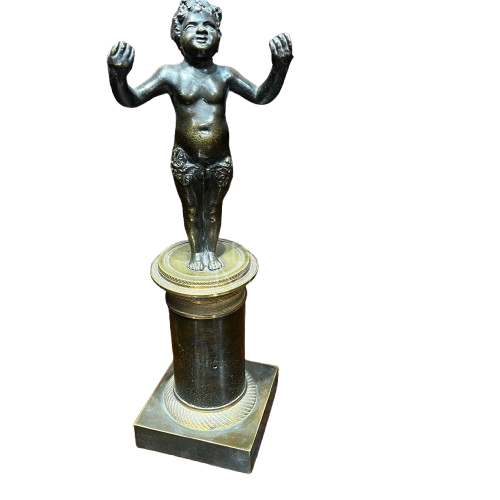
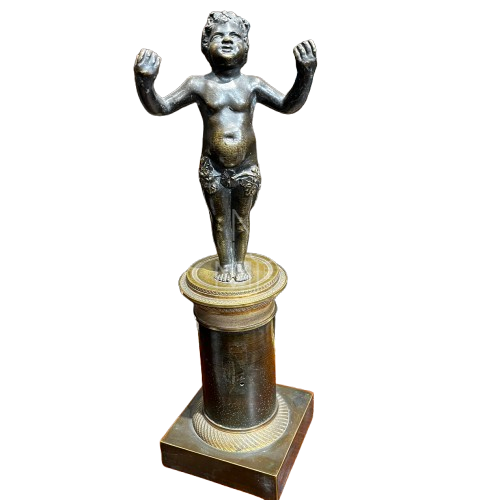
The nineteenth-century cabinet bronze depicting a standing Dionysian faun on a column
Explore the academic analysis and technical record of a nineteenth-century cabinet bronze depicting a Bacchic faun on a gilded guilloché base.
The Triumph of the Cabinet Bronze in the Nineteenth Century
Formal Genealogy and the Allure of the Antique
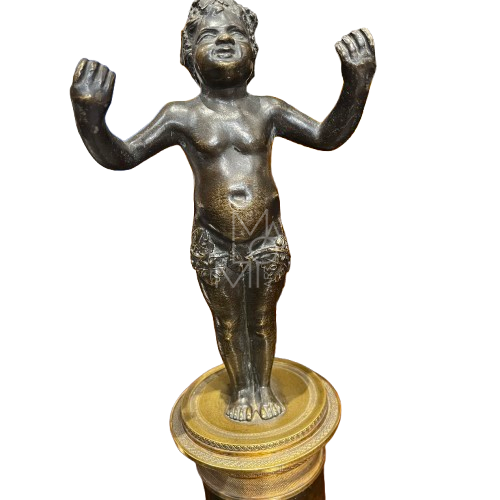
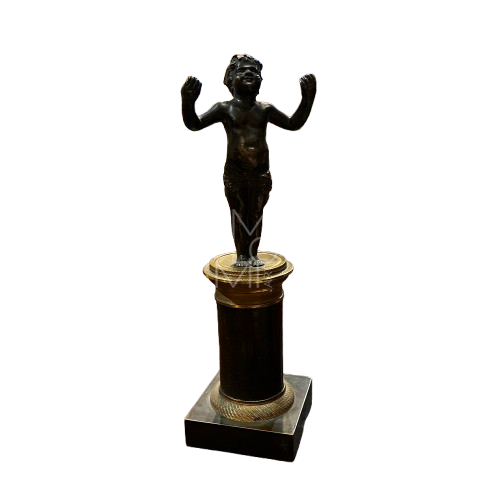
The naked youth raising his arms in a gesture of joyous Dionysian exultation constitutes one of the most fascinating and persistent motifs in European sculpture. To understand the genesis of this small bronze, which stands thirty-four centimeters tall and rests upon a solid quadrangular base, it is necessary to trace the genre back to its Renaissance origins. It was during that period that masters of the caliber of Donatello and Andrea Briosco, known as Il Riccio, reinvented the ancient concept of the spiritello. These small figures, originally conceived to inhabit Florentine courtyards or humanistic studioli, were not mere miniature reproductions of monumental statuary, but autonomous creatures endowed with a vibrant vitality of their own.
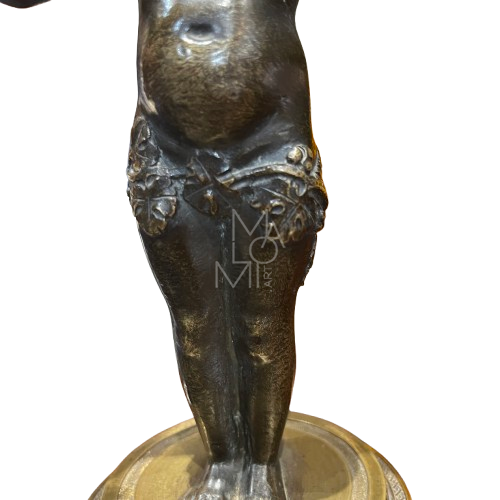
During the nineteenth century, an era dominated by historicism and eclecticism, bronzesmiths rediscovered this formal repertoire, fusing it with the suggestions arising from the archaeological excavations of Pompeii and Herculaneum. The youth under examination fits precisely within this revivalist tradition. Rather than a Christian angelic putto, the work depicts a young faun or a minor satyr, recognizable by the grapevines that encircle his hips, evoking the secret rituals of the retinue of Bacchus.
The Taste of the Grand Tour and the High Bourgeoisie
In the course of the nineteenth century, the ownership of a cabinet bronze (bronze de cabinet) became an indispensable hallmark of status for the rising and dominant class of the industrial and financial high bourgeoisie. This phenomenon was closely linked to the practice of the Grand Tour—the educational journey that the aristocracy and cultured European youths undertook across Italy to study its ruins and its art. Those who could not afford to purchase ancient marbles, or who desired a tangible memento of their intellectual experience, found in these small bronzes the perfect answer to their quest for prestige.
Artistic foundries in Paris, alongside major Italian centers in Milan, Florence, and Naples, began producing table sculptures destined to adorn the mantels and mahogany writing desks of urban palazzi. A period anecdote recounts how gentlemen favored keeping these small bronzes within arm's reach during business discussions or evening readings, as it was believed that manipulating the polished metal fostered mental concentration and offered temporary relief from the rigidities of modern life, reconnecting the businessman with the mythological harmony of the pagan past.
Morphological Analysis and Postural Dynamics
The Antithesis Between Stasis and Motion
From a purely plastic standpoint, the sculpture is founded upon a refined visual paradox that immediately captures the viewer's gaze. The lower limbs express an almost hieratic firmness, with the feet placed close together resting solidly upon the metallic base, recalling the stability of ancient archaic sculptures or architectural telamons. This structural rigidity is, however, contradicted and redeemed by the centrifugal and dynamic movement of the upper body. The torso flexes slightly and the arms open symmetrically upward, describing a wide arc that expands the figure into the surrounding space.
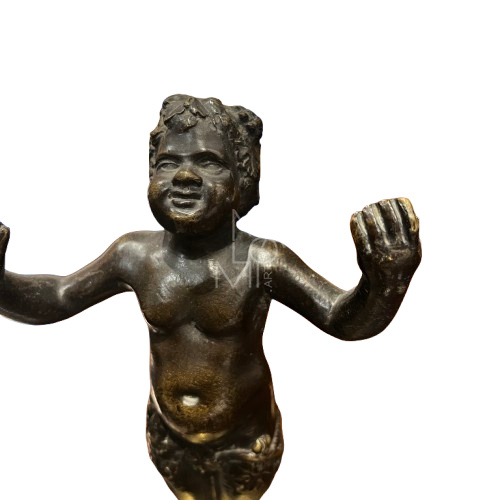
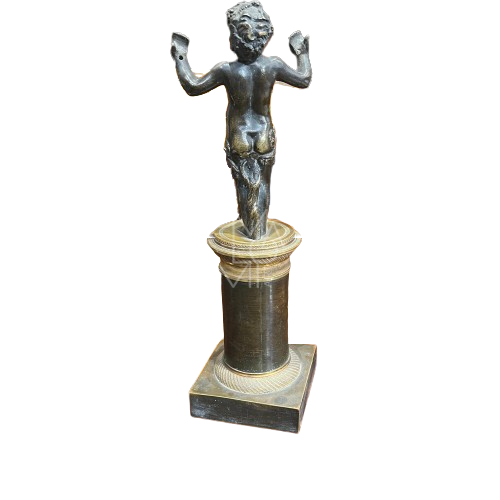
The upward thrust and the pursuit of a centrifugal development originate from the rigid vertical axis of the lower limbs, intended as structural stasis and load-bearing pillars of the entire work. From this solid foundation, the plastic energy propagates through the pelvis toward the prominent abdomen, which faithfully reflects natural infant morphology. The ascendant trajectory then meets the iconographic hinge of the vegetative loincloth, adorned with vine and ivy leaves, culminating in the sharp torsion of the contracted face, caught in the Dionysian expression of furor. The line of force finally resolves in the centrifugal and expansive movement of the raised arms, whose open hands, equipped with micro-holes, serve as the anchoring point for the missing garland, discharging the dynamic tension of the bronze into a sophisticated play of luminous reception. This complex kinesis does not suggest the oppressive effort of an Atlas condemned to bear an invisible weight, but expresses instead a gesture of proud exhibition and joyous offering, conceived to capture ambient light and guide the eye upward. On the reverse of the sculpture, the artist inserted a technical device of extraordinary intelligence: the long vegetative stem detaching from the loincloth descends vertically to the left heel, transforming into an occult third point of support that absorbs the metal's vibrations and guarantees the perfect stability of the figure.
The Naturalism of Infant Forms
The anatomy of the faun reveals an acute spirit of naturalistic observation that departs sharply from the geometric and idealized proportions of pure neoclassicism. The sculptor chose to describe the volumes typical of early childhood, highlighting a prominent and globose abdomen that shifts the body's center of gravity slightly forward. This natural roundness is balanced on the reverse by a pronounced lumbar lordosis, accentuated by the strain of the raised arms.
The bodily surfaces are treated with soft, warm modeling that imitates the turgor of infant flesh through nuanced and continuous chiaroscuro transitions. This naturalism intentionally clashes with the treatment of the vegetative garland girding the hips, where the bronze is carved with a graphic, nervous chisel that raises the edges of the leaves, creating sharp shadows that detach the ornamental apparatus from the nudity of the epidermis.
Metallurgical Technique and the Splendor of Patinas
Lost-Wax Casting and Cold Finishing
The execution of this small bronze required the application of the most sophisticated techniques of nineteenth-century toreutics. The principal figure was obtained through lost-wax casting, an ancient and complex procedure involving the creation of a wax model destined to dissolve during the pouring of the molten bronze. This methodology, though risky due to the potential formation of air bubbles or defects within the metallic alloy, was the only one capable of ensuring a faithful reproduction of the minutest details.
Once extracted from the casting mold, the raw bronze was itself subjected to a lengthy process of cold finishing. Artisans utilized chisels, files, and punches to define the mass of curly hair, the anatomical details of the digitated extremities, and the delicate veins of the vine leaves. Close examination of the sculpture displays the absolute precision of these manual interventions, which bear witness to the high level of specialization achieved by the craftsmen of the period.
The Chromatic Dialogue Between Bronze and Gold
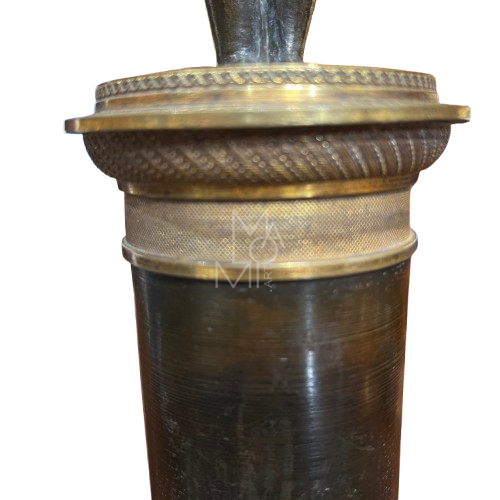
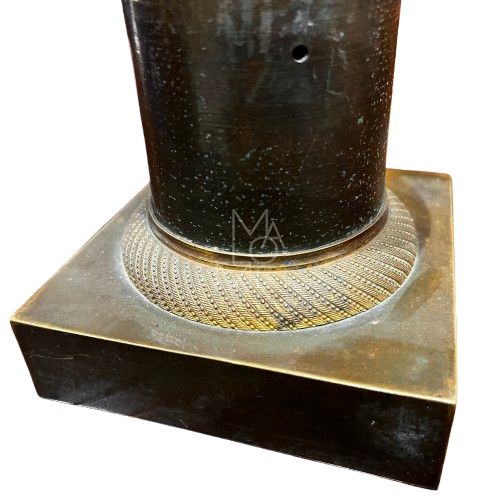
The element of greatest aesthetic merit in the work lies in the sophisticated chromatic contrast between the different surface finishes. The figure of the faun presents a dark, dense, and deep patina, which darkens further within the recesses by accumulating the natural oxide of time, while on the projections it allows the warm reflections of the underlying bronze alloy to emerge due to historical friction. This dark torso dialogues with the golden splendor of the basement, decorated with running geometric motifs and extremely fine engine-turned (guilloché) diamond textures.
The original gilding, presumably executed via the fire-gilding method through the employment of a gold and mercury amalgam, remains vivid, particularly in the zones protected by the moldings. In nineteenth-century workshops, this combination of burnished bronze and or moulu gold was considered the pinnacle of decorative refinement, as the fluctuating light of candles or early gas lamps reflected off the gilded surfaces, creating suggestive gleams that made the sculpture appear almost animate.
The Mystery of the Micro-Holes and the Archaeology of the Object
The Hypothesis of Historical Electrification
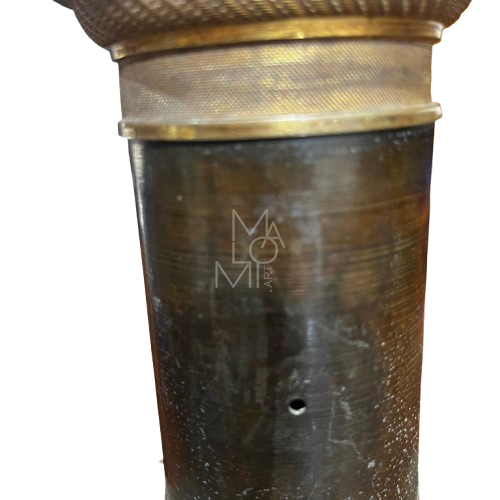
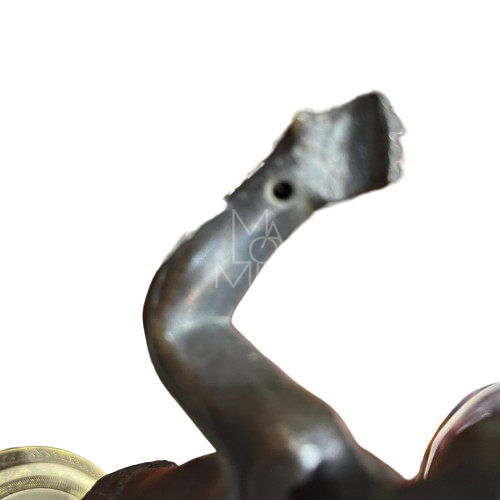
In the course of the scientific study of this small bronze, the presence of several small circular holes sparked an interesting interpretive debate among art historians. One hole is clearly visible on the dark cylindrical shaft of the lower column, while two other small perforations are located at the wrists of the figure. Initially, the presence of these openings prompted the hypothesis of a late-nineteenth or early-twentieth-century functional conversion, aimed at transforming the sculpture into a refined electric desk lamp, the so-called lampe de bureau.
According to this first theory, the electric cable would have entered through the base, ascended the internal cavity of the lost-wax cast figure, and exited through the wrists to power the bulb sockets secured to the hands. This modernization practice was extremely widespread in Belle Époque residences, where collectors did not hesitate to structurally modify their antique bronzes to adapt them to new technological discoveries, viewing them as living, functional objects rather than untouchable museum specimens.
The Scientific Truth of Removable Appliques
A closer millimetric and morphological analysis, however, refuted the electrification hypothesis, revealing a far more fascinating and philological archaeological truth. The holes proved too narrow to permit the passage of an insulated electric conductor of the period and present internal edges that rule out the friction wear of a flexible cable. Instead, they are historical micro-lodgements executed cold to house the fastening pins or bayonet mounts of removable decorative elements now unfortunately lost.
In cabinet bronzework, it was indeed customary to cast the primary figure in the round and subsequently apply minute ornamental details to preserve the sharpness of the chiseling and create effects of superimposed relief. The hole on the shaft of the column served to secure a gilded applique, such as a knotted ribbon motif or a Dionysian mask, which interrupted the geometric severity of the smooth support. The holes at the wrists indicate, instead, that the faun did not raise his arms into empty space, but originally supported a large flexible garland in gilded bronze, interwoven with vine leaves and small clusters of grapes, which joined the two hands and framed the child's head, completing the narrative microcosm of the Bacchic triumph.
The Socio-Political Context and the Universe of Beliefs
The Reflection of Social Order in Form
The structure of the small bronze, divided between the rigid architectural verticalism of the base and the organic freedom of the upper sculpture, reflects in a striking manner the tensions and aspirations of European society in the mid-nineteenth century. This period, marked by profound political transformations, from post-Napoleonic restorations to liberal uprisings, witnessed the affirmation of an aesthetic that sought to combine order and economic progress with the authority of tradition.
The columnar base, with its perfect turned geometry and the quadrangular plinth measuring ten centimeters per side, visually represents the concept of stability, social order, and scientific rationality upon which the nineteenth-century bourgeoisie founded its power. Above this base develops, instead, the figure of the faun, which embodies expressive freedom and evasion from conventions, creating a perfect dialectical balance between the rigor of the structure and the vitality of art.
The Cult of Pan and Dionysian Exorcism
The choice of a subject linked to the Dionysian world responds to a precise cultural fascination that traversed literature and the visual arts of the nineteenth century. Beneath the surface of a rigid, severe, and often puritanical social morality, the nineteenth century cultivated a deep and sometimes restless attraction to ancient paganism, the myth of Pan, and the primordial force of untamed nature. Writers and intellectuals saw in the retinue of Bacchus a symbol of the liberation of instincts and a return to a rural golden age, contrasted with the alienation of the rising industrial cities filled with factories and smoke.
Possessing upon one's desk the image of a small satyr caught in the height of furor bacchicus was thus no mere decorative choice, but represented a sort of cultured exorcism. The small bronze introduced a fragment of wild vitality, fertility, and good fortune into the rational and controlled space of the modern home. The grape clusters and vine leaves were considered symbols of abundance and rebirth, capable of ideally protecting the collector's study and reminding them, through the witty grimace and open mouth of the child, that behind the veil of technological civilization still beat the ancient, pulsing heart of nature.
Diagnostics of the Base and Technical Frontispiece
The Mechanical Skeleton Revealed
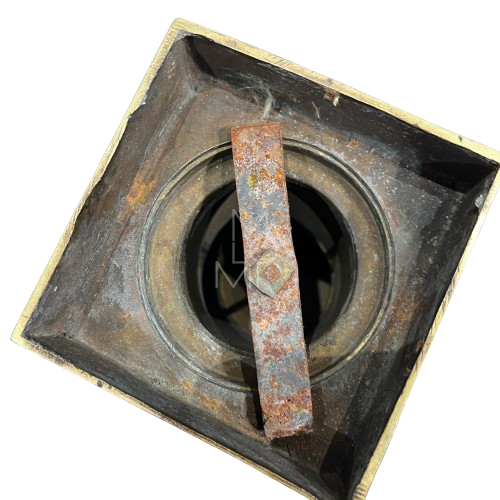
The inspection of the lower part of the plinth allowed penetration into the mechanical heart of the work, revealing its original assembly system and definitively confirming the nineteenth-century authenticity of the artifact. Inside the cavity of the cylindrical shaft, a solid straight strap of forged iron is visible, crossing the opening diametrically and acting as a contrasting element to lock the upper column to the quadrangular base. At the center of this strap engages an antique fastening nut with a strictly square profile, inserted onto a central threaded pin.
The quadrangular geometry of the nut and the manually executed threading are fundamental chronological indicators, as they predate the introduction of modern industrial machinery-stamped hexagonal nuts. The condition of the metals inside the base displays the typical signs of secular aging devoid of recent tampering. The iron strap is entirely covered by a compact layer of reddish rust that developed naturally due to environmental or atmospheric moisture trapped within the cavity, while the internal walls of the brass present a raw casting surface with dark, dusty areas due to the natural oxidation of the copper.
Scientific Cataloging Record
The work is registered under the classification of a cabinet furniture sculpture, depicting a standing Dionysian faun, executed in the mid-nineteenth century, between 1840 and 1870, within the sphere of high European craftsmanship attributable to the Parisian school or the excellence of northern Italian foundries. The overall measurements correspond to a total height of thirty-four centimeters, with a lower base measuring ten by ten centimeters. The state of conservation is to be considered excellent regarding the structural integrity of the principal castings and the quality of the period patinas, noting, however, the philological lacuna of the removable ornamental elements in gilded bronze originally inserted into the holes of the wrists and the shaft.
The current commercial valuation of the small bronze, in its present condition, falls within a range between one thousand two hundred and one thousand eight hundred euros, taking into account the absence of the accessories. The potential valuation of the work, should one decide to proceed with a philological and reversible reconstruction of the garland and the applique based on historical models preserved in coeval repertoires, could easily reach a figure between two thousand five hundred and three thousand duecento euros, confirming the high collector interest in this specimen of nineteenth-century toreutics.
Bibliographical Notes and Reference Sources for the Study of Nineteenth-Century Bronzework
General Literature on Cabinet Bronze Sculpture
To deepen the study of nineteenth-century decorative bronzes and comprehend the mechanisms of iconographic model dissemination between France and Italy, it is indispensable to consult the fundamental texts of European metallurgical historiography. An essential starting point is the monumental work by Pierre Kjellberg, titled Les Bronzes du XIXe siècle: Dictionnaire des sculpteurs, a milestone that catalogs the principal Parisian foundries and the most widespread plastic repertoires between the Empire period and the end of the historicist era. Alongside this volume stands the specialized study by Hans R. Weihrauch, Europäische Bronzestatuetten: 15.-20. Jahrhundert, which traces a continuous evolutionary line of the collectible bronze, allowing an understanding of how Renaissance motifs of the putto and the spiritello were reinterpreted in the nineteenth century in light of eclectic taste. For the Italian context and the production of northern foundries, the text edited by Alfonso Panzetta, Nuovo dizionario degli scultori italiani dell'Ottocento e del primo Novecento, proves highly useful, analyzing the transition from artistic craft of academic matrix to foundry production destined for private high-bourgeois patrons.
Toreutic Studies on Masters of Gilded Bronze and Appliques
The analysis of the sophisticated architectural base of the small bronze and the understanding of the system of elements decorative amovibles today lost require comparison with sources dedicated to the great masters of brass and fire-gilded bronze. The volume by Jean-Dominique Augarde, Les Ouvriers du Temps: La querelle des corporations, offers a fundamental insight into the techniques of chiseling, turning, and machine-turned surface processing, such as the guilloché band found on the work under examination. For a specific focus on the manufactures that influenced the whole of Europe in the first half of the nineteenth century, the reference text is the exhibition catalog edited by Jean-Pierre Samoyault, Musée National du Château de Fontainebleau: Catalogue des collections de mobilier - Raccords et bronzes d'ameublement. This publication describes in detail the pin and bayonet fastening mechanisms of floral garlands and appliques, providing the comparative historical models necessary for the eventual philological reconstruction of the Dionysian festoon missing from the faun's wrists.
Iconographic Repertoires and the Fascination with the Ancient World
The decoding of the symbolic meaning of the young satyr and the beliefs linked to the revival of Dionysian cults in nineteenth-century society find confirmation in a series of studies dedicated to collecting and the culture of the Grand Tour. The essay by Francis Haskell and Nicholas Penny, Taste and the Antique: The Lure of Classical Sculpture 1500-1900, analyzes the reasons why the nineteenth-century bourgeoisie preferred small statuary linked to themes of Dionysian nature, seen as an intellectual escape from the moral rigidities of the era. Finally, to understand the integration of the small bronze within the living space and its function of tactile interaction in the cabinet de travail, reference is made to the research of Mario Praz reflected in the volume An Illustrated History of Interior Decoration, a masterly analysis of the psychology of the antique object and the evocative value that bronzes with two patine held in the daily life of the intellectual and collector of the nineteenth century.
Methodological Project for Restoration and Conservation
General Criteria for Intervention on Historical Patinas
The long-term restoration and conservation of a metallic artifact with two patinas demand a rigorous protocol of intervention, informed by the modern principles of critical and scientific restoration: minimal invasiveness, recognizability, and the total reversibility of every material applied. The preservation of the original dark patina of the figure and the gilded layer of the base constitutes the primary objective, as it is an irreplaceable historical witness to the natural aging of the metal. Any drastic cleaning operation conducted via acids, aggressive solvents, or mechanical abrasions must be strictly avoided, as it would irreversibly alter the stable surface oxide layer, impoverishing the documentary and commercial value of the object.
The ideal intervention must limit itself to a gradual removal of incoherent dust deposits and exogenous greasy encrustations accumulated within the recesses of the moldings and the vegetative carving. This result is achieved through localized packs of neutral surfactants diluted in demineralized water or controlled micro-washings with isopropyl alcohol, applied using cotton swabs under microscopic control. This methodology allows the elimination of residues from old polishing products without affecting the natural brown-greenish hues that enhance the chiaroscuro of the reliefs.
The stabilization of the internal iron strap and square nut requires, instead, arresting the Kenyan corrosive process of the rust. Without removing the stable layer of reddish oxidation, one proceeds with the brush application of a rust converter based on tannic acid, followed by a protective coating of microcrystalline wax with a very high melting point. The latter, penetrating into the porosities of the iron, isolates the metal from atmospheric moisture, preventing future phenomena of cyclic corrosion inside the hollow shaft.
Protocol for the Philological Reconstruction of Lost Appliques
Should the patron or collector express the desire to remedy the visual lacuna by restoring the object's original Dionysian appearance, the reconstruction of the upper garland and the base applique must follow a rigorous technical path, based on the metric surveys of the micro-holes and the analyzed bibliographical evidence. The methodological project initiates from a preliminary phase of iconographic and documentary study of coeval historical sources, indispensable for defining the exact morphology of the missing decorative parts. Once the philological references are outlined, the actual technical development begins through computer-assisted digital modeling, aimed at a three-dimensional prototyping of the object in a 1:1 scale. This three-dimensional model is printed in synthetic material or resin to perform a meticulous mechanical trial, aimed at verifying that the mounting pins and physical tolerances correspond perfectly to the position and axis of the historical micro-holes present on the wrists and the column, preventing any invasive intervention on the antique metal.
Having passed the structural cross-check of the simulacrum, one proceeds to the definitive translation of the artifact via lost-wax metallic casting or mold-casting of brass or bronze trim, the raw surfaces of which are entirely finished through manual cold chiseling to reproduce the same graphic execution found on the body of the faun. The cast and chiseled element is finally subjected to a high-thickness galvanic gilding, which presents itself as a safe and reversible alternative to ancient fire-gilding; the splendor of the new gold is subsequently softened through an artificial patination based on Judean bitumen and natural oxides to harmonize the brilliance of the integrated pieces with the warm, muted tone of the original gilded surfaces, finally proceeding to the non-invasive mechanical assembly via flexible pins or locking screws concealed within the hollow interspaces of the small bronze. This method guarantees the total reversibility of the restoration: at any moment, the modern integrations can be removed, returning the object to its current state of discovery without leaving any permanent trace, respecting the historicity of the piece and preserving its dual nature as a work of art and a historical document.