The murano glass 20 th century
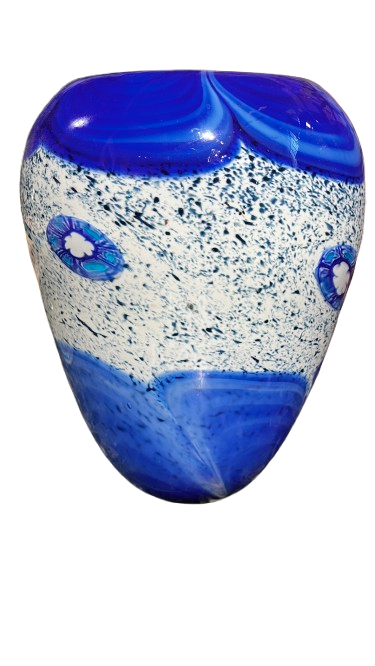
Authentic 29 cm Murano blown glass oval vase. Expertly crafted using the traditional layered sommerso technique in deep cobalt blue, enriched with white fritta grit and embedded floral murrine. Features a mirror-polished cold-ground base and rim. A pristine mid-century/contemporary collector's piece.
- Provenance: Murano Island, Venice, Italy
- Height: 29 cm (approx. 11.4 inches)
- Typology / Morphology: Tapered oval art glass vase / Centerpiece
- Color Palette: Deep cobalt blue, turquoise, milky opalescent white
- Manufacturing Techniques: Hot-worked stratified sommerso glass, fritta (grit effect) inclusion, embedded geometric-floral murrine (glass canes), hand-blown modeling.
- Finishing Processes: Cold-ground smooth rim and mirror-polished seamless flat base (devoid of rough pontil mark).
- Conservation Status: Museum quality / Pristine. Intact structure with no chips, cracks, or restorations. Displays authentic functional wear (micro-scratches from display sliding) restricted to the base, providing historical patina and verification of age.
The murano glass and the synthesis of artistic workmanship: a historical-technical, morphological, and conservation analysis of a 29 cm oval vase
The work under examination is a superb oval vase in artistic Murano glass, featuring a height of 29 centimeters. The object stands out for its complex chromatic and material score structured over multiple decorative registers, blending the technique of parietal chemical reaction, the inclusion of glass canes ("murrine"), the development of sommerso glass, and the mastery of blown glass. The following essay analyzes the work from a historical, technical-formal, morphological, and conservation perspective, integrating the details that emerged from the macroscopic inspection of the rim, the base, and the decorative texture.
Historical contextualization of murano glass
Glass production on the island of Murano roots deeply in the Early Middle Ages, reaching a fundamental turning point in 1291. In that year, the Republic of Venice decreed the forced relocation of all active furnaces from the historical center to preserve the urban area from fires and protect manufacturing secrets. From that moment on, Murano became a unique industrial and artistic district, a protected laboratory where empirical chemistry and manual skill have been handed down from generation to generation.
The 29 cm vase fits fully into the production of the second half of the twentieth century, a period characterized by constant dialogue between master glassmakers (the historical "fornaci") and avant-garde designers. In this context, the object ceases to be a mere functional container and rises to the status of an autonomous sculpture, where the form embraces and amplifies chromatic research.
Morphological analysis and formal structure
From a plastic point of view, the artifact displays an oval profile tapering toward the bottom, with a wide mouth lacking an outspread rim. The choice of this clean yet organic line fulfills a dual function:
- Static value: It ensures optimal distribution of internal tensions within the glass during the critical cooling phase inside the annealing lehr.
- Exhibitional value: It maximizes the parietal surface, offering the internal decoration the necessary space to develop without macroscopic formal distortions.
The height of 29 cm gives the object a monumental yet domestic volume, placing it in the category of centerpieces or display vases meant to capture ambient light and modify its propagation in the surrounding space.
The study of the lip: integrity and stratification
A close analysis of the mouth of the vase highlights the executive precision of the lagoon manufacture. The upper circular profile is completely intact, devoid of any chips, hairline cracks, fractures, or material losses along its entire circumference. The finish exhibits a typical cold-ground and polished profile, characteristic of high-quality vases, which eliminates any sharp edges, returning a smooth and regular surface.
From above, it is also possible to appreciate the thickness of the glass wall and its fascinating layered structure. The interior of the vase is characterized by a milky, opalescent coloration acting as a reflective core. This inner layer fades toward the outside as it meets the dense mass of the cobalt blue glass on the surface layer, creating a sharp, clean chromatic contrast that adds depth to the entire shoulder of the vase.
The sommerso glass technique and three-dimensional depth
The stylistic hallmark governing the transition between the vase's distinct chromatic registers relies on the sommerso (submerged) glass technique—one of the most iconic and refined methods developed in Murano, historically perfected during the 1930s. This methodology is based on the thermal layering of successive glass strata of varying thicknesses and pigmentations. The glassmaster gathers an initial molten mass from the crucible—in this case, the inner milky-white layer—and, after shaping its preliminary form, dips it while hot into a second crucible filled with glass of a different color, the deep cobalt blue, thus creating a true "submersion" of the primary material.
The core difficulty of this process lies in the flawless management of the thermal expansion coefficients across the different glass mixtures. If the two layers were chemically or physically incompatible, internal stress would cause the object to spontaneously shatter during the cooling phase. In the examined artifact, the sommerso technique acts as an optical magnifier: the transparent blue layer envelops the decorated middle section and softens at the base, trapping light and endowing the murrine and grit with a powerful sense of three-dimensional buoyancy, as if suspended in a dense, permanently crystallized fluid.
Analysis of decorative techniques: grit and murrine
The surface of the vase is a visual treatise of complex Murano techniques, showing two distinct methods of hot processing the glass material in synergy with the thickness of the submerged layer.
The grit effect and the fritta inclusion
The middle section of the vase presents a suggestive white and blue punctiform texture, resembling cosmic dust or a "snow" effect. This result is achieved by rolling the parison (the initial molten glass mass attached to the blowpipe) over a metal table (the marver) covered with small fragments of crushed glass (fritta or grit) and metallic oxides. Subsequently, the block is reheated in the mouth of the furnace to partially embed and fuse the decorative layer into the transparent glass mass.
The murrina technique and expansion dynamics
Embedded within the central band are a few sections of pattern-revealing glass canes, commonly called murrine. The geometric-floral element reveals a precise concentric stratification: a lobed core of opaque white color (simulating the corolla of a flower), surrounded by a dark cobalt blue intermediate crown and a transparent light blue and turquoise outer ring.
The oval shape of the murrine does not constitute a defect but rather the visual signature of manual blowing. During the expansion and rotation of the vase in the furnace, the force applied by the master stretched the canes along the stress lines of the modeling process. The outer surface is perfectly embedded and flush with the surrounding two-tone grit: the absence of microscopic ridges proves an impeccable marvering operation (rolling on the metal table), making the glass wall totally smooth to the touch.
The base: technical finish and the patina of time
The lower portion of the vase offers definitive answers regarding its authenticity and history of use. The bottom exhibits an organic, convex hemispherical shape without a structural flat foot. The absence of a prominent, rough pontil mark (or "scar") indicates that the vase was detached from the iron and the base was subsequently ground, flattened, and mirror-polished using felt wheels and fine abrasive powders (such as cerium oxide or pumice). This process restored total transparency and luster to the radial streaks, which document the twist Before imparted by the glassmaster during modeling.
Regarding its conservation state, an inspection under raking light reveals a dense network of functional wear marks (sliding scratches) running in multiple directions. In the absence of deep chips or cracks, these subtle surface scratches concentrated on the contact area represent the "patina of time." They prove that the object has been moved and displayed over the years on hard surfaces—a fundamental indicator that confirms its historical authenticity and distinguishes it from serial or recent reproductions.
Critical-aesthetic evaluation and conclusions
The 29 cm Murano vase examined here represents an excellent synthesis of formal rigor and material experimentation. The unknown glassmaster successfully balanced the visual weight of the deep blue—a color historically associated with the preciousness of lapis lazuli and spiritual depth—with the vibrant luminosity of the white grit.
The inclusion of the murrine acts as a geometric fulcrum anchoring the work to the great historical Venetian tradition, while simultaneously projecting it toward contemporary collecting tastes. The work stands not only as an object of high craftsmanship in optimal conservation conditions, but as a true testament to "liquid sculpture," in which fire and centrifugal force have permanently captured the movement and inspiration of the artist.