The Monumental Prie-Dieu from the Workshop of Filippo Parodi
Historico-Critical Essay: The Monumental Prie-Dieu from the Workshop of Filippo Parodi
A Philological, Iconographic, and Structural Analysis of a Masterpiece of Genoese Baroque Woodcarving
Introduction and Art-Historical Context
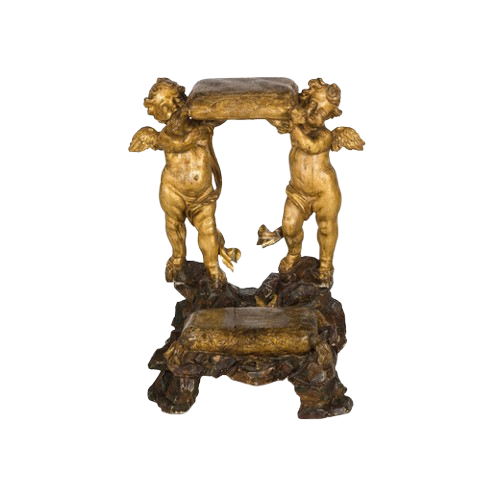
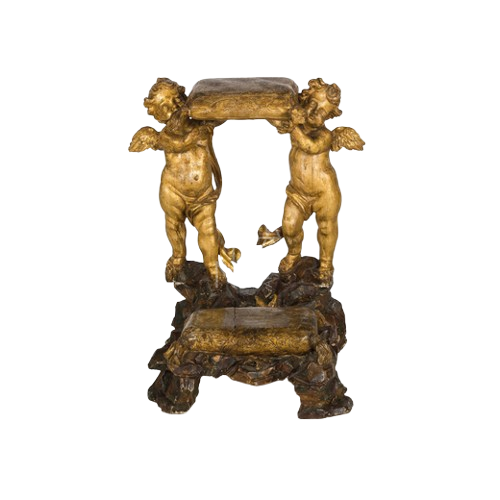
The monumental prie-dieu under analysis (measuring 77 cm in width, 90 cm in height, and 80 cm in depth) stands as an exceptional testament to Baroque state furniture, attributable to the circle and workshop of the Genoese master Filippo Parodi (Genova, 1630–1702). Initially trained as a woodcarver (bancalaro), Parodi underwent a pivotal stylistic evolution following his periods of residence in Rome, which were sponsored by the patronal support of the Sauli family. Coming into direct contact with the circle of Gian Lorenzo Bernini, he assimilated its theatrical syntax, translating the grandiloquence of Roman monumental sculpture into a highly successful output of woodcarving characterized by an extraordinary decorative density.
This piece belongs to the magnificent late seventeenth-century Ligurian production. During this historical period, the aristocratic Genoese patronage demanded the transformation of private devotional furniture into genuine, freestanding sculptural monuments. Such furniture was no longer merely a functional object relegated to a corner, but rather a theatrical device designed to engage in a visual dialogue with the fresco cycles and picture galleries of patrician palaces. It reflected both the social status and the private piety of prominent families such as the Doria, the Spinola, or the Durazzo Pallavicini.
Iconographic Analysis and Spatial Conception
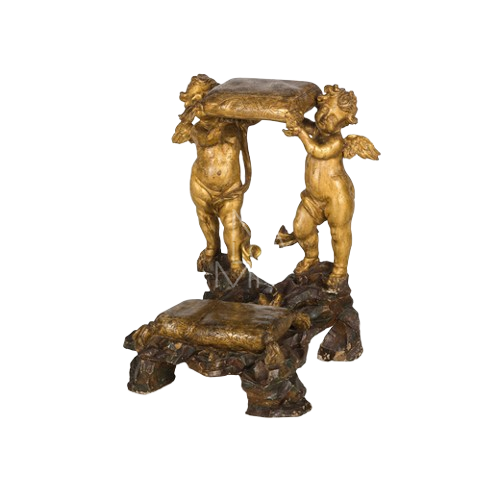
The structure departs radically from the traditional, geometric volumetric design of Renaissance or Counter-Reformation box-like prie-dieus, transforming instead into an airy, sculptural architecture resolved through a dynamic interplay of weights and opposing forces.
The Naturalistic Base
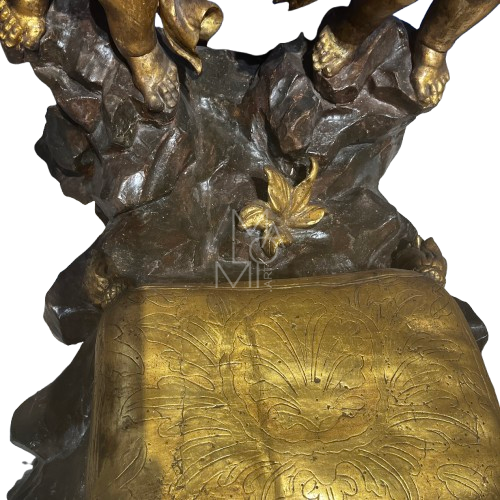
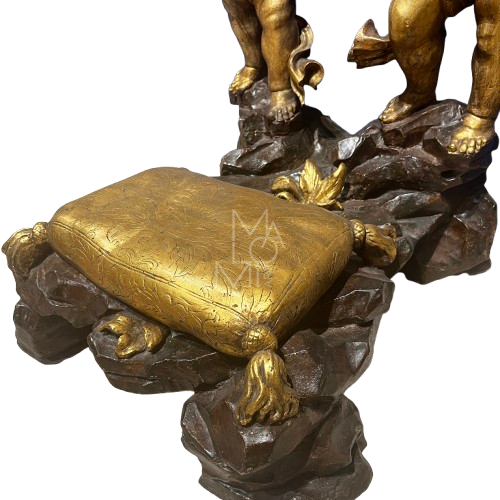
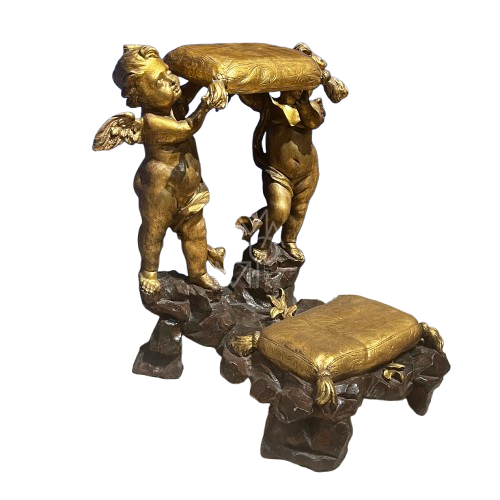
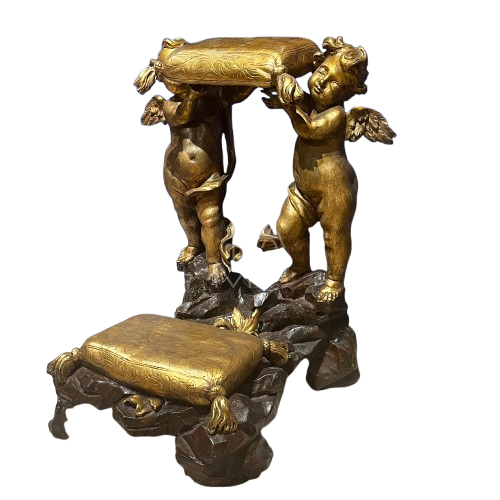
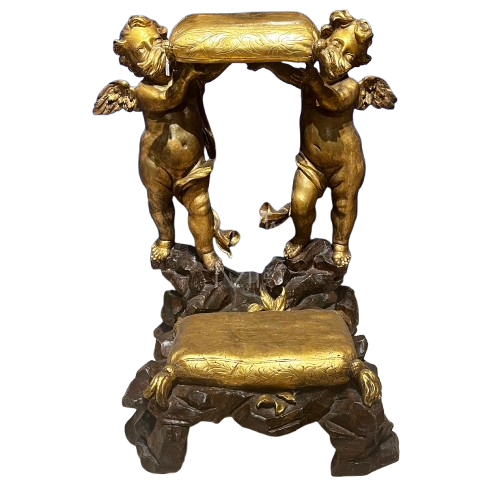
The lower kneeling platform (the predella) is integrated into a complex composition simulating an uneven, jagged rock formation or cliffside, lacquered in dark tones. This finish, highly characteristic of Parodi’s idiom, evokes the maritime and rugged topography of the Ligurian coast. At the center of this rocky outcrop, immediately above the lower cushion, emerges a small, gilded flower with thick petals (resembling a lily). This botanical insert functions as a focal light point and a visual hinge between the dark base and the vertical, ascending momentum of the upper section.
The Sculptural Group of Putti
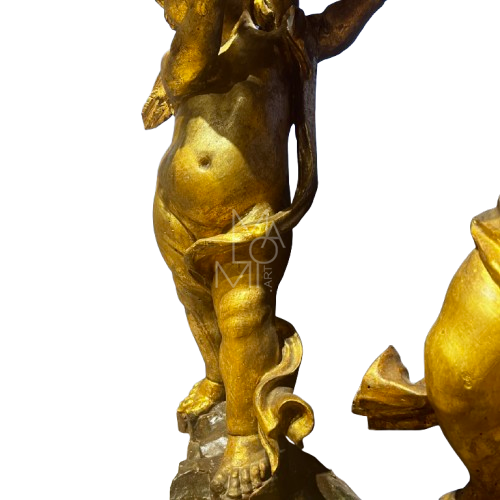
Two imposing winged putti serve as dynamic caryatids. Their bodies are articulated in specular and opposing poses that animate the entirety of the surrounding space:
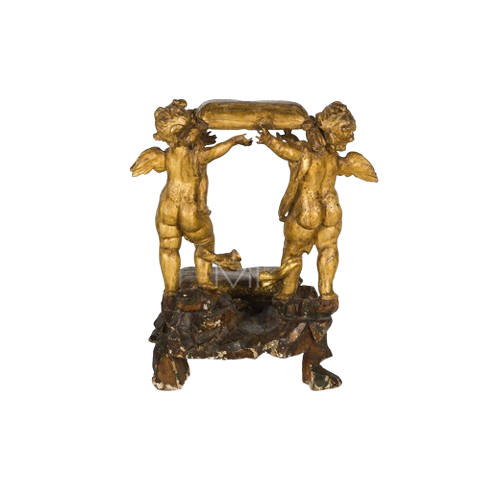
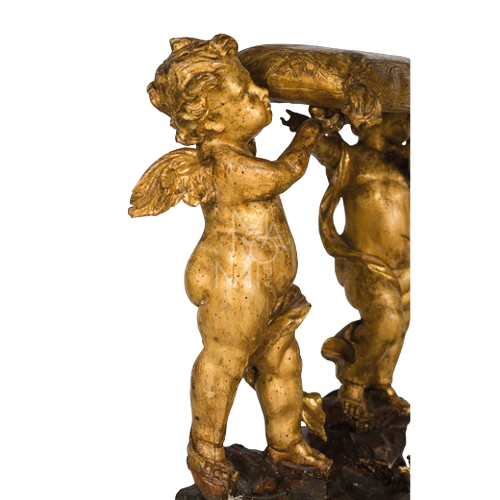
The left putto, captured in a complex, flexed torsion, displays his back and gluteal muscles, showcasing a pronounced anatomical contrapposto. The right putto, facing forward with his gaze directed upward, accentuates the upward, vertical thrust of the composition.The Structural Secret of the Reverse
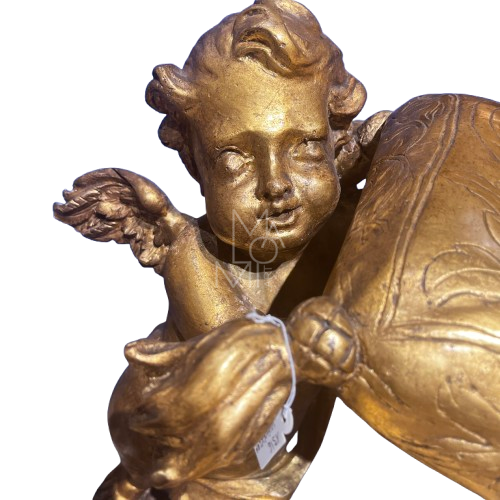
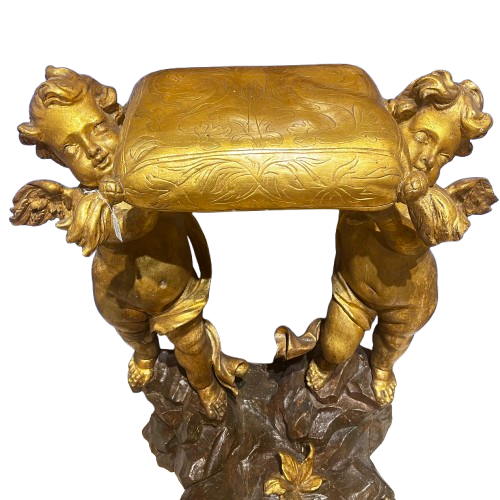
An examination of the rear view reveals an engineering stratagem of extraordinary theatrical efficacy: the inner arms of the two putti extend into the central void to touch and join hands. This structural human arch supports the upper cushion, creating the illusion that it floats in mid-air. The heads of the putti fit seamlessly beneath the corner tassels, where the vaporous curls of their hair act as transitional "capitels," transferring the weight of the upper platform directly onto the necks and shoulders of the figures.
Technological Aspects: Carving, Gilding, and Ornamentation
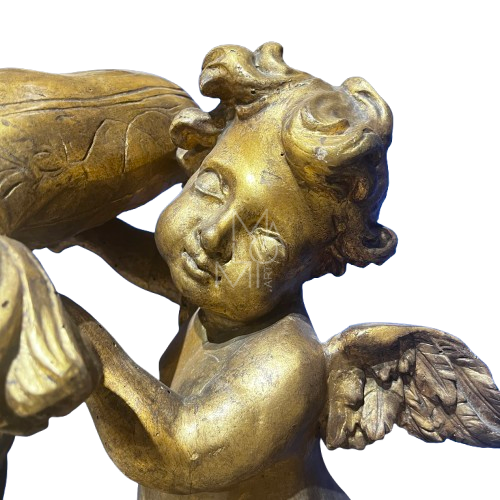
The execution underscores the superb technical proficiency of the workshop in handling softwoods (such as poplar or linden), which were ideally suited for the deep undercuts demanded by Baroque plastic forms. The rendering of the infantile anatomy—characterized by soft, rounded muscle masses, firm flesh, and dense curls hollowed out with deep gouge-work—directly recalls Parodi’s prototypical putti, such as those seen on the celebrated Mirror of Narcissus (Villa Faraggiana, Albissola Marina).
The upper and lower cushions both feature an extremely fine surface incision executed a bulino (with a burin and punch) onto the gesso ground prior to the application of the gold leaf. The decoration reproduces a symmetrical motif composed of a central palmette flanked by large, curling acanthus leaves. This scheme was meticulously conceived to replicate the texture of precious seventeenth-century Genoese figured velvets and damasks. At the corners, monumental passementerie tassels are carved directly from the wooden block, with their fringes arranged in disheveled strands that heighten the overall sense of movement.
The contrast of materials plays a crucial role in the perception of the work: the water-gilding with pure gold leaf, applied to the anatomy and the cushions, captured both natural light and the flickering illumination of candles. Conversely, the dark polychromy of the rocky base provides a tonal counterpoint, visually anchoring the piece to the ground while emphasizing, by contrast, the gilded, celestial lightness of the angelic figures above.
Diagnostics, State of Conservation, and Authenticity
A close-up analysis of the artifact reveals excellent philological indicators that confirm its age and structural integrity:
Physiological Shrinkage Cracks: Deep linear splits are visible on the left leg of the left putto and along the median axis of the lower cushion. These represent the natural movement of the solid wood core as it adjusted over the centuries to environmental hygrometric variations, consequently rupturing the rigid underlying gesso ground. Exposed Bolus and Craquelé: In the areas of highest relief subject to historical handling (such as the shoulders, glutei, and knees of the putti), the gold leaf has worn away to reveal the warm undertone of the bolo (the reddish-orange clay ground typical of the Ligurian tradition). Furthermore, the entire gilded surface is animated by a dense, microscopic network of hairline cracks (craquelé), resulting from the natural aging and shrinking of the animal-glue binder. Historical Lacunae: Losses in the gesso and gilding are evident on the rear feet of the rocky base and on the heels of the figures. The centuries-old oxidation of the exposed raw wood within these lacunae rules out modern re-gilding or heavy over-painting with bronze powder (porporina), which would have flattened the chiaroscuro transitions and filled in the natural shadows accumulated within the recesses of the carving.Conclusion and Museum Comparisons
The monumental prie-dieu under discussion is far from a mere piece of utilitarian furniture; it is a masterpiece of decorative sculpture that documents the pinnacle of interdisciplinary osmosis in Baroque Genoa. It finds direct parallels within local historical inventories, displaying a striking typological affinity with the Prie-Dieu in the Palazzo di Andrea Doria Pamphili in Genoa (Piazza Principe, Ministry of Culture datasheet no. 0700032855), which likewise features cushion-bearing putti standing upon a stylized rocky base