The British domestic horology of the late nineteenth century
The British domestic horology of the late nineteenth century: a technical-aesthetic synthesis and manufacturing horizons of the Clerkenwell district
Introduction
Within the vast landscape of the history of decorative arts and material culture in Western Europe, British domestic horology has occupied a position of absolute scientific, technological, and artistic prominence. Between the seventeenth and the early twentieth centuries, the table clock—historically defined as a bracket clock or table clock—underwent a profound evolution, transitioning from an elite instrument for time measurement to the aesthetic and acoustic centerpiece of the furnishing spaces of the ruling class.
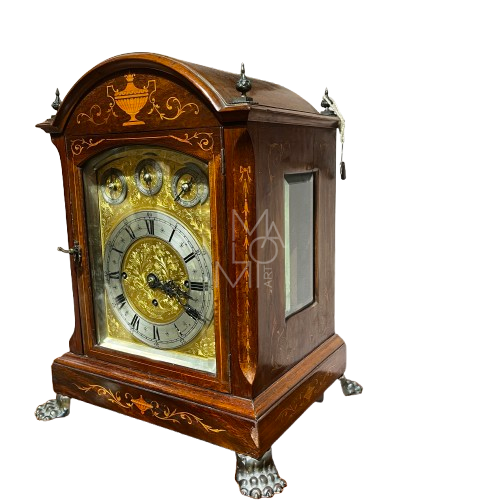
The specimen under examination represents a mature and refined expression of late-Victorian horology, chronologically placeable within the last two decades of the nineteenth century. In this artifact, the most advanced instances of precision micro-mechanics merge admirably with the scholarly trends of historicist cabinetmaking, offering an emblematic essay on how the scientific requirement of temporal scanning was integrated with the pursuit of an absolute excellence in sensory, visual, and acoustic experience. Dimensions in centimeters 40x32x47 h.
The mechanical movement and the complications of the musical striking work
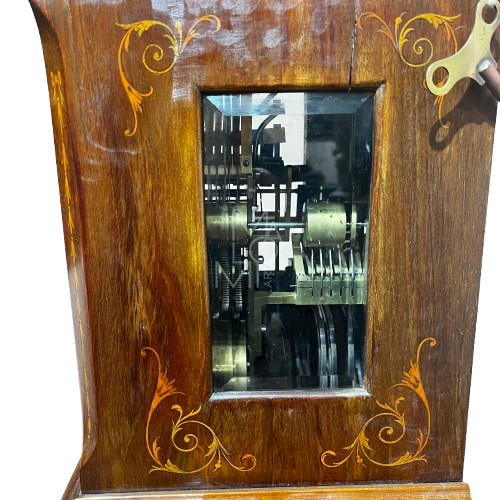
The primary value of this clock lies in the extraordinary complexity of its thick brass plate movement, an architecture designed to synchronously govern three distinct functions: timekeeping, hour striking, and the chiming of the quarter hours. From a structural standpoint, the mechanics are articulated on rectangular plates joined by robust cylindrical pillars secured with blued screws—a configuration that guarantees the stability necessary to withstand the tensions of the powerful mainsprings.
The acoustic management of time is entrusted to a mixed and differentiated system that marks the evolutionary transition of nineteenth-century horology. Positioned at the top of the movement is a cast bronze bell dedicated to the traditional hour striking, while a battery of large harmonic steel spiral gongs stands out in the foreground. The adoption of the spiral spring gong, which spread widely during the nineteenth century, allowed for a deep, warm, and reverberating timbre capable of emulating the monumental acoustics of cathedrals within the domestic walls.
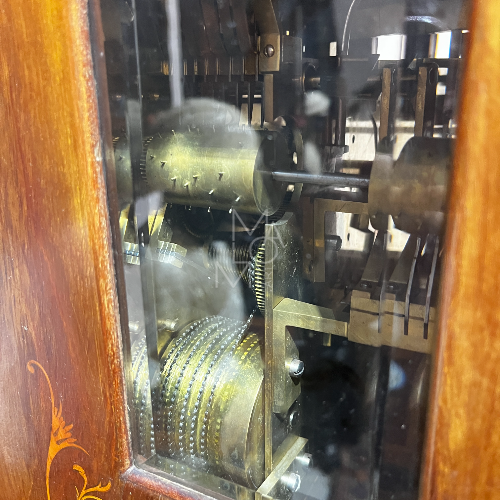
The element of greatest technical refinement is the pinned cylinder, or chime drum, responsible for programming the quarter hours. This brass roller, rotating by means of its own dedicated gear train, intercepts the tails of the hammers with its protruding pins. The geometric arrangement of the pins defines the sequence of notes and allows, through an axial displacement of the cylinder commanded by the front sub-dial, for variations in the melody by shifting the alignment of the trip levers.
The fusee and chain transmission system
An analysis of the side profile of the movement reveals the presence of the compensation cone, commonly denominated as a fusee, connected to the spring barrel by means of a microscopic steel chain with articulated links. This device represents one of the greatest engineering achievements of classical horology and addresses the need to correct the intrinsic irregularity of the elastic mainspring force.
A traditional mainspring delivers its maximum kinetic thrust when fully wound, only to undergo a progressive and drastic decline in energy as it unwinds. Such a fluctuation would compromise the isochronism of the escapement and alter the rhythm of the musical chime. The fusee resolves this problem by applying the physical principle of the variable lever: when the spring is fully wound, the chain exerts its pull on the smaller diameter of the cone, where the lever arm is reduced; as the spring unwinds, the chain rises toward the broader base of the cone, increasing the lever arm. In this manner, the driving force transmitted to the gear wheels remains constant throughout the duration of the power reserve, guaranteeing an exceptional regularity of both timekeeping and auditory performance.
The epigraphy and iconography of the front dial
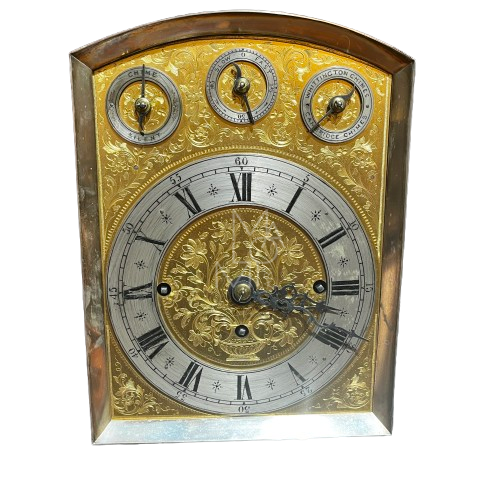
The dial constitutes the visual interface of the clock and presents itself as an essay in fine goldsmithing and chiseling. The base plate, crafted from gilded brass, is entirely decorated by burin engraving with dense foliate scrolls and acanthus leaves, featuring a central core that displays an engraved neoclassical vase in low relief from which symmetrical volutes emanate.
The silvered chapter ring contrasts sharply with the gilded background to facilitate legibility. The typography of the minutes is expressed in cursive Arabic numerals along the outer edge at five-minute intervals, while the hours are marked by elongated Roman numerals typical of late-Victorian production. The hands, made of steel and blued by fire, exhibit an elaborate pierced heart and beetle design, shaped to overlap millimetrically without friction.
In the upper portion, arranged in an arc, three brass-framed sub-dials are housed for the regulation of the complications. The left selector bears engraved inscriptions for activating or silencing the chime. The central dial features an arched numbered scale for the micrometric regulation of the regulation (fast or slow), acting directly on the rise and fall of the pendulum's spring suspension. Finally, the right selector houses the titles of the two available melodies, allowing the user to vary the clock's musical repertoire according to personal preference.
History and musical architecture of the chimes: Cambridge and Whittington
The ability to select two different musical programs highlights the dual cultural soul of the clock, deeply rooted in the history and liturgy of the Church of England.
The first melody, indicated as Cambridge Chimes, is the sequence that contemporary sensibility universally associates with the Westminster chime and Big Ben. Composed in 1793 for the university church of St Mary the Great in Cambridge, its conception is historically attributed to the Rev. Dr. Joseph Jowett and William Crotch. From the standpoint of musical theory, the sequence represents a decomposition and variation of the measures of the famous aria from George Frideric Handel's fifth symphony The Messiah, centered on the theological theme of redemption. Structured upon a battery of four tones, the melody develops a geometric progression of permutations of four changes for each quarter hour, resolving solemnly on the tonic at the strike of the hour.
The second option, denominated Whittington Chimes, expresses a higher order of polyphonic complexity, requiring a full octave of eight bells or an equal number of spiral gongs. The origin of the name links back to the historical and legendary figure of Richard Whittington, the future Lord Mayor of London, who in 1392, while fleeing the capital, believed he heard a prophecy of his radiant political destiny in the bells of St Mary-le-Bow church. Musically, the Whittington is characterized by a tighter and more lively rhythm of clear Renaissance derivation, distinguished by rapid descending scales and marked variations at each quarter, specifically designed to break the linear acoustic monotony of domestic life.
The inlaid case and cabinetmaking finishes
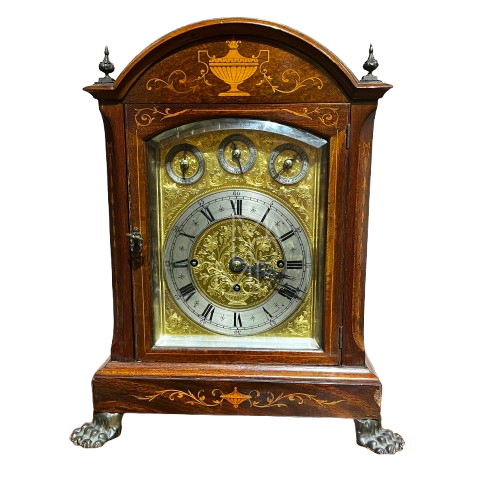
The wooden housing of the clock manifests an adherence to the historicist style of the Georgian revival, an artistic current that flourished in the last quarter of the nineteenth century. This trend tended to reproduce the sober and architectural lines of the early British eighteenth century, nobleing them, however, with the new and impeccable techniques of mechanical cutting and industrial finishing.
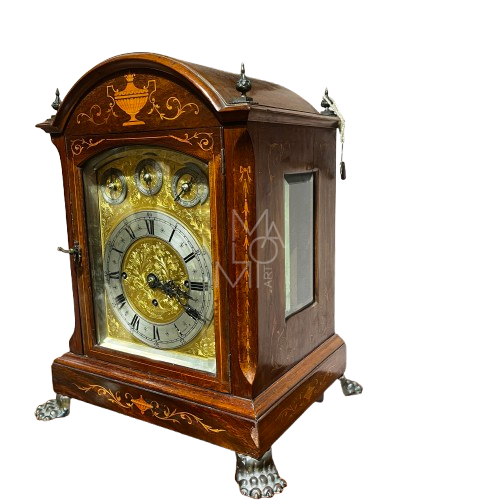
The case features a bell-top upper profile, adorned with decorative metallic pinnacles. The facade and flanks are embellished with refined inlays of light wood, verisimilarly maple, inserted onto a vertically mahogany veneer background. The decorative motifs reproduce neoclassical vases, flowering calyxes, and specular foliate scrolls framing the openings. The entire structure rests upon four robust metallic feet cast in bronze, modeled according to the claw-and-ball or lion-paw style, which provide visual lift and isolate the wood from the supporting surfaces.
The side inspection windows and the front door mount glass panels beveled by hand. The perimetric beveling of the glass generates a characteristic prismatic effect that captures ambient light and allows for the observation of the chain traveling along the fusee and the tripping of the hammers, transforming the clock case into a showcase of horological engineering.
The Clerkenwell district: epicenter of British horology
To fully comprehend the genesis of a movement of such quality, it is necessary to contextualize its production within Clerkenwell, the London neighborhood that for over two centuries served as the world capital of precision micro-mechanics. The fortune of the district began at the end of the seventeenth century with the immigration of French Huguenots, Protestant artisans who brought to London unparalleled skills in goldsmithing, chasing, and time engineering.
Clerkenwell did not operate according to the model of the large centralized factory, but rather through a highly refined system of specialized workshops known as a cottage industry. The neighborhood was a dense network of small independent shops where each artisan dedicated themselves exclusively to perfecting a single component. There were specialists tasked solely with cutting the fusee cones, masters dedicated to finishing the escapements, and artisans specialized in drilling and pinning the musical cylinders. The horologist whose name appeared on the dial acted predominantly as a coordinator and a finisher, assembling and calibrating the excellences produced by this distributed supply chain.
In the final decades of the nineteenth century, large manufacturing firms such as J. Smith & Sons or Thwaites & Reed—the latter famous for maintaining the capital's great public clocks—held high the banner of Clerkenwell, responding to the advent of foreign serial production by creating complex, solid, bench-finished furnishings. The movement of the present clock is material testimony to the final and splendid chapter of this artisanal epic, before the twentieth century imposed definitive industrial standardization.
Considerations on the conservation and operation of the mechanics
Horological artifacts equipped with fusee and chain transmissions and multiple striking works require rigorous protocols of maintenance and utilization to ensure longevity and prevent structural deterioration.
From an operational standpoint, the adjustment of the musical selectors and the chime/silent levers must strictly take place during the resting phases of the mechanics, ideally midway between the quarter hours. Operating the melody selector while the cylinder is in motion would cause an orthogonal collision between the pins and the lifting pieces, resulting in the immediate bending or breakage of the brass pins. Likewise, winding the mainspring barrels via the wing key must be executed with a steady motion, ceasing pressure as soon as the dead stop of the fusee is felt, in order to avoid snapping the links of the chain.
Under a conservation profile, the exhibition environment must be maintained at a constant humidity to prevent the shrinkage of the case timber, which could cause the lifting or detachment of the marquetry pieces. The superficial oxidation of the brass visible on the backplates protects the underlying metal and should not be removed with chemical abrasives; the lubrication of the gear pivots must be carried out exclusively with highly stable synthetic oils to avoid the formation of abrasive gummy residues that would ovalize the pivot holes of the plates.
Conclusion
Ultimately, the analyzed table clock configures itself as a historical-artistic document of exceptional value, an admirable synthesis of late-nineteenth-century British ingenuity. Within it coexist the scientific achievements of precision mechanics and the refinement of the decorative arts, offering an outstanding cross-section of late-Victorian material culture. The complexity of its acoustic systems, the elegance of its historicist lines, and the extremely high execution level of its dial and movement testify to the greatness of the Clerkenwell district—a cultural and technological legacy that continues to live through the isochronous beat of this extraordinary instrument of time.