The birth of saint John the Baptist by Giovanni Balducci called il Cosci: a masterpiece of Florentine mannerism
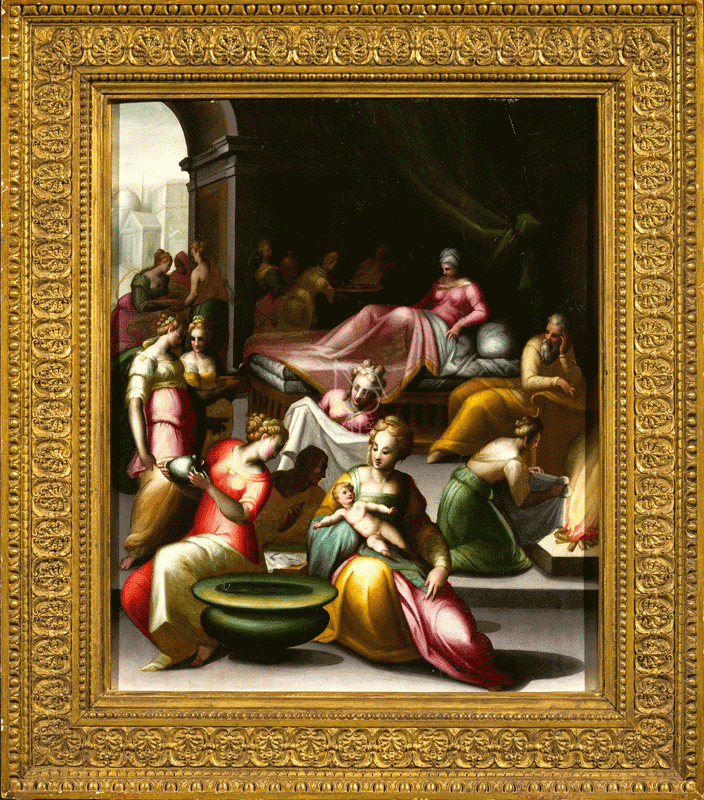
Giovanni Balducci il Cosci, Birth of saint John the Baptist, Florentine mannerism, Carlo Falciani attribution, Maurizio Ruffini collection.
The mirror of Florentine Mannerism and its southern migration: the Birth of Saint John the Baptist by Giovanni Balducci called il Cosci
- Introduction and historical-artistic context
The reflection of an era in the brush of Cosci
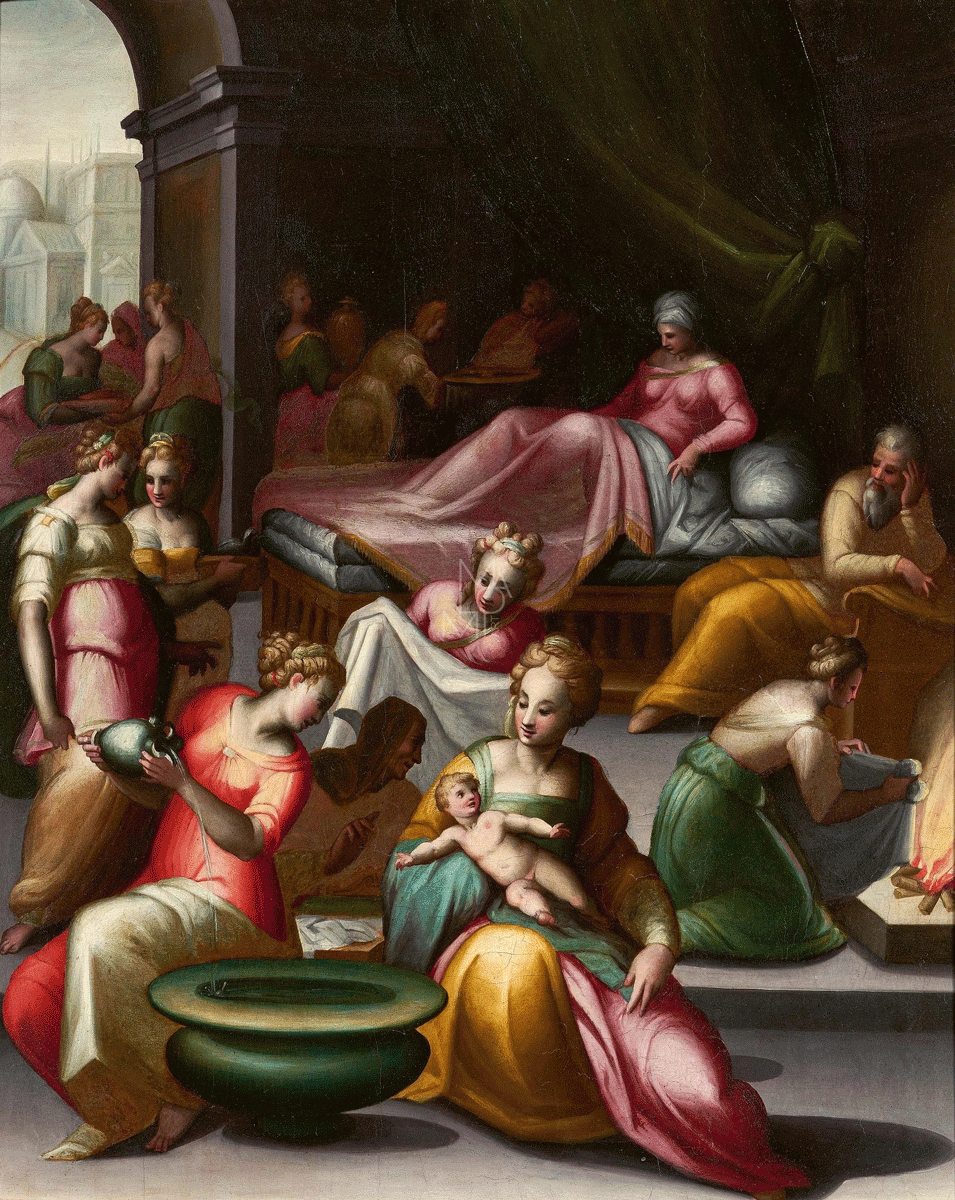
When standing in front of this superb panel, an oil painting measuring eighty-seven by one hundred and one centimeters including its imposing gilded and carved wooden frame, one has the impression of opening a window onto the beating heart of the late sixteenth-century Tuscan world. The work, depicting the birth of saint John the Baptist, bears the authoritative critical endorsement of professor Carlo Falciani, who formally confirmed its attribution to the Florentine master Giovanni Balducci, universally known in historical chronicles by the singular nickname of "il Cosci". This pseudonym, according to contemporary accounts, derived from his affectionate relationship with his maternal uncle, Raffaello Cosci, who took care of the young painter when he was orphaned and directed him toward his first rigorous artistic studies in the vibrant Florence of the second half of the sixteenth century.
Trained in the famous workshop of Giovanni Battista Naldini, who was himself the right-hand man of the monumental Giorgio Vasari, Balducci learned a strict method of working, where geometric and academic drawing formed the backbone of every composition. In looking at the figures populating this sacred scene, one clearly senses the stylistic transition of a highly receptive artist. He was moving in an Italy where aristocratic Florentine formal abstraction was beginning to dialogue with the new and pressing narrative demands imposed by the Catholic Church of the Counter-Reformation, paving the way for the painter's subsequent and definitive transfer first to Rome, and then to the wealthy Vice-royalty of Naples, following the powerful cardinal Alessandro de' Medici.
- Iconography and compositional analysis
The intimate scenography of sacred daily life
The evangelical episode, taken faithfully from the account of Luke, is set by Balducci within a sumptuous domestic interior that takes on the appearance of a true theatrical staging. The viewer's eye is immediately captured by the dynamic group of women in the foreground, entirely dedicated to the first care of the newborn John. At the exact center of the painting, a seated wet nurse holds the infant with a sculptural delicacy, while to her left a handmaiden dressed in a vivid and iridescent red pours water from a metallic pitcher into a large bronze basin, translating a purely everyday gesture into the ritual presage of Christ's future baptism.
Shifting the gaze toward the background, the narrative becomes more intimate and stratified. Reclining on a sumptuous four-poster bed partially veiled by heavy draperies, the elderly mother Elizabeth rests assisted by other female figures, while on the right side of the composition, almost confined in a dense shadow, sits the elderly Zechariah. His posture, with his head heavily resting on his hand and his gaze lost in a vacuum, expresses with extraordinary dramatic efficacy the melancholy and inner silence to which he was condemned by the angel for having doubted the birth of his son. Acting as a counterpoint to this domestic interior, a monumental classical arch opens on the left side of the panel, revealing a glimpse of an external urban scene populated by other women moving against the background of Renaissance buildings, a device of clear Vasarian origin conceived to dilate the perspective space and confer a monumental breath to the entire work.
- Graphic sources and variants: the link with Vienna and Moscow
The transnational journey of a workshop cartoon
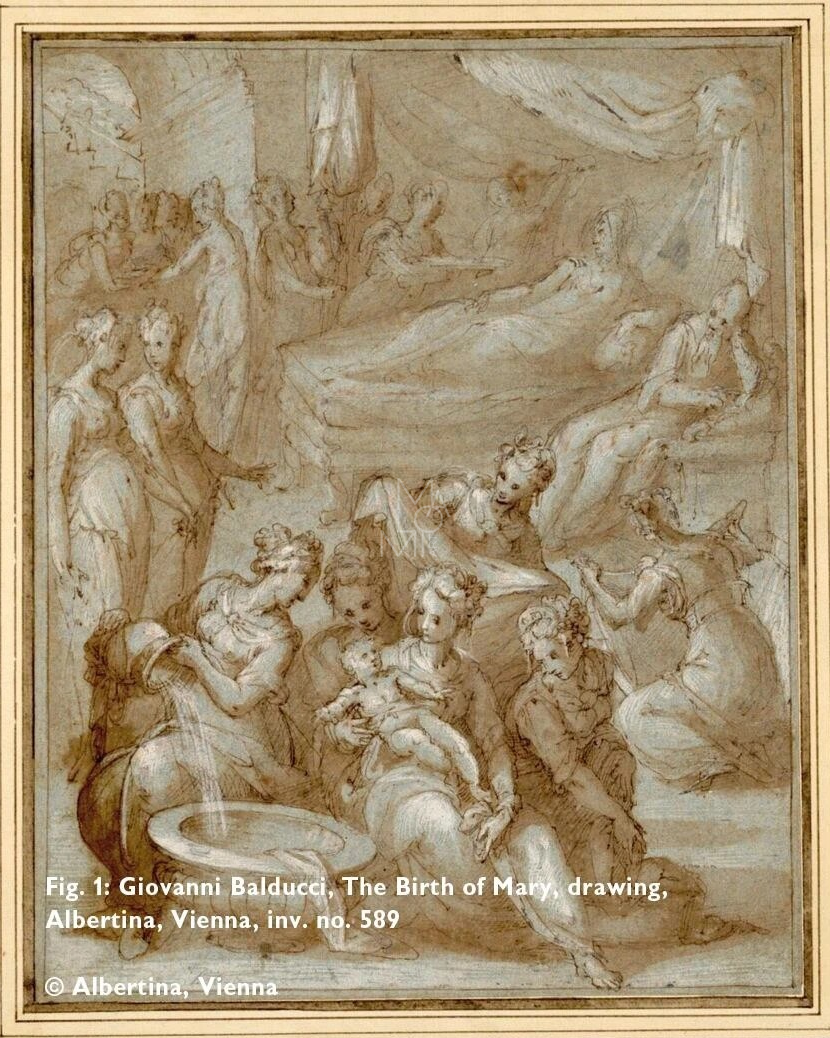
One of the most fascinating discoveries related to this painting lies in the possibility of faithfully reconstructing its design process through the most prestigious museums in Europe. The complex and rhythmic arrangement of the figures derives directly from an autograph preparatory drawing by Cosci, fortunately preserved in the famous collection of the Albertina in Vienna under inventory number 589. This precious sheet, which historical critics have sometimes cataloged as a study for the birth of the Virgin, served as a true "repertory cartoon" that the painter and his assistants used to transfer the outlines of the figures onto the final supports.
From a purely pictorial point of view, the execution of our panel finds its exact and noble philological counterpart in the painting housed in the Puškin State Museum of Fine Arts in Moscow, registered under inventory number 132. The Moscow canvas, which in the past had been curiously attributed to the hand of Balducci's master, Giovanni Battista Naldini, has now been fully restored to the catalog of Cosci. The existence of these variants reveals a precious custom of Balducci's workshop, which tended to replicate the most successful compositions, making minimal color variations or changes in the details of the furnishings, to satisfy both the demands of large public altarpieces and the growing demand for cabinet paintings by wealthy private Roman and Neapolitan collectors.
- Stylistic features, execution and chromatism
The technical secrets of light and matter
From a formal point of view, the work qualifies as a masterly essay in the pictorial techniques of mature Mannerism. Balducci orchestrates the fabrics of the main characters using a highly sophisticated academic shot-color technique. On the legs of the water-pourer in the foreground, the drapery shows a sudden transition from a deep scarlet red in the shadows to a bright golden yellow on the crest of the folds, giving the fabric an almost metallic consistency. In the center, the wet nurse responds with a specular but inverted chord, where an ocher fabric blends into pinkish and powder-colored shades, following the serpentine line of the body with an exquisitely calligraphic elegance.
However, the most interesting curiosities emerge from the analysis of the background planes and the shaded areas. Balducci, like many masters active at the turn of the seventeenth century, made extensive use of smaltino, an inexpensive pigment based on finely ground cobalt glass. Over the centuries, this material underwent an inevitable process of chemical alteration due to the loss of potassium in the oil binder, causing the blue and bluish tones to turn toward gray-brown shades. This phenomenon, which affects the secondary garments and the bed hangings of the panel, has over time accentuated that nocturnal and mysterious atmosphere that strikes the modern observer, giving the scene a tone of intimate and severe spirituality. Beneath the pictorial surface, infrared reflectography reveals an underdrawing executed with an extremely thin black stone, a sharp and continuous line free of pentimenti that confirms the millimetric tracing of the Viennese graphic model.
- Provenance and critical history
The passport on the back of the panel
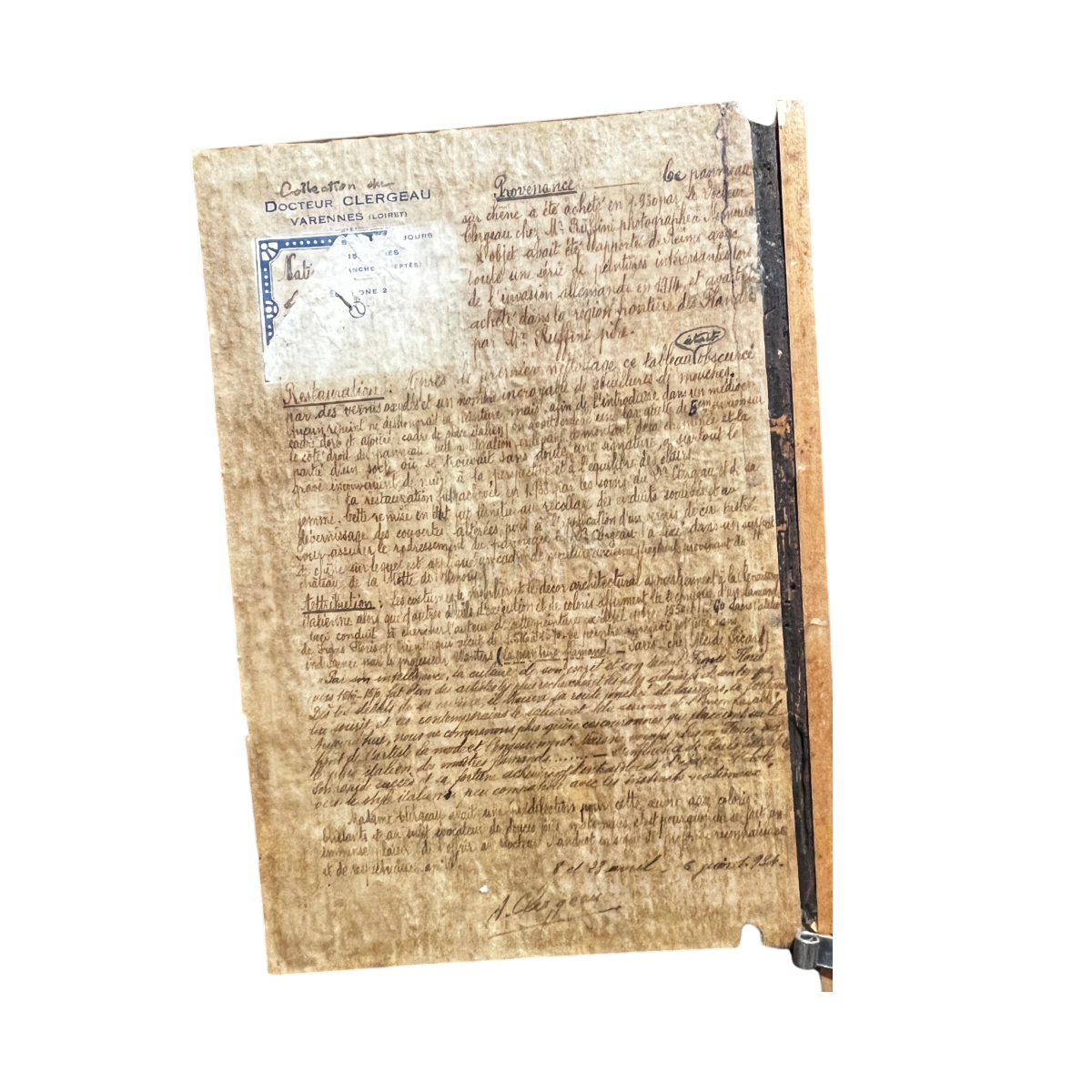
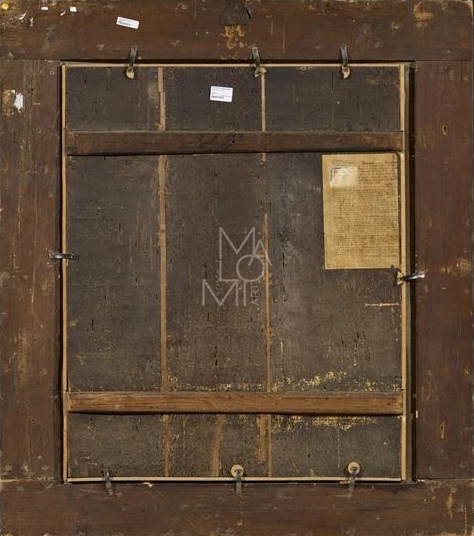
If the painted surface tells us the history of sixteenth-century art, the back of the panel guards a romantic tale linked to twentieth-century European collecting. Affixed directly to the oak wood is a monumental handwritten label in French, signed by Dr. Paul Henri Clergeau, a physician and refined art lover based in Varennes-Changy, in the department of Loiret. The text, written in a brown cursive ink in April 1928, reconstructs the material vicissitudes suffered by the artifact around the time of the First World War. Originally purchased in 1905 by Ruffini's father directly in Italy, the panel was transferred to Reims, where it lived through a series of tribulations during the German invasion of 1914, before being recovered in the border region of Flanders by Maurizio Ruffini, born in 1892, and subsequently integrated into the family collection.
The label also describes a meticulous restoration carried out in Orléans in 1928 by the restorer Cingria. The painting, which was then darkened by oxidized varnishes and an incalculable number of insect droppings, was cleaned and straightened, inserting it into a splendid frame assembled by reusing precious historical wooden paneling from the nineteenth-century dismantling of the rooms of the nearby Château de la Motte in Changy. The passage of the panel into the collection of Maurizio Ruffini places the work within that precise cultural climate of the mid-twentieth century which, thanks to the pioneering studies of historians such as Roberto Longhi and Giuliano Briganti, led to the radical critical rehabilitation of Mannerism, until then unjustly considered a phase of empty academic decadence and finally rediscovered as an era of extraordinary modernity and tormented intellectual complexity.
- The socio-political and cultural context and the influence of religion
The sacralization of everyday space in post-Tridentine Italy
To fully understand the genesis and profound meaning of this work, it is necessary to immerse oneself in the geopolitical and cultural context between roughly 1590 and 1610. The Italy of those years was bound around the political and spiritual axis of Rome-Florence-Naples, under the constant influence of the Spanish Empire and the Catholic Church reinvigorated by the decrees of the Council of Trent. In this rigidly stratified society, the figurative arts were not considered a simple decorative element, but a powerful instrument of social control and devotional propaganda. The manuals of spiritual behavior widespread at the time, such as the famous discourse on sacred and profane images by cardinal Gabriele Paleotti, imposed a strict decorum on artists: compositions had to be clear, historically faithful to evangelical texts, and devoid of any sensual license or heretical extravagance.
In this atmosphere, religion did not constitute a separate sphere from existence, but the ordering principle that controlled every single moment of daily life, penetrating even into the intimacy of domestic walls. A cabinet painting like this was commissioned by nobles or wealthy merchants to adorn bedrooms or small private oratories. The scene of the birth of the Baptist thus assumed a double function. On one hand, it played a devotional and protective role, invoking the benevolence of saints during the extremely difficult and often lethal moment of childbirth. On the other hand, the measured gestures of the midwives, their chaste and covered garments, and the attitude of silent submission of Zechariah and rest of Elizabeth offered the aristocratic family a mirrored model of behavior. Daily life was thus entirely sacralized: the fire burning on the right side of the room and the water poured into the basin to wash the newborn ceased to be purely profane elements to transform into liturgical symbols, reflecting that divine order that Church and State demanded to see applied at every level of contemporary society.
- Comparative bibliography according to the Chicago model
Abbate, Francesco. Storia dell'arte nell'Italia meridionale: Il Cinquecento. Roma: Donzelli Editore, 2001.
Albertina, Wien. Die Zeichnungen der Florentinischen Schule in der Albertina. Edited by Veronika Birke. Vienna: Albertina Graphische Sammlung, 1993.
Briganti, Giuliano. La maniera italiana. Roma: Editori Riuniti, 1961.
Falciani, Carlo. Il Manierismo a Firenze: da Pontormo a Mirabello Cavalori. Firenze: Edifir, 2011.
Leone de Castris, Pierluigi. Pittura del Cinquecento a Napoli. L'ultima maniera (1573-1606). Napoli: Electa Napoli, 1991.
Longhi, Roberto. "Il Manierismo toscano e la pittura a Napoli alla fine del Cinquecento." Paragone. Arte 4, no. 43 (1953): 3-22.
Naldini, Giovan Battista, and Giovanni Balducci. Disegni fiorentini del Gabinetto Disegni e Stampe degli Uffizi: Il tardo Cinquecento. Exhibition catalog edited by Annamaria Petrioli Tofani. Firenze: Olschki, 1982.
Paleotti, Gabriele. Discorso intorno alle immagini sacre e profane (1582). Edited by Stefano Della Torre. Bologna: Forni, 1990.
Pouncey, Philip. "Recent Attributions to Giovanni Balducci, il Cosci." The Burlington Magazine 118, no. 876 (March 1976): 148-159.
Sadeler, Jan, and Raphael Sadeler. I Sadeler incisori: la diffusione del modello fiammingo nell'Europa controriformista. Exhibition catalog edited by Chiara d'Afflitto. Roma: De Luca Editori d'Arte, 1998.
Vitzthum, Walter. Disegni napoletani dei secoli XVII-XVIII dal Gabinetto Nazionale delle Stampe. Roma: De Luca, 1966.