The baroque bracket clock
Historical-artistic and technical analysis of an 18th-century sabaudian bracket clock
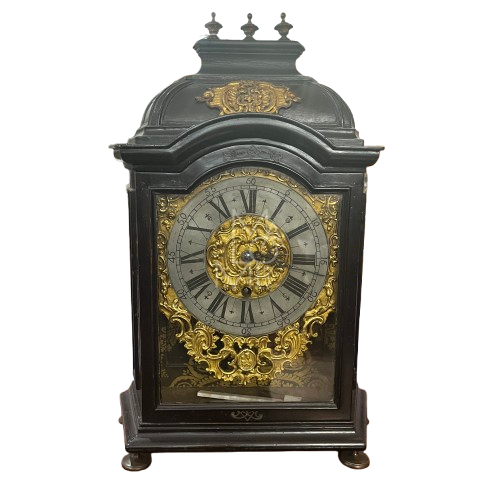
The baroque bracket clock represents one of the most successful syntheses of mechanical prowess and haute ébénisterie. The specimen under examination—a walnut table clock measuring an imposing yet balanced 35 x 15 x 59 cm—belongs to the Piedmontese horological production of the mid-18th century, a manufacture heavily influenced both by Anglo-Flemish bracket clocks and the refined decorative idioms of the Sabaudian Court in Turin. The following historical-artistic and structural analysis explores the artifact through its formal, constructive, and engineering components.
Architectural profile and case typology
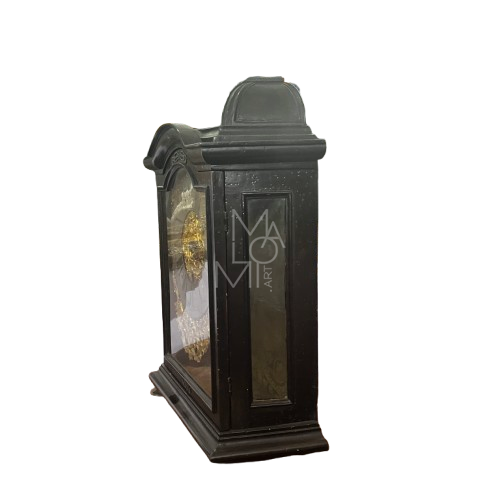
The case features a rigorous and symmetrical vertical composition, significantly indebted to late-baroque sacred and exhibition architecture. The walnut structure, which displays a splendid dark patina occasionally complemented by ebonized finishes characteristic of the period, rests upon four elegant, cast-metal top-shaped feet.
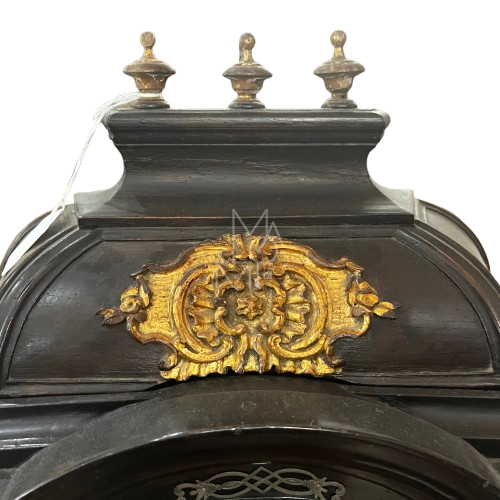
The upper section terminates in a refined, arched molding commonly referred to as a bell-top dome. This summit is crowned by a crest adorned with vertical baluster finials and enriched on its facade by a prominent decorative cartouche plaque displaying phytomorphic motifs. The presence of a glazed front door protects the dial and establishes a perspective frame, elevating the visual reading of time.
Iconography and technique of the dial
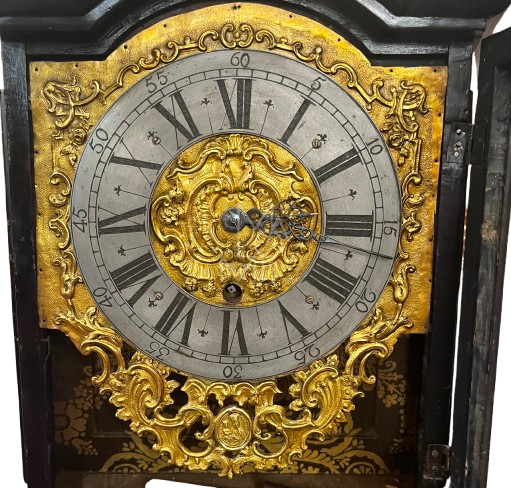
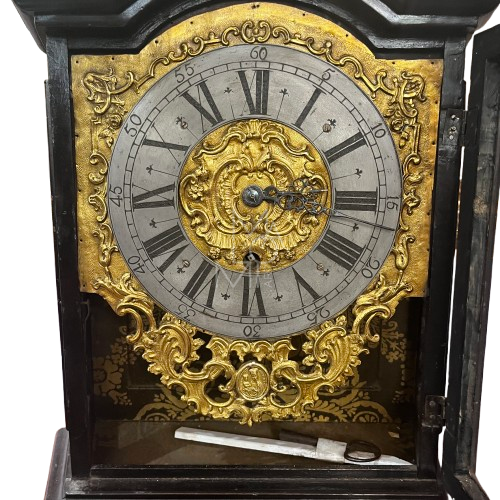
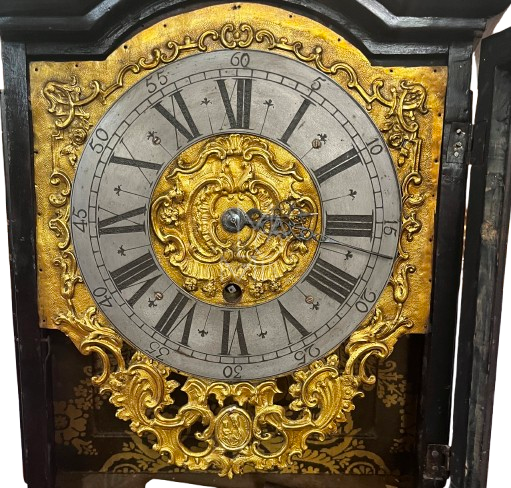
The dial constitutes the visual and semantic center of the work, where mathematical utility marries baroque exuberance. The silvered chapter ring (silvered dial) exhibits hours indicated in large Roman numerals, while the minutes are engraved on the outer band in Arabic numerals intervals of five. This alternating graphic system ensured immediate legibility even under dim lighting conditions.
The corner spandrels and the center of the dial are clad in intricately pierced, chased, and gilded bronze plaques. The central ornamentation features scrolling foliage radiating outward toward the winding arbor of the hands, which are finely hand-wrought from iron or blued steel. In the lower portion, a sumptuous bronze apron or mask descends below the dial, a decorative feature typical of 18th-century luxury workshops.
Mechanics, escapement, and horological functions
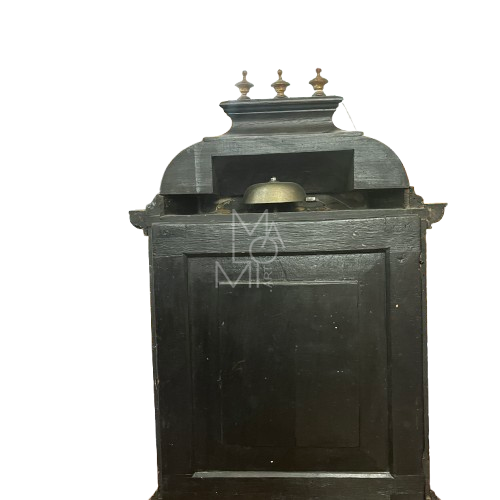
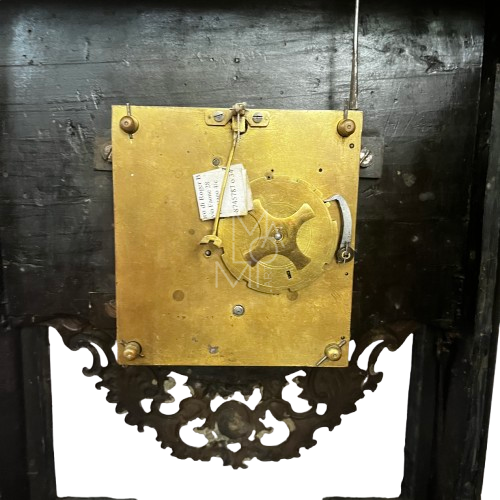
The engineering of a clock of these dimensions relies on a movement built between rectangular brass plates assembled via robust pillars and retaining pins. The upper section of the backplate reveals a bridge suspension block equipped with twin locking screws and a flexible steel spring. Depending vertically from this assembly is the pendulum rod, whose oscillating body extends downward into the case housing, serving as the primary regulator for timekeeping. The absence of a balance wheel and the configuration of the rod definitively confirm an anchor escapement, a mechanism optimized to ensure the steady rate and isochronism required of a high-tier domestic bracket clock.
The preeminent technical feature visible on the right side of the backplate is the external countwheel. The perimeter of this disc is milled with slots at progressively increasing intervals, upon which a steel detent lever acts. This device regulates the striking train on the hour: at the turn of the hour, the striking train is released, the lever lifts to allow the wheel to rotate, and the distance between the slots dictates the number of strikes before the detent falls back into a slot, arresting the mechanism. The inclusion of an external countwheel serves as a reliable chronological indicator of 18th-century horology, as it predates the 19th-century adoption of the internal rack-and-snail striking system.
An invaluable historical-documentary detail is provided by a small paper label attached to the left side with a sealed twine. The label refers to a 20th-century watchmaking repair workshop, proving that the movement underwent functional overhauls during the 1900s, thus preserving its kinetic transmission to the present day without altering the exquisite natural oxidation patina of the brass plates.
Acoustic broadcasting and rear carpentry
Housed within the upper dome is a bell cast from a bronze alloy with a high tin content. This specific metallurgical composition produces a crisp, crystalline, and lingering acoustic resonance. A hammer strikes the outer rim of the bell, reinforcing the 18th-century authenticity of the piece and distinguishing it from later productions that favored spiral gongs.
The reverse of the clock demonstrates solid and rational construction. Unlike the glazed front, the rear is enclosed by a large, framed blind panel that functions as a natural sounding board to amplify the chime. The treatment of the rear wooden surface presents a dark, unrefined matte finish: a characteristic signature of period cabinet-making where surfaces intended to sit against walls were treated solely with protective dark stains or raw shellac, preserving the original marks of hand planes and gouges.
Sculptural wood analysis and sacred iconography
The plaque applied to the upper arch exhibits a Barocchetto or Rocaille decorative repertoire dominated by symmetry and phytomorphic structures. The center features an arrangement of stylized baskets and blossoms enclosed by opposing C-scrolls. This cartouche plaque stands as an exquisite testament to master cabinet-making: the entire ornament is executed in finely carved wood and finished with leaf-gilding, a technical choice favored by Piedmontese artisans to reduce the structural weight of the dome. Atop the crest, the three vertical elements are shaped as inverted chalice finials with balusters, likewise entirely fashioned from gilded wood. The deep brilliance of the gilding, visible within the recesses of the carving, imparts a vibrant three-dimensional quality to the wooden sculpture, while the natural wear of the gold layer on the highlights confirms the authenticity of the piece, ruling out modern regilding interventions.
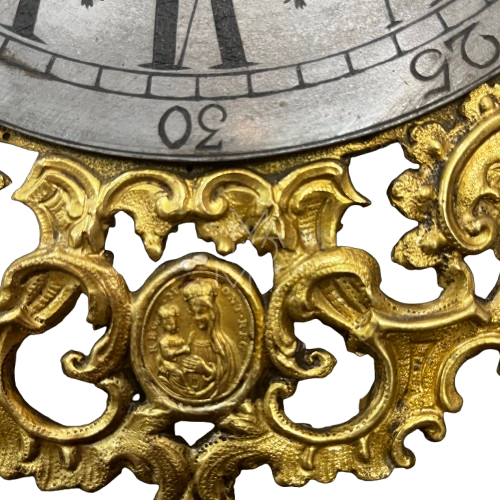
An analysis of the lower portion of the dial unveils the most significant historical-artistic feature of the entire object: a stamped oval bronze medallion nestled within the openwork bronze just below the thirty-minute mark. The bas-relief depicts the Madonna and Child rendered according to a specific regal iconography; the Virgin wears a prominent crown, qualifying her as Regina Caeli, while the Christ Child is captured in a gesture of blessing. Encircling the figures is a partially abbreviated Latin inscription featuring the terms KRG [...] ONT REG, invoking traditional Marian titles of sovereignty over European provinces. From a technical standpoint, the medallion was applied independently, showing a slightly different patination compared to the brilliant gilding of the surrounding plate—a solution that allowed regional craftsmen to customize clocks according to specific patrons or devotional lineages.
Graphic semiotics of the dial and conclusions
The silvered chapter ring reflects a classic mid-18th-century graphic layout. The inner edge of the hour ring is engraved with a chequered track dividing the hour into quarters, while refined, hand-engraved fleur-de-lis motifs separate the large Roman numerals. The hour and minute hands, fashioned from pierced and fire-blued steel, display an intricate arabesque silhouette that ensures legibility without obstructing the indices. The gilded bronze center of the dial features a sunburst pattern radiating toward the hands, where a single winding hole sits at the six o'clock position. This technical configuration implies either a single large barrel powering both time and strike trains, or a passing strike mechanism driven directly by the time train, a layout documented in specific northern Italian and continental horological traditions. Finally, the lower interior of the case retains its period damask fabric lining adorned with floral motifs, upon which rests the original wrought-iron winding key with an oval ring handle.
Based on the analyzed structural, decorative, and mechanical evidence, the artifact can be attributed to Piedmontese manufacture of the mid-18th century, within a chronological window spanning approximately 1740 to 1770. Its style embodies the transition from Sabaudian Barocchetto to Rocaille, a regional production renowned for exquisite walnut carving and close ties to court bronze-casters. The outstanding state of conservation, the integrity of the original patinas, and the presence of its historical accessories elevate this bracket clock from a mere chronometric instrument to a masterpiece of decorative art worthy of inclusion in prestigious museum collections.
Academic bibliography
The scientific study of 18th-century horology and regional manufacturing relies on a consolidated body of specialized literature, which bridges period technical treatises with modern historical-critical research. For methodological contextualization and stylistic comparison, the following reference texts are essential:
- Bargoni, Augusto. Mastri Orafi E Argentieri In Piemonte Dal XVII Al XIX Secolo, Centro Studi Piemontesi, Torino, 1976. This volume is critical for understanding the evolution of Piedmontese decorative arts and the metalworking and gilding techniques applied to court manufactures.
- Brusa, Giuseppe. L'arte dell'orologeria in Europa, Bramante Editrice, Milano, 1978. A fundamental text for studying continental mechanical horology, featuring an extensive section on the evolution of escapements and external countwheel striking mechanisms in the 18th century.
- Cardinal, Catherine. L'orologio da tavolo e da tasca: evoluzione tecnica ed estetica dal XV al XIX secolo, Istituto Geografico De Agostini, Novara, 1985. A useful study for tracing the formal evolution of wooden clock cases and the integration of contrast-applied bronze plaques.
- Morpurgo, Enrico. Dizionario degli orologiai italiani, Milano, 1974. An indispensable biographical directory to verify attributions and map workshops active across Italian urban centers and Sabaudo territories during the 1700s.
- Pippa, Luigi. Orologi antichi dal XV al XIX secolo, Milano, 1966. A monograph focusing on the structural components of silvered dials and the paleographic classification of engraved numerals.