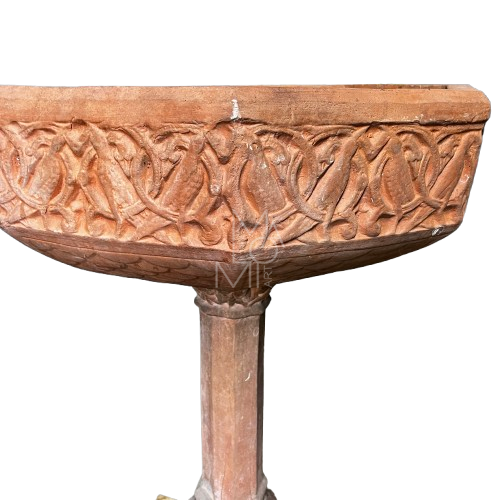
Terracotta baptismal font fifteenth-century
INTRODUCTION AND HISTORICAL-ARTISTIC FRAMEWORK
The object of the present study is a liturgical artifact of exceptional historical, artistic, and ecclesiological significance: a terracotta baptismal font (or monumental holy water font), datable to the 15th century (the height of the Early Renaissance) and standing at a total height of 130 cm.
The adoption of terracotta for sacred furnishings of such monumental scale represents a technical and aesthetic choice deeply rooted in specific geographic regions of Central and Northern Italy, with particular emphasis on the Emilia-Romagna and Lombardy areas. In these territories, the historical scarcity of fine marble quarries was not experienced as a limitation, but rather as an incentive that spurred local workshops to achieve levels of absolute excellence in the plastic modeling of clay.
The work fully aligns with the 15th-century cultural milieu in which master workshops elevated terracotta from a "poor" material to a noble medium of high artistic expression, capable of engaging in a direct dialogue with the coeval spatial breakthroughs of Renaissance architecture.
ARCHITECTURAL STRUCTURE AND SACRED GEOMETRY
The artifact develops vertically according to a rigorous tripartite scheme (basin, shaft, and base), orchestrated upon an octagonal plan that adheres to precise theological and geometric canons.
The choice of the octagonal plan is by no means merely aesthetic: in Christian numerology, the number eight represents the Eighth Day, namely the dimension of Eternity, the Resurrection of Christ, and the spiritual rebirth facilitated by the baptismal bath. The transition between the different volumes is rhythmically defined by architectural moldings that distribute visual weight with elegant equilibrium.
ICONOGRAPHIC ANALYSIS AND CLOSE READING OF DETAILS
The Basin: The Frieze of Souls and the Vine
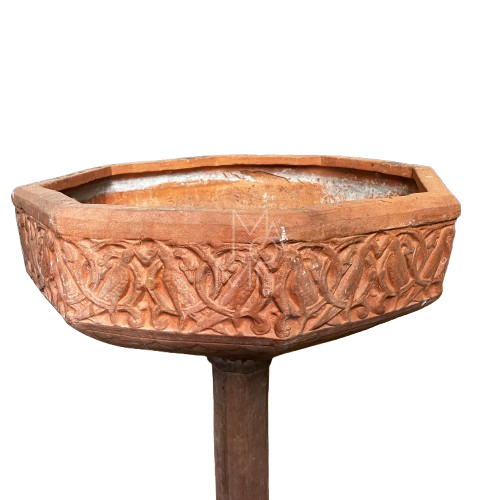
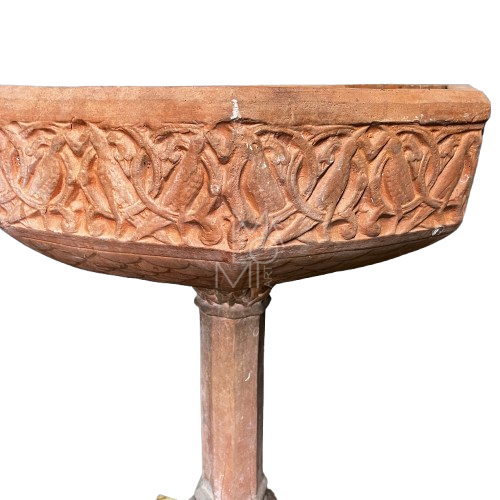
The upper portion consists of an octagonal basin crowned by a sober, square-section molding. The primary register hosts a continuous high-relief of extraordinary narrative density: a rhythmic sequence of birds (likely doves or partridges) captured in profile.
The birds, oriented alternately to the right and left with bodies tilted forward and wings folded, are embedded within a dense, sinuous grapevine, complete with leaves and small clusters of grapes.
This iconographic motif draws directly from the early Christian and medieval repertoire, preserving its theological potency intact well into the 15th century: birds feeding on the fruits of the vineyard symbolize the souls of the faithful drawing spiritual sustenance from Divine Grace and the sacrifice of Christ (the "True Vine"). Beneath this frieze, the basin tapers abruptly toward the center with a smooth, geometric bevel that accentuates the plastic contrast against the central shaft.
The Shaft and the Central Junction
The central shaft consists of an octagonal-section pillar, slender and deliberately devoid of anecdotal decoration. This structural choice responds to the need to guarantee visual stability to the composition while emphasizing its vertical elegance. The point of junction between the tapered underside of the basin and the pillar is masterfully resolved via a small circular capital with molded turning, a clean and rational element of architectural transition.
The Basement: The Plastic Exuberance of the Acanthus
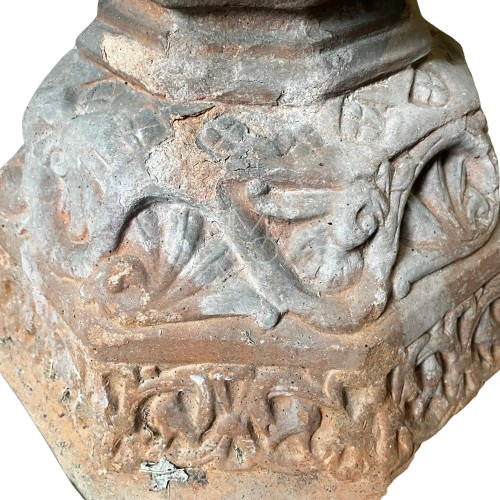
The monumental base represents the most structurally complex and dynamically sculptural section of the artifact, articulating itself across two superimposed decorative registers:
- The Upper Register: Dominated by a vigorous high-relief featuring large, fleshy, stylized acanthus leaves alternating with diagonally arranged tendrils. The tips of the leaves curl inward with an organic movement typical of the 15th-century style, generating a profound chiaroscuro effect.
- The Lower Register: Functions as a solid structural plinth and is decorated with a continuous low-relief of vegetal rinceaux and small, stylized four-petaled flowers. This dense ornamental apparatus symbolizes the thriving life sprouting from the earth, standing in deliberate aesthetic contrast with the smooth surface of the shaft above.
TECHNICAL, MATERIC, AND CONSERVATION ASPECTS
Execution Technique and Firing Joints
From a strictly technical standpoint, fabricating a terracotta baptismal font 130 cm in height constituted a formidable technological challenge for 15th-century kilns. To prevent macroscopic warping or cracking during the drying and firing phases, the artifact was designed and modeled in distinct sections (basin, shaft, and base).
Direct examination reveals subtle vertical join lines sealed with traces of historical mortar or stucco along the upper rim of the basin. The modeling, executed vigorously a stecca (with modeling tools) and gouges on the hollow internal walls, lends a character of vibrant immediacy to the sculpture.
The Stucco Coating as Faux-Stone
The most significant material evidence emerges from the inspection of the basement's surface. The terracotta did not originally present itself bare; broad portions of the relief remain coated in a grayish-white surface finish (either an engobe or a lime-wash scialbatura).
This surface finish served a dual purpose:
- Conservation: Protecting the porous clay matrix from the rising damp typical of church floors [VENEZIALE, 2009].
- Aesthetics: Simulating grey stone or marble (such as pietra serena), a widespread practice in rural Po Valley parish churches (pievi), thereby visually integrating the terracotta furniture into the surrounding stone architecture [MARCONI, 1999]. In the lacunae where this historical stucco coating has spalled away, the underlying clay body re-emerges, characterized by a warm, compact, and intense rosy-orange hue.
COMPARATIVE MORPHOLOGY AND ARTISTIC GEOGRAPHY
To define the cultural horizon of this baptismal font, it is necessary to move beyond the isolation of the single object and map a direct stylistic comparison with the two great poles of 15th-century Italian terracotta sculpture: the Tuscan sphere (the Renaissance of order) and the Po Valley sphere (the Renaissance of plastic and expressive vigor).
The Comparison with the Tuscan Sphere: Structural Rigor
The first axis of comparison concerns the genesis of the octagonal plan and the balance of proportions, which closely align with the artistic breakthroughs of early 15th-century Florence.
- The Brunelleschian and Donatellian Matrix: The clean geometry of the central shaft and the sharp transition provided by the circular capital recall the architectural rigidity found in the terracotta reliefs of Donatello's circle and the geometric frameworks of Filippo Brunelleschi.
- The Workshop of the Della Robbia: The relief frieze enclosed within restrained moldings evokes the structural layout of tabernacles and baptismal fonts from the workshop of Luca and Andrea della Robbia (for instance, the Baptismal Font of Santa Maria a Galatrona) [GENTILINI, 1992]. However, the work under examination diverges sharply from the Della Robbia output due to the absolute absence of stanniferous lead-glazing (white and blue enamels), opting instead for a wash-and-stucco finish that shifts its geographic attribution northward.
The Comparison with the Po Valley Sphere: Materic Expressiveness
While the architectural structure looks toward Tuscany, the plastic execution of the relief and the treatment of the medium firmly orient its attribution toward the Emilian, Romagnol, and Lombard schools.
- The Fregio of Birds and Vines (The Emilian-Ferrarese Component): The manner in which the birds are embedded within the dense vegetal scrollwork, utilizing a crisp relief that casts deep shadows, exhibits strong affinities with the terracotta decorative apparatuses of Estense Ferrara and Bentivolesche Bologna [GRANDI, 1982]. Striking analogies are found in the terracotta friezes adorning the facades of Ferrarese palaces (e.g., Palazzo Schifanoia) or Bolognese monastic complexes (e.g., the cloisters of San Michele in Bosco or the Certosa di Bologna). In these works, the late-Gothic motif of exuberant nature is reinterpreted during the Quattrocento with a newfound volumetric strength, mirroring precisely what occurs on the basin of our artifact.
- The Acanthus Leaf Basement (The Lombard-Padan Component): The plastic vigor of the base, characterized by fleshy acanthus leaves deeply carved a stecca with curled-in tips, finds direct parallels in Lombard sculpture. The decorative program of the base dialogues closely with the terracotta ornaments of the Certosa di Pavia (specifically, the cloister friezes executed by workshops active in the second half of the 15th century, such as Rinaldo de Stauris) and the terracotta panels of the Crema Cathedral [CENTRO DI STUDI..., 1996]. The tendency to saturate the visual space (horror vacui) in the lower register is a stylistic signature diagnostic of Lombard plastic art.
The Coating Technique as a Geographical Indicator
The detail of the grayish finish layer (stucco/lime wash) designed to simulate grey sandstone or stone is the true element of cultural synthesis within this artifact.
While in Tuscany faux-stone treatments were frequently bypassed in favor of sumptuous glazed terracotta, in the parish churches (pievi) of the Tosco-Emilian Apennines and the Po Valley plains, stuccoing and painting monochrome terracotta to mimic noble stone was a ubiquitous practice [BARRAL, 2022].
This allows us to hypothesize that the author of the work was an itinerant master sculptor from the Po Valley region, capable of assimilating the cutting-edge geometric innovations radiating from Central Italy (the Renaissance proportion of the octagon) and translating them through the expressive techniques and decorative motifs of the northern terracotta tradition.
The font under examination is not the product of an isolated provincial workshop, but rather a refined example of stylistic hybridization. It visually maps the transition from the International Gothic to the Early Renaissance: it borrows its order, anthropomorphic scale (the 130 cm height optimized for liturgical ergonomics), and sacred octagonal geometry from Tuscany; it inherits the raw vitality of clay, the chiaroscuro vibration of relief work, and the technical cunning of the faux-stone finish from the Po Valley.
CONSERVATION AND RESTORATION PLAN
The safeguarding of a Renaissance terracotta artifact demands a rigorous methodological approach based on the principles of minimal intervention and reversibility. The current state of conservation exhibits differentiated degradation phenomena: coherent surface deposits within the basin, partial cleavage and micro-fissuring of the grayish stucco layer on the basement, and mechanical abrasion along the molded profiles.
CONCLUSIONS
The historical-artistic, iconographic, and material analysis conducted upon this exceptional 15th-century terracotta baptismal font has restored critical depth to an artifact that stands as a primary testament to the narrative and plastic capabilities of Renaissance clay sculpture.
Through the analytical study of its components, this research has established three fundamental vectors of interpretation:
- Geographical and Stylistic Synthesis: The work transcends the traditional dichotomy between the major centers of cultural irradiation of the Quattrocento, acting as a crucible of stylistic convergence. While the strict tripartism and the sacred geometry of the octagonal plan reflect the adoption of the order and spatial rationality of the Early Tuscan Renaissance, the plastic execution of the reliefs unequivocally shifts the attributive axis to the Po Valley (Emilia-Lombardy). The vital naturalism of the upper frieze—where the birds and grapevines reclaim late-Gothic traditions through a modern volumetric lens—and the chiaroscuro fleshiness of the basement acanthus leaves testify to the extraordinary maturity of northern fittile masters.
- Material Evidence and Workshop Practice: The macroscopic details identified during close physical examination have provided invaluable data regarding the technical prowess of the executing workshop. The technological challenge of firing a monumental 130 cm artifact was brilliantly circumvented by modular casting (basin, shaft, and base), whose historical seams remain structural evidence. The element of highest scientific interest, however, remains the residual gray stucco scialbatura on the basement. This faux-stone finish, intended to simulate prestigious stone, responded to a specific aesthetic vernacular indigenous to Po Valley churches, elevating the clay medium by harmonizing it with the surrounding ecclesiastical architecture.
- Liturgical Centrality: From an ecclesiological perspective, the artifact is not exhausted by its supreme aesthetic value, but qualifies as a flawless liturgical engine. Its monumental height is calibrated to the precise ergonomic requirements of the celebrant performing baptism by affusion, while the entire iconographic program—from the numerological symbolism of the octagon to the salvific metaphor of souls nourishing themselves upon the "True Vine"—visually manifests the theological mystery of baptismal regeneration.
In conclusion, this baptismal font does not represent an isolated episode of provincial production, but rather the sophisticated output of an itinerant master plasticator from the Po Valley, working in dialogue with the avant-gardes of his time.
BIBLIOGRAPHY
- Terracotta Sculpture in the Italian Renaissance: General Studies
- BOUCHER, Bruce (ed.), Earth and Fire: Italian Terracotta Sculpture from Donatello to Canova, exhibition catalogue (Houston-London), New Haven, Yale University Press, 2001.
- GALLI, Aldo, ROSA, Beatrice, SCANSANI, Marco (eds.), Tra arte e industria. La serialità della scultura nel Rinascimento, Rome, Viella Editrice, 2026.
- GENTILINI, Giancarlo (ed.), Scultura italiana del Rinascimento. Statue e rilievi in marmo e pietra, terracotta, stucco e legno, Florence, Polistampa, 2013.
- POESCHKE, Joachim, La scultura italiana del Rinascimento, Milan, Rizzoli, 1993.
- Plastic Fittile Art in the Po Valley (Emilia-Romagna and Lombardy)
- CAMPANINI, Graziella (ed.), Il Compianto di Niccolò dell'Arca a Santa Maria della Vita, Bologna, Editrice Compositori, 2012.
- CENTRO DI STUDI PER LA STORIA DELL'ARCHITETTURA REGGESE, La scultura in terracotta nel Rinascimento padano: Guido Mazzoni e la cultura fittile tra Emilia e Lombardia, conference proceedings, Modena, 1996.
- GRANDI, Renzo, I monumenti in terracotta a Bologna e in Romagna nel Quattrocento, Bologna, Istituto per la Storia di Bologna, 1982.
- VENEZIALE, G., "Morfologia e tecnica costruttiva dei manufatti fittili rinascimentali tra Po e Appennino", in Rivista di Archeologia dell'Architettura, XIV, 2009, pp. 112-128.
- The Tuscan Sphere and the Robbian Tradition: Comparative Models
- CRUTTWELL, Maud, Luca and Andrea della Robbia and their successors, London, J.M. Dent & Co., 1902.
- GENTILINI, Giancarlo, I Della Robbia e l'arte della terracotta invetriata, Florence, Cantini, 1992.
- MARQUAND, Allan, Robbia Heraldry, Princeton, Princeton University Press, 1919.
- Liturgical Furnishings Typologies and Baptismal Iconography
- CASAGRANDE, Giovanna, Fonti battesimali e acquasantiere monumentali nelle pievi dell'Italia centro-settentrionale, Perugia, Edizioni Scientifiche, 2004.
- RÉAU, Louis, Iconographie de l'art chrétien, vol. II: Iconographie de la Bible, Paris, PUF, 1956.
- TAGLIAFERRI, Amelio, I motivi decorativi vegetali e zoomorfi nell'arte di transizione e nel Primo Rinascimento, Udine, Del Bianco, 1988.
- Technological Aspects, Surface Finishes, and Faux-Stone
- BARRAL, Philippe, "“Colorite de boni colori et ornate secundo il naturale”. La policromia e le finiture superficiali nella scultura fittile del Quattrocento", in Technè. La science au service de l'histoire de l'art, n. 53, 2022, pp. 45-58.
- MARCONI, Paolo, La scultura in stucco e finto lapideo nell'architettura rinascimentale: tecniche di esecuzione e problemi di conservazione, Rome, Istituto Centrale del Restauro, 1999.