Study of an Eighteenth-Century Genoese Gilt-Bronze Statuette
The Dignity of the Bond: An Analytical Study of an Eighteenth-Century Genoese Gilt-Bronze Statuette
Introduction and Historico-Critical Framework
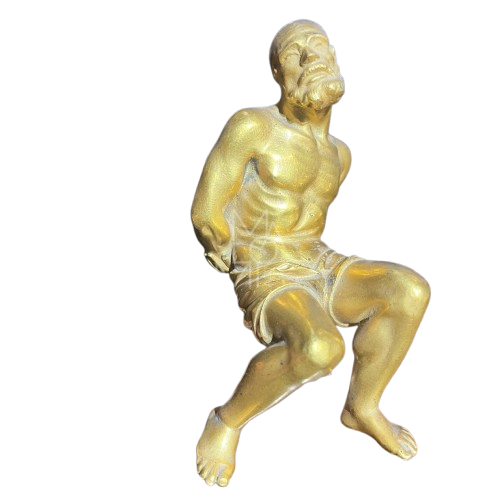
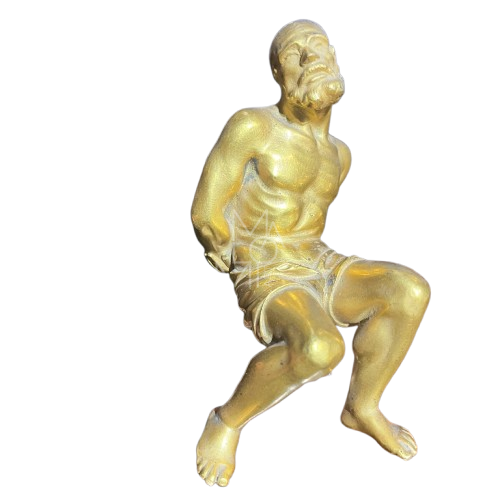
Throughout the early modern period, the bronze cabinet sculpture served as a primary medium for the dissemination of monumental models and as a key focus for refined art collecting. The work under consideration—a fully round, gilt-bronze statuette depicting a seated prisoner or slave, produced within the eighteenth-century Genoese school and measuring a compact 15 centimeters in length—fits seamlessly into this well-established tradition of high-epoch artifacts.
During the eighteenth century, the Republic of Genoa underwent a complex transitional phase. Despite a progressive contraction of its geopolitical influence, the local aristocracy preserved vast financial fortunes and maintained a decorative taste aligned with Late Baroque innovations and the nascent impulses of the Classicist transition. This small bronze reflects that specific cultural milieu, combining intense dramatic expressiveness with an exceptionally controlled, miniature-scale technical mastery.
The Cultural Context of the Superba in the Eighteenth Century
To fully understand the genesis of this gilt bronze, it must be situated within the distinctive cultural and social climate of eighteenth-century Genoa. Although the Republic had seen a decline in its maritime and military power, it remained a financial hub of paramount importance in Europe. Prominent patrician families—such as the Durazzo, Balbi, Brignole-Sale, and Doria—cultivated lavish private collections. Their patronage was no longer directed toward the celebration of the State, but rather toward the exaltation of dynastic prestige and the sumptuous furnishing of their urban palaces and suburban villas.
Genoese culture of this period was defined by a strong intellectual and artistic osmosis with France, as well as with major Italian centers like Rome and Venice. In the plastic arts, this produced an international idiom: the theatrical drama characteristic of the Ligurian Baroque gradually softened into a more fluid, airy, and decorative grace, closely akin to the European Barocchetto and Rococo. Gilt-bronze statuettes became indispensable status symbols for cabinets d'amateur and the refined salons of the aristocracy. They were displayed alongside monumental mirrors, carved console tables, and precious ebony cabinetry, entering into a visual dialogue with large-scale gallery paintings.
The Practice of Lost-Wax Casting in the Eighteenth Century
The creation of a statuette measuring a mere 15 centimeters demanded a sophisticated mastery of lost-wax casting (cire perdue), a technique that reached levels of absolute executive excellence in eighteenth-century Genoa. For objects of this scale intended for close inspection, sculptors and founders favored the indirect lost-wax casting method. This process allowed the original clay or wax model to be preserved through plaster piece-molds, theoretically enabling the replication of the subject while minimizing the risk of a failed pour.
The process unfolded in rigorous stages:
- Molding and Coring: A layer of wax of the desired thickness for the final bronze was applied or poured into the negative plaster mold. The internal cavity was then filled with a heat-resistant refractory mixture (the core), which was stabilized by core pins (armature nails) to prevent shifting.
- Sprues and Vents: A network of wax rods was attached to the surface to create channels for the entry of the molten metal (sprues) and the escape of gases (vents). This step was crucial to prevent air bubbles that would otherwise compromise the minute anatomical details.
- Baking and Pouring: The entire assembly was encased in a refractory investment mantle and baked in a kiln. The wax melted and drained away (hence "lost wax"), leaving a millimeter-thin gap. The molten bronze alloy was poured into this void, with its fluidity precisely regulated to ensure seamless penetration into the finest details of the torso and face.
Once the metal had cooled, the investment shell was broken away to reveal the raw bronze casting (il getto). This was followed by the delicate phase of chasing and cold-working (nettaggio e cesello), executed with burins, files, and scrapers to eliminate casting flaws, define the texture of the loincloth, and sharpen the facial features, thereby preparing the metallic surface for fire gilding.
Corporeal Morphology and Anterior Anatomical Investigation
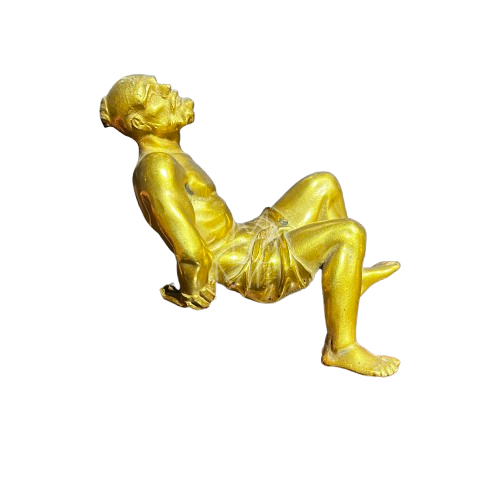
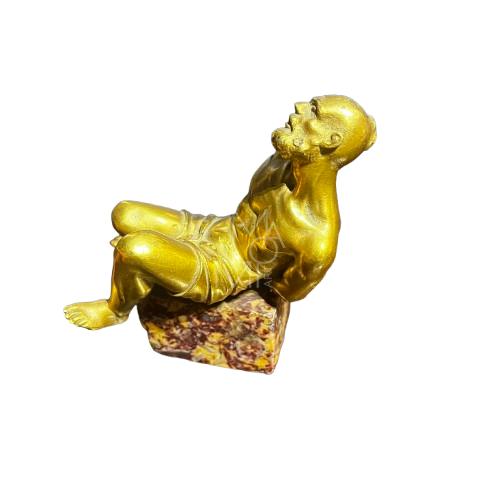
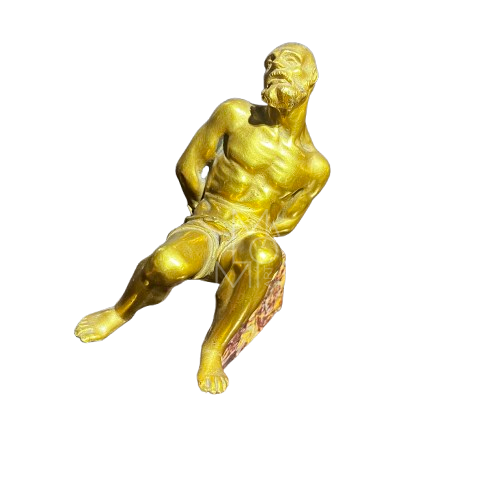
The sculpture concentrates an extraordinary plastic energy within its 15-centimeter framework, structured around a morphological investigation of the human form that balances naturalism with Late Baroque idealization. The body of the prisoner is captured in a complex, dynamic, and asymmetrical torsion, calculated to offer multiple viewpoints and to emphasize the physical strain of confinement.
The anatomical analysis reveals evidence of remarkable virtuosity:
- The Torso and Abdomen: The muscular bands of the chest and abdomen are rendered with near-academic precision. The pectoral muscles are contracted and elevated, responding to the backward pull of the bound arms. The abdominal wall exhibits a highly defined iliac crest and rectus abdominis segmentation; its sharp contours catch the golden highlights, generating stark chiaroscuro contrasts that amplify the figure's vitality.
- The Tension of the Arms and Shoulders: Although the arms are concealed behind the back, their constraint is morphologically signaled by the deeply retracted and compressed posture of the shoulders. The neck muscles (sternocleidomastoids) and the trapezius are strained to their limit to support the backward tilt of the head, which is cast back in a gesture of suffering and fierce submission.
- The Lower Extremities: The legs, partially draped by the rigid, crisp folds of the loincloth, maintain the same muscular tension as the torso. The flexed left leg juts forward, guiding the viewer's eye downward, while the feet—modeled with lean, sinewy toes—grip the surface, grounding the physical weight of the figure onto the marble block.
The finishing of the metallic surface alternates between highly polished, reflective passages on the muscular highlights and matte, textured passages in the recesses, thereby intensifying the tactile and volumetric perception of the small nude form.
Posterior Structure and the Syntax of Constraint
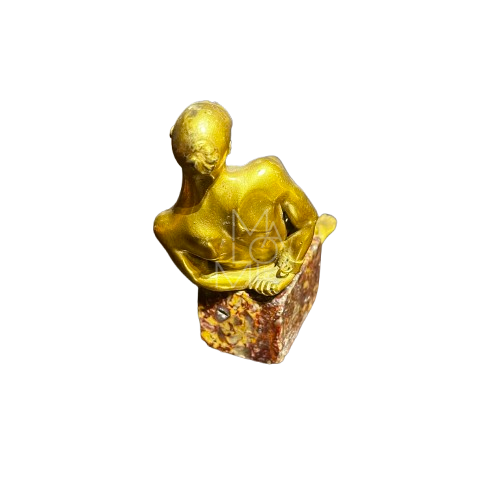
The dorsal view of the statuette confirms its status as a fully freestanding sculpture, revealing a plastic design intended for three-dimensional viewing. The posterior portion focuses on the dramatic rationale of the bond, resolved through an anatomical rendering of surprising formal economy.
- The Back and Plastic Asymmetry: The back presents the exact muscular counterpoint to the anterior torsion. The latissimus dorsi and the left periscapular musculature appear heavily compressed and contracted, whereas the right shoulder projects slightly forward. This creates a pronounced asymmetry between the two hemispheres of the back, visually translating the physical stress and postural imbalance imposed by captivity.
- The Dynamics of the Bond: The arms converge toward the lumbar region, where the wrists are tightly bound one over the other. The rendering of the hands behind the back displays a detailed definition of overlapping fingers, confirming the high quality of the chasing even in the least visible, shadowed areas. The outward curve of the elbows serves as a spatial hinge, expanding the overall volume of the sculpture.
- Finishing and Technical Anchoring: In the rear view, the short hair is modeled in compact, almost geometric tufts that accentuate the exposed nape and the powerful build of the neck. Structurally, the bare back tapers down to the rear loincloth, which terminates abruptly to accommodate the point of attachment to the polychrome marble seat. The presence of an exposed screw or mounting pin on the back face of the stone block documents the eighteenth-century system used to secure and stabilize the small bronze.
Iconographic Analysis: The Theme of the "Prisoner" between Renaissance Heritage and the Baroque
The iconography of the subject is rooted in the established artistic type of the "Prisoner" or "Slave"—a theme whose supreme archetypes are found in Michelangelo’s Prisons for the tomb of Julius II and, within the Ligurian territory, in Giambologna’s celebrated bronzes executed for the Grimaldi Chapel in San Francesco di Castelletto.
However, when compared to the titanic and tragic tension of Michelangelo, this eighteenth-century example shifts toward a more intimate, almost theatrical dimension:
- The Pose: The figure is depicted seated with his arms bound behind his back, a posture that registers the loss of physical freedom while maintaining an intrinsic moral dignity.
- The Face: The head is sharply tilted backward and upward. The facial features—marked by a thick, curling beard and deeply set eyes—evoke the expressive vocabulary of Cynic philosophers or the river god personifications of the Roman Baroque, here reimagined through the lens of Ligurian sculpture.
This upward gaze suggests a dual reading: a plea for divine clemence or a stoic acceptance of one's captive destiny, a motif widely utilized in the moral allegories of the period.
Critical Fortune and Attribution within the Eighteenth-Century Ligurian Milieu
Attributing this work to the eighteenth-century Genoese school recognizes its debt to the grand plastic tradition inaugurated in Genoa by Filippo Parodi and continued in wood and metal sculpture by masters of the caliber of Anton Maria Maragliano and the Piola circle. The pathetic expressiveness of the face, the agitated movement of the drapery folds, and the sensitivity to chiaroscuro contrasts are stylistic signatures that point directly to the workshops active in the Superba between the Late Barocchetto and the earliest stirrings of the Neoclassical transition.
Artifacts of similar scale and subject matter frequently served as autonomous decorative elements for writing desks, as finials for luxurious bronze inkwells, or as components within complex furniture programs integrated with high-quality cabinetmaking.
Conclusion
In conclusion, this gilt-bronze statuette stands as an exquisite testament to eighteenth-century Genoese sculpture. It demonstrates how the monumental themes of High Renaissance and Baroque sculpture were successfully assimilated by the Ligurian aristocracy and translated into a microscopic scale, preserving the expressive power, anatomical precision, and vibrant plastic vitality that characterize the artistic production of the Republic.