Study of a "famille rose" vase pair
The international appeal of Canton porcelain: a historical-artistic study of a "famille rose" vase pair
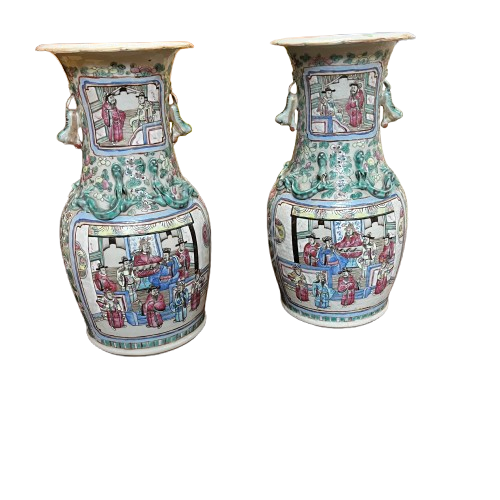
The examined set of vases (height 38 cm, width 20 cm) belongs to the renowned category of Canton "famille rose" porcelain (fencai or yangcai in Chinese). These wares were predominantly manufactured for the Western export market from the 18th century throughout the 19th and early 20th centuries. This essay provides a comprehensive morphological, stylistic, iconographic, literary, and socio-economic analysis of the artifacts, highlighting their role as cultural conduits between Qing dynasty China and European courts.
- Morphological analysis and the structure of the baluster form
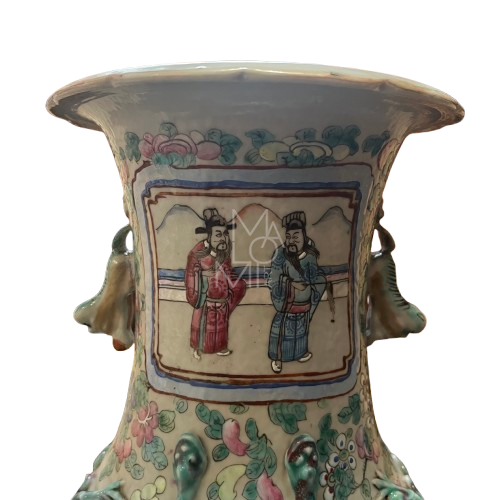
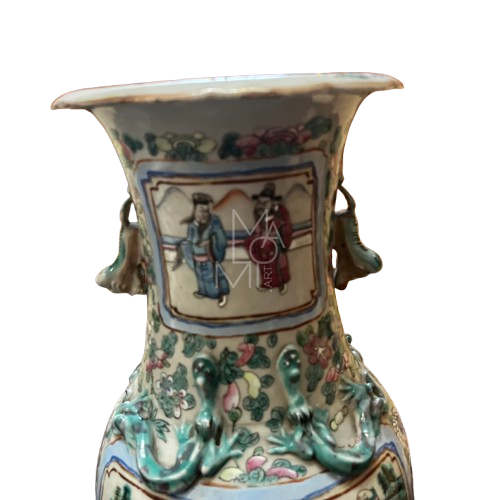
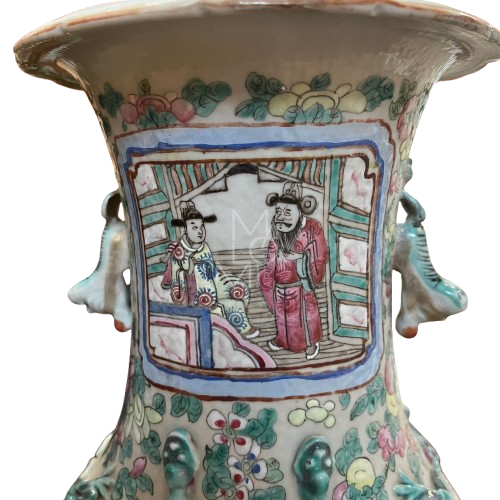
The artifacts exhibit a classic baluster profile characterized by an elongated ovoid body, a flared ring foot, and a pronounced shoulder. The neck extends upward, terminating in an elegantly sved and slightly everted rim (trumpet neck). This specific proportion ensured optimal visual stability while providing an additional vertical surface for pictorial execution. Mold-pressed sculptural elements are applied in relief where the shoulder meets the neck. Sinuous pairs of archaic dragons (qilong) and zoomorphic creatures reminiscent of Buddhist lions (Foo dogs) serve as both structural transitions and handles. These plastic inserts generate a stark three-dimensional contrast against the smooth surface of the glazed porcelain, enhancing the overall dynamism and scenographic presence of the objects.
- The chromatic palette and the technique of the "famille rose"
The wares are decorated with overglaze enamels typical of the famille rose palette, which was introduced to China around 1720 through the influence of Jesuit missionaries and trade contacts with Europe. The dominant hue defining this stylistic classification is the rose enamel derived from colloidal gold, historically known as the purple of Cassius. Unlike the translucent enamels of the preceding famille verte, the addition of an arsenic-based opaque white allowed Cantonese artisans to blend colors. This technical innovation facilitated delicate gradations, chiaroscuro effects, and realistic tonal transitions within the figures' faces and drapery. The background of the vases is saturated with a dense, meticulous floral and botanical ground (the millefleurs motif intertwined with golden tendrils and butterflies), interspersed with vibrant copper greens, antimonial yellows, cobalt blues, and accents of iron red for minor decorative or heraldic details.
- The iconographic program: court scenes within reserves
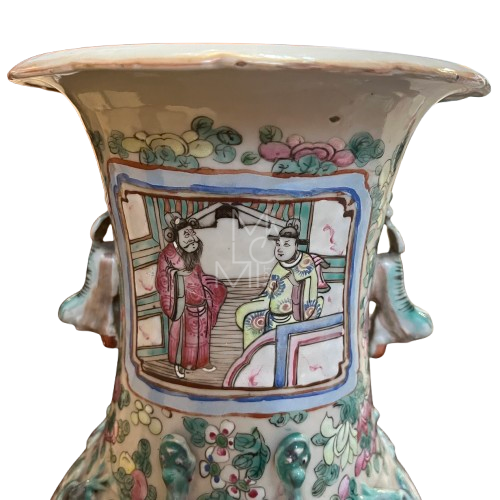
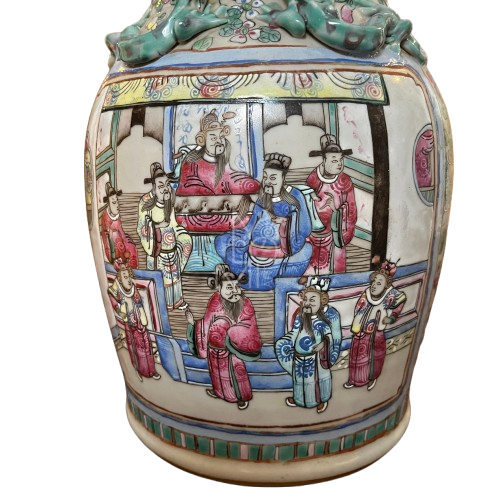
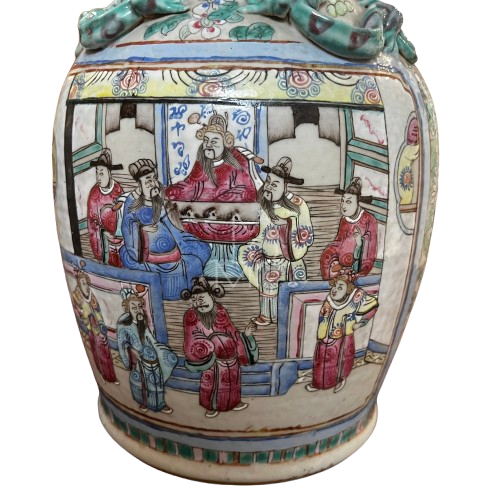
The narrative core of the vases is enclosed within quadrilobed reserves outlined by thick black and gilded borders. This geometric device isolates the two-dimensional space of the narrative painting from the dense horror vacui of the surrounding ornamental ground. The trumpet neck introduces the upper section of the object, where a minor reserve depicts intimate domestic interior scenes populated by standing dignitaries engaged in conversation or showing deference. Below the shoulder, marked by the applied relief elements, the central body of the vase is dominated by a large cartridge. Within these primary reserves, a grand scene of court life or an official imperial audience is staged. Centrally positioned, a high-ranking dignitary or a member of the imperial family sits upon a throne behind a ceremonial table, flanked by guards, advisors, and courtiers clad in traditional Qing dynasty robes. The perspective is characteristically inverted and axonometric—a classical canon of Chinese painting that allows the concurrent depiction of the architectural interior (pavilion scene) and the figures arranged across superimposed registers without mutual obstruction. This alternation between the monumentality of public audiences and the intimacy of domestic life exalted the Confucian virtues of political stability and familial harmony.
- The role of Canton and the export market (export porcelain)
To fully comprehend this pair of vases, they must be contextualized within their contemporary financial and manufacturing framework. The blank, unglazed porcelain bodies (biscuit) were thrown and fired at extremely high temperatures in the imperial kilns of Jingdezhen. From there, they were transported via river networks to Canton (Guangzhou), the sole port open to foreign traders under the restrictive regulations of the Canton system. Within the Cantonese artisanal workshops (hong), painters specialized exclusively in the decoration and subsequent low-temperature muffle firing of overglaze enamels. The Cantonese style evolved specifically to satisfy the exuberant tastes of the 19th-century European and American aristocracy and high bourgeoisie, who sought objects capable of evoking an idealized, opulent, and fairytale Orient, thereby fueling the cultural phenomenon of Chinoiserie. Production in symmetrical pairs directly addressed Western interior design requirements, where vases were symmetrically displayed over fireplace mantels or atop console tables in formal reception reception rooms.
- The principle of narrative duality: balancing wen and wu on a single vessel
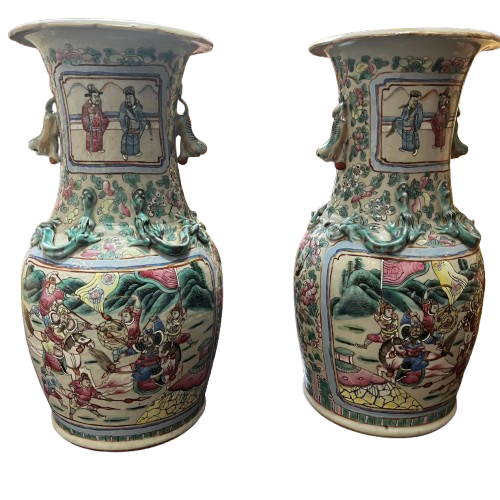
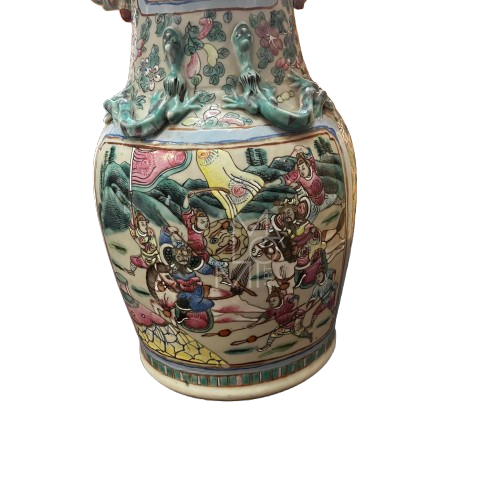
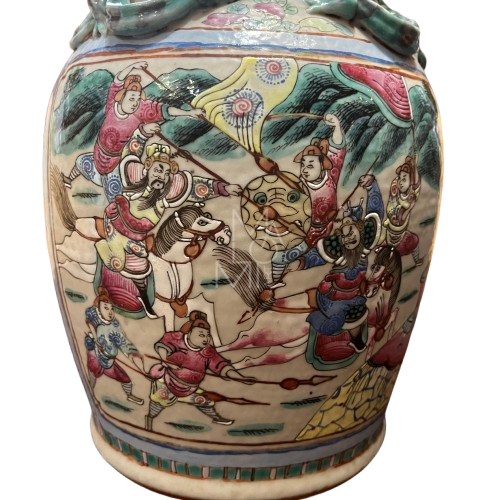
The deliberate choice to decorate the two faces of the same vase with antithetical scenes—a court audience on one side and a pitched battle on the other—is not arbitrary, but rather reflects the Chinese philosophical and political doctrine of the balance between wen (civil order) and wu (military virtue). Within the same ceramic body, the obverse face embodies the wen style, associated with peace, Confucian bureaucracy, intellect, and good governance through governance and diplomacy. Conversely, the reverse face introduces the wu style, linked to strength, courage, state defense, and the dynamic actions of warriors. This conceptual dualism ensured that the vases, depending on how they were rotated or positioned within Western domestic spaces, could display two complementary facets of Chinese virtue, doubling the narrative value and the scenographic possibilities of the decor.
- Compositional solutions and the continuity of the ornamental ground
An analysis of the secondary face reveals the skill of the Canton decorators in managing spatial transitions across the convex ceramic body. The dense ground of floral motifs, butterflies, and gilded enamels serves as a continuous connective tissue wrapping the entire object. This ground never breaks; instead, it behaves as an uninterrupted frame for both major reserves, which visually function as windows looking out onto two different worlds or historical epochs. This scheme is echoed on the neck: the transition from the architectural interior of the first face to the open mountainous landscape of the second consistently correlates the shift from the "enclosed" spaces of power to the "open" realms of action and untamed nature.
- The concept of dynamic symmetry in Canton export pairs
In a high-quality pair of export vases, Chinese decorators eschewed identical, millimeter-perfect replication in favor of the principle of dynamic symmetry. Although the second vase mirrors the military theme of the first vessel's reverse, the arrangement of the warriors and the kinetic force of their movements vary noticeably. One observes a distinct orientation of the spears and a altered composition of the infantrymen in the foreground, proving that each scene was painted freehand. Within the upper neck cartridges, the chromatic correspondence of the pair of scholars in the landscape (one dressed in azure, the other in rose) mirrors the palette of the companion vase, establishing a harmonious visual equilibrium when the two objects are displayed side by side.
- Set integrity and the historical-artistic value of the pair
From a historical and antiquarian perspective, the survival of an intact pair of vases of these dimensions is of paramount significance. Over decades of ownership transfers, pairs were frequently broken up due to partible inheritance or the accidental breakage of one vessel. Locating both vases intact and coeval exponentially increases the historical and collectable value of the set compared to isolated, mismatched examples. An examination of the applied plastic details on the neck and the shoulder dragons reveals identical wear to the gilding and the exact same paint mixture, providing irrefutable evidence that the two vases were conceived together, fired in the same kilns in Canton, and decorated simultaneously by the same workshop team.
- Mirror correspondence and the dialogue between the two vessels
The civil face of the second vase reveals a refined compositional strategy typical of top-tier Canton workshops: inverted mirror correspondence. On the first vase analyzed, the enthroned dignitary was positioned on the right side of the ceremonial table, whereas on this second face, the central enthroned figure sits to the left of the table's visual axis. The standing courtiers are distributed accordingly in a mirrored layout. This geometric inversion served a precise scenographic purpose for European collectors. When the two vases were displayed together showing their civil faces, the two enthroned figures converged visually toward the center of the room, imparting a sense of perfect geometric closure, symmetry, and architectural harmony to the grand salon.
- Technical analysis of the base: authenticity and Qing dynasty dating
An examination of the underside provides the definitive technical evidence for correct dating, revealing structural details characteristic of export porcelain produced in the second half of the 19th century. The base is completely white, smooth, and devoid of reign marks (nianhao) or iron-red seals. This absence is entirely standard and consistent for the vast majority of Canton porcelain destined for Western markets during the Tongzhi and Guangxu periods, as overseas merchants did not require dynastic marks, prioritizing instead exterior visual opulence.
The unglazed foot ring prevented the vessel from fusing to the refractory kiln furniture during the high-temperature firing at Jingdezhen. The rim of the foot displays a light orange or brownish discoloration at the points of contact, caused by the oxidation of natural iron traces within the clay (the so-called "iron spots" or kiln burning). At the center, the inner glaze is covered with a thick white-blueish slip with a distinct "orange peel" texture and tiny pinholes, resulting from air bubbles trapped during firing in traditional 19th-century wood-burning kilns—a detail impossible to replicate in modern industrial kilns.
- Rim and interior surface analysis: thickness and finish
Observing the vessels from above allows for an inspection of their cross-section and the glazing techniques applied to the interior cavities. The upper surface of the everted rim features clusters of floral motifs, minor tendrils, and stylized peoneis executed with the same rose and copper-green enamels found on the main body. This decorative continuity ensured the aesthetic integrity of the vase when viewed from above, such as when placed on furniture below eye level. The glaze lining the interior of the neck is a characteristic grayish-white, exhibiting a fluid but uneven application where faint horizontal throwing lines from the potter's wheel remain visible. The presence of isolated iron specks and the total absence of macro-chipping or hairline cracks confirm excellent structural preservation, ruling out invasive or concealing restorations.
- Criteria for historical attribution: the Tongzhi/Guangxu period (1862–1908)
To distinguish with academic precision whether this pair belongs to the late Daoguang period (1820–1850) or the Tongzhi/Guangxu era (1862–1908), one must analyze the stylistic evolution of the Canton workshops. The vases under review can be confidently attributed to the late 19th century due to the total saturation of the surface (horror vacui), where the minute floral ground is incredibly dense and uninterrupted, contrasting with the more spacious and airy grounds of the Daoguang era.
Furthermore, the famille rose enamels appear noticeably thicker, denser, and more opaque to the touch, applied almost in impasto relief and bound by a stark black outline—an unmistakable marker of post-1860 production. The modeling of the qilong dragons and Foo dogs, derived from standardized molds rather than being finely hand-carved, and the introduction of a more acidic, brilliant green hue starting in the 1870s, exclude the translucent palettes and slender silhouettes of the early half of the century, confirming the full maturity of the late-nineteenth-century "Canton Rose" style.
- The naturalistic iconography of the lateral panels: the "flower and bird" genre (huaniao)
While the primary faces are dedicated to historical and political narratives, the lateral bands introduce the third great pillar of classical Chinese painting: the huaniao (flower and bird) genre. At the center of the side panel, between the large cartridges, sits a long-tailed bird, identifiable as a pheasant or a phoenix (fenghuang), perched amidst ornamental scholar's rocks and large peonies in full bloom. In Qing culture, this association symbolized prosperity, wealth, and auspicious wishes for a successful social ascent. Directly above, near the base of the applied dragon, are depictions of the peaches of longevity and pomegranates, included to convey blessings of long life and a numerous progeny to the owners of the artifact.
- The literary source of the battle scenes: Qing dynasty martial epics
The vivid combat scenes within the military cartridges (wu) depict precise episodes culled from the swashbuckling martial and historical novels of the Chinese literary tradition. During the Qing dynasty, export porcelain drew extensively from the repertoire of theatrical dramas and popular illustrated vernacular texts. The vast majority of Canton famille rose battle scenes are inspired by two milestones of epic literature, whose tales were cyclically performed by itinerant opera troupes in Canton.
The first is the Romance of the Three Kingdoms (Sanguo yanyi), set during the turbulent collapse of the Han dynasty, which recounts the deeds of immortal heroes such as General Guan Yu and the master strategist Zhuge Liang. The scenes on the vases, featuring mounted generals wielding heavy halberds (guandao) beneath fluttering heraldic banners, directly invoke the celebrated battles of the text and individual duels between champions, celebrating martial prowess and loyalty to the state.
The second reference text is The Water Margin (Shuihu zhuan), which follows a band of 108 outlaw-heroes fighting corrupt officials in the name of social justice. The convulsive melees of infantrymen wielding circular rattan shields painted with tiger faces and warriors armed with sabers reflect the iconography of this popular novel. The transposition of these narratives onto porcelain was mediated by popular New Year woodblock prints (nianhua) and book illustrations, where elements like stylized pink scroll clouds and stratified rocks functioned as theatrical backdrops to frame the epic action.
- Concluding considerations on antiquarian market positioning
In light of the comprehensive multi-faceted analysis, the excellent state of preservation, and the security of the Tongzhi/Guangxu attribution, the vases stand as exemplary decorative objects of significant scenographic impact. The primary factors determining their relevance within the decorative arts market include the integrity of the set—preserving the union of the two elements since their manufacture—the rich dual-reading civil and military decoration, and the absence of losses or damage to the applied reliefs. The commercial appreciation of such lots is intimately bound to the interest of international collectors and the Asian market, which remains highly active in repatriating these export wares known as the Chinese taste trade. Such artifacts benefit enormously from meticulous photographic and descriptive documentation confirming their absolute coeval nature across every single section.