Seventeenth-century bolognese double-body walnut burl cabinet: technical profile and antiquarian analysis
seventeenth-century double-body cabinet, bolognese walnut burl furniture, antique emilian cabinetmaking, baroque bolognese cabinet, seventeenth-century italian antiquities.
The double-body walnut burl cabinet: a masterpiece of seventeenth-century bolognese cabinetmaking
Historical introduction and emilian context
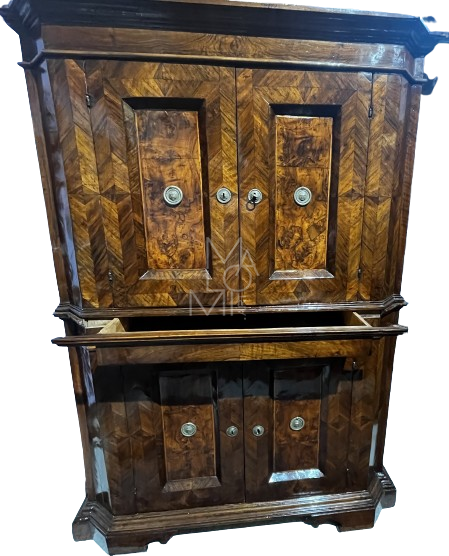
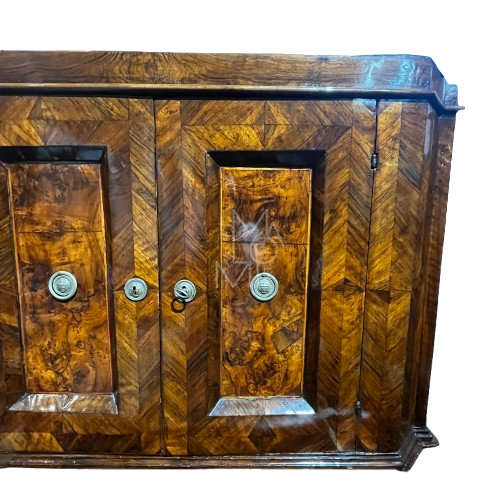
When standing before a double-body cabinet of this nature, measuring one hundred and thirty-seven centimeters in length, fifty-eight in depth, and one hundred and ninety-two in height, the mind immediately wanders to the grand patrician residences of late seventeenth-century Bologna. During this period, the city was experiencing a cultural season of extraordinary fervor, driven by an aristocracy eager to legitimize its prestige through the visual arts. Local artisan workshops felt the pull of the major decorative innovations emerging from the papal capital and the nearby Venetian region, yet they reinterpreted them with a distinct rigor and geometric composure. Bolognese master cabinetmakers preferred the harmony of proportions and the chromatic richness of local wood species over the sculptural and sometimes redundant forms of Roman baroque. A curious anecdote surrounds this type of stationary furniture, which was frequently commissioned for important noble weddings to safeguard the family's most precious trousseaux, jewelry, or legal documents. Their imposing presence served not only to store everyday objects but also to immediately declare the social standing of the master of the house to visitors, acting as a genuine status symbol visible within the reception halls.
Architecture and proportions of the double body
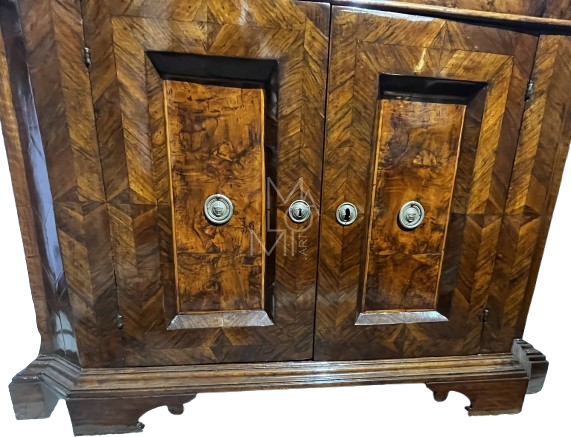
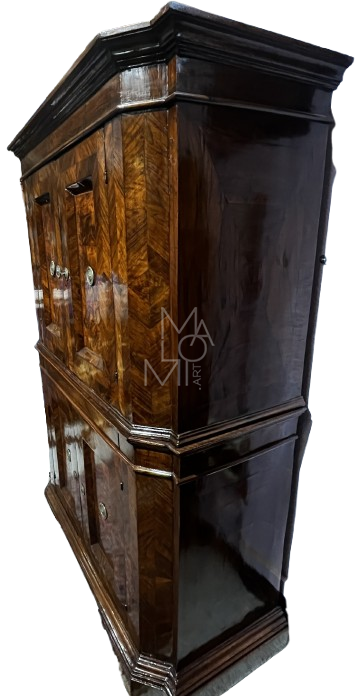
The structure of the piece develops across two superimposed sections, maturely reviving the monumental layout of ancient Renaissance cabinets. The upper body impresses with a strongly projecting crown that acts as a true upper architectural cornice, visually stabilizing the entire composition. Below this crowning element open two large doors bordered by canted pilasters, a geometric choice highly useful for softening the corners and creating a refined interplay of light and shadow along the sides. The transition to the lower half occurs via a mid-level belt molding that conceals a secret typical of the parade furniture of the era, namely a spacious concealed drawer whose existence often remained hidden from the eyes of onlookers and domestic staff. The lower body rests in turn upon a monumental stepped gadrooned molding, supported by characteristic bracket feet that detach the cabinet from the floor with elegance and solidity. A curiosity regarding this type of base involves protection against dampness from the terracotta floors of the period, as lifting the carcass preserved the softer woods of the bottom from the cold drafts of the large rooms. Furthermore, the distinctive bracket shaping of the feet echoed the ornamental motifs of refectory tables in Emilian convents, binding the domestic furniture to the historic monastic traditions of the region.
The art of veneering and the geometric interplay of burl wood
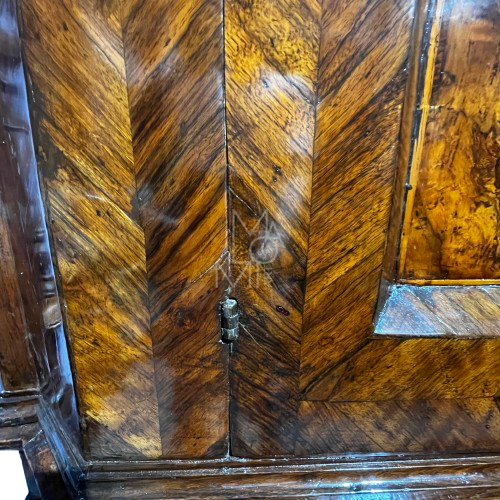
The external surface of the cabinet is a visual triumph thanks to the methodical use of walnut burl applied through the complex technique of surface veneering. Seventeenth-century masters extracted these thin sheets from the knotted sections or root burls of the tree to obtain that tormented, almost painterly pattern reminiscent of marble veins or stormy skies. To introduce movement to the structure, the perimeter bands and stiles were veneered by arranging the wood in a herringbone pattern, a painstaking task that required millimetric precision in the forty-five-degree cutting. The door panels exhibit a slight internal tapering and are bordered by a very subtle stringing in contrasting wood, often maple or boxwood. This technical device deliberately breaks the chromatic continuity to create a perfect geometric frame around the central book-matched burl figure, a baroque artifice intended to astonish the observer by exalting the natural qualities and organic imperfections of the raw material.
Internal diagnostics of the carcass and door engineering
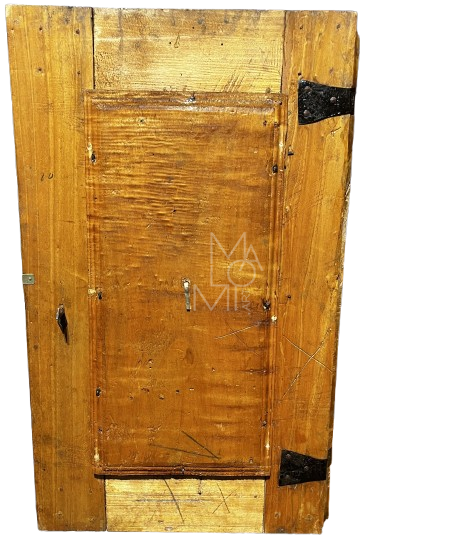
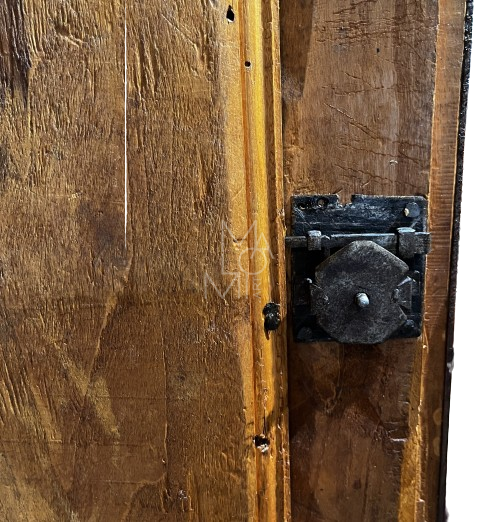
Examination of the interior portions reveals the most intimate and constructive side of the piece, showing the practical choices made within the workshop. The internal carcass and the supporting structure of the doors are crafted from solid poplar wood, a local species that is light, economical, and endowed with excellent elasticity. Craftsmen of the Po Valley knew that poplar was the perfect substrate for burl wood because it adapted to seasonal climate shifts without cracking or exerting excessive tension on the overlying veneer. The reverse of the door unveils complex structural engineering, characterized by a robust perimeter frame enclosing an inserted raised center panel. The edges of this panel are finished with a stepped ogee molding to allow the wood to move freely within the grooves according to humidity levels, thereby protecting the precious external veneer from hazardous delamination. Upon one of the internal poplar stiles, a conspicuous marking in antique ink stands out with the number eighty, accompanied by graphite drafting marks and cross incisions. These are original annotations left by the cabinetmaker during the squaring and assembly phases, a small fragment of workshop life surviving to the present day that illustrates the sequential working methods of the master woodworkers.
Applied metallurgy and aesthetic updates over time
The metallic components complete the diagnostic study by offering decisive chronological confirmation regarding the history of the cabinet. Inside the doors, we find powerful hot-forged iron rim locks mounted on quadrangular plates, dominated by a central raised octagonal shield with decorative notches. These hinges and locks bear the clear signs of the blacksmith's hammer blows and are secured with original, hand-hammered irregular-headed nails. The trapezoidal strap hinges with a truncated dovetail design were specifically engineered to distribute the weight of the heavy doors across the soft poplar wood, preventing structural sagging. Examining the exterior of the cabinet, however, we notice a fascinating anachronism consisting of the circular escutcheons and central knobs in polished brass, which date back to a later period, likely the mid-eighteenth century. This detail tells a story of domestic aesthetic updating, a widespread practice among the heirs of great collections who enjoyed modernizing the furniture of their ancestors by replacing the old dark iron pulls with luminous brasses in line with the new dictates of neoclassical fashion.
The back and internal shelves marked by use
The final, invisible section of the furniture guards the deepest structural authenticity of the artifact. The back of the cabinet is formed by large, rough vertical poplar planks placed side by side and nailed directly onto the rear of the load-bearing carcass. The coarse workmanship, with evident signs of the ax and gouge, bears witness to an ancient technique derived directly from Renaissance wardrobes. Internally, the large horizontal shelves in solid wood show heavy signs of wear, rounding, and erosion along the front edge due to the continuous friction of crockery, books, and heavy objects stored over the centuries. A small iron locking wedge positioned beneath the midpoint of the shelf ensures that the structure does not bow under the heaviest loads, demonstrating a constructive wisdom of yesteryear that prioritized the solidity of the work over any superfluous aesthetic virtuosity.
Reference bibliography
Alberici, Clelia. Il mobile lombardo. Milan: Görlich, 1969.
Bacchi, Andrea, and Luciana Martino. Arredi e interni bolognesi: elementi per una storia dell'abitare a Bologna dal XIV al XX secolo. Bologna: Cassa di Risparmio in Bologna, 1993.
Bandera, Luisa. Il mobile emiliano. Milan: Görlich, 1972.
Banzola, Vincenzo. L'arredo ligneo in Emilia dal Rinascimento al Neoclassicismo. Parma: La Nazionale Editrice, 1979.
Colle, Enrico. Il mobile barocco in Italia: arredi e decorazioni d'interni dal 1600 al 1738. Milan: Electa, 2000.
Lotti, Pierluigi. L'ebanisteria bolognese del Seicento: maestri, botteghe e committenza. Bologna: Edizioni Compositori, 2005.
Mannoni, Edith. Mobili emiliani e romagnoli. Milan: Longanesi, 1987.
Riccomini, Eugenio. Il seicento ferrarese e bolognese. Bologna: Istituto Bancario San Paolo di Torino, 1971.
Symonds, Robert Wemyss. Veneered Walnut Furniture 1660-1760. London: Alec Tiranti, 1946.