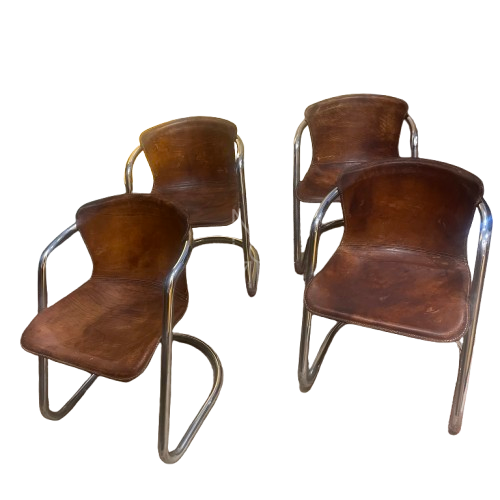
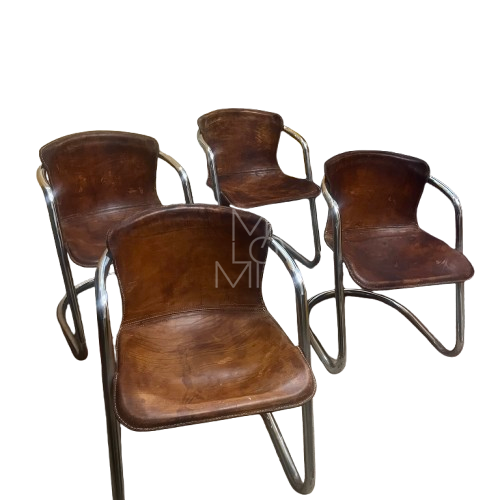
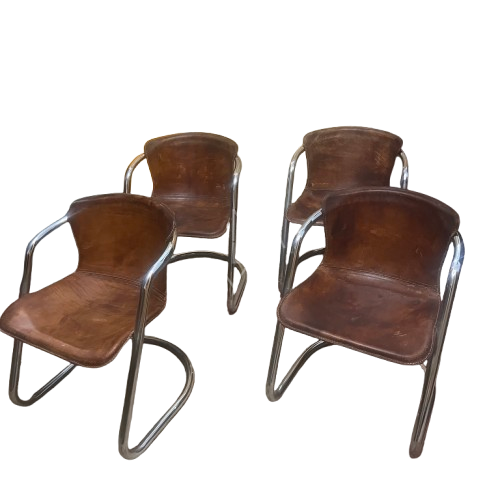
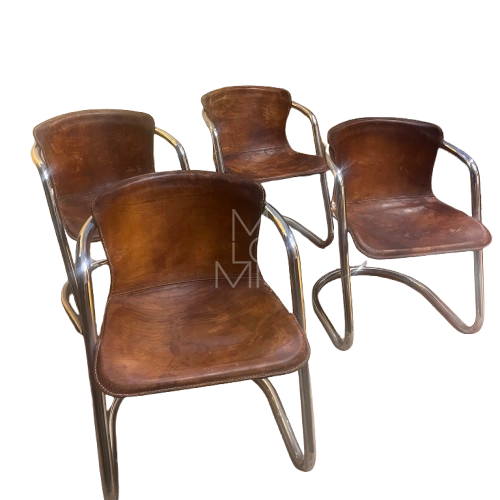
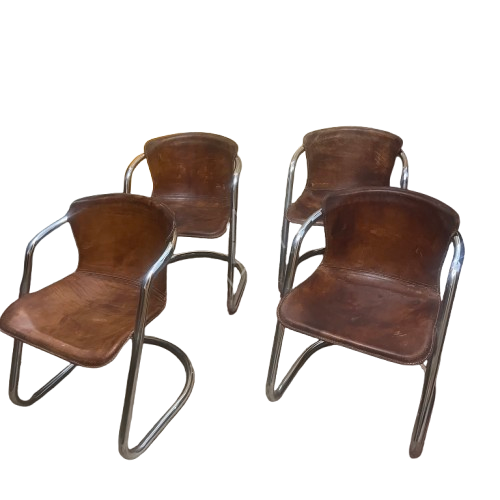
Set of four vintage 1970s cantilever chairs in chrome tubular steel and brown saddle leather attributed to Cidue in the style of Willy Rizzo
- Typology: cantilever dining chairs / executive conversation armchairs
- Period: circa 1970–1979
- Attribution / Style style: attributed to Cidue / designed in the manner of Willy Rizzo, Gastone Rinaldi, and Guido Faleschini
- Materials: cold-drawn structural steel tubing, electrodeposited nickel-chromium plating, full-grain bovine bridle leather
- Condition report: excellent vintage condition; the chrome finish maintains high specular reflectivity with minimal pitting; the leather shells exhibit a noble, historically authentic aged patina with superficial character marks; structural integrity is fully preserved with entirely stable stitching and functional mechanical underside alignment
The Aesthetics of Suspension: A Historico-Critical Analysis of Steel and Hide Cantilever Seating from the 1970s
Introduction
Seating design in the twentieth century ceased to be a mere utilitarian object, transforming instead into a programmatic manifesto of ideological, technological, and formal import. The set of four chairs depicted in the accompanying image fully embodies this transition, positioning itself at the crossroads of the structural rigor inherited from early twentieth-century functionalism and the material hedonism characteristic of 1970s design culture. This work, historically linked to premium Italian manufacturing of the era—such as the celebrated productions by Cidue and designs attributable to the geometric sensibility of Willy Rizzo—manifests an exquisite synthesis of tension and reception.
An illuminating anecdote recounts how Willy Rizzo’s foray into furniture design was born almost by chance out of personal necessity. In 1968, the celebrated photographer of cinema stars and the international jet set moved into a Roman apartment near Piazza di Spagna with his wife, the actress Elsa Martinelli. Finding nothing on the market that reflected his sophisticated taste and the need for spaces suited to the conviviality of his illustrious social circle, he decided to design his own furniture, launching a production that would soon captivate personalities such as Salvador Dalí, Brigitte Bardot, and Coco Chanel. Through the use of continuous tubular metal and high-thickness natural hide, these chairs redefined the late-modern domestic space, offering an excellent case study for understanding the evolution of designer furniture in the second half of the twentieth century.
The Genesis of the Cantilever Structure
From Bauhaus to the 1970s
The geometric configuration of the cantilever or sled base constitutes one of the most theoretically dense nexuses in the history of industrial design. Born from the avant-garde intuitions of the late 1920s by masters such as Mart Stam, Ludwig Mies van der Rohe, and Marcel Breuer, the chair devoid of rear legs disrupted the traditional statics of furniture. Contemporary chronicles note that the original inspiration struck Mart Stam while observing the structure of tubular steel bicycle handlebars, intuition leading him to exploit the elasticity of steel to eliminate vertical rear supports, which until then had been considered indispensable.
While the original Bauhaus approach favored an aseptic industrial purity and strictly orthogonal lines, the reinterpretation carried out during the 1970s introduced sinuous curves and an unprecedented organic fluidity, evident in the set under analysis. The line of the tubular steel does not merely support the body but traces a continuous flow through space. The base transitions with a soft radius into the rising curve, which ascends before flexing to form the integrated armrests, terminating in the dorsal embrace of the backrest. This formal evolution testifies to the transition from a dogmatic, mechanistic functionalism to a mature modernism, capable of accommodating visual softness without sacrificing structural honesty.
The Material Dialogue
Chromium and the Patina of Hide
The expressive core of these chairs lies in their material dualism, a calculated contrast between the aseptic coolness of metal and the warm organicity of leather. The mirror-like finish of the metal reflects the ambient light, lightening the volumetric impact of the furniture and imparting a dynamic, almost immaterial quality. In the 1970s, chrome became the symbol of a futurity projected onward, closely tied to the cosmic aesthetic of the Space Age and the atmospheres of the most sophisticated bourgeois salons and clubs. A curiosity from the societal chronicles of the era reveals that the choice of such highly polished, reflective finishes also responded to the needs of photographers and filmmakers of that decade, who sought to amplify the diffused lighting of cinematic and domestic interiors, creating interplays of reflections that accentuated the chromatic contrasts of fashionable attire.
In stark contrast to the metal, the suspended shell in brown hide introduces the human and biological element. The hide does not function as a simple upholstery fabric but assumes a load-bearing, structural role, tensioned directly over the metallic frame. The anatomical conformation of the seat cradles the body, enveloping it. The surface displays the passage of time—a noble patina, superficial scuffs, and chromatic variations that do not diminish the object but enhance its historical value and authenticity, transforming aging into a programmed aesthetic process highly sought after by contemporary collectors.
The Engineering of Comfort
The Solution of the Suspended Shell
From a strictly ergonomic and constructive standpoint, the chair masterfully resolves the challenge of suspension. The absence of a rigid under-structure allows the steel frame to flex slightly under the user’s weight, offering an elastic comfort that accommodates the micro-movements of the body. The leather shell is three-dimensionally molded to create a contour that functions simultaneously as a seat, lumbar support, and lateral containment. Attachment to the frame is achieved via precise perimetral stitching lines and tensioning systems concealed on the underside, ensuring formal integrity over time and preventing the structural sagging of the organic material. The presence of armrests integrated into the very deployment of the tubular metal elevates the typology from a standard dining chair to a conversation armchair, accentuating the fluid, multi-functional spatial vocations typical of that decade's furnishings.
Historico-Critical Placement within Italian Design
The Craftsmanship of Made in Italy
The architecture of this set reflects the excellence of the Italian manufacturing sector in the 1970s, a golden age during which companies like Cidue and designers of the caliber of Willy Rizzo experimented with high-end furniture solutions for a cosmopolitan international clientele. The design approach visible in these chairs diverges from the radical, plastic experimentations of the period—which favored the use of polyurethane foam or fiberglass—in order to reclaim a modern classicism linked to the grand artisanal tradition of Italian leatherwork. Similar objects shared the market and visual imaginary with the formal investigations of Gastone Rinaldi or Guido Faleschini for 4Mariani, defining an elegant, rigorous, yet intimately luxurious upper-middle-class style that cemented the global primacy of Made in Italy [1.14].
Techniques and Technologies of Tubular Steel Bending in the 1970s
Material Selection and Cold Bending
The production of cantilever seating in the 1970s represents the culmination of an industrial technological evolution that allowed tubular steel to be transformed from a rigid structural element into a fluid, continuous line. To understand the geometric precision and mechanical resistance of the four chairs analyzed, it is necessary to examine the metallurgical processes and cold plastic deformation techniques in use during that decade. Prior to bending, the selection of raw materials was paramount to prevent structural collapse during deformation. Manufacturers utilized either cold-formed tubes longitudinally welded at high frequency, or seamless cold-drawn tubes for high-end models, which guaranteed uniform wall thickness and a consistent response to flexural stress.
The principal risk in bending an empty tube consisted of section ovalization or wrinkling on the inner wall of the curve. In the 1970s, the furniture industry perfected the use of mechanical and hydraulic tube-bending machines assisted by internal mandrels. During the bending process, an articulated mandrel composed of a series of linked ball segments supported the inner wall of the tube from within, while the tube was clamped against a rotating die that defined the soft bending radius characteristic of the base and armrests of these chairs. A counter-pressure wiper die pressed against the exterior to distribute the tensile stress evenly.
Variable-Radius Bending and Galvanic Treatments
While the Bauhaus relied on manual or mechanical fixed-radius bending machines, the 1970s witnessed the mass introduction of semi-automatic hydraulic bending machines. These apparatuses managed high and constant pressures, essential for achieving wide-radius curves without altering the tube diameter, and executed multiple bending sequences on a single continuous piece of tubing, thereby minimizing the need for intermediate structural welds. Once the mechanical deformation was complete, the shaped tube underwent post-forming treatments. The bends were intensively ground and polished with abrasive belts to eliminate micro-ripples caused by the mechanical stress of bending, before immersing the tubular frame into galvanic baths for the sequential electrodeposition of nickel and, ultimately, chromium. The thickness of the chrome layer in the 1970s was considerably greater than subsequent industrial standards, which explains the excellent state of preservation and mirror-like brilliance still visible in these specimens today.
Critical Comparison with Coeval Designers
Marcel Breuer and the Purity of Origins
The work of Marcel Breuer, particularly through masterpieces like the B32 Cesca chair or the B34 armchair, defined the foundational canons of cantilever seating in the 1920s and 1930s. When compared with the models of the 1970s, substantial differences emerge in their approach to geometry and fluidity. Breuer adopts a rigorous constructive logic based on right angles or tight-radius curves strictly dictated by static function, whereas the 1970s set exhibits a sinuous line wherein the tubular metal flexes with wide, emphasized sweeps, transforming structural necessity into a decorative graphic gesture. Furthermore, in Breuer’s seating, the metallic frame, seat, and backrest remain visually and conceptually distinct elements, often consisting of wooden frames with cane webbing or individually tensioned leather modules. In the set under analysis, the hide shell unifies the seat and backrest into a single, suspended anatomical hull, eliminating visual interruptions.
Gastone Rinaldi and Sculptural Lightness
Gastone Rinaldi represents another pinnacle of tubular and steel wire design in 1970s Italy, particularly with celebrated models such as the Sabrina chair or the Thema series [1.6, 1.12]. While Rinaldi experimented extensively with welded steel wire to form dense, dynamic, and sculptural mesh shells—which required removable cushions for comfort—the set in question favors the solidity and substantial cross-section of continuous tubular steel. The management of the base also reflects contrasting philosophies. Rinaldi's structures frequently play on daring balances and broken lines that challenge the perception of stability, whereas the present set maintains a closer link to the visual stability of the classical sled base, even while integrating the armrests into the same continuous extension of the upright, a solution close to the formal composure of Willy Rizzo or Cidue productions.
Shell Engineering and Tensioning Techniques
Structural Stitching and Inferior Adjustment Systems
The aesthetic and functional success of 1970s cantilever chairs resides in the engineering of the leather shell, which acts as a suspended structural element tensioned directly over the tubular steel frame. This construction method requires specific technical expedients to counteract the physical laws of gravity and the stretching of organic material. To ensure the stability of the shell, manufacturers exclusively employed heavy bridle leather sourced from the steer's butt (groppone), renowned for its maximum fiber density and minimal elasticity, stabilized via a vegetable tanning process.
The joints of the hide are not merely decorative but distribute the mechanical stresses exerted by the user's weight. High-tenacity twisted nylon or heavy-gauge waxed polyester thread was used, worked with a traditional two-needle saddle stitch that ensures the integrity of the seam even if a single loop should fail. The margins of the bonded leather layers were cut raw, burnished, hand-dyed, and brushed with beeswax according to the tintura in costa (edge-dyeing) technique. Because leather naturally yields with prolonged use, the underside of the seat and the reverse of the backrest conceal mechanical tensioning systems, such as perimetral sleeves through which the tubular metal slides, and inferior tension rods adjustable via leather laces or buckled straps, allowing the user to recalibrate the tautness of the seat over the years.
The Italian Upper-Middle-Class Design School of the 1970s
Stylistic Canons and Rigorous Hedonism
While the international design world of the 1970s was shaken by the avant-gardes of Radical Design (such as Archizoom and Superstudio) and the pop utopias of molded plastic, a parallel, cultured, and refined current consolidated in Italy, defined by critics as the upper-middle-class school or luxury modernism. This movement did not seek an ideological rupture with the past but responded to the needs of a new, cosmopolitan ruling class desirous of elegant, formal, yet distinctively contemporary interiors. This design school became the interpreter of a rigorous hedonism, characterized by furnishings of imposing volumes and clean geometric lines suited to spacious urban penthouses and executive corporate offices.
Its distinguishing features stood opposed to the democratic ethos of plastic furniture, preferring solemn materials like chrome-plated or brass-plated steel, full-grain leather, smoked glass, precious marbles, and glossy briarwood. Instead of the primary colors of pop, the palette favored deep blacks, dark espresso browns, cognacs, charcoal grays, and creams. The work of designers like Willy Rizzo, Guido Faleschini, and Gastone Rinaldi shared this conceptual matrix [1.3.6, 1.14]. Faleschini, with the 1971 Tucroma collection for 4Mariani, signed one of the touchstones of the period, uniting industrial precision with a palpable sensuality of materials [1.14]. Specialized companies like Cidue and Fasem asserted themselves on the global market by demonstrating how high craftsmanship could industrialize without losing its sartorial soul.
The Intersection of Visual Avant-Gardes
Space Age and the Mirror Finish
The design landscape of the 1970s is distinguished by an extraordinary dialectical tension between the Space Age, devoted to technological optimism and futuristic fluidity, and Brutalism, rooted in expressive materiality and rigorous structural honesty. When these two philosophies intersected with furniture metallurgy, they generated iconic appointments that redefined the domestic space of the era. Born in the late 1960s under the influence of the space race, the Space Age transposed the imagery of lunar modules and orbital stations into interior design, abandoning cheap plastics to embrace polished metal inflected with a sophisticated luxury.
In Space Age productions, chrome-plated steel or mirror-polished aluminum acted as a visual device that dematerialized the furniture, absorbing and reflecting the light and colors of the surrounding environment to make the object appear suspended within the room. The preferred shapes were the sphere, the cylinder, and the continuous fluid line. In the set of chairs previously analyzed, the wide curvature of the tubular metal uniting base, armrest, and backrest without abrupt interruptions is a direct legacy of this pursuit of aerodynamic fluidity, borrowed from aerospace engineering.
Brutalism and the Honesty of Matter
In total opposition to the sci-fi smoothness of the Space Age, Brutalism developed in furniture design through the celebration of raw, heavy, unadulterated matter. Where the Space Age erased the marks of fabrication through chrome plating, brutalist furniture exalted welding, torching, oxidation, and casting, utilizing heavy metals such as wrought iron, weathering steel, cast bronze, and acid-etched box-section aluminum, with rugged, hammered, or incised surfaces communicating a sense of primordial, primordial force. Geometries were squared, monolithic, and fractured, evoking geological sculptures or defensive fortifications.
A curious editorial anecdote from the era reveals that even glossy interior design magazines sometimes struggled to catalog these interiors, where a brutalist bronze coffee table, heavy as an erratic boulder, might sit alongside walls clad in mirrors and futuristic neon lamps, creating a jarring contrast that was the very essence of that decade's style. Italian design of the 1970s accomplished a masterful operation, succeeding in fusing the formal cleanliness and luster of the Space Age with the volumetric severity and scenic presence of Brutalism, adapting the latter for upper-middle-class interiors. The set of chairs subject of our essay perfectly demonstrates this synthesis, as the mirror-chrome tubular frame recalls the technological purity of the Space Age, while the high-thickness rigid hide shell introduces that structural concreteeness and constructive honesty which form the core of brutalist thought.
Conclusion
Ultimately, the analyzed set does not represent merely a fine example of mid-century modern design, but rather a material document of a transitional epoch. Within the curvature of its steel and the texture of its leather, one reads the persistence of the rationalist myth of the continuous line, mitigated by the demands for comfort, warmth, and anthropocentric prestige proper to the 1970s. The preservation of their structural integrity and the compelling chromatic maturation of their surfaces confirm the validity of a project born to challenge obsolescence and to inhabit space as architecture in miniature.