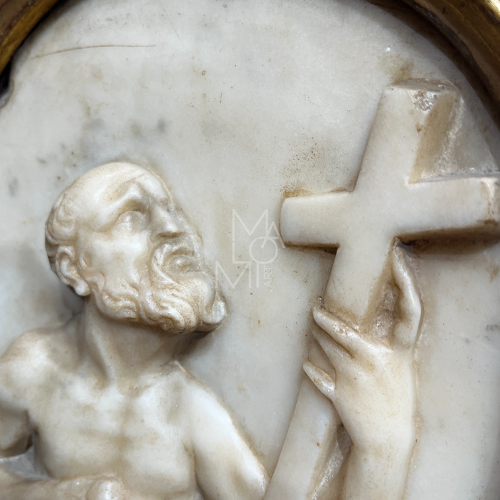
Saint Jerome Penitent in the Desert White marble plaque, 16th century
Last arrival
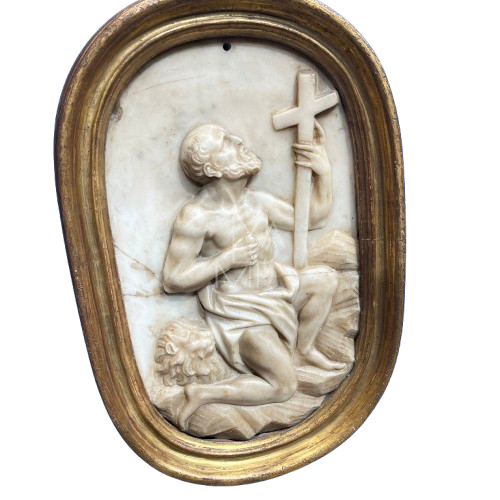
Saint Jerome Penitent in the Desert White marble plaque, 16th century
Saint Jerome Penitent in the Desert
White marble plaque, 16th century
Carved and gilded wood frame, 18th century
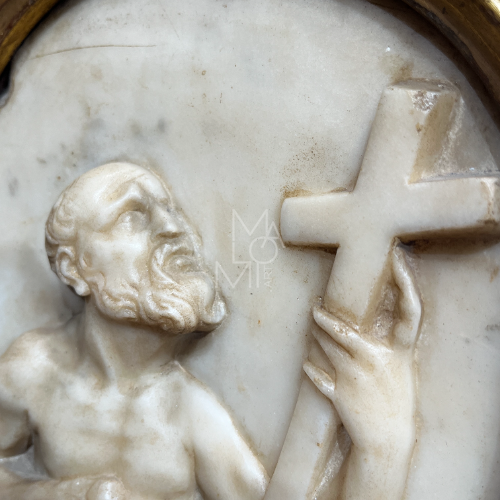
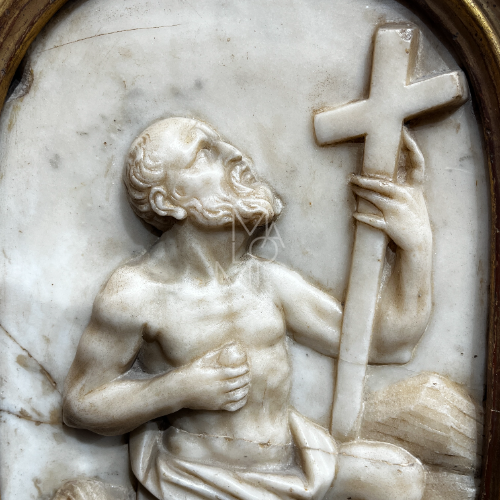
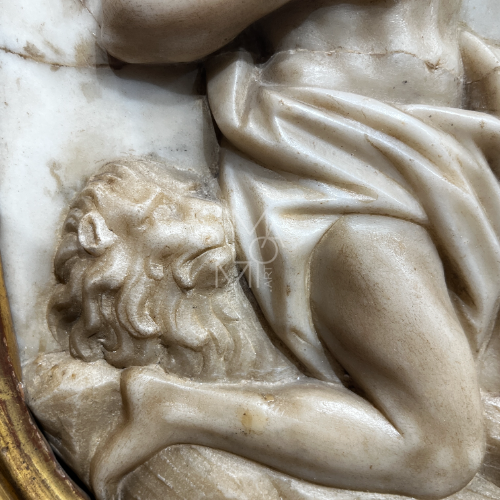
Cultural sphere: 16th-century Lombard Renaissance sculpture Introduction This art-historical study analyzes an oval white marble plaque depicting Saint Jerome Penitent in the Desert. The artwork stands as an excellent example of private devotional sculpture from the second half of the 16th century, originating within the fertile artistic workshops of the late Lombard Renaissance. A particularly compelling feature for critical analysis is its perimeter frame in carved and gilded wood. Added during the 18th century, this frame bears witness to the enduring collectable appeal of the artifact and its subsequent redisplay within a Late Neoclassical setting. 1. Historical and Cultural Context: 16th-Century Lombardy Throughout the 16th century, the Duchy of Milan and its surrounding territories underwent a complex political transition, ultimately falling under Spanish rule. Far removed from the monumental idealization characterizing papal Rome or Medicean Florence, the Lombard school of sculpture developed a highly autonomous visual language. This regional tradition was rooted in a profound expressive realism, the technical mastery of stonecutters (lapicidi) active in the major workshops of the Duomo of Milan and the Certosa di Pavia, and a meticulous dedication to naturalistic detail. With the onset of the Counter-Reformation and the pastoral governance of Saint Charles Borromeo (Archbishop of Milan from 1564 to 1584), sacred art faced strict regulation. Imagery was directed away from Mannerist intellectualism, evolving instead into a mirror for a direct, dramatic faith capable of moving viewers to genuine piety and repentance. 2. Iconography and Analysis of the Sculptural Language The relief masterfully condenses the iconography of Saint Jerome as an ascetic hermit in the Chalcis desert, capturing the emotional climax of his penitential ecstasy. The Anatomy of Pathos: The Saint is depicted semi-nude, kneeling upon the bare rock. His anatomy is lean, almost emaciated by the hardships of his hermitage, yet it retains a powerful, vigorous musculature showing a clear Michelangelesque influence. The twisting of the torso, the taut tendons of the left arm, and the contraction of the right hand against his chest—as he prepares to strike himself with a stone to mortify the flesh—imbue the figure with intense physical and emotional strain. The Divine Dialogue: Jerome’s anguished gaze is cast upward, rapt in adoration of the simple wooden Latin cross he firmly supports. This juxtaposition between physical exertion and spiritual yearning is a hallmark of Lombard piety from this era, aiming to visually manifest a mystical communion with Christ. The Naturalism of the Wilderness and the Lion: The Saint is immersed in a harsh environment, dominated by a jagged, layered rock outcrop. This landscape treatment reflects Northern European artistic traditions and German prints (such as those by Albrecht Dürer) that circulated widely throughout the Po Valley. In the lower-left corner emerges the lion. Its thick mane and deeply creased features display the naturalistic, quasi-descriptive approach inherited from late-Gothic Lombard model books. Theologically, the tamed beast symbolizes human passions subdued by ascetic discipline. Relief Technique: The sculptor demonstrates remarkable proficiency in managing the shallow space of the plaque. The figure of the Saint and the cross project outward in a vigorous high-relief, almost detaching themselves from the surface toward the viewer, while the landscape elements recede into a delicate schiacciato (flattened) low-relief, creating an effective sense of perspective and chiaroscuro. 3. Workshop Environment and Stylistic Comparisons The refined execution of the plaque points toward some of the most prominent personalities and workshops active in the region: The Milan Cathedral Workshop (Veneranda Fabbrica): The style is closely aligned with the output of sculptors like Angelo Marini (called Il Siciliano) or Andrea da Milano. These masters excelled in producing marble reliefs characterized by sharp contrasts of light and shadow and crisp, closely folded drapery—as seen here in the cloth cinching the Saint’s hips—typical of international Mannerism adapted to a Northern Italian sensibility. The Legacy of Bambaia: Although the plaque dates to the latter half of the century, the use of finely polished white marble for a small-scale, domestic artwork recalls the virtuosity and technical precision championed by Agostino Busti (called Il Bambaia), whose teachings shaped generations of Lombard stone carvers. 4. Intended Use and Collecting History: The 18th-Century Frame Originally, this plaque was intended as a private devotional object for the palaces or private chapels of the Milanese and Lombard aristocracy. The small hole drilled near the upper edge of the marble confirms that the piece was meant to hang flush against a wall, without a structural wooden frame, directly above a kneeler (inginocchiatoio) for daily prayer and contemplation. The presence of the 18th-century carved and gilded wood frame introduces a crucial chapter in the object's provenance and the history of collecting: A Shift in Taste: During the 18th century, many Renaissance artworks were rediscovered and integrated into updated curiosity cabinets and private galleries. To harmonize the relief with opulent Barocchetto interiors or the burgeoning symmetries of early Neoclassicism, it was fitted into a molded oval frame. The Aesthetic Role of the Gilding: The choice of 18th-century gilding provides a sophisticated contrast in tone and light. As light catches the gilded surface of the frame, it accentuates the purity and stark whiteness of the marble by contrast, transforming a austere tool of Counter-Reformation penance into a precious, highly sought-after gallery piece.
Carved and gilded wood frame, 18th century
Cultural sphere: 16th-century Lombard Renaissance sculpture Introduction This art-historical study analyzes an oval white marble plaque depicting Saint Jerome Penitent in the Desert. The artwork stands as an excellent example of private devotional sculpture from the second half of the 16th century, originating within the fertile artistic workshops of the late Lombard Renaissance. A particularly compelling feature for critical analysis is its perimeter frame in carved and gilded wood. Added during the 18th century, this frame bears witness to the enduring collectable appeal of the artifact and its subsequent redisplay within a Late Neoclassical setting. 1. Historical and Cultural Context: 16th-Century Lombardy Throughout the 16th century, the Duchy of Milan and its surrounding territories underwent a complex political transition, ultimately falling under Spanish rule. Far removed from the monumental idealization characterizing papal Rome or Medicean Florence, the Lombard school of sculpture developed a highly autonomous visual language. This regional tradition was rooted in a profound expressive realism, the technical mastery of stonecutters (lapicidi) active in the major workshops of the Duomo of Milan and the Certosa di Pavia, and a meticulous dedication to naturalistic detail. With the onset of the Counter-Reformation and the pastoral governance of Saint Charles Borromeo (Archbishop of Milan from 1564 to 1584), sacred art faced strict regulation. Imagery was directed away from Mannerist intellectualism, evolving instead into a mirror for a direct, dramatic faith capable of moving viewers to genuine piety and repentance. 2. Iconography and Analysis of the Sculptural Language The relief masterfully condenses the iconography of Saint Jerome as an ascetic hermit in the Chalcis desert, capturing the emotional climax of his penitential ecstasy. The Anatomy of Pathos: The Saint is depicted semi-nude, kneeling upon the bare rock. His anatomy is lean, almost emaciated by the hardships of his hermitage, yet it retains a powerful, vigorous musculature showing a clear Michelangelesque influence. The twisting of the torso, the taut tendons of the left arm, and the contraction of the right hand against his chest—as he prepares to strike himself with a stone to mortify the flesh—imbue the figure with intense physical and emotional strain. The Divine Dialogue: Jerome’s anguished gaze is cast upward, rapt in adoration of the simple wooden Latin cross he firmly supports. This juxtaposition between physical exertion and spiritual yearning is a hallmark of Lombard piety from this era, aiming to visually manifest a mystical communion with Christ. The Naturalism of the Wilderness and the Lion: The Saint is immersed in a harsh environment, dominated by a jagged, layered rock outcrop. This landscape treatment reflects Northern European artistic traditions and German prints (such as those by Albrecht Dürer) that circulated widely throughout the Po Valley. In the lower-left corner emerges the lion. Its thick mane and deeply creased features display the naturalistic, quasi-descriptive approach inherited from late-Gothic Lombard model books. Theologically, the tamed beast symbolizes human passions subdued by ascetic discipline. Relief Technique: The sculptor demonstrates remarkable proficiency in managing the shallow space of the plaque. The figure of the Saint and the cross project outward in a vigorous high-relief, almost detaching themselves from the surface toward the viewer, while the landscape elements recede into a delicate schiacciato (flattened) low-relief, creating an effective sense of perspective and chiaroscuro. 3. Workshop Environment and Stylistic Comparisons The refined execution of the plaque points toward some of the most prominent personalities and workshops active in the region: The Milan Cathedral Workshop (Veneranda Fabbrica): The style is closely aligned with the output of sculptors like Angelo Marini (called Il Siciliano) or Andrea da Milano. These masters excelled in producing marble reliefs characterized by sharp contrasts of light and shadow and crisp, closely folded drapery—as seen here in the cloth cinching the Saint’s hips—typical of international Mannerism adapted to a Northern Italian sensibility. The Legacy of Bambaia: Although the plaque dates to the latter half of the century, the use of finely polished white marble for a small-scale, domestic artwork recalls the virtuosity and technical precision championed by Agostino Busti (called Il Bambaia), whose teachings shaped generations of Lombard stone carvers. 4. Intended Use and Collecting History: The 18th-Century Frame Originally, this plaque was intended as a private devotional object for the palaces or private chapels of the Milanese and Lombard aristocracy. The small hole drilled near the upper edge of the marble confirms that the piece was meant to hang flush against a wall, without a structural wooden frame, directly above a kneeler (inginocchiatoio) for daily prayer and contemplation. The presence of the 18th-century carved and gilded wood frame introduces a crucial chapter in the object's provenance and the history of collecting: A Shift in Taste: During the 18th century, many Renaissance artworks were rediscovered and integrated into updated curiosity cabinets and private galleries. To harmonize the relief with opulent Barocchetto interiors or the burgeoning symmetries of early Neoclassicism, it was fitted into a molded oval frame. The Aesthetic Role of the Gilding: The choice of 18th-century gilding provides a sophisticated contrast in tone and light. As light catches the gilded surface of the frame, it accentuates the purity and stark whiteness of the marble by contrast, transforming a austere tool of Counter-Reformation penance into a precious, highly sought-after gallery piece.