PORTRAIT OF A GENTLEMAN BY AMBROGIO BORGHI (1881)
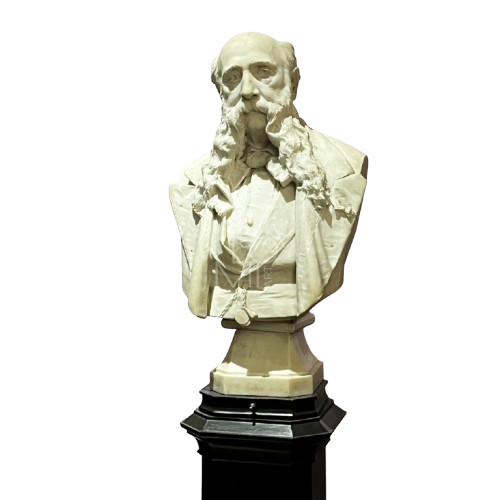
- Ambrogio Borghi - Portrait of a Gentleman (1881) | Marble Sculpture
- Official scholarly entry for "Portrait of a Gentleman" (1881) by Ambrogio Borghi. Features stylistic analysis, metrological data (84x40x30 cm), and 19th-century context.
- Ambrogio Borghi sculptor, 19th-century marble sculpture, portrait of a gentleman borghi, brera academy 1881, umbertine lombard sculpture, carlo tenca marble bust.
- Artist: Ambrogio Borghi (Monza, 1848 – Milan, 1887)
- Attributed Title: Portrait of a Gentleman (alternatively: High-ranking Milanese Official)
- Date of Execution: 1881
- Medium and Technique: White Carrara marble, carved utilizing extensive undercutting and deep drill work
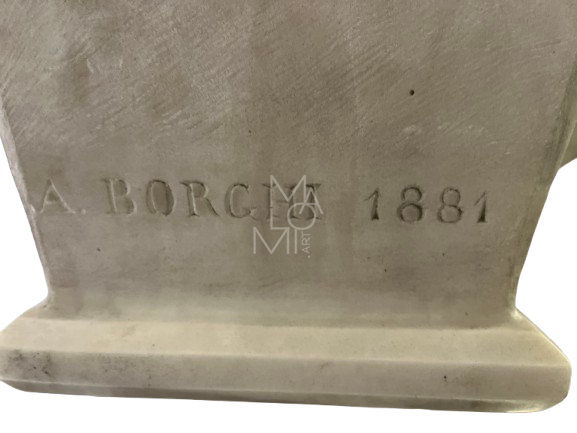
- Inscriptions and Epigraphy: Signed and dated on the reverse in capital letters: A. BORGHI 1881
- State of Conservation: Excellent
- Total Height: 84 cm
- Maximum Width (shoulders): 40 cm
- Depth / Base Diameter: 30 cm
- Support Typology: Contemporary tapered octagonal pedestal in matching marble
PORTRAIT OF A GENTLEMAN BY AMBROGIO BORGHI (1881)
A historical-critical study, epigraphic analysis, and iconographic
- INTRODUCTION AND HISTORICAL-ARTISTIC CONTEXT
In the landscape of late 19th-century Italian sculpture, marble portraiture commissioned by private patrons serves as a privileged vantage point for examining the social, economic, and cultural dynamics of the newly unified Kingdom of Italy. This bust, signed by the Lombard sculptor Ambrogio Borghi (1848–1887), stands as a plastic document of exceptional value, faithfully reflecting the self-assertion and pride of the upper-middle class in Milan during the Umbertine era.
Trained under the rigid yet fertile discipline of the Brera Academy of Fine Arts, Borghi distinguished himself early on within the international critical arena. His triumph at the 1878 Paris Exposition Universelle with his celebrated group Berenice's Hair (La Chioma di Berenice) cemented his technical virtuosity and compositional sensitivity.
The dating revealed by epigraphic analysis places the genesis of this bust in 1881, a golden year and a pivotal turning point in the artist's career. During these months, at only thirty-three years old, Borghi was in the midst of his first official year as the holder of the prestigious Chair of Advanced Modeling at Brera. Concurrently, Milan was experiencing the milestone of its historic National Exhibition in the Giardini Pubblici, an event that consolidated the city’s role as the economic and moral capital of the Kingdom. It was within this atmosphere of industrial and cultural fervor that the Milanese ruling class turned to Borghi—the most fashionable "Professor" of the moment—to immortalize their social achievements in marble.
- EPIGRAPHIC ANALYSIS AND CHRONOLOGICAL REVISION
A fundamental piece of evidence for the correct historical contextualization of the artwork is provided by the inscription carved directly into the marble on the lower reverse section of the bust, immediately above its junction with the octagonal pedestal.
The inscription reads in capital letters: A. BORGHI 1881.
Paleographic analysis reveals the adoption of a monumental capital alphabet with serifs, deeply rooted in the academic lapidary tradition. The grooves, sharp and devoid of hesitation, exhibit a subtle chiaroscuro variation in the thickness of the vertical strokes, demonstrating that the execution was performed directly by the master’s hand or under his strict supervision.
The presence of the first initial ("A.") combined with the surname and the exact year dispels any doubt regarding the authorship of the marble. This highly visible and confident signature rules out the hypothesis of late workshop copies, confirming that the artwork originated as a high-level commission intended for display in the salon of an illustrious estate or in a public exhibition as a certificate of status.
- METROLOGICAL AND SPATIAL ANALYSIS
The physical dimensions of the sculpture offer key insights into its original architectural and domestic context, reinforcing its elite and celebratory nature:
- Total Height (84 cm): An overall height of 84 cm places this bust well above standard life-sized portraiture, tilting it toward a semi-monumental scale. In 19th-century academic practices, such a scale was reserved for institutional portraiture or high-ceilinged reception rooms (saloni d'onore), ensuring the sculpture would command the surrounding space rather than being lost in it.
- Maximum Width (40 cm): This measurement defines a compact yet powerful silhouette. The 40 cm width corresponds to the tight, vertical cut of the shoulders, which forces the viewer’s eye upward, emphasizing the torsion of the neck and the dramatic weight of the beard.
- Pedestal Base (30 cm): The 30 cm dimension of the lower base/pedestal ensures absolute structural stability for an inherently heavy block of Carrara marble. Geometrically, this substantial base creates a powerful tapered vertical thrust (a height-to-width ratio of over 2:1), elevating the gentleman's gaze far above the eye level of a standing viewer.
- STYLISTIC ANALYSIS AND EXECUTIVE TECHNIQUE
From a strictly formal perspective, the bust reveals the extraordinary lyrical eclecticism of Ambrogio Borghi, who skillfully blended academic volumetric rigor with the vibrant demands of Verism and the early influences of the Milanese Scapigliatura movement.
The artwork thrives on a masterful interplay of material and luminous contrasts:
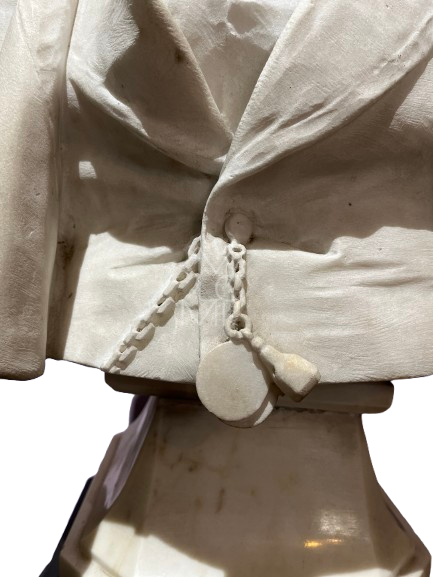
- The Drapery and Attire: The heavy jacket, vest, and shirt are treated with smooth, geometric surfaces. The folds of the fabric are sharp and deep, catching ambient light to generate decisive shadows that volumetrically detach the bust from its surrounding space. The attention to detail is almost photographic, as evidenced by the rendering of the buttons and the lapel buttonhole.
- The Pocket Watch Chain: Prominently displayed on the front of the vest is a refined watch chain with a faux terminal fob or seal. This element, sculpted in low relief with extraordinary goldsmith-like precision, is not a mere decoration; it is the ultimate iconographic attribute of the 19th-century gentleman, symbolizing precision, control of time, and economic solidity.
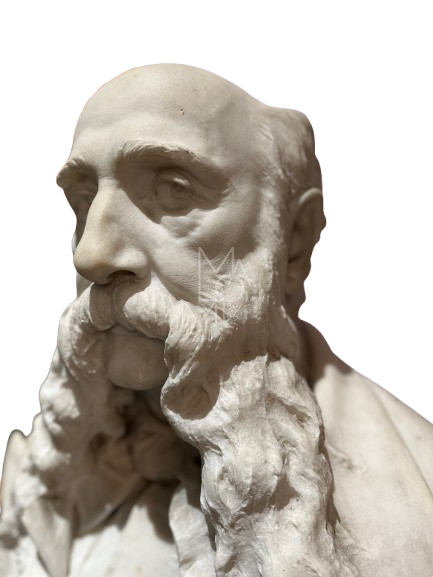
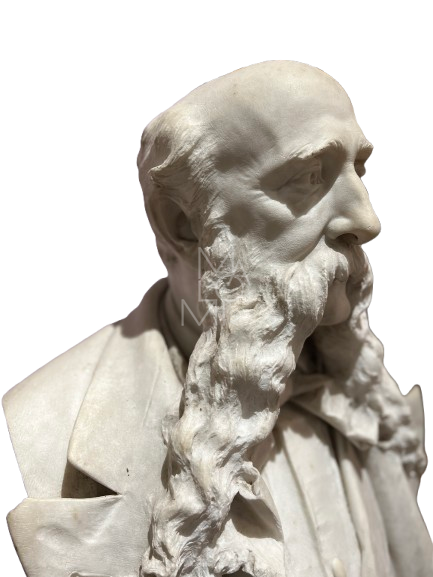
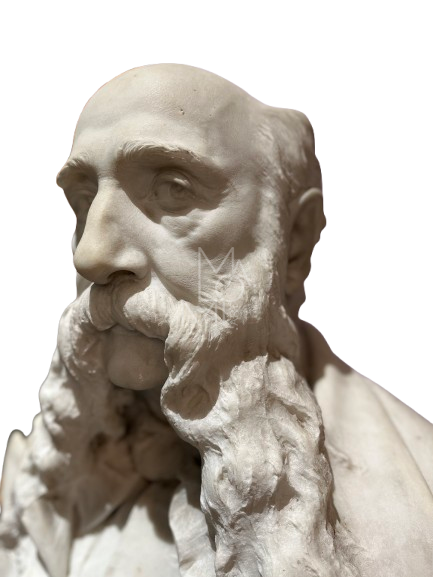
- The Treatment of the Face and Use of the Drill: The true pinnacle of execution is concentrated in the head. In stark contrast to the smoothness of the attire, the monumental flowing beard and the long, twisted mustache are handled with a virtuosic use of undercutting and the drill. The marble sheds its native hardness to become soft, almost "painterly," fragmenting light into a thousand shimmering reflections that infuse the sitter with a potent sense of vital dynamism.
- STUDY OF PATRONAGE AND ICONOGRAPHIC INVESTIGATION
The Physiognomy of Umbertine "Gravitas"
The elderly gentleman is portrayed with his head slightly turned to his right and his gaze directed upward. This proud posture draws directly from the repertoire of monumental Risorgimento statuary, conferring a dimension of moral nobility and political or intellectual foresight upon the subject. The face is unidealized: the deeply incised frontal wrinkles and the signs of aging around the eyes celebrate mature age as synonymous with wisdom, experience, and consolidated personal success.
The Case of Carlo Tenca and the Brera Circles
In an attempt to identify this face, the iconographic investigation examined one of the most influential figures in late 19th-century Milan: the scholar, journalist, and patriot Carlo Tenca (1816–1883).
Cross-referencing the features of the bust with authentic archival photographs—such as the celebrated albumen prints from the Le Lieure and Schemboche collections cataloged on the scientific portal Lombardia Beni Culturali—reveals fascinating parallels. Tenca shared the sitter's extensive frontal baldness and the habit of wearing a flowing beard, and the 1881 dating of the marble preceded his passing by only two years, a period when commemorative busts were highly frequent.
However, a stringent biometric and critical analysis reveals certain morphological discrepancies. In the archival photographs from Lombardia Beni Culturali, Tenca's beard appears more linear, geometric, and compact along the cheeks. In Borghi's marble, by contrast, the beard displays an emphatically wavy and free volumetric movement that borders on the Baroque.
If this is not a highly idealized or "Scapigliata" interpretation of Tenca himself, the artwork must be attributed to another prominent figure from the same circle: a high-ranking state official, an eminent lawyer, or a member of the Brera Academic Council with whom Borghi shared the institution's halls on a daily basis.
- CRITICAL RECEPTION AND CONCLUSIONS
This Portrait of a Gentleman from 1881 confirms its status as a key artwork for understanding the private production of Ambrogio Borghi, which is all too often overshadowed by his public monuments. This marble encapsulates the trajectory of an artist who, at the height of his institutional success, knew exactly how to interpret the desires of his city’s ruling class. The bust is not merely the portrait of a man; it is the plastic materialization of an entire era, in which bourgeois pride clothed itself in the solemnity of marble and the vibrant modernity of Lombard sculpture.