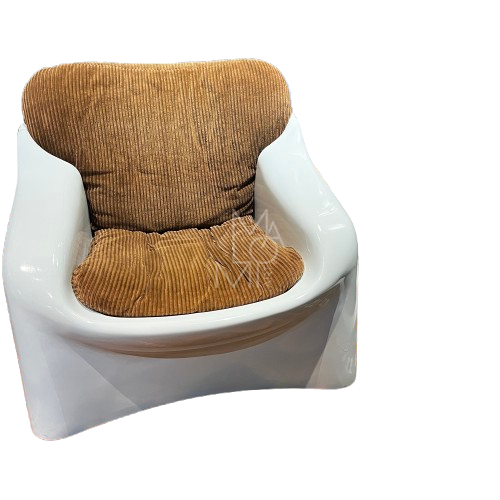
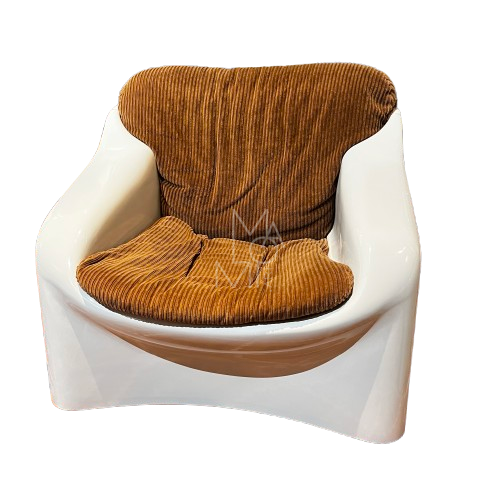
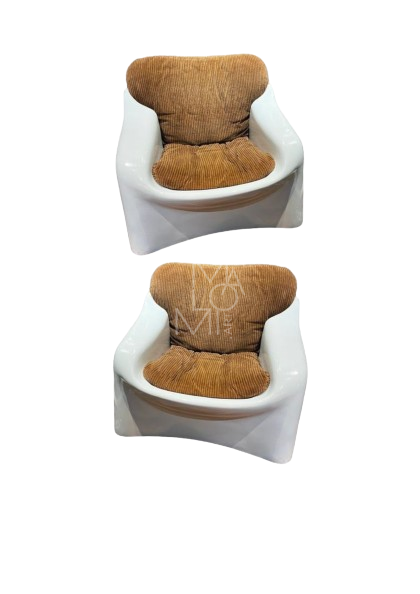
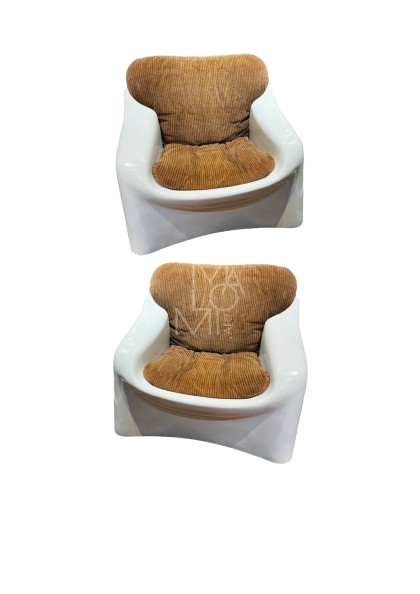
Pair of "Galassia" armchairs by Ferdinando Buzzi for Brunati – 1970s design icons in molded polystyrene and corduroy
The Synthetic Design of the 1970s: The Case of Ferdinando Buzzi's "Galassia" Armchair
The "Galassia" armchair, conceived by the Meda-born architect Ferdinando Buzzi and manufactured by the Ferruccio Brunati company from approximately 1970 onwards, represents one of the most successful and audacious examples of technological and formal experimentation within twentieth-century Italian industrial design. Born during a period of profound cultural transition, this seat establishes a highly sculptural presence within the domestic space, defined by proportions measuring eighty-one centimeters in height, seventy-three in width, and seventy in depth, although these dimensions may undergo slight variations depending on the compression of the internal cushioning and the different historical batches documented in industrial catalogs of the era.
The debut of the armchair occurred at the height of pop culture and the cosmic fascinations tied to space exploration, elements that deeply influenced the nomenclature of the object. Between the late 1960s and the beginning of the subsequent decade, Italy experienced a genuine plastic utopia supported by the introduction of new synthetic polymers, viewed no longer as cheap substitutes for natural matter but as symbols of scientific progress capable of liberating designers from the geometric constraints of traditional carpentry. The "Galassia" distinguishes itself in historiographical analysis as one of the final and most significant testimonies to the extensive use of industrial thermoplastic shells before the global oil crisis of 1973 and sudden shifts in collective taste reoriented production toward the ecology of wood and biological materials.
Technological innovation and high-impact polystyrene processing
From an industrial perspective, Ferdinando Buzzi’s work constituted a pioneering testing ground for the application of advanced engineering materials in domestic furnishings. The monobloc load-bearing structure is manufactured entirely from molded high-impact polystyrene (HIPS), a choice that guarantees excellent structural rigidity paired with an elasticity capable of absorbing considerable mechanical stress. This process enabled the manufacturer to generate continuous curved surfaces devoid of visible joints, conforming to the complex morphology of the human body in a resting position. The glossy exterior finish, historically produced in shades of white, orange, or black, was designed to reflect ambient light, thereby emphasizing the three-dimensional fluidity of the object and its nature as a futuristic shell.
The Ferruccio Brunati manufacturing company, historically rooted in the manufacturing heartland of Brianza, successfully interpreted this technological transition thanks to an extraordinary corporate flexibility. Before investing heavily in chemical molding, the firm had distinguished itself through exceptional mastery in bending solid walnut wood, as demonstrated by the famous 1969 "Tiffany" sofa, designed by Buzzi himself and emphatically reviewed in the architectural journals of the time. A curious workshop anecdote recounts that Brunati’s technicians initially met Buzzi’s plastic designs with skepticism, fearing that abandoning the cabinetmaking tradition might alienate their historical clientele; on the contrary, molding the "Galassia" required such massive and innovative pressing machinery that it transformed the Brianza workshop into a cutting-edge laboratory admired by competitors across the sector.
Formal analysis, ergonomics, and material variants of the seat
The morphology of the armchair is dictated by an enveloping organic shell with a sinusoidal configuration, wherein the armrests blend fluidly into the backrest and the supporting base. The rigid ergonomics of the shell are skillfully mitigated by a system of independent cushions positioned within the seating basin, designed to cradle the shoulders and body in a protective embrace. Over the years, the versatility of the design permitted the adoption of various types of textile upholstery, among which the caramel or ochre-brown cotton corduroy found in archival specimens stands out. This vertical texture creates a refined material contrast with the glossy coldness of the polystyrene, softening the industrial impact of the object and bestowing a warm domesticity upon it.
Alongside the corduroy version, period catalogs document variants upholstered in full-grain leather or vinyl materials such as skai in tones of deep black or bright red, intended for international markets and public reception areas. A curiosity regarding the development of the cushions lies in the fact that Ferdinando Buzzi, influenced by his design lectures in Meda, long insisted that the internal padding be shaped to maintain its structural firmness even after prolonged use, prompting Brunati to collaborate with the early producers of flexible polyurethane foam to achieve comfort without sacrificing the clean geometric lines of the exterior.
Socio-political context and the evolution of customs in the 1970s
The genesis of the armchair cannot be detached from the convulsive cultural landscape that characterized the West at the turn of the late 1960s and early 1970s. This decade, marked by profound social tensions and extraordinary libertarian impulses, radically redefined the concept of domestic space, transforming the furnishing object from a simple bourgeois status symbol into an ideological and behavioral manifesto. Faced with an external world perceived as chaotic and rapidly changing, the home was reinterpreted as a microcosm or a private orbital station where the seat became a welcoming refuge for isolation and relaxation.
Regarding social customs, the post-1968 era dismantled the rituals of traditional domestic rigidity, decreeing the decline of the formal parlor in favor of a fluid and democratic management of space. The youth of the period rejected the erect and restrictive postures of the past, popularizing the culture of floor-living or informal reclining. The "Galassia", with its low center of gravity and deep seat, responded perfectly to this new sociological demand, allowing individuals to lounge, listen to music, or converse without formal constraints. Choosing an armchair made of molded polystyrene meant visually declaring one's adherence to modernity, celebrating plastic as an intrinsically egalitarian and anti-classist material capable of transcending aristocratic ostentation in favor of pop culture.
The manufacturer's monogram and the scientific diagnostics of restoration
An element of fundamental importance for the critical authentication of the work is the trademark stamped directly into the mold on the underside of the glossy shell. The monogram featuring intertwined lowercase letters, accompanied by the wording denoting a registered design (modello depositato), certifies the editorial authorship of Ferruccio Brunati and serves as a legal protection against period counterfeits. This industrial detail represents the birth certificate of the object and is essential for its traceability in ownership transfers and expert appraisals.
The preservation of these historical artifacts presents unique chemical and physical challenges today due to the intrinsic degradation of early synthetic polymers, which are prone to aging, plasticizer migration, and photo-oxidation. Prolonged exposure to sunlight often causes surface yellowing of the original white pigmentation and embrittlement of the polystyrene, which tends to exhibit micro-fractures at points of greater mechanical stress. Modern museum restoration protocols mandate interventions based on minimal invasiveness and reversibility, strictly forbidding the use of aggressive solvents such as acetone or pure ethyl alcohol, which would irreversibly dissolve the polymer and destroy its original gloss. Cleaning is executed exclusively using aqueous solutions of non-ionic surfactants applied with cotton swabs, followed by surface protection with highly stable microcrystalline waxes to preserve the material over time.
Historiographical considerations and contemporary market dynamics
The historical trajectory of the "Galassia" armchair allows for a clear link to be forged between the industrial utopias of the past and the dynamics governing today's high-end collectors' market. What was conceived as a mass-produced, democratic consumer good has been transformed, more than fifty years later, into an elite cult phenomenon, completing a crucial transition that has elevated plastic to the status of museum-grade artwork. The abrupt interruption of production cycles caused by the 1973 oil crisis drastically limited the number of specimens that have survived intact, transforming the remaining batches into absolute rarities sought after by international galleries and collectors of Italian Radical Design.
In specialized auctions, such as those documented by Cambi Casa d'Aste, the commercial value of a coordinated pair is amplified by the pristine preservation of the dichotomy between the glossy shell and the original corduroy fabrics. This aesthetic contrast embodies a period style that is now widely re-evaluated by influential interior designers to embellish contemporary residences. Ferdinando Buzzi's "Galassia" thus remains an extraordinary time capsule, a plastic monument that continues to exude the timeless charm of the golden age of Italian design, testifying to the moment when chemical synthesis and formal audacity mapped out a course toward a frontierless future.
Archival considerations and documentary validation in contemporary collecting
To definitively seal the scientific and philological study of this extraordinary pair of Galassia seats, it becomes imperative to analyze the crucial role played by archival research and period visual documentation. Within the landscape of the twenty-first-century international collectors' market, the legitimation of a historical piece is not exhausted by the simple survey of its aesthetic or conservative qualities; rather, it requires objective documentary grounding, traceable exclusively within the specialist dissemination channels of the era.
The architectural literature of the early 1970s, led by avant-garde publications, constitutes the core of this historiographical validation. Period photo essays, editorials, and industrial selection catalogs did not serve as mere advertising spaces, but represented the theoretical stage upon which the Ferruccio Brunati manufacturing company and the creativity of Ferdinando Buzzi presented their vision of the domestic future. Within these glossy pages, Galassia armchairs were depicted inside radical, conceptual interiors, juxtaposed with deeply saturated carpeting, chromatically bold walls, and space-age lighting fixtures. These historical images, which can also be traced in encyclopedic retrospectives within catalogs published by Taschen, do not merely crystallize the object in its original socio-cultural context; they offer the restorer and appraiser the sole objective point of comparison to verify the exact original shape of the volumes, the alignment of the corduroy ribs, and the native gloss of the molded shell. Reconstructing this visual trajectory and comparing it with the provenance of batches cataloged on international platforms, confers a status of absolute authenticity upon the armchairs, transforming the act of collecting into an operation aimed at safeguarding the historical heritage of Italian design.