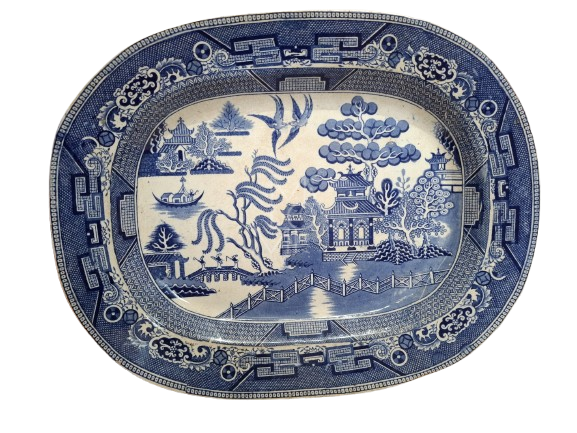
Oval earthenware serving platter
Introduction: the aesthetic syncretism of the Victorian era
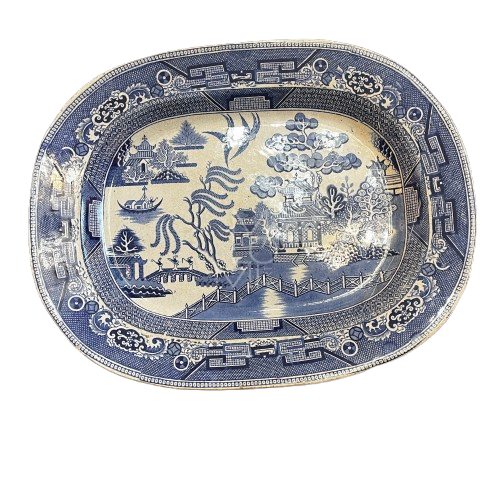
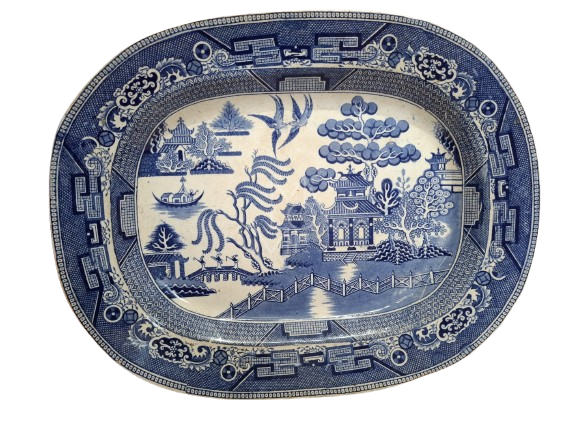
The artifact under analysis is an imposing oval earthenware serving platter of considerable dimensions, measuring 45x36 cm, adorned with the renowned Anglo-Chinese motif universally recognized as the Blue Willow Pattern. From a historico-artistic perspective, this object transcends the status of a mere domestic utensil, embodying one of the most fascinating cruxes in the history of Western decorative arts: the cultural intersection between the phenomenon of Chinoiserie and the dawn of industrial mass ceramic production in the United Kingdom.
An analysis of this piece reveals how Oriental exoticism was assimilated, standardized, and redistributed to satisfy the burgeoning aesthetic demands of the rising European bourgeoisie. Through a rigorous examination of its historical, technical, iconographic, and diagnostic components, it is possible to reconstruct the intricate network of commercial, technological, and cultural dynamics that lie beneath this iconic blue-and-white surface.
The historical context: the obsession with the Orient and the Staffordshire potteries
Between the 17th and 18th centuries, Europe was swept by a profound aesthetic fervor for artifacts imported from the Far East. Chinese porcelain, decorated in underglaze cobalt blue, was deemed a paramount luxury item, exclusively accessible to princely courts and the high aristocracy. Given the prohibitive costs of imports managed by the East India Company, British potteries sought to formulate a domestic, economically viable alternative. The epicenter of this commercial revolution was concentrated in the Staffordshire district, a geographic region abundant in clay and coal resources, which rapidly established itself as the global capital of industrial ceramics.
The Willow pattern was codified in England around 1780–1790, emerging from the collaboration of skilled engravers and potters such as Thomas Minton and Thomas Turner at the Caughley manufactory, and subsequently perfected by industry giants like Josiah Spode. Contrary to the contemporary consumers' perception, who discerned within the platter an authentic reflection of Celestial culture, the design does not constitute a faithful replication of an original Chinese piece. Rather, it is a syncretic pastiche—a fantastical Western reinterpretation of Oriental landscapes (inspired by imported Nanking and Canton styles) expressly devised to cater to the romantic and exotic imagination of the European market.
Technical aspects: the revolution of earthenware and transferware printing
In terms of material culture and technology, the specimen under examination is not composed of hard-paste Asian porcelain, but rather of white earthenware (frequently designated as earthenware or ironstone). This opaque, robust, cost-effective, and remarkably durable ceramic body was the true catalyst for British commercial supremacy, simulating the pristine whiteness of porcelain at a fraction of its manufacturing cost.
The definitive watershed that facilitated the mass distribution of this large platter was the implementation of underglaze transfer printing (transferware), a process that supplanted the slow and costly practice of freehand painting:
- Engraving: The design was meticulously incised using a burin onto copper plates by master craftsmen.
- Inking: The incisions were filled with an oily pigment formulated with cobalt oxide, capable of withstanding the exceedingly high temperatures of the kilns.
- Transfer: The motif was pressed onto a specialized, highly flexible tissue paper.
- Application: The paper, while still damp with ink, was meticulously transferred onto the biscuit-fired ceramic body. During the subsequent glost firing, the paper burned away completely, leaving the pigment fixed to the clay, ready to be sealed under a brilliant, transparent lead glaze.
Close visual inspection of the platter highlights the hallmarks of this industrial process, including the subtle and compelling bleeding of the cobalt pigment caused by the flow of the glaze during the high-temperature firing.
Formal attribution: the Sampson Bridgwood & Son maker's mark
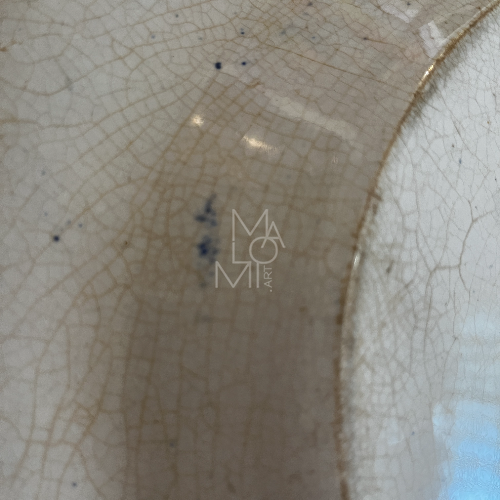
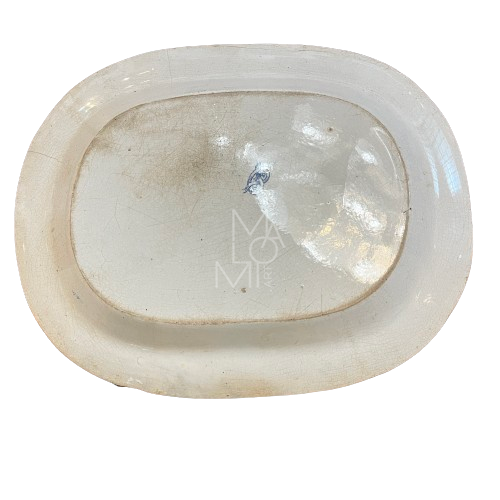
The cornerstone for the scientific identification of the platter resides upon its reverse side. The underglaze mark stamped in cobalt blue displays a prominent monogram nestled within the Staffordshire Knot, a paramount heraldic and territorial symbol that served as a seal of regional authenticity and guild pride for the premier potteries of the Stoke-on-Trent district.
The Latin characters "S & B", graphically intertwined within the loops of the rope knot, conclusively attribute the manufacture of the artifact to the historic firm of Sampson Bridgwood & Son, whose production facilities were located at the Anchor Pottery Works in Longton. Originally established by Sampson Bridgwood at the turn of the 19th century, the firm attained international renown for the superior quality of its fine earthenware and its highly resilient ironstone body, commercially marketed as Granite Ware. The corporate nomenclature officially transitioned to "Sampson Bridgwood & Son" following the permanent inclusion of his sons in the company management from 1853 onward, thereby establishing the identity parameters of this specific specimen.
Chronological diagnosis and industrial indicators
A morphological and philological analysis of the maker's mark allows the chronology of the serving platter to be circumscribed within a well-defined temporal arc, situated squarely within the second half of the 19th century, and more precisely between 1870 and 1890. This dating is corroborated by both significant positive and negative industrial indicators:
- Absence of the McKinley Tariff Act indicators: The word "England" is noticeably absent from the reverse. This omission is critical, as the inclusion of the country of origin became a statutory requirement only after 1891 to comply with United States customs regulations.
- Absence of later corporate nomenclature: The suffix "Ltd" (Limited) is lacking—a designation that the Bridgwood manufactory only began to utilize routinely on its 20th-century productions.
- Presence of subsidiary numerical marks: Inside the rear perimeter, partially obscured by the very dense network of craquelure, a trace of impressed digits (referable to the numbers "4" or "7") can be distinguished. In late-Victorian factories, the application of these small numerical marks met specific internal traceability requirements to identify the clay batch, the size of the piece, or the individual artisan assigned to the press work and piece-rate firing.
Iconographic analysis: the romantic legend as a marketing strategy
The central decoration of the platter is articulated according to a precise geometric and symbolic code, whose figurative elements synthesize a complex visual narrative. Although the composition originally arose for purely decorative purposes, 19th-century British manufacturers codified and disseminated a celebrated romantic legend for promotional ends, effectively transforming the platter into a narrative object to be "read" at the dining table:
- The pagoda and noble mansion (center-right): These depict the residence of the powerful and austere Mandarin. His daughter, Koong-se, had fallen in love with her father's humble secretary, Chang—a union fiercely opposed due to rigid social stratification.
- The zigzag fence (foreground): This symbolizes the enclosure erected by the Mandarin to imprison his daughter and sever her connection from her lover.
- The bridge with three figures: This serves as the dynamic focal point of the composition. It portrays the two lovers in flight, pursued by the Mandarin wielding a whip.
- The boat and island (top-left): These signify the vessel in which the fugitives escaped toward a remote islet to seek refuge, prior to being discovered by the Mandarin's soldiers and condemned to death.
- The two birds in flight (upper register): A crucial compositional element, these represent the souls of the deceased lovers, who, pitied by the gods, were transformed into a pair of doves to remain eternally united in the heavens.
- The weeping willow tree (Willow): The dominant botanical element that functions as the visual axis of the scene and lends its name to the entire iconographic tradition.
The rim of the platter displays an elaborate geometric and floral border, characterized by fretwork motifs alternating with reserves containing stylized details—a structural feature characteristic of 19th-century production designed to scenographically frame the central landscape.
Support morphology and industrial firing techniques
A zenithal view of the platter's reverse permits an appreciation of its three-dimensional architecture, engineered to fulfill precise static and practical requirements:
- The foot rim profile: The platter is structured with a broad, flat base enclosed by a subtle internal raised ring, designed to evenly distribute the substantial weight of the earthenware body and prevent warping or sagging of the plastic clay during the delicate high-temperature firing phase inside the kiln.
- The outturned rim (marli): The wide outer rim exhibits a uniform, sinuous curvature outward, devoid of sharp edges, engineered to facilitate a secure grip for domestic staff when lifting the large platter (45x36 cm) when heavily laden with courses.
- Stilt marks: Along the edges and base, beneath the glaze, minute punctiform imperfections can be discerned. These correspond to the contact points of refractory supports (stilts or "cockspurs") utilized in Victorian kilns to keep the stacked platters separated, preventing the fluid glaze from fusing them together during vitrification.
The impact of exceptional dimensions on the piece's rarity
A determining factor that significantly elevates the historical value and rarity of this specimen is represented by its monumental dimensions of 45x36 cm. Within a nineteenth-century table service, the numerical ratio between individual flat plates (intended for single diners) and large oval serving platters (intended for the central presentation of meats or large game dishes) was heavily unbalanced: for every large-format serving platter, twenty-four to thirty-six standard plates were produced. Consequently, the original market availability of these large formats was intrinsically limited.
In addition to an original quantitative disparity, the survival of a piece of such proportions is subject to physical and preservation dynamics that are much more severe compared to the normal plates of the same series:
- High thermal and mechanical shocks: Due to the extensive surface area and the significant thickness of the paste, large platters accumulated notable internal stresses during the firing and cooling phases in industrial kilns, resulting in a much higher discard rate at the factory.
- Structural stresses of use: During table service, a 45 cm platter had to support heavy loads. Manual lifting and washing of such a bulky and heavy object exponentially increased the risk of drops, edge chipping, or sudden stress fractures.
- The vulnerability of the center: Normal flat plates rest on small surfaces, whereas the vast central span of this platter was subject to continuous thermal shocks due to direct contact with boiling food, accelerating the onset of the craquelure phenomenon.
Finding a surviving large oval platter today, structurally intact and free of large hairline fractures running through the body, is a considerably rarer event than finding common dinner plates from the same Willow series, making it a piece of high collector interest.
Conservation diagnosis: craquelure and the historicity of material
The reverse of the platter yields significant macroscopic indicators regarding the lifecycle and degradation of the ceramic body. The most prominent feature is the dense network of superficial micro-fissures traversing the glazed surface, diagnostically termed craquelure (or crazing).
This phenomenon does not constitute a contemporary manufacturing defect; rather, it represents a progressive structural alteration arising from a mismatch in the coefficient of thermal expansion between the internal porous clay body (the earthenware) and the exterior vitreous glaze. Over the decades, microscopic fluctuations in ambient humidity and temperature induce mechanical stresses that fracture the brittle surface glaze without compromising the structural integrity of the underlying earthenware.
The image further highlights an area of brownish-grey discolored patina localized primarily within the upper-right quadrant of the base. This alteration is the historical consequence of prolonged exposure to hot liquids or organic fats during its 19th-century domestic utility. Having permeated through the micro-fissures of the craquelure, these organic residues deposited within the porous earthenware matrix, oxidizing over time to leave an indelible shadow beneath the protective glaze. Fortunately, no structural fractures or invasive historical repairs are present, testifying to the excellent structural stability of the piece.
Conclusion: the legacy of the Willow pattern and its European dissemination
The Blue Willow pattern enjoyed an unprecedented production longevity, manufactured continuously by over five hundred global firms throughout the 19th and 20th centuries. This exceptional commercial success extended across Continental Europe by the late 19th and early 20th centuries. Major national manufacturers, such as the Società Ceramica Richard (later Richard-Ginori) at its San Cristoforo facility in Milan, chose to faithfully reproduce the British calcographic Willow design to satisfy domestic market demands, which viewed this style as a hallmark of international elegance and refined domestic taste.
This specimen by Sampson Bridgwood & Son stands as an excellent material document of that era; the alterations visible upon its reverse do not diminish its historical value but, on the contrary, authenticate its long functional lifecycle, resilience, and the narrative charm of a monumental survivor of the Victorian table.