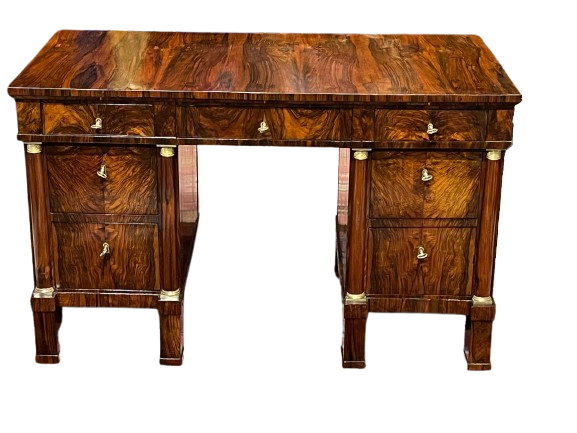
Neoclassical Venetian Empire freestanding double-pedestal desk in feather-veined walnut
- Primary timber: feather-veined walnut veneer (book-matched alignment)
- Secondary timber: solid walnut single-board sheets (drawer casings and linings)
- Metalwork: chased gilt-bronze (capitals) and hand-wrought cased iron (locks)
- Dimensions: 128 x 67.5 x 78 cm
- Period: early nineteenth century (Empire / early Restoration, circa 1805-1820)
- Provenance: Italy, Veneto region (Paduan circle)
- Condition report: excellent, historic surface wear and minor micro-scratches, untouched original patina, free from aggressive modern interventions
The Empire aesthetic in Venetian joinery: a historical-artistic analysis of a Paduan desk in feather-veined walnut
Introduction and historical-political context: the spread of the Empire style in Northern Italy
The Empire style represents one of the moments of maximum cohesion between political propaganda, decorative arts, and architecture in nineteenth-century Europe. Born in Paris and inextricably linked to the meteoric rise of Napoleon Bonaparte, from his imperial coronation in eighteen hundred and four until the definitive fall of the regime in eighteen hundred and fifteen, this expressive language did not remain confined within French borders. On the contrary, it rapidly radiated into satellite territories and kingdoms influenced by the Napoleonic campaigns. In the Italian context, and particularly within the Venetian territory and the Paduan area, the reception of the Empire style underwent a peculiar stylistic evolution. Although the congress of Vienna in eighteen hundred and fifteen had sanctioned the transfer of Veneto under the control of the Austrian Empire, establishing the newly formed Kingdom of Lombardy-Venetia, the echo of French neoclassical taste continued to exert a profound influence during the first two decades of the nineteenth century. The cultured Paduan patronage, closely linked to the historic university and an educated landed aristocracy, found in the sober, geometric, and monumental lines of Empire furniture the ideal reflection of a rigorous social and cultural status. A lesser-known historical curiosity reveals that the adoption of this aesthetic in Padua was also fueled by the passage through the city of Viceroy Eugène de Beauharnais himself, who, during his official visits and stays in the grand villas along the Brenta, favored local cabinetmakers to commission furnishings capable of competing in dignity with Parisian ones. This established a genuine channel of cultural transmission, prompting Paduan artisans to study the transalpine repertoires described in the famous pattern books of Charles Percier and Pierre-François-Léonard Fontaine, Napoleon's personal architects, while readapting them with an exquisitely local and less militaristic sensibility.
The socio-cultural and political period of the Restoration and the Kingdom of Lombardy-Venetia
The two decades spanning from eighteen hundred to eighteen hundred and twenty are split almost symmetrically into two opposing political phases, which left an indelible mark on the material culture of the era. Until eighteen hundred and fourteen, during the first phase, Padua and the Veneto were part of the Napoleonic Kingdom of Italy, a satellite state with Milan as its capital, where furniture was considered not merely decorative but a political manifesto designed to project the concept of a solid, centralized, and monumental power, directly linked to the grandeur of the Roman Empire. Beginning in eighteen hundred and fifteen, with the advent of the Restoration and the establishment of Habsburg rule, the desk under examination was crafted precisely during a delicate phase of cultural transition. While its formal structure maintained a strict Napoleonic rigor, local patrons and Venetian artisans began to purge the furniture of French militaristic excesses, favoring a restraint that anticipated the pragmatism of the Central European bourgeoisie. The definitive fall of the Republic of Venice in seventeen hundred and ninety-seven had already dismantled old patriarchal balances, fostering the emergence in Padua of a new, cultured, and dynamic ruling class consisting of Enlightenment-inspired landowners, magistrates, lawyers, and university professors elevated by bureaucratic meritocracy. For this specific elite, the freestanding desk became the ultimate status symbol. It was no longer the fragile and purely decorative writing table of the eighteenth century, but an imposing and rational piece of furniture that expressed wealth not through outward ostentation, but through solidity, substance, and absolute quality. In an era when private finances had to be reorganized after heavy war taxes imposed by both the French and the Austrians, investing in a piece with such a superb structural framework was also a choice of extraordinary economic foresight, a way to anchor patrimonial value in a durable asset destined to withstand the storms of the Restoration.
Historical context of use and the modern living space
Until the late eighteenth century, writing furniture was often designed to be placed against walls, integrating into wood paneling or being easily moved around salons according to the requirements of aristocratic sociability. With the advent of the Napoleonic era and the subsequent Restoration, the domestic layout underwent a fundamental transformation that saw the birth of the study, or cabinet, as an autonomous and specialized room. This space was no longer a place of mere leisure, but the nerve center for estate management, political affairs, and intellectual activity, an environment where the desk permanently abandoned the wall to occupy the geometric center of the room, becoming the visual and symbolic anchor around which the entire setting revolved. A fascinating anecdote related to the daily life of grand Paduan families of the period recounts how access to these private offices was governed by a strict ceremonial protocol. The freestanding pedestal desk, strategically positioned between the windows and the entrance door, served as a literal hierarchical and relational barrier between the master of the house and his interlocutor. Anyone entering the study faced the piece in its full monumental presence, immediately perceiving the authority of the individual seated behind it. The furniture required a three-hundred-and-sixty-degree operational space, as the owner sat on the inner side, having immediate access to the intricate arrangement of seven drawers to archive confidential documents, ledger books, and correspondence related to the administration of nearby agricultural estates in the lower Paduan plains. The outer side, facing the guest, presented itself instead as a severe and visually arresting surface due to the superb figure of the feather-veined walnut, illuminated by natural light pouring from the tall windows of Paduan palaces, brightening dense manuscripts and accentuating the gilded reflections of the bronzes.
Morphological analysis and the freestanding pedestal typology
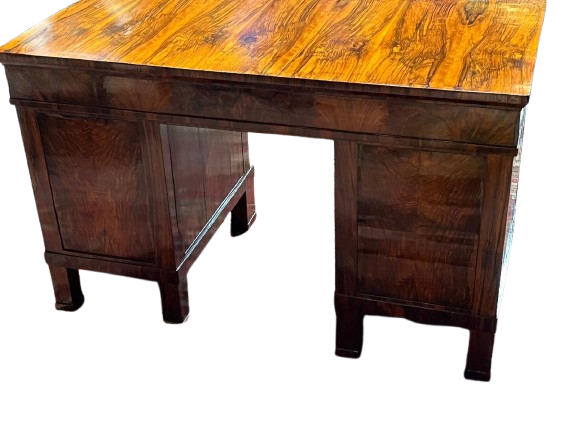
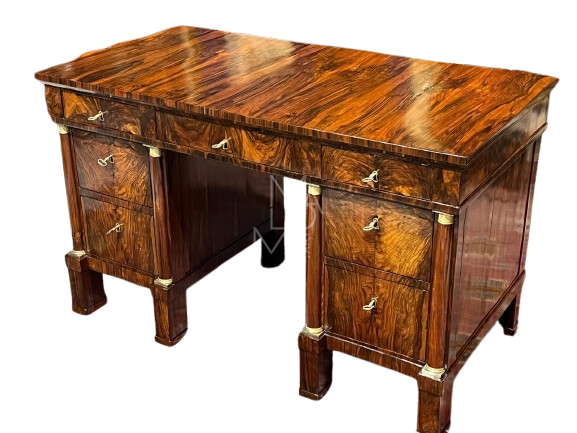
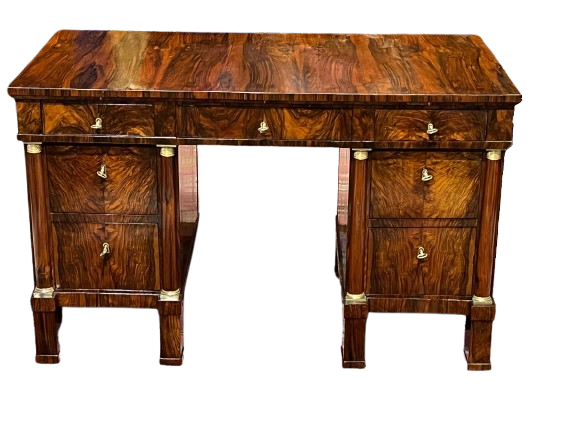
The object under examination is configured as a monumental freestanding pedestal desk, whose dimensions of one hundred and twenty-eight centimeters in width, sixty-seven and a half centimeters in depth, and seventy-eight centimeters in height conform to precise canons of ergonomic functionality and geometric symmetry typical of the early nineteenth century. The architectural structure is articulated according to the classical double-pedestal typology, designed to stand independently within a study or salon, offering a complete aesthetic perspective from every angle. Projecting a piece of freestanding furniture represented the ultimate challenge for a cabinetmaker within the Paduan circle, as it eliminated the possibility of concealing less noble structural components. Unlike wall furniture, whose backs were historically left in raw wood, a freestanding desk demanded a comprehensive and homogeneous finish on all four sides, which had to be veneered in feather walnut with the same millimetric precision reserved for the front. The double-pedestal morphology masterfully resolved issues of stability and ergonomics, since the two lateral blocks housing stacked drawers functioned as solid structural pillars that transferred weight to the floor via square-section legs. The central kneehole space was calibrated to ensure postural comfort for those writing for extended hours, whilst also serving as a visual lightener that broke up the overall mass of the furniture. On the front, the configuration is rigidly defined by an upper frieze housing three aligned drawers and lower lateral pedestals with two pairs of stacked drawers, flanked by vertical architectural elements. The structure of the back reveals that the cabinetmaker chose not to simulate false drawers, opting instead for a rigorous architectural resolution based on the symmetry of pure volumes, where the two lateral bodies are finished with two large geometric rectangular panels defined by subtle raised moldings applied around the perimeter, explicitly evoking classical paneling and smooth rustication.
Feather-veined walnut: cabinetmaking, material selection, and veneering techniques
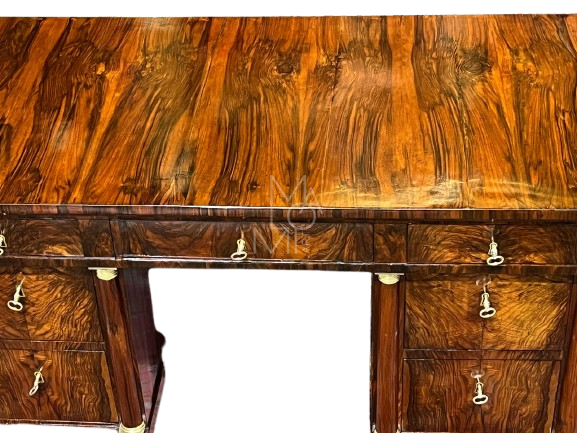
From a material perspective, the piece celebrates the mastery of Venetian cabinetmaking through the expert use of feather-veined walnut. This particular wood selection is harvested from the section of the trunk where the main branches fork, where the fibers, compressed and deflected in their natural growth, generate a symmetrical, iridescent grain with undulating and flamed patterns resembling the softness of plumage. The execution technique involves veneering, wherein thin sheets of feather walnut are applied over a solid carcass of solid wood, ensuring stability over time against hygrometric warp. While the visual impact on the front is fragmented by drawer openings, keyholes, and half-columns, the back reveals itself as the true pictorial stage of the piece, as the artisan was able to fully express the veneering technique by arranging the feather walnut sheets on the two vertical blocks according to the book-matching method. The veneer sheets, cut consecutively from the same flitch of wood, were placed mirror-like against each other, creating a symmetrical design where dark flames emphasize the verticality of the two lateral pillars, while on the top surface the grain extends longitudinally, establishing a directional contrast of extraordinary luminous dynamism. An antiquarian note of interest concerns the origin of these timbers, as walnut trees of exceptional vigor grew in the environs of Padua, along the banks of the Bacchiglione river and within rural hinterland estates. Local cabinetmakers jealously guarded the secrets of cutting these crotches, and workshop lore dictates that the most precious trunks were left to season sheltered from the bitter bora winds for over a decade before being sliced into veneer, thereby ensuring that the natural pattern of the fiber would undergo no distortion during the hot-gluing process using animal bone glue.
Internal structures: walnut as a secondary wood and joinery expertise
The presence of walnut as a lining or secondary wood for the internal structures of the drawers, comprising the linings, backs, and bottoms, constitutes an indicator of extraordinary critical significance. This choice elevates the classification of the artifact to a level of exceptional execution and elite commission, differentiating it sharply from common coeval production that utilized inexpensive or readily available local woods such as poplar or fir. In nineteenth-century cabinetmaking, the use of solid walnut even for internal parts not visible from the exterior was a luxury reserved exclusively for high-status furniture, fulfilling a principle of total aesthetic and qualitative coherence where the piece had to prove flawless to both sight and touch upon opening. From a strictly technical standpoint, utilizing walnut for internal linings offered enormous structural advantages, ensuring a consistently smooth glide of the drawers over time and permitting the cabinetmaker to execute dovetail joints that were extremely fine, crisp, and geometrically perfect. The presence of a drawer bottom obtained from a single wide board of walnut is an exceptional trait for a piece of furniture of these dimensions, indicating that the cabinetmaker had access to centennial logs that were healthy and free of central knots. Cutting and seasoning walnut boards of such width required years of air stabilization to prevent the wood from warping or splitting, an execution choice that, beyond incurring a staggering material cost for the period, guarantees perfect planarity of the bottom, eliminating the risk of splitting along the joint lines typical of multi-panel linings. This detail confirms that the executing Paduan workshop did not operate on provincial serial models but competed directly with the qualitative standards of major European manufacturing centers such as Milan, Vienna, or Paris itself.
The decorative apparatus and mechanical locking devices
The desk translates the principles of classical Greco-Roman architecture into micro-architectural furniture components. The facade of the piece is rhythmically articulated by four cylindrical half-columns positioned flanking the stacked drawers, elements that act as visual pillars linking the upper frieze to the base. The intersection between wooden rigor and the ornamental apparatus is represented by metal details, prominent among which are the capitals at the summits of the half-columns, crafted in chased bronze and enhanced with gilded finishes that contrast chromatically against the dark tone of the walnut with decorative motifs derived from the ancient classical repertoire, alongside keyhole escutcheons that maintain a discreet and geometric profile. The entire structure transfers its weight to the ground through square-section block feet, a stylistic choice for the base that departs from the bracket or saber feet of the preceding neoclassical period, preferring a solid block that accentuates the sense of stability typical of formal furniture from the first two decades of the nineteenth century. The iron lock boxes, applied or mortised into the wood, represent the perfect technological transition point of the early nineteenth century, being entirely hand-forged and filed by the blacksmith, with a robust protective casing enclosing the internal mechanisms of springs, bolts, and tumblers. Hand-wrought iron guaranteed resistance to wear and tampering infinitely superior to subsequent late nineteenth-century industrial productions made of stamped sheet metal or cast brass, and the fact that they have survived unaltered and preserved attests to the care owners bestowed upon the furniture across centuries, blending the robustness of eighteenth-century manufacturing traditions with the geometric precision of the nascent industrial age.
State of conservation, philological restoration, and scientific conclusions
Close observation of light reflecting across the finish reveals slight irregularities, minor historical signs of wear, and superficial micro-scratches accumulated over generations, traces that bear witness to hours of labor, the movement of manuscripts, and the placement of inkwells or metal signets by officials who owned the furniture in nineteenth-century Padua. The presence of these micro-fissures rules out aggressive restorations or modern machine sanding, which would have stripped away the top layer of the veneer, obliterating the historical and antiquarian value of the desk. The vibrant yet non-vitreous sheen of the top indicates that the piece has been preserved using the traditional spirit and shellac French-polishing method, a treatment characteristic of nineteenth-century cabinetmaking that accentuates the three-dimensional depth of the feather walnut, highlighting tonal transitions from light to dark fibers. This method protects the wood without entirely sealing its pores, allowing the raw material to continue to breathe and shift in tone over time, harmonizing perfectly with the bronze mounts and hand-wrought iron lock boxes analyzed previously, resulting in an artifact of coherent and philologically flawless aesthetics. In light of this evidence, the profile of the desk is defined as a total work of art in the field of high Venetian craftsmanship. While the exterior adheres to the aesthetic tenets of French Napoleonic Neoclassicism, the interior reveals its deeper and proudly local structural essence, where the use of single-board walnut for the bottoms and the selection of hand-wrought iron lock boxes preclude any hypothesis of serial production or late nineteenth-century revival styles. We are before a luxury artifact commissioned in the early years of the nineteenth century by a patronage that spared no expense, realized by a premier Paduan workshop staffed with exceptional artisans capable of mastering both wood and iron with an executive rigor worthy of the great cabinetmakers of the court.