Neoclassical bronze sculpture from the Moreau school: the pensive idea
- Artist: school of the Moreau brothers (Mathurin Moreau, 1822–1912 / Auguste Moreau, 1834–1917)
- Attributed title: the pensive idea (seated female figure in meditation)
- Period: nineteenth century, circa 1865–1885 (transitional period between the Second Empire and the Third Republic)
- Materials: sand-cast bronze with two-tone patina (patine médaillée and dark brown), shaped base in polished black marble, original coeval hand-forged iron hardware
- Dimensions: 28 cm (width) x 15 cm (depth) x 30 cm (height)
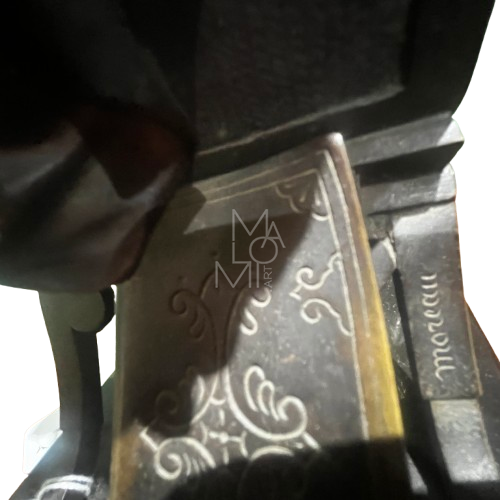
- Signature: "Moreau" incised in cursive script on the right flank of the chair
- Condition report: excellent; original patina intact with minor historical highlights on the drapery ridges; marble base intact; internal mounting hardware fully original with no modern alterations or replacements
Short critical description
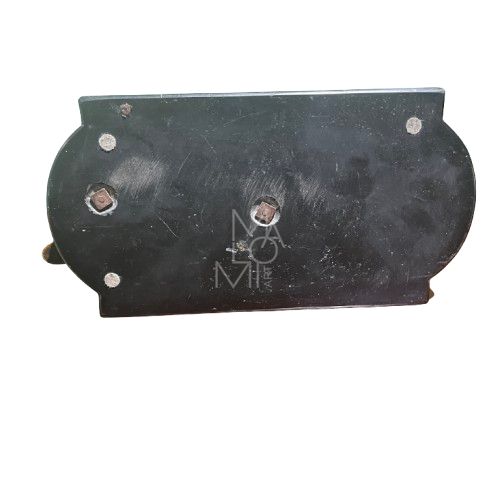
a refined nineteenth-century French salon bronze sculpture depicting an allegorical female figure or classical muse in a meditative pose. The work epitomizes the aesthetic synthesis of French eclecticism, blending academic proportional rigor derived from Praxitelean prototypes (specifically referencing the iconography of the Diana of Gabii) with the fluid decorative treatment of the drapery, which is enriched by hand-chased Greek key and meander borders. The presence of original square-profile wrought iron nuts underneath the base confirms the absolute material authenticity and historical integrity of the artifact.
The Pensive Idea: A Historico-Critical Analysis of the Neoclassical Bronze Sculpture from the Moreau School
Typological Contextualization and the Tradition of the Melancholy Muse
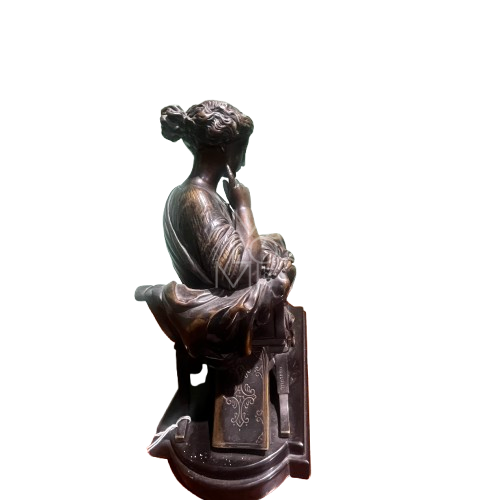
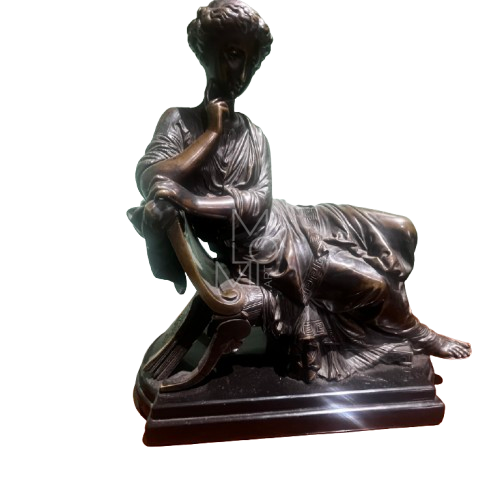
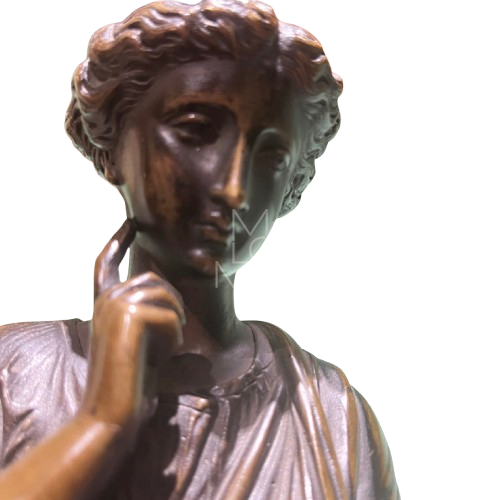
The work under examination holds a distinguished place within the refined and complex corpus of nineteenth-century European salon sculpture. This period was characterized by a profound, nostalgic classicist revival that intertwined closely with the celebration of intimate, elegiac drama rooted in the Romantic sensibility. The composition features a female figure draped in a virtuoso chiton and himation of strict Greek orthodoxy, captured in a moment of intense, solitary interiorization.
The iconography of the seated woman, her face gently propped upon her hand and her gaze lost in the void of memory or melancholy, directly evokes the grand Neoclassical and Romantic prototypes of the first half of the nineteenth century. Most notably, it recalls the celebrated historical formulations of the Swiss sculptor James Pradier, whose memorable interpretations, such as Sappho or Nemausa, captivated the Parisian public. This pose, recognized since Roman antiquity and later codified during the Renaissance as the classic attitude of Melancholia or the meditative muse, sheds the monumental severity and reverential awe of large-scale public commissions. Instead, it adopts an intimate grace perfectly suited to ornamenting and ennobling the private interiors of the burgeoning nineteenth-century high bourgeoisie.
Behind the popularity of this specific meditative stance lay a curious literary fashion of the period. Mythological figures, particularly the muses Clio or Calliope, were no longer viewed as distant divinities but rather as ideal intellectual companions for the scholars of the era, capable of evoking a philosophical quietude amidst the urban chaos brought about by the Industrial Revolution.
The Socio-Political Context Between the Second Empire and the Third Republic
To fully comprehend the genesis and profound significance of this artistic bronze, it is indispensable to contextualize it within the complex, vibrant socio-political transition that swept through France between the Second Empire of Napoleon III and the opening decades of the Third Republic. This specific forty-year span of European history was marked by the definitive and unstoppable rise of the industrial and financial grande bourgeoisie. Having consolidated unprecedented economic power through railways, mining, and banking speculation, this new social class sought cultural legitimization and an affirmation of its status through the domestic display of luxury, taste, and knowledge.
The very concept of interior furnishing underwent a radical revolution during these years. The home ceased to be a merely functional space or a private refuge, transforming instead into a veritable visual stage—an encyclopedic microcosm dominated by the Eclectic style, occasionally referred to as the Napoleon III style. Within this domestic theater, the invocation of classical antiquity no longer carried the moral severity, archaeological rigor, or revolutionary intent that had characterized late eighteenth-century Neoclassicism under the influence of Jacques-Louis David. Instead, it became an attribute of intellectual prestige and cultivated decorum.
Possessing a small bronze from the Moreau school depicting an allegorical figure, meticulously positioned on the marble mantlepiece of the reception salon or upon the mahogany desk of a personal library, immediately signaled to visitors that the master of the house was not merely a pragmatic, self-made businessman, but also a refined connoisseur of letters, history, and the fine arts. Salon sculpture thus functioned as a form of visible cultural capital, redeeming the sometimes humble or purely mercantile origins of the new industrial elite.
A curious phenomenon linked to this period was the collecting fever that gripped Parisian salons, leading them to compete fiercely in the accumulation of small bronzes. Contemporary chronicles frequently satirized these salons, describing them as miniature museums where even the physical space for movement was sacrificed in the name of artistic exhibition.
Formal Syntax and the Postural Analysis of Dynamic Equilibrium
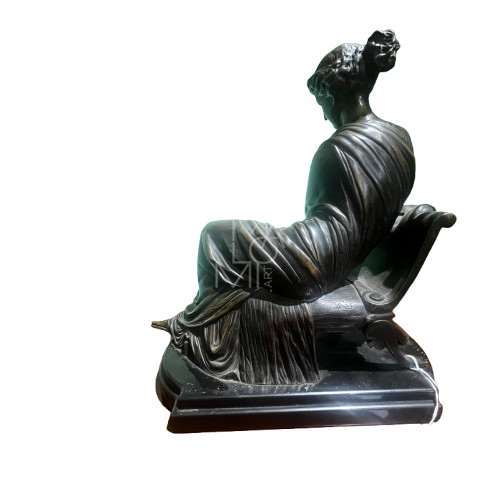
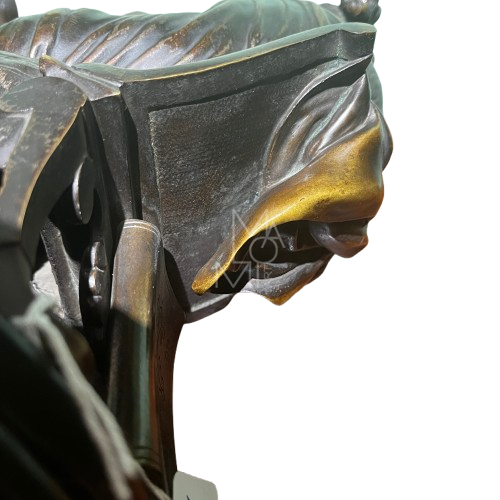
From a strictly compositional standpoint, the sculpture is organized around a skillful sequence of diagonal lines and opposing curves that guide the viewer’s eye along the contours of the flexed figure. The woman is seated upon a refined chair that closely mirrors the forms of the classical klismos, enriched by fabrics and drapery that fall softly over it, tempering the rigidity of the object’s structural lines.
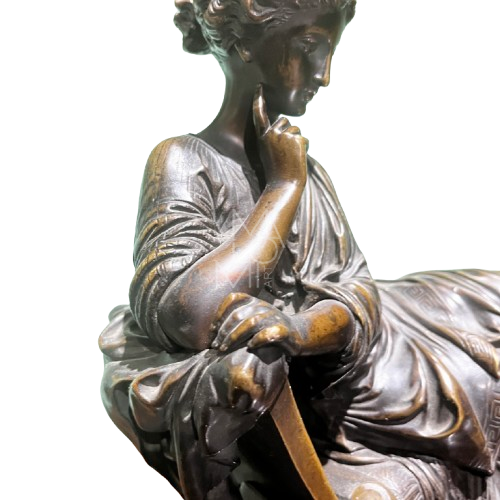
The posture of the female figure represents an authentic masterpiece of dynamic equilibrium within a pose that, upon superficial inspection, might appear purely static. The sculptor deliberately chooses to portray the woman in a position of asymmetric rest that unfolds along a complex diagonal spatial coordinate. The weight of the upper body shifts entirely to the right side, where the elbow rests firmly upon the curved backrest of the chair, while the forearm flexes upward in a taut line. The right hand, placed in high prominence, grasps the upper rim of the furniture with a sculptural, firm, and natural grip, serving as the primary anchor of stability for the entire upper torso. The index finger rises to brush the cheek gently, establishing a formal and conceptual continuity between the physical action of the body and the intellectual activity of the mind.
This hand is by no means inert or abandoned; it actively participates in the reflective effort, suggesting that the internal cognitive process of the subject is vivid, profound, and in full animation. In perfect contrast to this visible intellectual tension of the torso and face, the pelvis and lower limbs rotate and extend in the opposite direction, toward the viewer's left, expressing a sense of absolute release and relaxation. The legs are elongated, almost sliding laterally from the seat, and the feet softly overlap one another, yielding to the force of gravity and creating a sinuous line that softens the dramatic concentration of the upper body.
This dualism between the vigilant mind and the body at rest represents the stylistic hallmark through which the Moreau school successfully translates the abstract, elusive concept of melancholy meditation, transforming metal into a mirror of the soul.
Anatomical Morphology and the Idealization of Physiognomic Features
Morphologically, the figure expresses an admirable synthesis between the proportional rigor learned in the academies and the idealized softness typical of grand nineteenth-century statuary. The woman's anatomy does not exhibit marked musculature, nervous tension, or realistic angularities that might disrupt the harmony of the vision. On the contrary, the contours of the body are modeled through smooth, gentle, and continuous volumetric transitions. The shoulders are delicately rounded, and the neck displays a graceful elongation that enhances the complex twist of the head toward the right shoulder. The hands and feet, notoriously difficult and intricate areas in bronze casting, reveal an extraordinary anatomical attention that attests to the high level of the artisans involved. The fingers of the right hand are slender, elegant, and aristocratic, while the visible left foot in the foreground shows a bone and plantar structure defined with extreme verisimilitude, without ever sliding into crude verism.
A close examination of the face reveals the deep and conscious adherence of the work to the timeless canons of fourth-century BCE Greek sculpture, filtered through the emotional lens of French Romantic sensibility. The face offers itself to the viewer with features marked by an idealized, almost divine, and timeless beauty, devoid of intense passionate or dramatic expressions, yet imbued with a composed and sweet melancholy. The straight profile that continues almost in a straight line from the forehead, universally known as the Greek profile, the thin lips slightly parted in a serene expression, and the perfect oval shape of the face directly recall Praxitelean statuary.
In particular, the sculpture shows a precise iconographic derivation from the celebrated prototype of the Diana of Gabii, an ancient sculpture discovered in 1792 and preserved in the Louvre Museum, which became an absolute reference point for generations of artists. The resemblance is especially noticeable in the shape of the orbital cavities and the delicate turn of the neck. The hair is treated with exceptional plasticity and volumetric richness. The coiffure is parted centrally and arranged in soft, wavy locks that frame the temples and forehead, before being gathered at the back of the head into an elaborate, high, richly braided chignon. This feature imparts a further vertical elegance to the head and breaks the potential rigidity of the metal through a vibrant play of light and shadow.
The Virtuosity of the Drapery and Classical Micro-Ornamentation
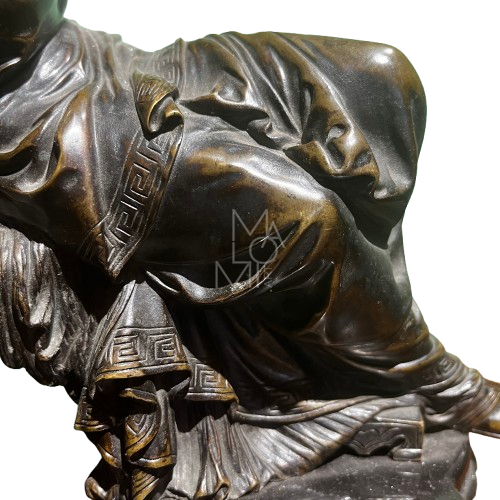
The treatment of the garments constitutes one of the technical and formal pinnacles of the entire sculpture. The folds of the fabric do not conceal the underlying anatomy, but follow its volumes with a grace reminiscent of the masters of classicism. This creates a vibrant chiaroscuro contrast between the zones of deep shadow and the illuminated ridges of the casting. The bronze patina, expertly rubbed on the most prominent ridges according to a technique known as patine médaillée, catches the ambient light and creates warm golden and coppery reflections that surface from the dark dark base. This device simulates with extraordinary efficacy the weight and silken texture of a himation of fine wool or a rich ceremonial textile of classical antiquity.
Along the borders of the fabrics that fall over the chair and wrap around the woman's body, the sculptor has inserted a refined, meticulous decoration of a Greek key or meander, the geometric motif par excellence of Greek and Etruscan art. The extraordinary regularity of the incised lines, which follow the soft curves and sudden undulations of the folds without ever undergoing gross perspective distortions, highlights the minutely detailed work and steady hand of the chaser in the foundry. This specialized artisan reworked and refined every single geometric segment with a burin after casting, correcting the imperfections of the raw metal. In the lower section, the main drapery is interrupted by a cascade of tighter, thinner, and almost crimped folds. This refined expedient creates a marked material differentiation between the enveloping cloak and the undergarment, giving the work a remarkable sensory variety and a visual richness that elevates the overall quality of the ensemble, sharply distinguishing it from the later and simplified serial castings of the early twentieth century.
An interesting anecdote related to these geometric decorations concerns the catalogs of nineteenth-century foundries, which offered price variations depending on the complexity of the chasing requested by the buyer, transforming the Greek key into a literal indicator of the object’s luxury status.
Critical Attribution Within the Moreau Dynasty
The presence of the autograph signature Moreau, sharply incised in an elegant cursive script on the lateral bronze slat of the chair, allows the work to be firmly anchored within the production of one of the most celebrated, influential, and prolific dynasties of French sculptors of the nineteenth century. Originally from Dijon and later establishing themselves in Paris to attend academy courses, the Moreaus dominated the landscape of decorative sculpture and the official Salons in the second half of the nineteenth century, led by the three brothers Mathurin, Hippolyte François, and Auguste.
A cross-morphological analysis and stylistic study reveal that the sculpture represents a sophisticated meeting point within the production and sensibility of this artistic family. On one hand, the austere solemnity of the pensive figure, the geometric purity of the coiffure, and the presence of rigorous classical decorative elements belong strictly to the stylistic DNA of the eldest brother, Mathurin Moreau. Mathurin was an artist renowned for his institutional and monumental neoclassicism, awarded the prestigious Prix de Rome and author of famous public statues that still adorn the facade of the Paris City Hall and the Musée d'Orsay today. On the other hand, the synthetic signature in a fluid cursive, lacking initials or an extended first name, indicates with high probability that the model, though conceived in the noble and monumental spirit of Mathurin, was cast, finished, and marketed by the organizational structure of the Moreau workshop to satisfy the pressing demand of the Parisian decorative arts market during the prosperous period of the Third Republic.
This practice of collaboration and sharing models within the same family workshop was extremely common in the Paris of that era, and the Moreau brothers were known to exchange advice and assistants to cope with the influx of commissions arriving not only from France, but from all over Europe and even the Americas.
Material Aspects and the Technology of Sand Casting
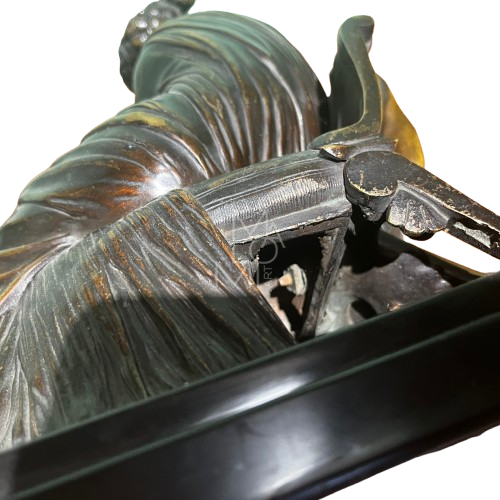
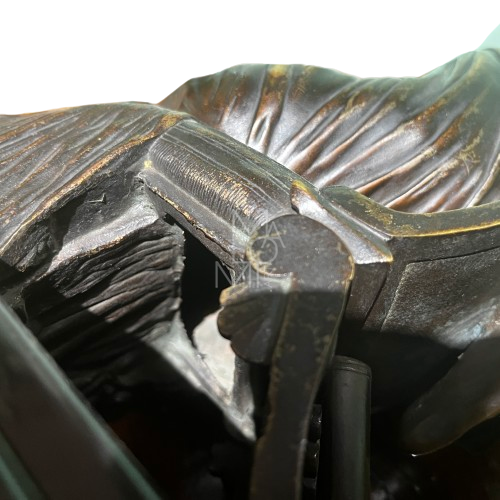
The work, boasting calibrated proportions equal to twenty-eight centimeters in width, fifteen centimeters in depth, and thirty centimeters in height, presents itself mounted on a solid, shaped base of polished black marble, a stone highly favored at the time for its ability to reflect light and accentuate the dark tone of the metal. A close view of the interior of the metallic structure lays bare the object’s mechanical skeleton, revealing fascinating details about the technology of the period and confirming that the sculpture is not a single-block casting. Instead, it is a sophisticated modular assembly composed of elements cast separately and subsequently joined with millimeter precision.
The hollow interior of the figure shows bronze walls of a consistent, calibrated thickness, with an internal surface characterized by the typical matte granularity that reveals the use of sand casting, or fonte de sable. This foundry technique reached the pinnacle of its technological perfection and widespread use precisely in nineteenth-century France, as it allowed an extremely faithful reproduction of the plaster or wax model executed by the sculptor, minimizing the risk of metal deformation. The backrest and sides of the throne are pieces cast independently, inserted into the main structure of the figure through mechanical butt joints and firmly tightened from the interior using threaded pins. This substantial internal cavity addressed specific, pressing needs of the artistic craftsmanship of the time: it reduced the overall weight of the bronze, facilitating transport; it prevented thermal stress and irregular shrinkage of the metal during the cooling phase; and it allowed the artisan assembler to tighten every bolt from the inside, leaving the exterior of the sculpture perfectly clean, immaculate, and free of visible welds or screws that would break the illusion of continuous form.
A careful examination of the lower part of the stone base brings to light the undeniable, original mounting hardware of the period. Here, the bronze is anchored to the marble by three pass-through threaded pins secured by square-profile nuts made of wrought or hand-forged iron, partially oxidized by the natural passage of time. The presence of the square nut constitutes a precise index for art historians, as the use of this specific hardware represents the industrial and artisanal standard of the nineteenth century, predominantly widespread until the 1880s, before square-headed industrial bolts and standardized machine cutting took over during the twentieth century. The lower surface of the marble also shows the typical signs of manual leveling and circular abrasion performed with traditional tools to smooth the stone, offering irrefutable proof of the authenticity and historical coherence of every single component of the artifact.
Critical Conclusions on the Object's Biography
The three-dimensional, physiognomic, and technological analysis conducted on the artifact has allowed for the reconstruction of the entire material and intellectual biography of the object, lifting the veil on the complex network of relationships between art and high industry that defined nineteenth-century Paris. Conceived according to the rigorous aesthetic canons of French academicism, cast with the flawless technical skill of sand casting, and enhanced by a cold-chasing finish that borders on virtuosity, the sculpture represents an excellent, precious fragment of the history of taste, expressly intended for the refined studies and salons of the cultured bourgeoisie.
The work succeeds in condensing within itself the aspirations of an era that sought in the classical past a spiritual guide and a symbol of stability in the face of the rapid transformations of modernity. Having reached us in conditions of exceptional historical and philological integrity, without undergoing invasive restorations or alterations to its precious original patina, the sculpture embodies the perfect point of equilibrium between the formal rigor of neoclassicism and the subtle emotional sensitivity of the late nineteenth century in Europe, reaffirming the central role of the Moreau dynasty in the history of small-scale French sculptural art.
Section A: General bibliographical sources and historical dictionaries
- Bénézit, Emmanuel. Critical and Documentary Dictionary of Painters, Sculptors, Designers and Engravers of All Times and All Countries. Paris: Gründ, 1999.
- Lami, Stanislas. Dictionary of Sculptors of the French School of the Nineteenth Century. Vol. 3. Paris: Édouard Champion, 1919.
- Pingeot, Anne, Antoinette Le Normand-Romain, and Laure de Margerie. Musée d'Orsay: Illustrated Summary of Sculptures. Paris: Réunion des musées nationaux, 1986.
Section B: Critical studies on the Moreau dynasty and nineteenth-century bronze sculpture
- Berman, Harold. Bronzes for the Salon: Sculptors and Foundries. Vol. 2. Chicago: Abage Publishers, 1976.
- Cadet, Pierre. The Bronzes of Mathurin Moreau: From Public Monument to Cabinet Sculpture. Dijon: Éditions de l'Amateur, 2002.
- Kjellberg, Pierre. Bronzes of the 19th Century: Dictionary of Sculptors. Paris: Éditions de l'Amateur, 1989.
- Richman-Abdou, Kelly. "Eclecticism and the Dematerialization of Sculpture in the Second Empire." French Art Historical Review 44, no. 2 (2018): 112–129.