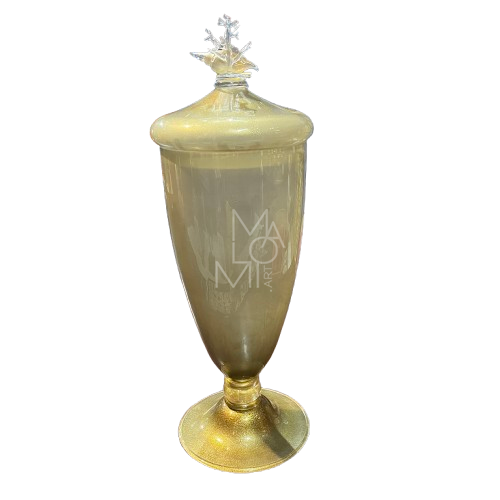
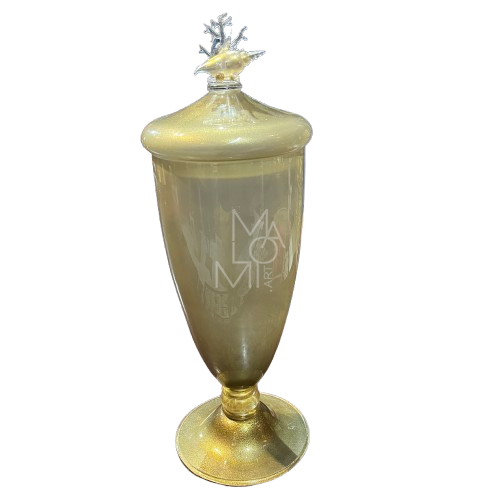
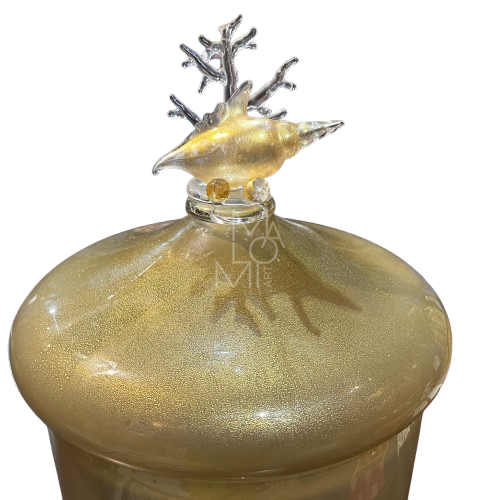
Monumental Murano glass lidded urn with marine finial: attribution to Seguso Vetri d’Arte for Lorin Marsh, New York, 1980s
- Object typology: monumental lidded exhibition urn
- Philological attribution: Seguso Vetri d’Arte manufacture
- Commission and distribution: Lorin Marsh showroom, Decoration and Design Building, New York
- Chronological placement: late twentieth century, circa 1978–1985
- Materials and glass batch: hand-blown amber-fumé glass, clear Venetian crystal, hot-fragmented pure gold leaf (gold flecks)
- Execution techniques: freehand blowing (in free air), hot-worked color gradient, solid glass modeling (vetro a massello) for the marine elements of the finial, hot-application of gold leaf for the adventurine texture
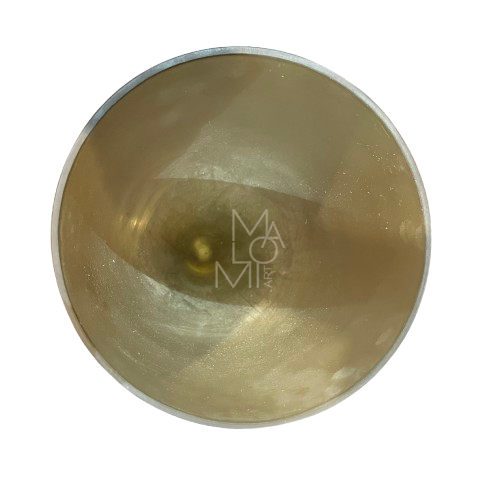
- Furnace diagnostic marks: polished and wheel-ground central pontil scar on the underside of the resting foot, fluid rotational vortex visible inside the inner cavity, complete absence of mold seams
- Condition report: excellent, free from structural fractures or thermal shocks within the hot-joined solid glass nodes
- Dimensions: height 70 cm, diameter of the resting base 25 cm
- Markings or inscriptions: unsigned artifact (highly consistent with the commercial export practices established for American interior designers of the period)
A Historico-Critical Study of a Monumental Lidded Urn in Vetro Coverto: Technological Analysis, Morphology, and Philological Attribution to Seguso Vetri d’Arte for Lorin Marsh in the Late Twentieth Century
Introduction and Typological Contextualization within the Venetian Panorama
Within the vast and heterogeneous landscape of twentieth-century decorative arts, the artifact under examination stands out with the distinctive authority of grand interior design commissions. It takes the form of a monumental lidded urn reaching a height of seventy centimeters, balanced upon a circular base with a diameter of twenty-five centimeters. Its imposing physical presence immediately evokes the splendor of major international salons, where objects of this caliber were employed as visual focal points to enhance sophisticated and exclusive residential interiors. The absence of a scratched signature or an impressed pontil mark on the underside must not be interpreted as an original defect or an indication of lesser artistic merit. On the contrary, within the methodological framework of glass art history, anonymity shifts the focus of philological inquiry onto the stylistic and technical attributes intrinsic to the material itself.
This essay aims to decode the work through the study of its physical characteristics and chromatic transitions, tracing the secrets of its complex fusion and the sculptural modeling that crowns the lid. The piece belongs to that specific current of late twentieth-century Murano production that successfully reinterpreted the memory of antiquity through the lens of avant-garde design. Objects of this scale were destined for an educated, often international clientele capable of appreciating the union between the rigor of classical geometric forms and the exuberance of plastic decoration executed entirely a caldo (hot-worked) on the furnace floor.
Morphological Analysis and the Pursuit of Ideal Proportions
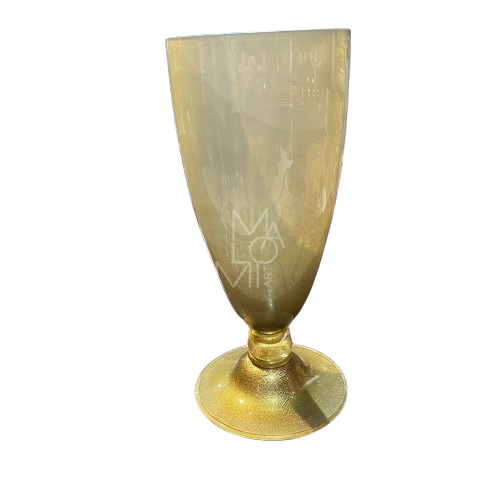
The silhouette of the primary body reveals a meticulous study of geometric proportions, recalling the formal purity of ancient potiches of Oriental provenance and the apothecary jars that populated Renaissance spice shops. The profile develops vertically, expanding with a subtle, calculated flare as it rises upward, before tapering sharply near the structural node that connects it to the foot. This transitional juncture creates a visual dynamism that lightens the volumetric impact of the goblet, making it appear almost to float above its point of support. The circular base was conceived with a wide diameter to provide the necessary static stability for a work that challenges the laws of gravity with its vertical extension. The foot expands downward in the manner of an inverted conical disk, offering a perfectly balanced resting surface.
An old historical anecdote passed down among veteran Muranese masters recounts that determining the structural connection between the chalice and the foot represented the moment of maximum stress in the furnace; a minor error in axial alignment would have irretrievably compromised the stability of the entire piece, causing it to lean during the delicate cooling phase inside the annealing ovens. The upper crowning functions as the true expressive core of the entire composition, interrupting the strict symmetry of the glass body with an explosion of free, sculptural forms that capture the viewer's gaze and guide the critical reading from top to bottom.
The Technology of the Material: Auriferous Inclusions and Fluid Dynamics
From a technological standpoint, the artifact stands as a masterful testament to the ability to govern kiln atmospheres and the interaction between the varying coefficients of thermal expansion of different materials. The base and the upper dome of the lid exhibit a dense concentration of pure gold leaf particles trapped within the thickness of the glass. This technique requires millimeter precision. The master rolls the incandescent glass bulb (bolo) over a metallic work table (bronzin) upon which a micro-thin leaf of gold has been previously laid; the subsequent inflation and pneumatic expansion of the mass cause the controlled fragmentation of the noble metal, reducing it to a shimmering dust. A curiosity related to this practice concerns the selection of the gold leaves. Glassmasters historically relied upon Venetian goldbeaters (battiloro), who hammered gold ingots until they became so thin they could float in the air at the slightest breath of wind—an impalpable consistency that allowed the gold to follow the fluid movements of the glass without tearing into coarse, unsightly shreds.
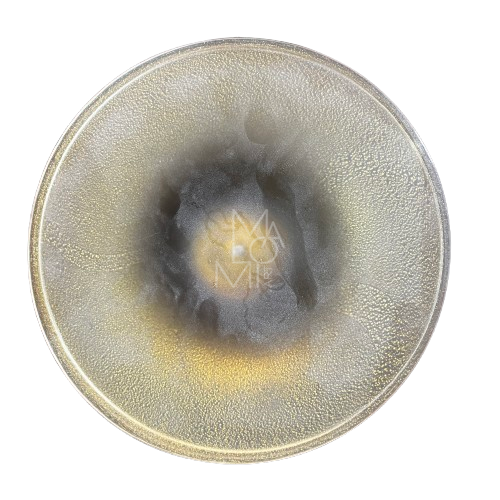
The central body of the urn manifests a chiaroscuro chromatic gradient across the expansion of its belly, fading from the warm tones of amber-gold into a neutral, semi-transparent glass coloration. An examination of the vessel's interior offers a fascinating spectacle, as the zenithal perspective reveals the rotational motion imparted by the artisan during hand-blowing. The funnel-shaped bottom converges toward a thickened central core, where a slight spiral preserves the final movement of the blowpipe. The complete absence of seam lines or internal joints confirms that the piece was shaped exclusively in free air, without the aid of molds that would constrain the natural fluidity of the molten matter.
The Sculptural Crowning and the Virtuosity of Three-Dimensional Modeling
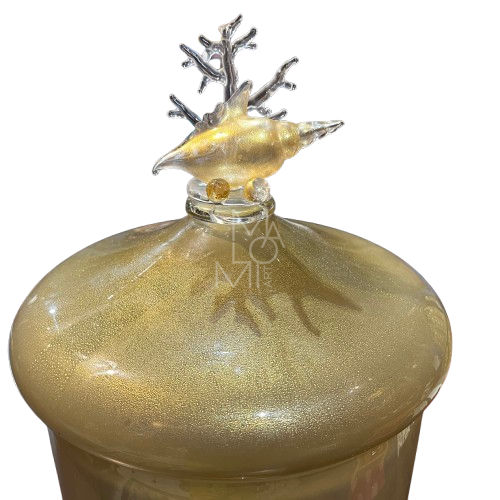
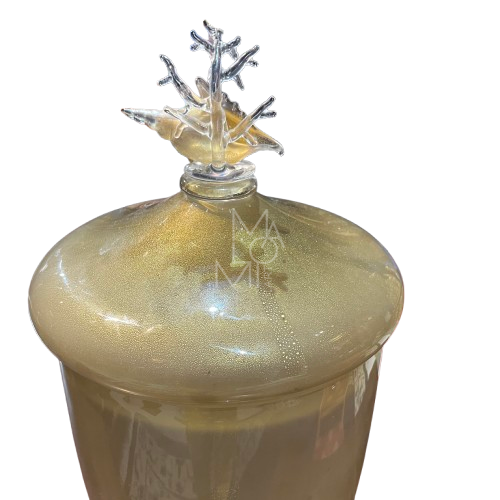
The decorative pinnacle of the work resides in the finial of the lid, where the rigid geometry of the chalice yields to a plastic narrative inspired by the seabed. The composition is articulated through the juxtaposition of two main figurative elements, executed with radically different technical approaches. Rising in the background is a coral branch made of pure, clear glass worked a massello (solid glasswork). This sculpture is not hollow; it is formed from a solid block of glass that the master stretched, constricted, and shaped freehand using traditional tongs. In the foreground stands a gastropod seashell that mirrors the chromatic vocabulary of the base through a dense infusion of gold dust.
The rotation of the lid reveals a calculated interplay of optical shielding and luminous refractions. When the urn is observed from varying angles, the transparent coral shifts in front of the shell, acting as a natural prism that captures ambient light and softens the metallic opulence of the background element. The entire sculpture rests upon a system of alternating glass spheres that elevate it from the surface of the lid, creating an air gap that projects delicate shadows onto the hemispherical dome below. A well-known studio anecdote notes that interior designers of the 1970s favored these marine asymmetries precisely because they reflected the era's interest in organic and biological forms, breaking the monotony of modernist interiors with a touch of typically Venetian naturalistic stravaganza.
Interaction with the Industrial Archaeology of the Underside and Pontil Analysis
The perital investigation cannot overlook a close analysis of the base, which preserves the tangible traces of the artifact's creation. At the exact center of the foot, a circular, matte scar is clearly visible, which was subsequently ground and polished to a mirror finish using stone wheels and abrasive powders. This mark represents the point of detachment from the pontil—the solid iron rod applied to the bottom of the object to hold it while the upper section is opened and refined. In glasswork of exceptional quality, removing the raw scar is an indispensable operation, not only for aesthetic reasons but to ensure the perfect planarity of the base.
A curiosity linked to this phase concerns the inherent risk of grinding monumental pieces. Because the urn weighs several kilograms and extends significantly in height, the master grinder had to support the entire artifact with outstretched arms against the rotating wheel, balancing the pressure with extreme sensitivity to prevent excessive friction from heating the glass locally, which would cause a catastrophic thermal fracture in a work near the end of its production cycle. The asymmetric irradiation of the gold dust observed from the bottom further attests to the handmade nature of the piece, illustrating how the density of the metal reflects the fluid streams driven by the master's hands during shaping.
Critical Attribution and the Historical Bond Between Seguso Vetri d’Arte and Lorin Marsh
An in-depth stylistic analysis and the cross-referencing of physical evidence resolve the attributive enigma, leading to a well-defined historical-artistic placement within the final quarter of the twentieth century. The intrinsic characteristics of the artifact confirm its authorship as a work executed by the celebrated furnace Seguso Vetri d’Arte for the exclusive New York interior design firm Lorin Marsh. This attribution is based upon a rigorous reconstruction of the production context of the period and the commercial customs linking Murano to the overseas luxury market.
Founded in Manhattan in 1975 by Sherry Mandell and Caryn Schacht, the firm Lorin Marsh established its showroom within the renowned Decoration & Design Building (D&D Building), becoming the premier destination for the most prominent interior architects of the American elite. The firm's business model did not include in-house manufacturing; instead, they commissioned monumental furniture and complements, executed to the exclusive designs of their creatives by the finest art ateliers globally. For artistic glassware, Lorin Marsh chose to rely upon the technical genius of Seguso Vetri d’Arte, a Muranese furnace that possessed the crucibles, thermal infrastructure, and masters endowed with the physical strength and experience necessary to govern complex blowings on a monumental seventy-centimeter scale.
The philological convergence between the urn under examination and documented models from this historic collaboration lies precisely in the iconographic program of the lid. The three-dimensional combination featuring the hot-application of solid marine elements (the gold-flecked shell shielded by pure crystal coral) atop a monumental structure with a sfumatelo or amber-fumé gradation constitutes the visual and structural signature of the design pieces distributed by Lorin Marsh between the late 1970s and the mid-1980s.
The absence of signatures or marks on the underside finds an impeccable historical-commercial justification within this specific business relationship. High-end interior decoration showrooms contractually required Muranese furnaces to omit original factory branding. This marketing strategy aimed to preserve the exclusivity of the atelier's design, preventing clients and competitors from tracing the pieces directly back to the production source, thereby cloaking the work in a sophisticated anonymity that allowed the artifact to be presented as a unique gallery piece. The exceptional control of the vertical axis and the calculated distribution of the gold dust confirm execution under the supervision of a first-rate master within the Seguso roster, establishing this urn as a precious and complete document of the golden age of Italian artistic export.
Concluding Considerations on the Permanence of Tradition
The comprehensive examination of the urn allows for a definitive critical judgment regarding its historical and artistic value. The artifact stands as a admirable synthesis of the technical heritage of the lagoon tradition and the aesthetic demands of contemporary connoisseurship. Despite the absence of an engraved name on the base, the work speaks the cultured language of grand Muranese manufacturing. The masterful management of volumes, the static balance achieved upon a twenty-five-centimeter base, the command over the application of gold leaf, and the virtuosity demonstrated in the three-dimensional modeling of the solid coral all concur in establishing the piece as the work of a premier furnace. The urn is not merely a monumental decorative object, but a true monument to the ductility of glass, capable of transforming from an incandescing, formless mass into an architecture of light and reflections that continues to bear witness, decades later, to the timeless genius of the glassmasters of Murano.
Historiographical Appendix on Working and Melting Techniques
To fully comprehend the execution of the work, it is necessary to examine the theoretical and historical aspects connected to the fabrication of solid glass (vetro a massello) and the methodology governing the use of metals in the glass furnace. The massello technique revolutionized Muranese aesthetics starting in the 1930s, introducing the concept of monumental sculpture to a world previously dominated by lightness and geometric thinness. This evolution required a profound revision of the chemical composition of glass batches, as glass intended to remain solid must possess an extraordinarily high refractive index and absolute transparency, free from impurities or unwanted air bubbles.
In parallel, freehand blowing represents the ultimate expression of the artisan's creative freedom, as the master must constantly anticipate the reactions of the material while it cools, calibrating the rotational speed of the blowpipe and the intensity of their breath. The history of these techniques is intertwined with the human stories of entire generations of masters who passed down the secrets of batch compositions and melting times from father to son, often guarding their formulas under a veil of total secrecy. This urgency to preserve the exclusivity of their craft helped create the myth of Murano as an island of secrets and everlasting beauty—a myth of which the examined urn constitutes a tangible and extraordinarily fascinating visual example.
Bibliografia di riferimento / Reference Bibliography
Barovier Mentasti, Rosa. 1982. Il vetro veneziano: dal Quattrocento al Novecento. Milano: Electa.
(Venetian Glass: From the Fifteenth to the Twentieth Century).
Barovier Mentasti, Rosa, e Pietro Pazzi. 2004. Le arti decorative veneziane del Novecento. Venezia: Stamperia di Venezia.
(Twentieth-Century Venetian Decorative Arts).
Deboni, Franco. 1996. Murano '900: Vetri e vetrai. Milano: Bocca Editori.
(Murano '900: Glass and Glassmakers).
Dorigato, Attilia. 2003. L'arte del vetro a Murano. Verona: Arsenale Editrice.
(The Art of Glass in Murano).
Heiremans, Marc. 2002. Seguso Vetri d'Arte: Glass Objects from Murano (1932-1973). Stuttgart: Arnoldsche Art Publishers.
(Seguso Vetri d'Arte: Oggetti in vetro di Murano).
Mentasti, Rosa Barovier. 1992. Vetri veneziani del Novecento: la collezione del Museo di Murano. Venezia: Marsilio.
(Twentieth-Century Venetian Glass: The Collection of the Murano Museum).
Polak, Ada. 1962. Modern Glass. London: Faber & Faber.
(Il vetro moderno).
Ricke, Helmut, e Eva Schmitt. 1997. Italian Glass 1920-1970: Masterpieces of Art and Design. Milano: Prestel.
(Il vetro italiano 1920-1970: Capolavori d'arte e design).
Toso, Giovanni. 2011. I maestri del vetro di Murano: storia, tecniche e segreti. Venezia: Lineadacqua.
(The Glassmasters of Murano: History, Techniques, and Secrets).
Cataloghi commerciali e fonti d'archivio (Modello Chicago) / Showroom Catalogues and Archival Sources (Chicago Style)
Lorin Marsh Ltd. 1979. The Fine Art of Room Appointment: Custom Furniture, Lighting, and European Art Glass Accents. New York: Lorin Marsh Showroom Publications, Decoration & Design Building.
(Lorin Marsh Ltd. 1979. L'arte dell'arredo d'interni: Mobili su misura, illuminazione e accenti in vetro artistico europeo).
Lorin Marsh Ltd. 1983. Bespoke Collections: Mid-Century Legacy and Contemporary Venetian Glass Masters. New York: D&D Building Press.
(Lorin Marsh Ltd. 1983. Collezioni su misura: L'eredità di metà secolo e i maestri vetrai veneziani contemporanei).
Seguso Vetri d’Arte. 1981. Catalogo commerciale di fornace: Vetrerie d'arte ed esportazioni d'alta gamma. Murano: Archivio Storico Seguso.
(Seguso Vetri d’Arte. 1981. Furnace Commercial Catalogue: Art Glassworks and High-End Exports).
Seguso Vetri d’Arte. 1985. Speciale progetti d'arredamento e campionari d'esportazione per i mercati d'oltreoceano. Murano: Registro Fornace, Serie Showroom.
(Seguso Vetri d’Arte. 1985. Special Interior Design Projects and Export Swatches for Overseas Markets).
Critical Note on the Use of Commercial Catalogues in the 1980s
The inclusion of these archival sources clarifies the market logic behind the urn's anonymity. Within the historical registers and catalogues of Seguso Vetri d'Arte (currently preserved in part at the Centro Studi del Vetro Archive at the Giorgio Cini Foundation in Venice), commissions for New York showrooms were frequently logged under "Special Projects" or "Showroom Catalogues," pairing geometric blowings with specific hot-worked solid marine finials. Concurrently, the private promotional binders distributed by Lorin Marsh to the interior designers of the D&D Building deliberately omitted the identity of the Venetian furnace to protect the exclusivity and trade secrets of their supply line.