Mid-century wrought iron rooster: 1960s Brescian brutalist sculpture
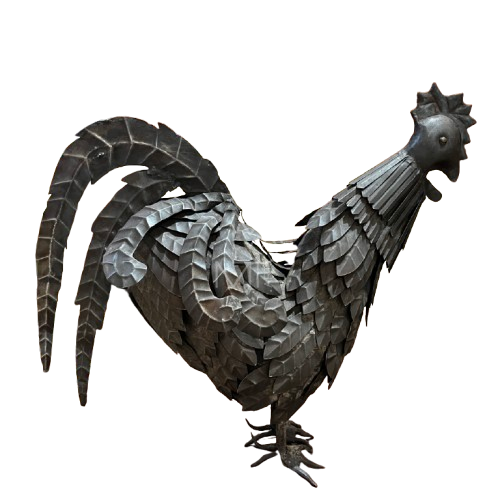
Vintage mid-century modern wrought iron rooster sculpture from the 1960s/1970s. Self-supporting brutalist metal art handcrafted by Brescian master smiths.
A fine mid-century decorative zoomorphic sculpture depicting a rooster, handcrafted in Italy (Brescia region) between the 1960s and 1970s. This piece fully aligns with the international brutalist and modernist movements of the second half of the twentieth century, which celebrated raw, expressive metal textures and visible manufacturing processes.
- Period: 1960s / 1970s
- Origin: Italy, Brescia (Lombard metalworking tradition)
- Material: wrought iron, sheet iron, steel rebar
- Technique: hot forging, manual shearing, electric arc welding
- Style: brutalist, modernist, mid-century decorative art
- Dimensions: height 58 cm, length 60 cm
- Condition: excellent vintage condition, original dark patina with minor surface oxidation consistent with age
The Mid-Twentieth-Century Wrought Iron Rooster: A Historico-Artistic Analysis, Forging Techniques, and Material Culture in the Lombard Region
Introduction and historical contextualization within high Brescian craftsmanship
Metallo-morphic zoomorphic sculpture represents one of the most fertile and original currents within twentieth-century European decorative arts. Within this rich production, the figure of the rooster holds a place of distinction, carrying archaic symbolic values related to vigilance, pride, and the solar cycle, while simultaneously offering an excellent ground for plastic experimentation for generations of ironsmiths. The artifact under examination—a sculpture made of wrought, cut, and tiered welded sheet iron, measuring fifty-eight centimeters in height by sixty centimeters in length and historically originating from the Brescian territory—fits fully into this expressive horizon. The work dates chronologically to the successful period between the 1960s and 1970s, a time of profound renegotiation of the boundaries between high-school artistic craftsmanship and avant-garde sculptural movements, such as international Brutalism and Modernism. In the Brescian valleys, this historical moment coincided with an unprecedented economic boom that prompted many art smiths to evolve their production from purely architectural or utilitarian ironwork to true interior sculptural elements, which were highly sought after by the rising industrial bourgeoisie.
Artistic territorial context and horizons of attribution
The geographical provenance restricted to the Brescia area necessitates an immediate comparison with the figure of Vittorio Piotti, the celebrated iron sculptor from Valtrompia, historically known by the pseudonym Brusafer [Vittorio Piotti]. Piotti left a definitive mark on Lombard metallurgical art through a highly personal geometric decomposition of animal forms, often working outdoors in his workshop in Lavone di Pezzase, where the valley inhabitants themselves would stop to watch him tame iron with impressive physical strength [Vittorio Piotti]. However, comparative morphological analysis excludes direct authorship by the Triumplino master for this specific specimen. While Piotti operated a cubist and structural synthesis, in which the eye and beak of the birds were integrated into complex, sharp, and monumental polyhedral volumes, the rooster under examination responds to different executive canons. The physiognomic elements, such as the flat crest and the applied teardrop eye, deviate from Piotti's stylistic signature, shifting the attributional axis toward an excellent workshop production or toward an as-yet-unidentified coeval author rooted in the same rich Brescian siderurgical tradition.
The work reveals clear affinities with the European Brutalist style, a current that celebrated raw matter, surfaces tormented by fire, and the evidence of construction processes. In particular, striking formal analogies are found with transalpine metal manufacturing, personified by figures such as Gérard Bouvier [Gallo, scultura in ferro]. During the 1960s and 1970s, cultural interchange between Italian and French master smiths was frequent, facilitated by the first major trade fairs and antiques markets. This international language, characterized by the modular repetition of metal scales to simulate plumage or organic textures, found an ideal ground for assimilation in the Lombard region. Brescian smiths, accustomed for centuries to working iron for heavy industry and weaponry, applied their extraordinary mastery of temperature to this new aesthetic trend, giving life to unique pieces of extraordinary decorative impact.
Morphology of the head and expressiveness of the figure
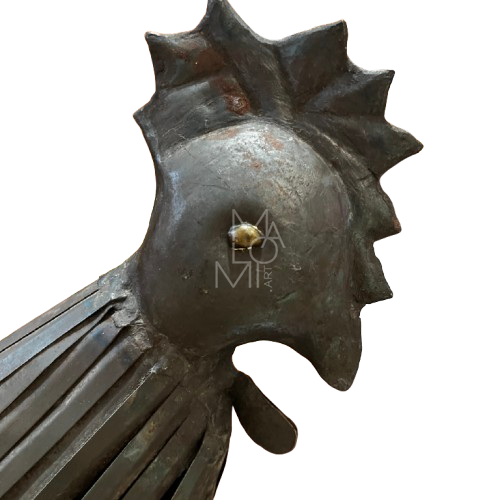
The head of the rooster is distinguished by a marked structural two-dimensionality that contrasts dialectically with the volumetric bulk of the body. The crest is made from a single flat sheet of iron, cold-shaped using large workshop shears and finished along the edges with a geometric and regular zig-zag indentation. The beak, robust and strongly arched downward, is obtained by bending and is welded to the head along the median line. Beneath the throat, the small, smooth wattle echoes the same essential linearity of the crest, conferring a hieratic pride upon the animal's profile that recalls medieval weather vanes.
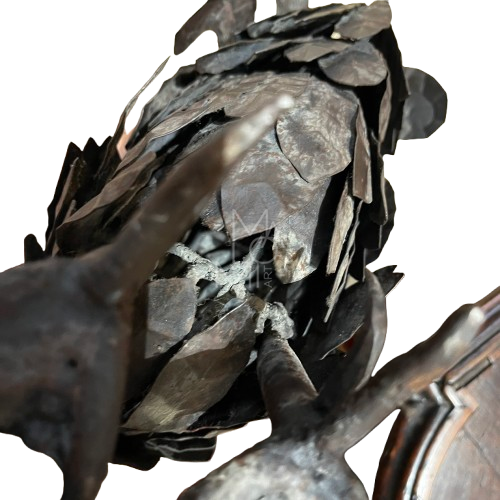
A detail of considerable plastic interest is the eye, which was achieved not by incising or punching the sheet metal, but rather through the application of a fusion droplet brought to heat. In the jargon of Brescian forges, this technique consisted of dropping a small fragment of molten metal directly from the torch onto the sheet iron, creating a spheroidal and smooth relief. This protrusion captures the ambient light in a zenithal manner, creating a point of strong luminous contrast against the dark and matte surface of the head. This technical expedient, widespread in mid-twentieth-century small zoomorphic sculpture, bestows a vivid yet deliberately anti-naturalistic expressiveness, typical of modern plastic art.
Construction technology and the hidden internal framework
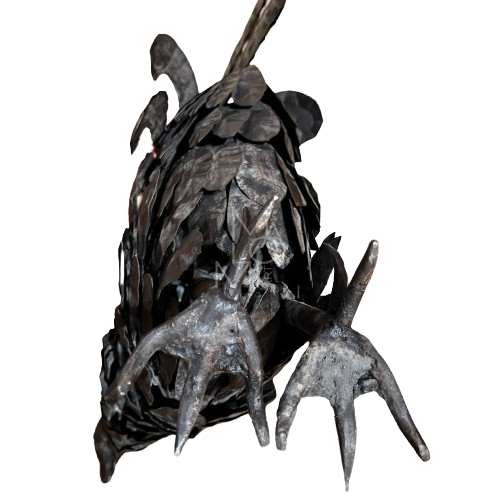
An inspection of the ventral cavity reveals the authentic nature of the artifact, uncovering a contrast typical of the artistic craftsmanship of those years between the refined aesthetics of the exterior and the pragmatic functionality of the interior. The work is structurally hollow, supported by an internal trellis or skeleton made of raw iron rebar. It is a curious anecdote to note that these rebars are completely identical to those used in construction sites of the period for reinforcing reinforced concrete—an inexpensive material easily available in Lombard workshops during the years of the building boom. The joints of this framework are joined by electric arc welding, a technology that was definitively replacing classical rivet jointing during that period.
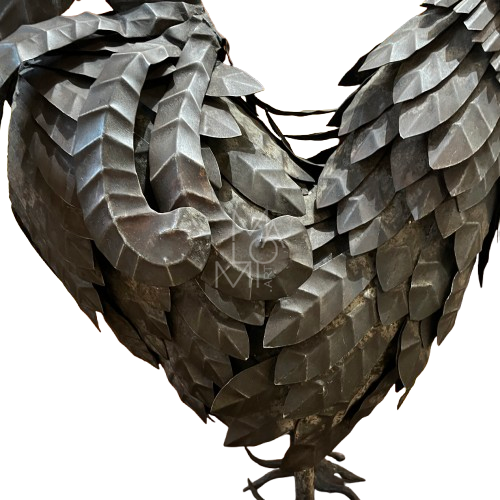
The internal welds were left in a raw state, along with the relative slag and fusion burrs, as they were not intended for public view. This choice highlights a construction philosophy aimed at maximum structural solidity and speed of execution. Over the solid internal cage, the artisan then applied the feathers made of sheet iron cut in the shape of a lanceolate leaf, proceeding from the bottom upward, as in the actual molting of a bird. Each individual scale was slightly convexed at the center through hammering on an anvil to give tridimensionality to the animal's body, perfectly concealing the rough framework beneath.
The execution of the tail and the refraction of light
The neck of the sculpture is articulated in taut vertical strips, which connect the head to the torso with a sharp transition marked by a continuous weld bead. The tail represents the element of maximum dynamic and aesthetic momentum of the entire piece. The long sickle-shaped feathers were cut from thicker strips of sheet iron, hot-bent to a convex cross-section to resist their own weight without flexing, and finished with large, manually curled volutes.
This complex hot-working not only accentuates the stylized naturalism of the rooster but also performs a precise optical function. The micro-facets produced by the hammer blows on the incandescent sheet iron break the monotony of the metal. When the sculpture is displayed in a lit environment, the light does not slide away uniformly but generates a vibrant chiaroscuro that simulates the iridescent reflections of a real rooster's feathers. This expedient demonstrates that the artisan, despite not being an academically trained artist, possessed a deep empirical knowledge of the visual effects of matter.
Statics, finish, and conservation methodologies of the patina
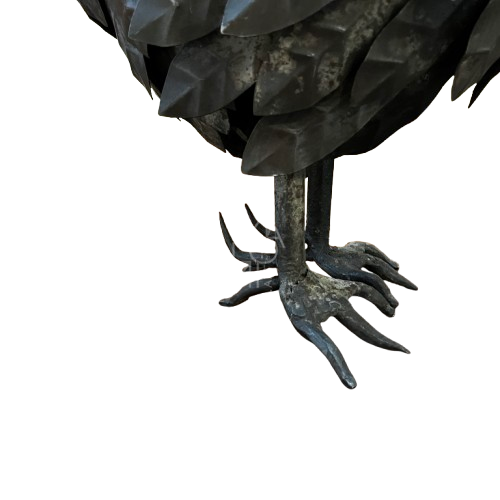
From an engineering and sculptural standpoint, the element of greatest merit lies in the work's capacity to stand autonomously in a state of perfect static equilibrium, a characteristic defined as self-supporting capability. The legs, hot-modeled to imitate the scaly texture of the tarsi and equipped with well-defined posterior spurs, do not rest on any base plate or pedestal. The ironsmith was able to empirically calculate the center of gravity of the entire structure, distributing the weight of the hollow body and the heavy tail onto the open toes, which adhere perfectly to the supporting surface, ensuring stability. In the forges, the equilibrium test was a crucial moment: the artisan would give small taps to the newly cooled sculpture on the workshop table to ensure that it would not rock or fall forward under the weight of the head.
The surface of the iron shows the classic fire finish of period high-craftsmanship. The dark, almost anthracite color is the result of controlled oxidation of the metal during forging. Traditionally, to protect the iron and give it that warm, deep tone, Brescian workshops applied a mixture of natural beeswax or spent mineral oils recovered from workshop machine engines onto the still-warm sculpture, which polymerized instantly within the pores of the metal. The presence of slight and widespread traces of reddish oxidation and dust accumulations in the recesses of the feathers is consistent with the natural aging of iron. For conservation, it is essential to avoid aggressive commercial chemicals or rotating wire brushes, which would erase this precious historical patina. The ideal conservative restoration involves a gentle mechanical cleaning with extra-fine steel wool soaked in vaseline oil, followed by the application of a thin film of microcrystalline wax, a stable and inert product that seals the pores of the iron, blocking moisture without altering the original matte finish and Brutalist charm of the piece.
Historical continuity of matter: the Museo del Ferro of Brescia and the San Bartolomeo forge
To fully comprehend the origin of the technical skills that allowed the creation of the rooster under examination during the 1960s and 1970s, it is necessary to place the work within the broader ecosystem of Brescian industrial archaeology, whose identity center is represented today by the Museo del Ferro of Brescia, housed in the ancient San Bartolomeo forge [Museo del Ferro - La Fucina di San Bartolomeo]. This site, located in the San Bartolomeo district in the northern outskirts of the city, constitutes an extraordinary palimpsest of material culture, where metalworking has been handed down uninterruptedly for centuries, exploiting the hydraulic driving force of the Bova stream. The forge, whose original structure dates back to the late medieval period and which saw constant technological implementation until the first half of the twentieth century, still preserves intact its hydraulic hammers, water wheels, forging hearths, and bypass channels [Museo del Ferro - La Fucina di San Bartolomeo]. This place was not merely a factory, but a true open-air school where the learning of ironworking occurred empirically and generationally, codifying those technical gestures that would later re-emerge in post-war decorative sculpture.
The comparison between the ancient equipment preserved at San Bartolomeo and the construction technology of our rooster highlights a profound link and a partial technological transition. Within the historical forge, ironmasters achieved the shaping of volumes and the compaction of iron through the rhythmic percussion of the large hydraulic power hammer and subsequent manual finishing on an anvil with bench hammers. In the plumage and tail of the rooster, one finds the same formal attitude in the management of sheet metal: the plastic lanceolate-leaf effect and the large sickle-shaped volutes of the tail were modeled following the same rules of ductility of iron heated in a charcoal hearth. However, while at San Bartolomeo the joining of complex artifacts historically occurred through interlocking, riveting, or forge welding—joining the edges of iron brought to white heat by violent hammering until their partial molecular fusion—the author of the rooster introduced electric arc welding. This innovation, which characterized the conversion of Brescian workshops in the post-war period, freed the artisan from the static limitations of riveting, allowing him to anchor the feathers directly to the internal rebar framework with a rapidity and volumetric freedom that were previously unthinkable.
The Museo del Ferro, now integrated into the heritage routes of the Fondazione Civiltà Bresciana, thus performs a critical function for the understanding of this sculpture [Museo del Ferro - La Fucina di San Bartolomeo]. It demonstrates that the rooster is not an isolated object born from aesthetic improvisation, but rather the late and refined product of an iron civilization deeply rooted in the territory. The smiths who in the 1970s created these Brutalist accoutrements for Brescian residences were the same individuals who, often trained in traditional hydraulic forges or born of that working-class culture, had assimilated the visual control of metal temperatures and the wisdom of base-free static balance. A visit to and study of the technical repertoires of the San Bartolomeo forge allow one to read each individual hammer blow impressed on the surface of the bird not as a period decorative whim, but as the final link in a historical chain in which iron, historically bent to the needs of war, agriculture, and heavy industry, finally opened itself to pure plastic expression and interior decoration.
Conclusions
The wrought iron rooster analyzed constitutes a valuable testimony to the material culture and artistic craftsmanship of Lombardy in the second half of the twentieth century. Although the evidence of the internal construction techniques and the physiognomic choices exclude its assignment to the major artistic production of Vittorio Piotti, the work expresses a high technical mastery in manual forging and static balancing [Vittorio Piotti]. Placing itself masterfully between international Brutalism and the Brescian siderurgical tradition of the 1960s and 1970s, the sculpture possesses a distinct expressive and decorative value, fully representative of that successful season in which industrial and construction iron became the language of art and furnishing.
Bibliographical appendix according to the chicago manual of style
AA.VV. Vittorio Piotti. Brescia: Associazione Artisti Martino Dolci, 2005. [Vittorio Piotti]
AA.VV. "Il ferro battuto nelle chiese di Brescia: utilizzi, forme, artisti." Civiltà Bresciana, Nuova Serie, IX, no. 1 (2026): 143-159. [Il ferro battuto nelle chiese di Brescia: utilizzi, forme, artisti]
Bossaglia, Rossana, and Arno Hammacher. Mazzucotelli, l'artista italiano del ferro battuto liberty. Milan: Il Polifilo, 1971. [Mazzucotelli, l'artista italiano del ferro battuto liberty]
Corradini, Mauro. Artisti bresciani dall'Art Nouveau al Novecento: percorsi di scultura in Villa Mazzotti. Chiari: Gam, 2005.
Spiazzi, Luciano, and Vittorio Piotti. Vittorio Piotti: 8-21 marzo 1969. Trento: Galleria d'arte M. Fogolino, 1969. [Vittorio Piotti: 8-21 marzo 1969]
Spinozzi, Luciano, and Vittorio Piotti. Vittorio Piotti: sculture in ferro. Milan: Regione Lombardia, 1980. [Vittorio Piotti: sculture in ferro]
Terraroli, Valerio. Il Vantiniano: scultura monumentale a Brescia tra Ottocento e Novecento. Brescia: Grafo, 1990. [Il Vantiniano. Scultura monumentale a Brescia tra Ottocento e Novecento]
Vicario, Vincenzo. La scultura bresciana dell'Ottocento e del primo Novecento. Brescia: Grafica GM, 1995. [La Scultura Bresciana dell'Ottocento e del primo Novecento]