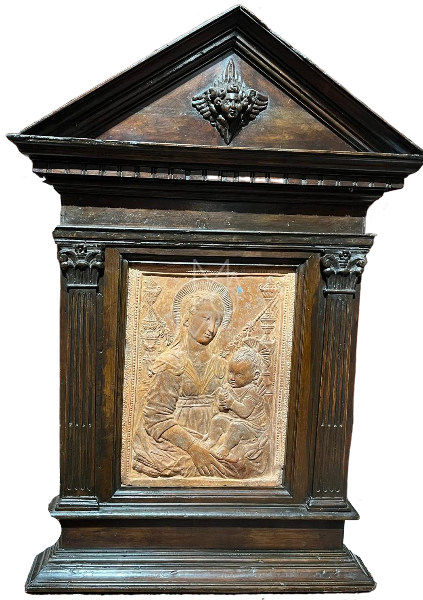
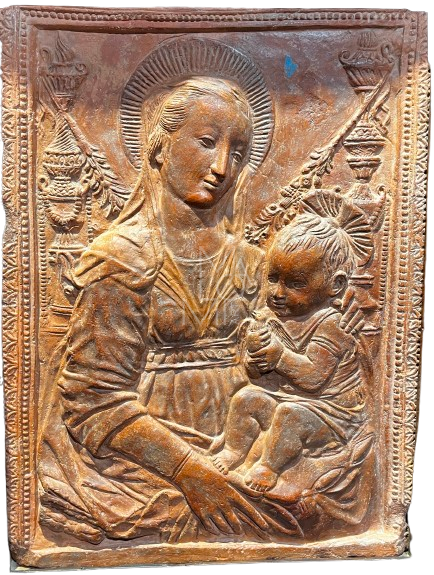
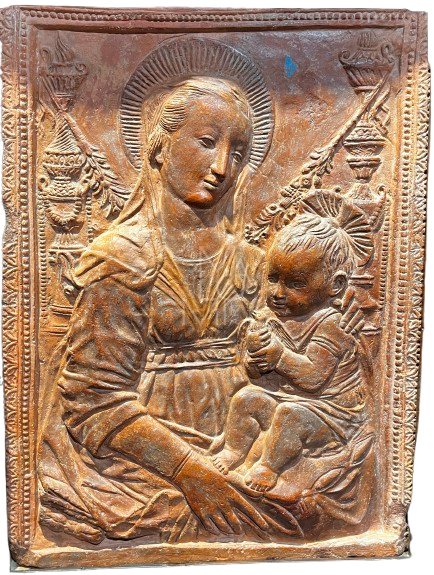
Madonna with child in terracotta by Antonio Rossellino
HISTORICAL-CRITICAL SHEET: MADONNA WITH CHILD
Cultural context: Florentine Renaissance
Author: Antonio Rossellino (Settignano, 1427 – Florence, 1479) or workshop / circle
Subject: Madonna and Child (derived from the prototype known as "Madonna dell'Ermitage" or "Madonna delle Candelabre")
Material and technique: Molded/imprinted terracotta with traces of original polychromy
Tile measurements: 40 x 30 cm
Setting: Ancient aedicule/tabernacle frame with spire gable in walnut wood, decorated in the center of the pediment with a winged cherub head (Overall measurements: 92 x 64 cm)
________________________________________
Stylistic and iconographic analysis
The relief analyzed is part of one of the most successful Marian compositions of the second Florentine fifteenth century. The work depicts the Virgin in half-length, three-quarter view, holding the blessing Child, sitting on her lap. In the background we can recognize the symmetrical profiles of two finely decorated candelabras, a formal iconographic element that identifies this specific plastic invention within Antonio Rossellino's catalogue.
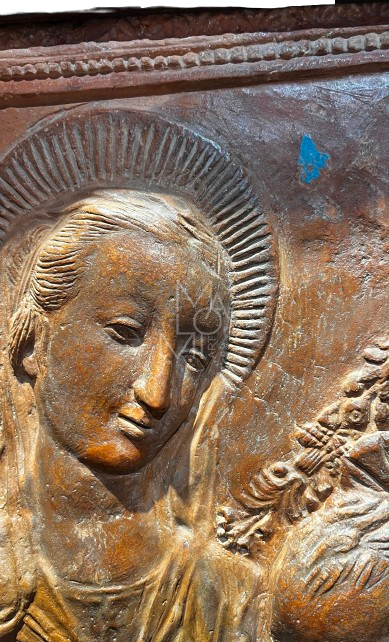
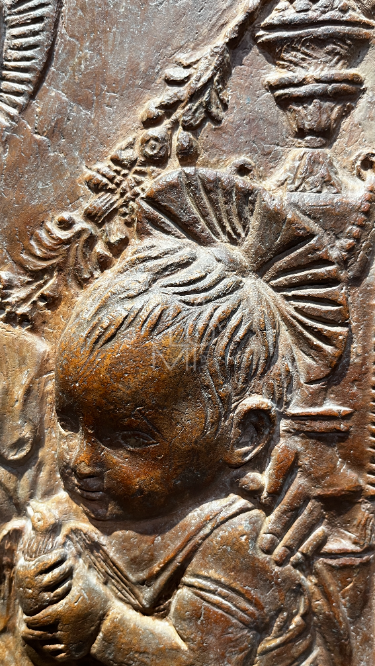
The peculiar stylistic characteristics are found in the aristocratic grace of the Virgin's features, in the refined hairstyle with veil that falls over the shoulders and in the soft plasticity of the drapery, typical of Rossellini's "stiacciato". The Child, with a shapely body and defined curls, holds the hem of the Mother's dress in his hands, a gesture of domestic naturalness that balances the hieratic solemnity of the whole.
The Context of the Fifteenth-Century Replicas
The marble models licensed by Antonio Rossellino (like the reference example preserved in the Hermitage Museum) enjoyed extraordinary critical and commercial success in Renaissance Florence. To satisfy the growing demand linked to private and domestic devotion, the workshops of the time (including those of Rossellino and Verrocchio) started a rich production of replicas through casts.
The materials of choice for this serial diffusion were stucco and terracotta, often enriched with tempera polychromy and gilding to simulate the noblest materials. The presence of traces of pigment on the surface of the tile attests to its original chromatic system, aimed at accentuating the three-dimensional depth of the crushed stone.
Notes on the Frame and Conservation Status
The panel is enclosed in a valuable walnut tabernacle frame, defined by an aedicule structure with grooved lateral pilasters and composite capitals. The top is crowned by a cusped tympanum (or triangular pediment) which houses a high-relief winged cherub in the centre. This type of framing not only has a structural function, but ennobles the work by transforming the relief into a real domestic altar, perfectly in line with the intended use of devotional artefacts from the 15th and 16th centuries.
The work shows a consistent patina of time; the reading of the smallest plastic details (such as the decoration of the candelabra in the background) appears partially attenuated, a phenomenon compatible with the nature of the mold cast or with wear phenomena on the clay surface.
1. Lucky Ancient Model: The "Madonna of the Candelabra" or "of Leningrad"
The work is a plastic derivation of one of the most famous Marian reliefs attributed to Antonio Rossellino, historically identified by critics as the "Madonna delle Candelabre" (or "Madonna of the Hermitage", from the famous marble preserved in St. Petersburg).
The decisive element for the assignment to the Rossellinian model is the invention of the background: two classical candelabra in very low relief which symmetrically frame the figures. This expedient takes up the decorative modules of the nearby workshop of Desiderio da Settignano and Bernardo Rossellino (Antonio's older brother and teacher), fusing early Christian and late ancient geometric purity with the aerial perspective theorized by Donatello
2. Technical Focus: Terracotta and Workshop Production
In the Florentine fifteenth century, the distinction between the master's autograph work and the workshop's serial product was regulated by sophisticated commercial logic:
• The Casting Technique: Artifacts of this size (40x30 cm) were usually obtained by pressing the fresh clay (or pouring the stucco) into negative plaster matrices obtained from the marble prototype.
• Variations and Hand Finishing: After demoulding, the craftsman finished the details that were not perfectly impressed (such as the pods of the candelabra or the curls of the hair). The close analysis of the softness of the Virgin's veil suggests a manual plastic intervention before firing.
• Cultural Function of Polychrome Traces: The original polychrome (here visible in filigree and fragments) did not have a mere aesthetic purpose. In domestic reliefs it served to simulate monumental materials and to confer naturalness