Gilt and Polychrome Wooden Statuette of Venetian Mosè School of a 16th-Century
The Prophet and the Law: A Critical, Structural, and Stylistic Study of a Sixteenth-Century Gilded and Polychrome Wooden Moses
Introduction and Historical-Artistic Framework
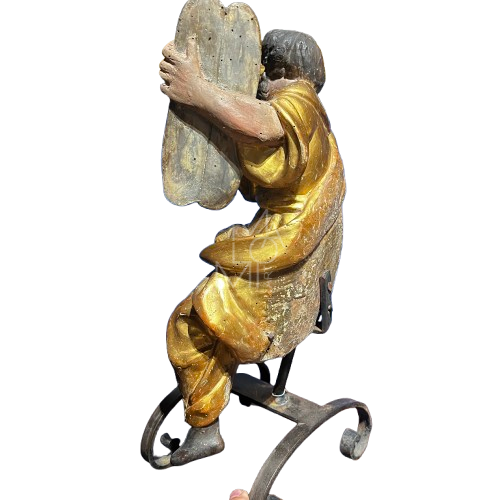
Within the landscape of sixteenth-century sacred sculpture, small- and medium-scale wooden works occupy a position of primary importance for understanding private devotion and the complex apparatus of liturgical furnishings. The subject of this study is an carved, gilded, and polychrome wooden sculpture depicting the prophet Moses. Measuring 40x18 cm, the piece has been mounted in recent times on a modern wrought-iron base.
The work fully belongs to the figurative culture of the High Renaissance and early Mannerism, demonstrating the extraordinary reception of monumental statuary within the Venetian lagoon and its mainland (entroterra). Analysis of the artifact reveals the hallmarks of sophisticated patronage and high-level workshop production, orienting its attribution toward the Venetian artistic milieu of the second half of the sixteenth century.
Plastic Analysis, Dynamism, and the Lesson of the Venetian Masters
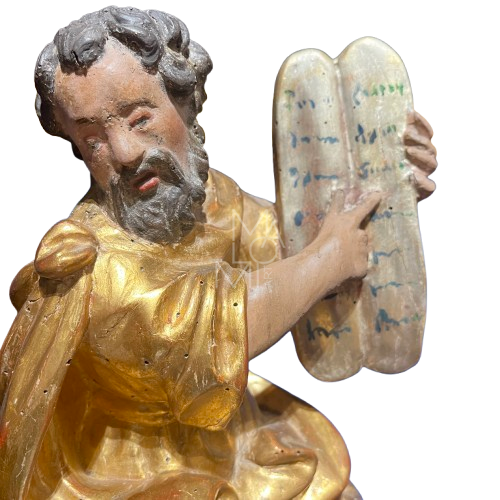
Despite its diminutive proportions, the sculpture achieves an extraordinary sense of monumentality, breaking away from the static, hieratic poses typical of medieval or Early Renaissance models. Moses is captured in a moment of vibrant intellectual and physical tension. The artist has imbued the figure with an unstable, energetic twisting motion, defined by a pronounced torsion of the torso: while the upper body turns to his left to vigorously display the Tablets of the Law, the legs accommodate the dynamic thrust of the seated posture, creating a linea serpentinata (serpentine line) characteristic of Mannerist taste.
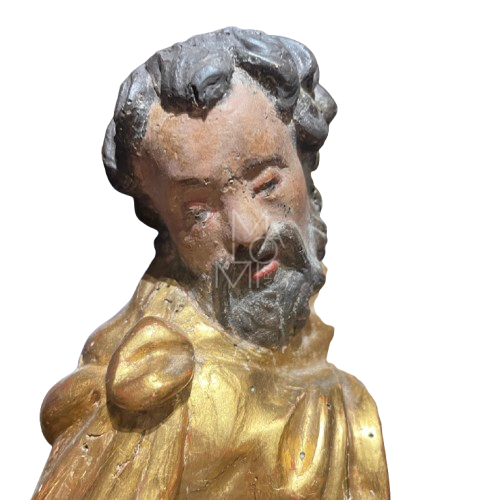
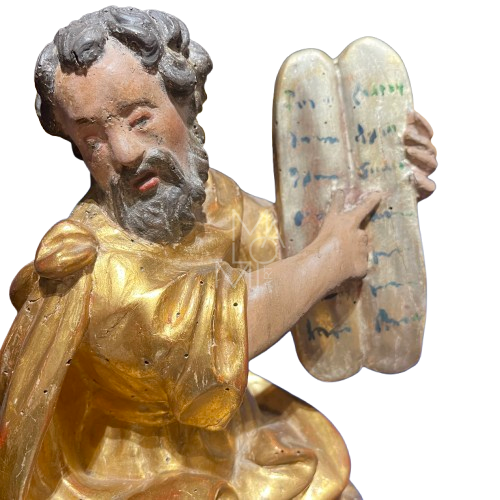
The physiognomy of the face and the proud bearing betray a specific stylistic lineage. The furrowed brow, the stern gaze filled with terribilità, and the thick beard—carved in deep, plastic locks that flow like waves—reflect the profound influence exerted in Venice by the models of Alessandro Vittoria (1525–1608). Vittoria, who successfully translated Michelangelo’s power into the dynamic and decorative rhythms of Venetian Mannerism, established a widespread school that heavily impacted small-scale carving.
Concurrently, the robust anatomical structure, the weight distribution shifting onto the left knee, and the didactic gesture recall the production of his main rival and successor, Girolamo Campagna (1549–1625). The work fits perfectly within the circle or lineage of these two giants of Venetian sculpture, translating into wood and on a reduced scale the grandiloquent language that the masters typically expressed in marble, stucco, and bronze for major lagoon churches such as San Giorgio Maggiore or Il Redentore.
The Recto: The Venetian Aesthetic of Light and Color
The surface treatment of the frontal view (recto) aligns with a precise aesthetic and theological intent, intimately linked to the primacy of color and light (colore and luce) characteristic of the Venetian painting tradition of Titian, Tintoretto, and Veronese. The drapery of the vestments is deep, almost agitated; the folds buckle and crumple vigorously around the waist and beneath the knees, creating sharp chiaroscuro contrasts that animate the physical matter.
This volumetric energy is enhanced by the water-gilding technique, applied with gold leaf over a preparation of gesso and bole. The gilded surface is not merely ornamental; it symbolizes the splendor of divine wisdom. The crests of the drapery catch the ambient light and reflect it in a myriad of shifting, shimmering gleams—a fundamental technical device designed to ensure the sculpture's visibility and plastic vibration within the dim recesses of chapels or wooden choir stalls.
Serving as a counterpoint to this luminous abstraction is the pronounced naturalism of the flesh tones (incarnato), applied using cold polychromy with warm, nuanced gradations. The right arm crosses the chest diagonally, the index finger pointing firmly at the arched tablets. The tablets bear incised markings simulating Hebrew characters of the Law, transforming the work into a tool of direct communication and potent devotional impact.
The Verso: Workshop Secrets and Artifact Archaeology
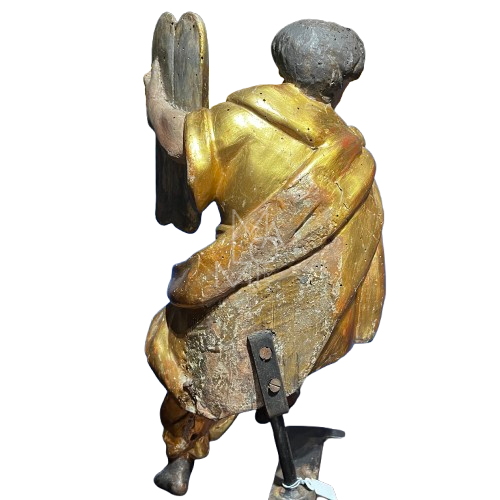
While the recto of the sculpture is conceived to captivate the eye and celebrate the sacred, an analysis of the reverse side (verso) reveals its true structural nature, offering an exceptional testament to the archaeology of the artifact and the workshop practices of sixteenth-century Venice.
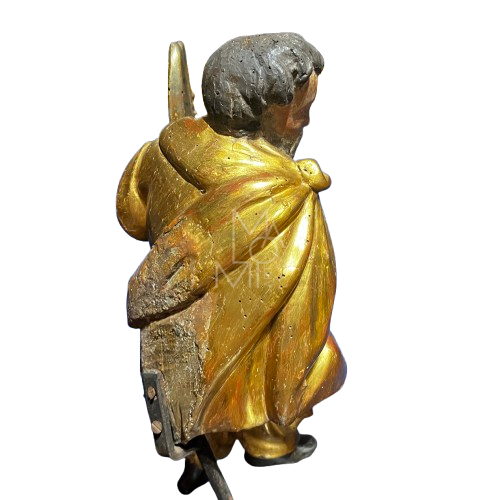
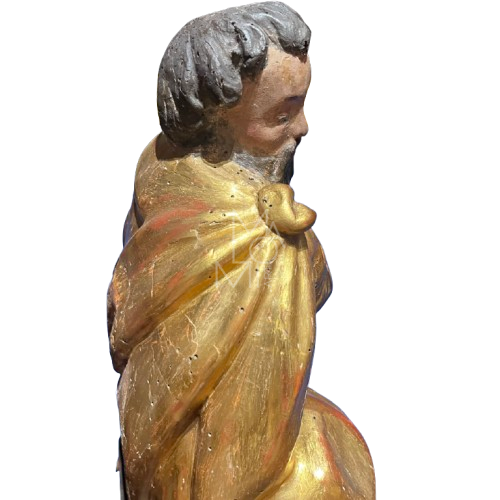
The work is clearly revealed to be a half-round structure, meaning a highly projecting high-relief rather than a freestanding, fully in-the-round statue designed for open space. The prophet's back and the rear portion of the mantle appear nearly flat, blocked out in synthetic, squared, and geometric volumes. This specific technical choice confirms the hypothesis that the sculpture was originally housed within an architectural niche, affixed to an organ case, or integrated into the complex carpentry of the upper tier of a monumental wooden polyptych or a patriarchal cathedra—contexts in which the reverse would remain permanently hidden from the faithful.
On this unpolished surface, the sharp, rapid marks left by the gouge and chisel remain perfectly legible, intentionally left rough by the woodcarver. The distribution of the finish is a masterpiece of workshop economy: the artist meticulously gilded only the outermost edges of the mantle and shoulder, abruptly halting the application of gold leaf across the central areas of the back. This expedient saved precious metal without compromising the final aesthetic result; even if a viewer looked at the work from a slight angle inside its niche, they would still perceive a continuous, fully gilded surface. Similarly, the hair undergoes a drastic plastic simplification on the reverse, reduced to a dark, compact skullcap devoid of the detailed, vibrant curls that adorn the prophet's brow and temples.
State of Conservation and Conservation Interventions
The verso also provides a clear overview of the artifact's complex conservation history across its four centuries of existence. The wood exhibits natural signs of aging: deep longitudinal fissures caused by the continuous hygrometric movement of the wooden fibers, which expanded and contracted in response to the fluctuating humidity levels of the churches where the work was housed.
Furthermore, there is a widespread presence of small, circular exit holes from insect infestation, evidence of historical damage by wood-boring beetles (anobiidae). The concentration of these exit holes on the reverse is a typical phenomenon: the pests preferentially attacked the raw, unprotected wood, finding an impenetrable barrier on the front due to the sealing thickness of the gesso preparation, the bole, and the gold leaf.
The original orientation of the figure—designed to be viewed from below (di sotto in su), as suggested by the slight forward tilt of the head projecting the prophet’s gaze down toward the observer—is preserved today by a modern mounting system. A robust, flat metal bracket is secured to the base of the original wooden block by two modern slotted screws. While a recent addition, this iron support strictly respects the integrity of the piece: it stabilizes the center of gravity without placing stress on the more fragile lower portions of the drapery and feet. In doing so, it restores the correct floating, suspended posture of the seated prophet, isolating him within the modern exhibition space with philological rigor.
Conclusion
In conclusion, this sixteenth-century Moses emerges as an artifact of superb technical and critical quality. The work successfully synthesizes the preciousness of materials—distinctive of the centuries-old Venetian tradition of woodcarving—with the new dynamic demands introduced to the Lagoon by Alessandro Vittoria and Girolamo Campagna. The state of preservation of its gilding, coupled with the extraordinary legibility of the tool marks on its reverse, renders it a invaluable historical and artistic document. It eloquently speaks to both the lofty theological aspirations of Counter-Reformation art and the pragmatic secrets of the master woodcarvers active in the shadow of San Marco.
Proposed Critical Attribution
In the absence of archival documentation or an autograph signature—impossible to find on works born as secondary components of a larger structure, where the signature belonged at best to the master builder or cantiere architect—the identification of the author must be pursued stylistically. The exceptional quality of the carving excludes the hands of a simple provincial carver, placing the pendant firmly within the orbit of the direct collaborators of the two great Venetian masters. Within this circle, three targeted attributive hypotheses can be formulated:
Francesco Cavrioli (active in Venice in the second half of the 16th century): A prominent figure in Venetian woodcarving, Cavrioli was celebrated for his ability to translate the plastic models and fluid rhythms of Alessandro Vittoria into wood. Specializing in niche figures and monumental furnishings (such as organ cases), he exhibits a sharp treatment of drapery and a structural synthesis of the reverse that perfectly match the characteristics of our pendant. Agostino Rubini (Vicenza, 1558 – post 1595): A pupil, close collaborator, and relative by marriage of Alessandro Vittoria, Rubini worked extensively between Venice, Vicenza, and Padua. His stylistic hallmark combines the Mannerist grace of his master with a pronounced bodily volumetry that almost seems to anticipate the classicism of Campagna. The proportions and marked expressiveness of the faces of David and Moses closely reflect the canons of Rubini's minor figures. The Segala Workshop (Orazio or Francesco Segala): Active during the final decades of the century between Padua and Venice, the Segala workshop embodies that transitional taste in which Vittoria's lessons were reduced to smaller formats with a heightened focus on the painterly rendering of the surface and a generous use of gold leaf to illuminate the drapery.In light of these elements, the work should be scientifically cataloged as: Venetian milieu, circle of Alessandro Vittoria / Girolamo Campagna (attributable to a master within the entourage of Francesco Cavrioli or Agostino Rubini), last quarter of the 16th Century.
Academic Bibliography
1. Primary Sources and Early Art-Historical Literature
STRINGHI, Giovanni, Venetia città nobilissima et singolare, Descritta già in XIIII. Libri da M. Francesco Sansovino [Venice, a Most Noble and Singular City, Already Described in XIV Books by M. Francesco Sansovino], Venice, Iacomo Sansovino, 1581 (with particular reference to the descriptions of sixteenth-century altarpieces and wooden choir stalls). RIDOLFI, Carlo, Le Maraviglie dell'arte, overo le Vite de gl'illustri Pittori Veneti, e dello Stato [The Marvels of Art, or the Lives of the Illustrious Painters of Venice and its State], Venice, Giovanni Battista Sgava, 1648. TEMANZA, Tommaso, Vite dei più celebri Architetti e Scultori Veneziani che fiorirono nel Secolo Decimosesto [Lives of the Most Celebrated Venetian Architects and Sculptors Who Flourished in the Sixteenth Century], Venice, Stamperia di C. Palese, 1778.2. Venetian Woodcarving and the Upper Adriatic Tradition
MARIACHER, Giovanni, Scultura lignea veneziana [Venetian Wooden Sculpture], Florence, Electa Editrice, 1965 (A fundamental foundational text for the study of Lagoon workshops). RAMA, Elena, La scultura lignea del Rinascimento a Venezia e nel territorio della Serenissima [Renaissance Wooden Sculpture in Venice and the Territory of the Serenissima], in "Storia di Venezia. L'Istituzione, la Società, la Cultura", Vol. V, Rome, Istituto della Enciclopedia Italiana, 1996. DE GRASSI, Massimo (ed.), Scultura lignea del Rinascimento nell'Alto Adriatico: studi, restauri, riflessioni [Renaissance Wooden Sculpture in the Upper Adriatic: Studies, Restorations, Reflections], Trieste, Editreg, 2014. CONTI, Roberto, L'intaglio ligneo a Venezia tra Rinascimento e Manierismo: le grandi macchine d'altare e la scultura minore [Woodcarving in Venice Between the Renaissance and Mannerism: Great Altarpieces and Minor Sculpture], Padua, Il Poligrafo, 2008.3. Monographs and Studies on Alessandro Vittoria, Girolamo Campagna, and Their Circle
BOUCHER, Bruce, The Sculpture of Jacopo Sansovino and his School, New Haven-London, Yale University Press, 1991 (Essential for understanding the roots of Alessandro Vittoria's workshop). MARTIN, Thomas, Alessandro Vittoria and the Portrait Bust in Renaissance Venice: Remodeling Antiquity, Oxford, Clarendon Press, 1998 (In-depth analysis of physiognomic rendering of beards and furrowed brows, mirroring the works under examination). BACCHI, Andrea; LORENZONI, Marta (eds.), Alessandro Vittoria (1525-1608). Scultore del Rinascimento veneziano [Alessandro Vittoria (1525-1608): Sculptor of the Venetian Renaissance], Exhibition Catalogue (Trento, Castello del Buonconsiglio), Trento, Provincia Autonoma di Trento, 1999. DE VINCENTI, Monica, Girolamo Campagna (1549-1625) e la scultura a Venezia tra tardo Rinascimento e Barocco [Girolamo Campagna (1549-1625) and Sculpture in Venice Between the Late Renaissance and the Baroque], Venice, Istituto Veneto di Scienze, Lettere ed Arti, 2012. ROSSI, Massimiliano, I seguaci di Alessandro Vittoria: Francesco Cavrioli, Agostino Rubini e la diffusione del Manierismo nell'entroterra veneto [The Followers of Alessandro Vittoria: Francesco Cavrioli, Agostino Rubini, and the Spread of Mannerism in the Venetian Mainland], in "Arte Veneta", LII, 1998, pp. 45–63.4. Technique, Diagnostics, and Conservation of Gilded Wooden Artifacts
MENDEL, Chiara; SPAGNOLO, Sandra, La doratura a foglia: storia, techniques e restauro delle superfici dorate [Leaf Gilding: History, Techniques, and Restoration of Gilded Surfaces], Florence, Nardini Editore, 2002 (Specific to the analysis of red bole and gesso preparation). CASTELNUOVO, Enrico (ed.), Artifex bonus: il mondo dell'artista medievale e rinascimentale [Artifex Bonus: The World of the Medieval and Renaissance Artist], Rome-Bari, Laterza, 2004 (Valuable for exploring the concept of "workshop economy" and the rough-hewing of the versos of sculptures). CIATTI, Marco (ed.), La scultura lignea policroma: storia, tecniche, restauro [Polychrome Wooden Sculpture: History, Techniques, Restoration], Florence, Edifir, 2009.5. Iconography and Religious Context (The Counter-Reformation in Venice)
PROSPERI, Adriano, Il Concilio di Trento: una introduzione storica [The Council of Trent: A Historical Introduction], Turin, Einaudi, 2001. RELETHFORD, John, The Decrees of the Council of Trent on Sacred Images and their impact on Venetian Liturgical Furnishings, in "Journal of Ecclesiastical History", LXIV, 2011, pp. 112–134. PANOFSKY, Erwin, Meaning in the Visual Arts, Garden City, N.Y., Doubleday, 1955 (For the iconological framing of Old Testament prophets and kings as Christological prefigurations).
M