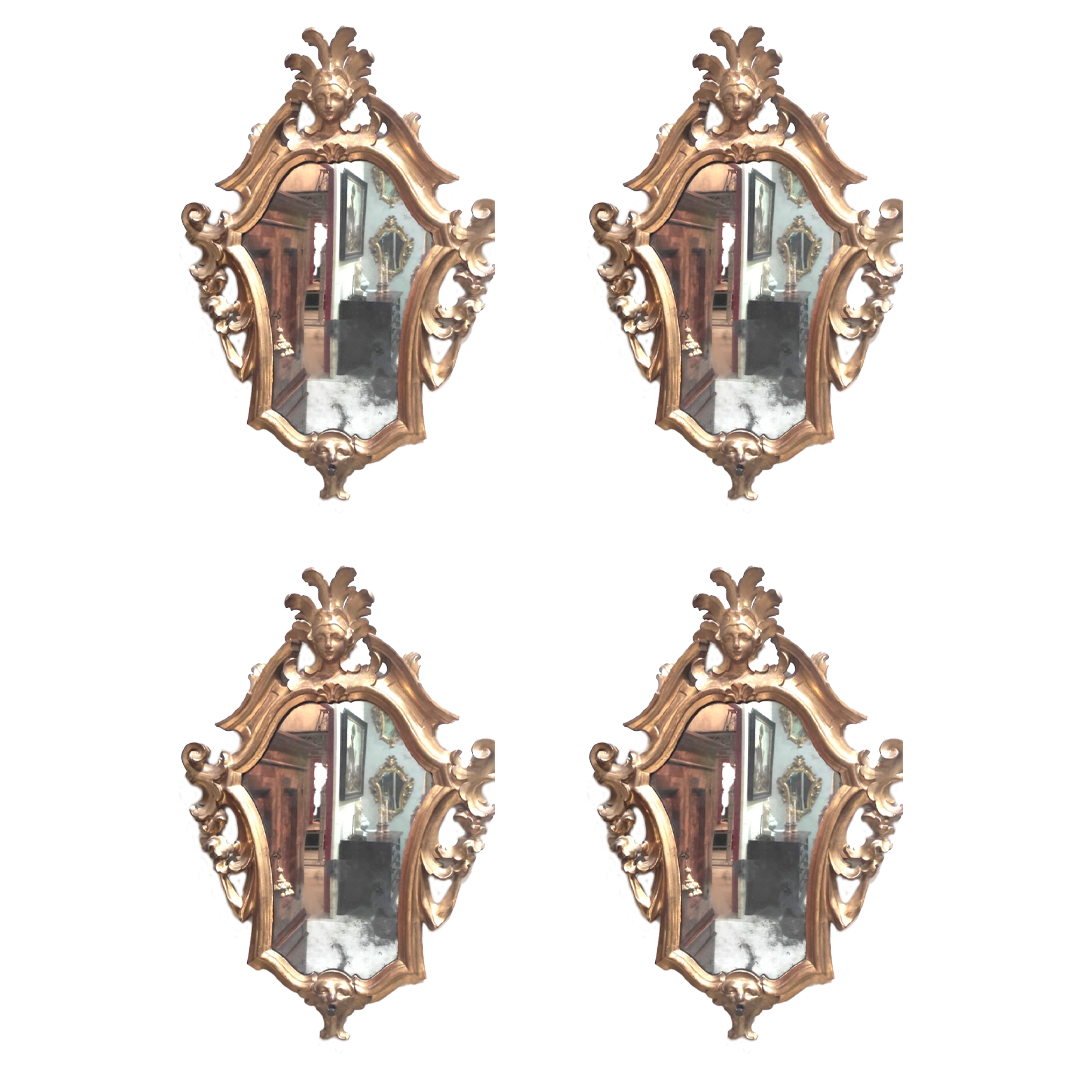
Four Venetian mirrors from the 18th century
The reflected illusion of the serenissima: a historico-artistic study on a set of four eighteenth-century venetian gilded mirrors with mercury glass
The present study offers a historico-artistic and technical analysis centered upon a homogeneous corpus of four gilded mirrors produced in Venice during the eighteenth century, distinguished by their original reflecting glass plates manufactured utilizing a tin-mercury amalgam. These works integrate harmoniously into the glorious furniture-making and glass-working tradition of the Most Serene Republic of Venice, standing as decorative paradigms of the lagoon’s Late Baroque (Barocchetto) and Rococo styles. Characterized by a structurally coordinated yet dynamically carved geometric-shape-shifting (mistilineo) framework, the mirrors exhibit dimensions of one hundred centimeters in height by seventy centimeters in width at their maximum extent. This optimal format responded to the precise requirements of spatial modulation, perspective symmetry, and aesthetics within eighteenth-century patrician interiors, seamlessly aligning with the domestic architecture of the period.
The historical and cultural context of eighteenth-century venice
During the course of the eighteenth century, Venice experienced a period of subtle and sumptuous political decline, which was powerfully counterbalanced by an extraordinary and fertile flourishing of the figurative and decorative arts. Venetian furniture progressively emancipated itself from the severe, architectural monumentality of the seventeenth-century Baroque to embrace the capricious asymmetries and organic sinuosities of the European Rococo, locally reinterpreted through the celebrated and highly successful formula of the lagoon Barocchetto.
Within this specific decorative landscape, the mirror ceased to be a mere functional tool confined to the private sphere, transforming instead into a fundamental device for collective scenography. Inside the majestic porteghi and the refined parlors of the palaces overlooking the Grand Canal, medium-sized mirrors were conceived to be arranged symmetrically along opposing walls. The utilization of an organic set of four elements allowed for a rhythmic punctuation of the hall’s walls, frequently alternating with the expansive windows overlooking the lagoon or surmounting elegant console tables. This geometric disposition multiplied the soft ambient light of candles and artificially dilated the physical boundaries of the architectural space, creating a visual vertigo that celebrated the splendor of the Venetian nobility.
Formal analysis and stylistic features of the carving
A morphological examination of the artifact highlights a skillful and virtuoso execution of carved and pierced wood, representing the pinnacle of craftsmanship achieved by the Venetian carvers (intagliatori) registered in the guild of the marangoni. The perimetral structure develops along a shaped silhouette with a curvilinear and angular (mistilineo) profile, where structural straight lines constantly yield to continuous and elegant curves and counter-curves, thereby rejecting any geometric rigidity.
The upper crowning is entrusted to a monumental openwork cresting (cimasa), rich in phytomorphic motifs and floating acanthus volutes, which encloses central decorative elements that serve as the visual focal point for the entire composition. Along the lateral flanks of the frame, scroll elements and elegant leaf-shaped protrusions unfold, enhancing the chiaroscuro dynamism of the work and lightening the visual impact of the wooden mass through calculated voids in the carving. The lower apron, commonly referred to as the grembiale, closes the composition by coherently echoing the upper asymmetries, thus ensuring perfect visual stability to the molded perimeter of the glass plate.
Analysis of iconographic details and the symbology of the ornament
The decorative apparatus surrounding the glass plate does not merely satisfy aesthetic criteria, but rather underscores a precise iconographic code typical of Late Baroque and Rococo culture, wherein the sacred and the profane, references to nature, and evocations of myth coalesce into a codified plastic vocabulary. The narrative core of the upper cresting is dominated by a female head nestled within a sumptuous foliate headdress, historically attributable to the allegorical figure of the Goddess Flora or an idealized evocation of classical deities associated with nature and springtime. The serene expression, symmetrical features, and hieratic quality of the face create a deliberate contrast with the surrounding asymmetry of the Rococo volutes, establishing a point of visual repose. Conversely, at the lower section of the frame, the figurative apparatus concludes with a second masqueron bearing zoomorphic and grotesque features, a motif derived from the grand tradition of sixteenth-century Mannerism. This deliberate vertical transition, moving from the Apollonian and luminous countenance positioned at the top to the chthonic or grotesque features placed at the bottom, symmetrizes the eternal dichotomy between intellectual order and the chaos of primitive nature.
The volutes clasping the flanks of the structure originate from the constant reinterpretation of the acanthus leaf, a classical symbol of immortality and regeneration. Within the specific context of the Venetian Barocchetto, the acanthus loses its original architectural rigidity of Roman lineage to become fluid, almost liquid, evoking the aquatic and undulating element intrinsic to the very identity of the lagoon city. Furthermore, one detects the earliest hints of rocaille, the typical jagged and asymmetrical shell decoration that dominated the middle of the century. The shell, historically linked to the birth of Venus—the goddess of beauty who emerged from the waters—becomes the perfect emblem for a reflecting object destined for the vanity and aesthetic contemplation of the Venetian aristocracy.
Comparative analysis: parallels with coeval production and reference models
To fully comprehend the critical placement of this nucleus of four mirrors, it is essential to establish a comparison with the coeval production of Venetian carvers active between the second and third quarters of the eighteenth century, as well as with the cornerstones of lagoon museography. This typology of carving, featuring a shaped mirror frame with a cresting adorned with a masqueron or shell, finds striking analogies in the graphic and plastic repertoires disseminated by the most prominent furniture-making workshops of the Serenissima. Although the Venetian artisanal landscape was fragmented into numerous minor workshops, the executive quality of this set evokes the structural solutions adopted by circles close to masters of the caliber of Antonio Corradini—renowned for his virtuosity in sculptural figures and masquerons—and the Brustolon family, whose followers softened their predecessors' seventeenth-century wooden monumentality in favor of Rococo lightness and whim. Mirrors with similar configurations of gadrooned acanthus volutes and lateral openwork elements were produced to satisfy not only the local market but also the robust demand from Northern European courts, which were influenced by French ornamental designs by Nicolas Pineau and Juste-Aurèle Meissonnier, promptly reinterpreted by the Venetian decorative genius.
An indispensable benchmark for stylistic homogeneity and decorative layout is found in the collections of the Museum of Eighteenth-Century Venice at Ca' Rezzonico. Within its salons and along the display itineraries of its historical furnishings, one finds wall mirrors and sconces (ventoline) that exhibit the exact same ornamental syntax, characterized by mistilineo frames with mercury glass enclosed by floating openwork carvings and surmounted by anthropomorphic crestings. Furthermore, the precision of the overall dimensions aligns this group with the so-called apartment or ceremonial mirrors (specchiere da parata), discoverable in the historical inventories of residences such as Palazzo Mocenigo and the Villa Pisani at Stra. In these spaces, dense and coordinated decorative programs required the presence of numerically substantial and aesthetically specular series to engage coherently with the frescoes and wall stuccowork.
The technique of water gilding and the preparation of the support
The surface finish of the frame is the result of a stratified and rigorous executive process, typical of period manufacturing. The wooden support, for which wild pine (cirmolo) or poplar were preferred due to their status as softwoods suited to the chisel, was initially sanded and coated with several layers of gesso and animal hide glue. This meticulous priming operation (imprimitura) was designed to fill the pores of the wood and refine the minutest plastic details prior to the subsequent phase.
Thereafter, Armenian bole was applied—a fluid clay pigment typically of a red or orange hue—which served both as a warm chromatic undertone and as a binder for the final finishing stage. The exceedingly thin genuine gold leaf was ultimately applied using the ancient water gilding technique (doratura a guazzo), wetting the surface with a solution of water and alcohol. Once drying was complete, the gold leaf was burnished with agate stones to impart the characteristic mirror-like brilliance to the raised areas, while leaving the recessed zones matte to accentuate the three-dimensionality of the carving. The warm and vibrant tone of Venetian gold, which still shines through today despite the natural abrasions of time that occasionally reveal the underlying bole, qualifies the authenticity and elevated antiquarian value of the work.
The mercury plate: eighteenth-century technology and the phenomenology of patina
The definitive technological and prestigious component of this lot is represented by the coeval mercury glass, a manufacturing process in which Venice, and specifically the island of Murano, held a European monopoly for centuries. Its production, highly toxic and complex, required spreading a thin sheet of tin onto a perfectly smooth stone surface. The tin was then doused with liquid mercury, generating a shiny metallic amalgam. Over this metallic surface, the plate of crystalline glass, previously flattened and polished by hand, was lowered with extreme precision. Through intense pressure and prolonged drying periods, the amalgam adhered permanently to the reverse of the glass.
Unlike modern mirrors chemically silvered using silver nitrate—a technique introduced only during the first half of the nineteenth century by Justus von Liebig—the eighteenth-century mercury mirror yields a deep, slightly silvery reflection endowed with a soft refraction caused by the slight irregularities of hand-blown glass. From a conservation perspective, the centuries-old action of oxygen and the inevitable chemical degradation of the metallic amalgam give rise to the phenomenon of foxing, commonly known as a "consumed mirror." This manifests as localized dark spots and charcoal-colored blemishes along the lower edges, resulting from the slow downward slippage of mercury due to gravity, accompanied by saline crystallizations and local alterations in reflectivity. Far from being considered defects, these alterations constitute the primary scientific evidence of the eighteenth-century plate's authenticity.
Considerations on the rarity of the set of four and conclusions
The discovery on the antiquarian market or within private collections of a pair of eighteenth-century mirrors is considered an event of significant interest for scholarly studies in the field. Consequently, the recovery of an intact set composed of four coeval and homogeneous elements represents an absolute rarity. Very frequently, during the course of hereditary transfers or patrimonial dispersions occurring throughout the nineteenth and twentieth centuries, original decorative ensembles were broken up to accommodate the division of assets among the commissioning families' heirs.
The consistency of the maximum dimensions confirms the serial and programmed genesis of the commission, conceived from the outset for a specific interior design project of high representation. This ensemble of four mirrors thus stands not only as an excellent testament to the high artistic craftsmanship of eighteenth-century Venice, but as an intact fragment of that Barocchetto scenographic culture which knew how to transform reflected illusion into its own timeless aesthetic manifesto.