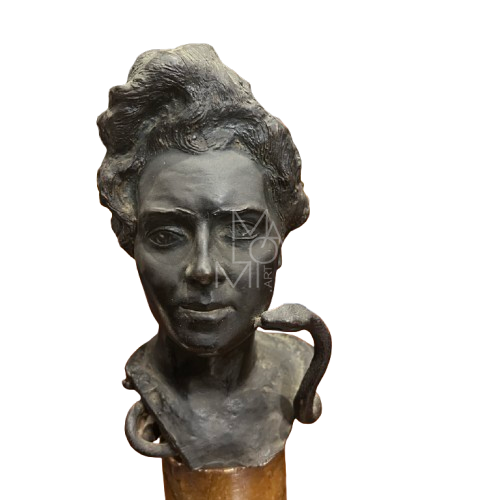
Eve and the serpent by Isidore De Rudder: symbolist bronze and alabaster sculpture
Explore the sculpture "Eve and the serpent" (Cleopatra) by Isidore De Rudder (c. 1900). A Belgian art nouveau masterpiece in bronze and alabaster, reflecting fin-de-siècle decadence.
Eve and the Serpent by Isidore De Rudder: a Historico-Critical, Formal, and Conservational Reinterpretation
Introduction and Historico-Cultural Context
The transition from the nineteenth to the twentieth century represented a period of extraordinary redefinition of aesthetic languages for Europe, an era in which rigid monumental academism was shaken by the subterranean currents of symbolism and the sinuous lines of Art Nouveau. At the heart of this ferment, Belgium emerged as one of the most audacious laboratories of modernity, thanks to the catalysing action of avant-garde artistic circles that sought to dismantle every barrier between the major arts and the applied arts. It was within this atmosphere of total renewal that Isidore De Rudder trained and operated. A sculptor, ceramicist, and decorator of profound culture, his artistic career perfectly embodies the spirit of the so-called Fin de Siècle.
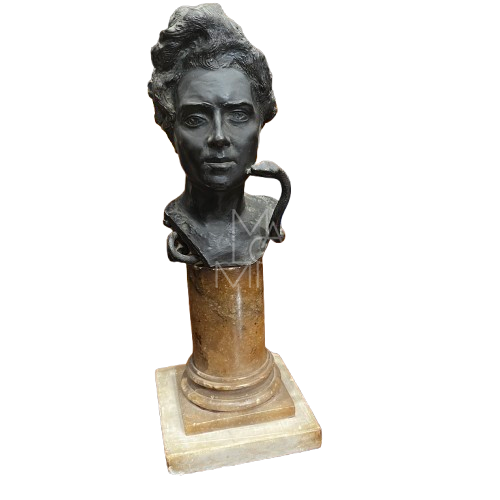
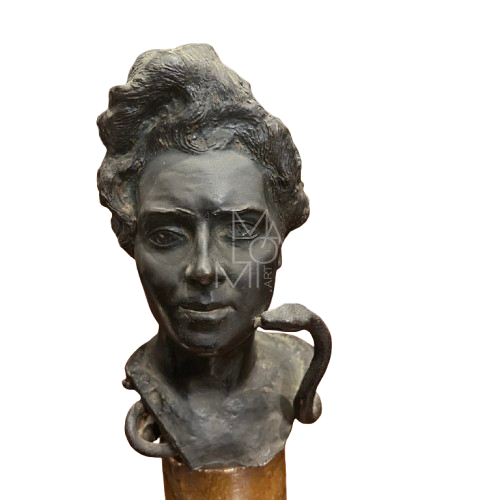
The work under examination—a bronze bust with a dark patina measuring thirty-four centimetres in overall height by thirteen centimetres in width and depth, dating to approximately nineteen hundred—fits magnificently into this panorama. Known historically both as Eve and the Serpent and by the alternative title of Cleopatra, the sculpture abandons the rhetoric of monumental statuary to embrace a psychological and intimista cabinet dimension. De Rudder does not intend to celebrate a public heroism, but rather to investigate the mysteries of the human psyche, translating into plastic matter the very literary and psychoanalytic suggestions that, during those same years, were altering the perception of modern man.
Iconography and Symbology of the Femme Fatale
The semantic core of the work develops around an intriguing iconographic ambiguity, a conceptual overlap that unites the biblical figure of Eve and the historical figure of Queen Cleopatra. This oscillation in titles, far from accidental, reflects the Decadent culture's obsession with the archetype of the femme fatale—the magnetic and fateful woman who embodies both seduction and danger, life and death. If interpreted as Eve, the sculpture captures the precise moment of primordial temptation, the instant in which the woman welcomes the counsel of the biblical reptile to access forbidden knowledge. If interpreted as Cleopatra, the work fixes her tragic end, the lethal embrace with the asp that would lead her to suicide.
In both interpretations, the key element lies in the extraordinarily complicit relationship that exists between the female figure and the animal. The serpent is not configured as an external threat, a predator, or an element of visual disruption, but rather as a physical and psychological extension of the woman herself. Its coils sinuously ascend her shoulder and encircle her neck until they brush her face, establishing a formal continuity that visually translates the concept of subconscious drive and libido. The woman's gaze, fixed and imperturbable, betrays a cold determination and a total absence of fear, suggesting that between the female flesh and the scales of the reptile there exists a secret pact, an intimate sharing of sin and power.
Formal, Plastic, and Volumetric Analysis
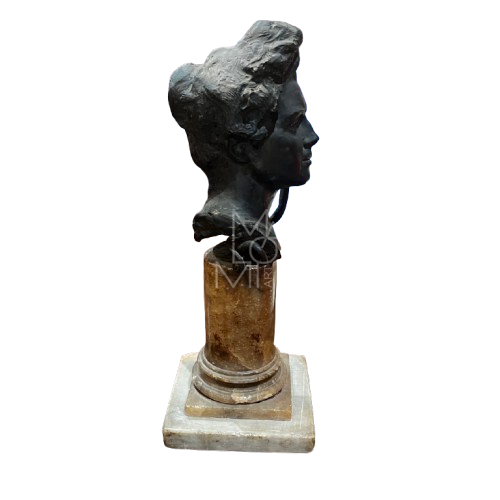
Close observation of the bust allows one to grasp the articulate compositional skill with which De Rudder orchestrated the volumes of the work, playing on a continuous contrast between smooth surfaces and heavily modeled areas. The woman's profile exhibits a linear purity that recalls the neoclassical tradition, evident in the regularity of the nasal septum and the composure of the lips. This composure is, however, dramatically contradicted by the acute psychological tension emanating from the hollowed eye, shadowed by the brow arch, and from the rigorous design of the clenched jaw.
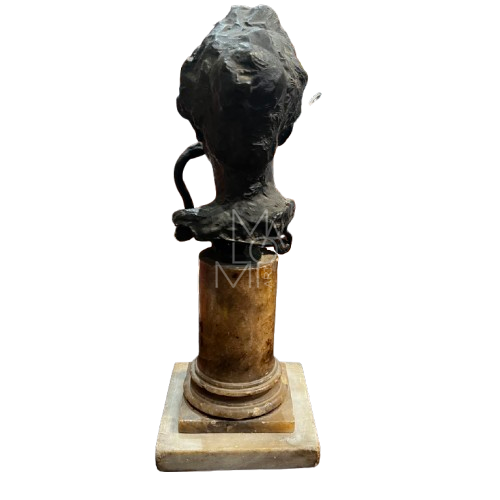
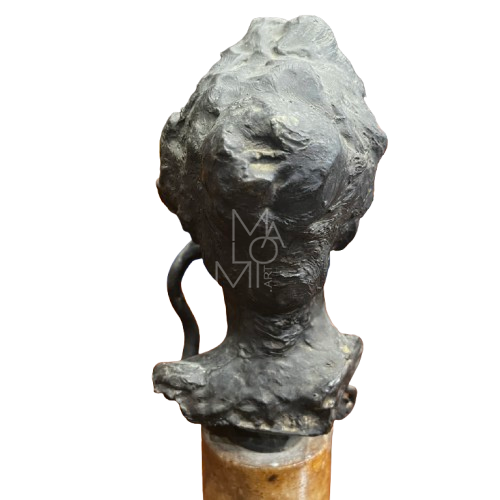
The hairstyle constitutes one of the most vibrant and expressive sections of the sculpture, as the artist chose to treat the mass of hair with a overtly tactile and almost non-finito modeling. The locks chase each other across the nape in deep waves that capture ambient light in ever-changing ways, anticipating the plastic sensibility that would characterize much of early twentieth-century sculpture. To this restless plasticity, the geometric and linear progression of the serpent acts as a counterweight. The lower coil loops over the viewer's left shoulder, creating a concave curve that lightens the base of the bronze and projects the animal upward. The body of the reptile then rises vertically, serving as a geometric axis, before suddenly flexing toward the woman's chin, perfectly embodying that serpentine line which constitutes the very essence of the decorative style of the era.
Material Aspects and Executive Techniques
The choice of bronze with a dark patina responds to a precise aesthetic intent of symbolism, a movement that favored materials capable of generating deep shadows and evoking mysterious atmospheres. The work was executed using the lost-wax casting process, the only technique capable of transferring into metal every minimal pressure exerted by the master's fingers and spatula onto the original clay model. Examining the surface of the bronze, one senses an extraordinary differentiation of material textures. The skin of the face appears polished to the highest degree, almost silky, designed to slide light uniformly and simulate the softness of the epidermis. Conversely, the scales of the serpent are evoked through small, rapid, and incisive touches, while the hair retains the original freshness of the bozzetto, with deep furrows carving the material to create an intense chiaroscuro.
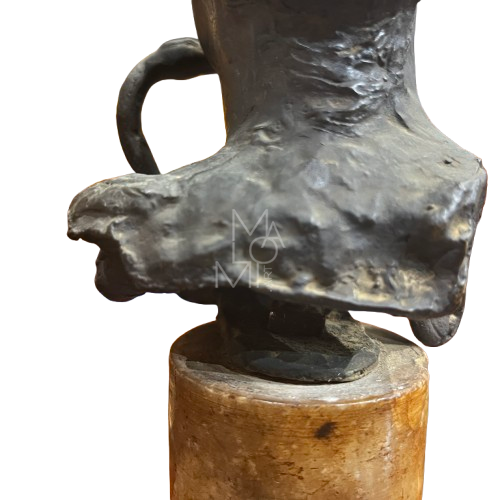
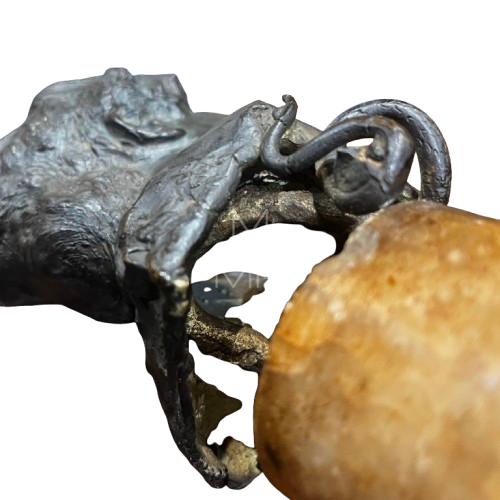
The internal view of the bust, accessible by gently upturning the piece, reveals the structural emptying typical of high-quality lost-wax castings. Within the cavity, one can appreciate the complex network of supports and casting residues, but above all, the mechanical anchoring system is revealed. A central metal pin passes through the cylindrical alabaster shaft, securing itself firmly inside the shell of the bust. This technical device ensures that the bronze mass remains perfectly immobile on its axis, integrating the sculpture into its base in a permanent and secure manner.
The Base and the Integration of Materials
Within the context of Art Nouveau, the base ceases to be a mere functional support element and becomes an integral part of the artwork, in accordance with the principle of total synthesis between different disciplines. De Rudder designed the supporting apparatus of this sculpture with extreme refinement, choosing a polymaterial solution that enhances the chromatic qualities of the bronze through contrast. The bust rests primarily on a cylindrical shaft made of alabaster, a calcareous stone celebrated for its partial translucency and warm amber and honeyed tones. The choice of alabaster is not accidental; its intrinsic luminosity introduces a note of warmth that lightens the severe and somber impact of the dark bronze patina above.
The alabaster shaft, enriched by delicate natural veins, is itself inserted into a square-based plinth made of marble, which provides the sculpture with the necessary tectonic stability and formal geometric rigor. This structural and material transition—leading the viewer's eye from the asymmetric fluidity of the bronze to the veined roundness of the alabaster, and finally to the squared stability of the marble stone—fully responds to the dictates of the applied arts of the period. Each stone element contributes to framing the female portrait, transforming the ensemble into a precious object of decorum for the private studies of the high bourgeoisie of the time.
Archival Chronicles and Period Exhibitions
The historico-archival reconstruction related to this specific model reveals a dense network of exhibitions that testify to its immediate critical and commercial success at the turn of the nineteenth and twentieth centuries. Isidore De Rudder presented the first plaster studies and preparatory wax versions in the avant-garde circles of Brussels, particularly within the Salon de la Libre Esthétique, where the work was received with enthusiasm for the modernity of its design. International consecration, however, arrived in nineteen hundred on the occasion of the Exposition Universelle in Paris, a monumental event in which the Belgian pavilion established itself as the true temple of Art Nouveau. On that occasion, the sculpture was included in the official catalogues of decorative arts, praised by Parisian critics for its exceptional executive quality and its nature as a cabinet sculpture.
A further and decisive moment of dissemination for this model in southern Europe was the Esposizione Internazionale d'Arte Decorativa Moderna in Turin in nineteen hundred and two, an exhibition that marked the zenith of the Liberty style in Italy. The Belgian pavilion, designed by the celebrated architect Victor Horta, hosted the finest achievements of Belgian artistic craftsmanship and small plastic arts, including the works of De Rudder. It was precisely during the Turin event that many Italian collectors and aristocrats purchased the artist's commercial specimens, facilitating the entry of this bust into the most prestigious private collections in our country.
Anecdotes, Curiosities, and Backstories of the Casting
Behind the popularity of this sculpture lie fascinating anecdotes related to the art market of the era and the habits of the clientele. One of the most curious aspects concerns the professional partnership between De Rudder and the renowned firm H. Luppens e Cie, an art publishing house with sumptuous showrooms located in the center of Brussels along the Boulevard Anspach. Given the enormous public demand for this specific subject, De Rudder decided not to handle the casting of individual specimens himself, but instead entrusted the reproduction rights to the Luppens foundry, which specialized in the distribution of high-end art bronzes and Liberty lamps. The Luppens firm recognized the commercial potential of the work and decided to include it in its catalogue, offering it in various polymaterial variants and in two main formats to meet the differing needs and financial capacities of clients.
The monumental version, defined in period records as the Grand Modèle, exceeded fifty-five centimetres in height and was usually intended for large reception rooms, mounted on imposing columns of Belgian red marble or golden onyx. The version under examination, characterized by a finished height of thirty-four centimetres, was instead conceived specifically as a reduced cabinet format, ideal for placement on writing tables or within private libraries. To embellish this chamber version and compensate for its reduced dimensions, the foundry chose to adopt the shaft of variegated alabaster—an aesthetic device that achieved tremendous success due to the play of transparency created when the sculpture was positioned near table lamps or windows. A further critical curiosity resides in the ideal link between this bust and another celebrated work produced by De Rudder during the same period, entitled Salome with the Serpent, considered by collectors to be the twin and mirror piece to Eve, in which the reptile assumes an even more tormented and dramatic progression.
State of Conservation and Methodological Indications for Restoration
The assessment of the artifact's state of conservation reveals a generally good condition that nevertheless warrants specific attention, primarily due to the natural aging of materials and the accumulation of environmental deposits. The dark patina of the bronze is fortunately intact in its foundational structure, free from deep scratches or mechanical abrasions that would expose the underlying metal. Furthermore, the presence of active saline corrosions, commonly known as bronze disease, which manifest as bright green efflorescences, is excluded. However, within the most protected recesses of the modeling—such as the locks of hair, the ear conchs, and the micro-grooves of the serpent's scales—there is a compact sediment of particulate dust that dulls the original chiaroscuro of the work.
The alabaster shaft manifests the vulnerabilities typical of this mineral, which is distinguished by being extremely porous, soft, and soluble. Over the decades, the stone's porosity has absorbed atmospheric moisture and dust, resulting in a slight superficial graying that diminishes the warm transparency of the amber stone. The upper edge of the cylinder also shows small signs of period wear and minimal chipping at the points of direct contact with the irregular fit of the bronze, a entirely physiological phenomenon for an object that boasts over a century of history.
The maintenance intervention must be inspired by the principle of minimum intervention, strictly excluding the use of running water or liquid detergents on the alabaster shaft, as the liquid would penetrate the porosity, staining the stone irreversibly. For cleaning the alabaster, it is advisable to proceed exclusively dry, using a soft drawing art eraser which, when dabbed onto the surface, will engulf the sedimented dust without scratching the mineral. Regarding the bronze, the removal of coherent particulate matter must be carried out with a soft-bristled brush, while any greasy deposits caused by hand fingerprints can be removed locally with a cotton swab lightly moistened with isopropyl alcohol. It is recommended to absolutely avoid commercial metal polishes, which would remove the original chemical patina, neutralizing the collectible value of the piece. Upon completion of the cleaning, applying a very thin layer of purified microcrystalline wax over the entire sculpture—both on the bronze and on the alabaster—will seal the pores of the stone and protect the metal from future oxidation, restoring the work's original and sophisticated silky luster.
Reference Bibliography
The drafting of this historico-critical essay and the contextualization of Isidore De Rudder's work are based on the following bibliographical, archival, and documentary sources, compiled according to the academic standards of the Chicago Manual of Style:
De Rudder, Isidore. "Letters and Studio Notes (1895-1905)." Isidore De Rudder Fund, Musées royaux des Beaux-Arts de Belgique, Brussels. Archive of Contemporary Art in Belgium, file BE-MRBAB-AACB-001.234.
Engelen, Cor, and Mieke Marx. Beeldhouwkunst in België vanaf 1830. Vol. 2, L-Z. Brussels: Algemeen Rijksarchief en Rijksarchief in de Provinciën, 2002.
Exposition Universelle Internationale de 1900. Catalogue général officiel: Exposition décennale des beaux-arts de 1889 à 1900. Paris: Lemercier, 1900.
L'Exposition Internationale des Arts Décoratifs Modernes, Turin 1902: Section Belge. Brussels: Imprimerie Scientifique Charles Bulens, 1902.
Pingeot, Anne, and Robert Hoozee, eds. Paris-Bruxelles, Bruxelles-Paris: Réalisme, Impressionnisme, Symbolisme, Art Nouveau. Paris: Réunion des musées nationaux, 1997.
Rudder, May de. Isidore De Rudder: sa vie, son oeuvre. Brussels: Éditions de la Société des Beaux-Arts, 1924.
Société des Beaux-Arts. La Libre Esthétique: catalogue de la sixième exposition. Brussels: Imprimerie Lombaerts, 1899.